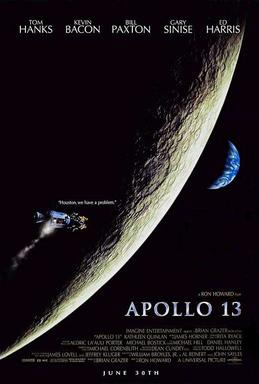
I just finished watching the TCM premiere of the 1995 Best Picture nominee, Apollo 13. Of course, it wasn’t the first time I had seen it. Apollo 13 is one of those films that always seems to be playing somewhere and why not? It’s a good movie, telling a story that is all the more remarkable and inspiring for being true. In 1970, the Apollo 13 flight to the moon was interrupted by a sudden explosion, stranding three astronauts in space. Fighting a desperate battle against, NASA had to figure out how to bring them home. Apollo 13 tells the story of that accident and that rescue.
There’s a scene that happens about halfway through Apollo 13. The heavily damaged Apollo 13 spacecraft is orbiting the moon. Originally the plan was for Apollo 13 to land on the moon but, following that explosion on the craft, those plans have been cancelled. Inside the spacecraft, three astronauts can only stare down at the lunar surface below them.
As Commander Jim Lovell stares out the craft’s window, we suddenly see him fantasizing about what it would be like if the explosion hadn’t happened and if he actually could fulfill his dream of walking on the moon. We watch as Lovell (and, while we know the character is Jim Lovell, we are also very much aware that he’s being played by beloved cinematic icon Tom Hanks) leaves his foot print on the lunar surface. Lovell opens up his visor and, for a few seconds, stands there and takes in the with the vastness of space before him and making the scene all the more poignant is knowing that Tom Hanks, before he became an award-winning actor, wanted to be a astronaut just like Jim Lovell. Then, suddenly, we snap back to the film’s reality. Back inside the spacecraft, Lovell takes one final look at the moon and accepts that he will never get to walk upon its surface. “I’d like to go home,” he announces.
It’s a totally earnest and unabashedly sentimental moment, one that epitomizes the film as a whole. There is not a hint of cynicism to be found in Apollo 13. Instead, it’s a big, old-fashioned epic, a story about a crisis and how a bunch of determined, no-nonsense professionals came together to save the day. “Houston,” Lovell famously says at one point, “we have a problem.” It’s a celebrated line but Apollo 13 is less about the problem and more about celebrating the men who, through their own ingenuity, solved that problem.
That Apollo 13 is a crowd-pleaser should come as no surprise. It was directed by Ron Howard and I don’t know that Howard has ever directed a film that wasn’t designed to make audiences break into applause during the end credits. When Howard fails, the results can be maudlin and heavy-handed. But when he succeeds, as he does with Apollo 13, he proves that there’s nothing wrong with old-fashioned, inspirational entertainment.
Of course, since Apollo 13 is a Ron Howard film, that means that Clint Howard gets a small role. In Apollo 13, Clint shows up as a bespectacled flight engineer. When astronaut Jack Swiggert (Kevin Bacon) mentions having forgotten to pay his taxes before going into space, Clint says, “He shouldn’t joke about that, they’ll get him.” It’s a great line and Clint does a great job delivering it.
Apollo 13 is usually thought of as being a Tom Hanks film but actually, it’s an ensemble piece. Every role, from the smallest to the biggest, is perfectly cast. Not surprisingly, Bacon, Bill Paxton, Gary Sinise, Kathleen Quinlan, and Ed Harris all turn in excellent performances. But, even beyond the marquee names, Apollo 13 is full of memorable performances. Watching it tonight, I especially noticed an actor named Loren Dean, who played a NASA engineer named John Aaron. Dean didn’t get many lines but he was totally believable in his role. You looked at him and you thought, “If I’m ever trapped in space, this is the guy who I want working to bring me home.”
Apollo 13 was nominated for best picture but it lost to Mel Gibson’s film Braveheart. Personally, out of the nominees, I probably would have picked Sense and Sensibility but Apollo 13 more than deserved the nomination.
Packard Walsh (Nick Cassavetes) has a pretty good business going. He and his gang of “road pirates” patrol the Arizona desert. Whenever they spot a car that they want, they demand that the driver race for pink slips and they cheat to win. Through fear and intimidation, Packard rules the town of Brooks and not even Sheriff Loomis (Randy Quaid) can stop him.
Packard is obsessed with Keri Johnson (Sherilyn Fenn), who works as a carhop at Big Kay’s Burger. Packard considers Keri to be his property and even demands that she drink his blood so that they will be forever linked. Earlier, Packard and his gang killed Keri’s boyfriend, Jamie. When a new kid named Jake (played by Charlie Sheen) shows up in town, both Keri and Jamie’s brother (Matthew Barry) feel as if they know him from somewhere. Jake also has scars on his back the match Jamie’s wounds.
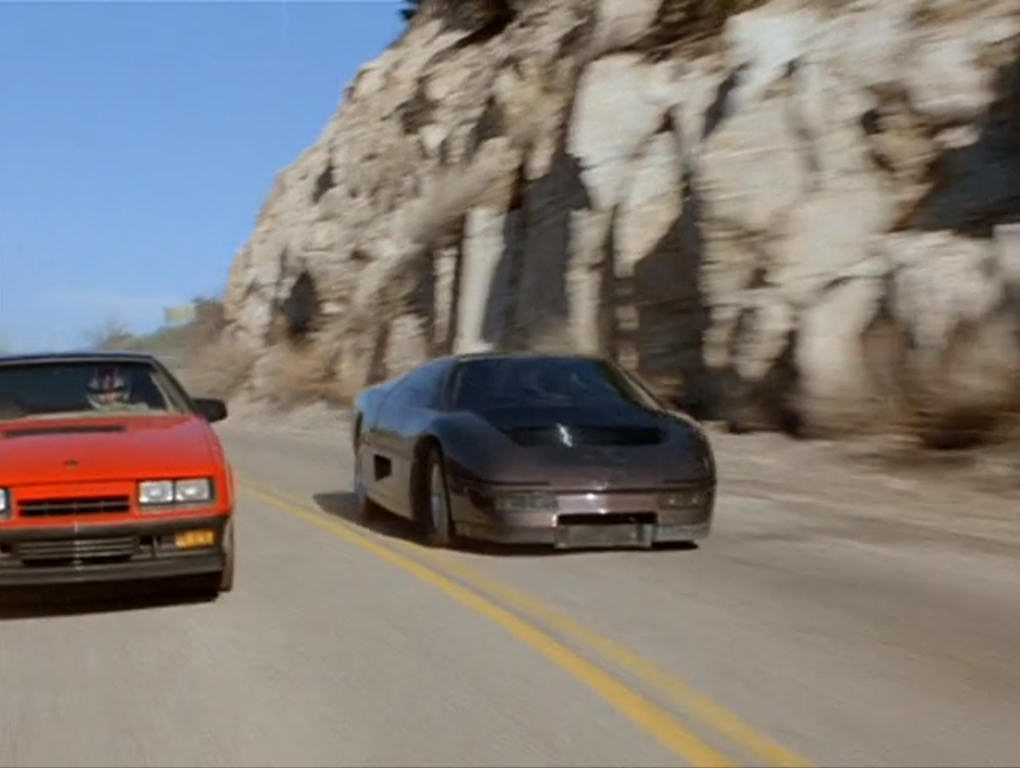
Shortly after Jake’s arrival, a mysterious black Turbo Interceptor appears on the roads. The unseen driver challenges each member of Packard’s gang to a race and then purposefully crashes into them. Whenever the Turbo explodes, it rematerializes somewhere nearby. When the driver does finally get out of the Turbo, it turns out that he’s covered in black leather armor and his face is hidden behind a black helmet.
According to Rughead (Clint Howard), the only member of Packard’s gang who did not take part in Jamie’s murder, the driver is “a wraith, man! A ghost, an evil spirit — and it ain’t cool!”
The Wraith is one of those films that always used to show up on TV when I was a kid. Thought it was often advertised as being a horror film, it’s actually an uncredited remake of High Plans Drifter with Clint Eastwood replaced by Charlie Sheen. Seen today, The Wraith is a major nostalgia trip. One of the fun things about watching the movie is ticking off all of the clichés that make this a definite 80s film, from the cars to the slang to the soundtrack. (It does not get more 80s than a soundtrack featuring both Billy Idol and Robert Palmer.) Packard’s gang is all made up of generic punk types. My favorite was Skank (David Sherrill), who had a mohawk and drank brake fluid.
Of course, the cars are the main appeal of The Wraith. All of the, are cool (even Rughead’s pickup truck) but the obvious star of the film is that black Turbo Interceptor. At its best, it rivals even Marty McFly’s DeLorean as the coolest car to show up in an 80s sci-fi film.
The Wraith may not be the greatest movie ever made but if you are into fast cars and Sherilyn Fenn at her loveliest, you should enjoy it.
Originally, when I started this series of Back to School reviews, I was planning on reviewing Grease. After all, everyone has seen that film. It’s on TV all the time. (Looking in your direction, AMC.) It’s a musical, which is a genre that I love but one which I also rarely seem to review. The movie features a good performance from Stockard Channing. It also has a lot of dancing and you know how much I love that. And speaking of love, a lot of people seem to absolutely love Grease.
But, the more I thought about it, the more I realized that while others may love Grease, I don’t. Oddly enough, I always seem to fool myself into thinking that it’s a fun movie but then I make the mistake of watching it whenever it pops up on AMC and every time, I am surprised to discover just how boring Grease really is. The majority of the cast play their roles as if they’re still on a Broadway stage and projecting to the back of the house. Olivia Newton-John is miscast. John Travolta appears to be acting on auto pilot. Both the songs and even Stockard Channing are never as good as I remembered. Worst of all, the dance numbers are so ineptly staged and filmed that, half-the-time, you can’t even see what anyone’s doing with their feet.
While I certainly don’t have any problem writing a negative review (and check out my thoughts on Avatar if you doubt me), I wanted to end the 70s on a positive note. So, instead of telling you that Grease isn’t good as many people seem to think, I want to recommend another film that, like Grease, features a lot of singing and dancing but which also happens to be a lot of more fun.
That film, of course, is the 1979 cult classic Rock ‘n’ Roll High School.
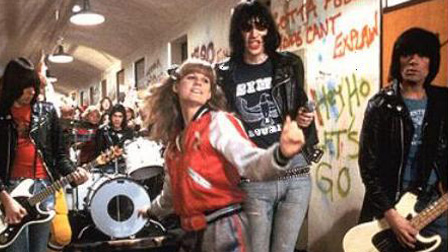
Things are amiss at Vince Lombardi High School. The students are so obsessed with rock and roll (and the music of the Ramones, in particular) that they have caused several principals to quit. The hallways are a disorganized mess. Student Riff Randall (P.J. Soles) spends all of her time having fantasies about the way that Joey Ramone eats pizza. A strange students named Eaglebauer (Clint Howard) runs a shadowy company known as Eaglebauer Enterprises out of a smoke-filled boy’s restroom. (He’s even got an administrative assistant to schedule meetings for him.) Handsome jock Tom Roberts (Vincent Van Patten) can’t get a date, largely because he’s obsessed with Riff who is obsessed with the Ramones. Little does Tom realize that Riff’s best friend, the sweet and intelligent Kate Rambeau (Dey Young), has a crush on him.
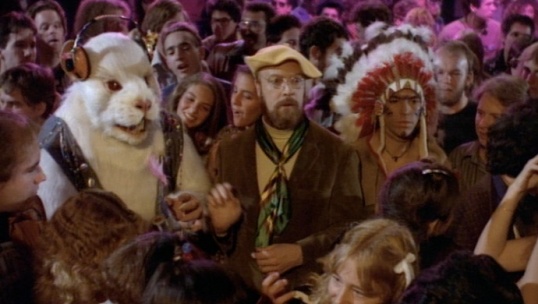
The school board hires a new principal to bring some peace to the high school. Ms. Togar (Mary Woronov) is a strict and mentally unbalanced disciplinarian who, with the help of two apparently subhuman hall monitors, is determined to suppress any sort of fun, rebellion, or free thought. Togar hates loud music, mostly because it causes white mice to spontaneously explode. (When, late in the film, a human-sized white mouse — or he could have just been a very strange man wearing a white mouse costume, the film is ambiguous on this point — attempts to enter a Ramones concert, he’s turned away for his own good. Until, of course, he reveals that he’s brought along headphones for his own protection…)
In the end, it all comes down to this: Togar and her allies want to burn records. Riff and the Ramones want to stop her. And maybe blow up the school. (David from Massacre at Central High would have been a fan of the Ramones.)
Rock ‘n’ Roll High School is an intentionally over-the-top film that both celebrates youthful rebellion while satirizing traditional high school films. The jokes (which are a good combination of the silly and the genuinely clever) come non-stop, the actors all bring a lot of energy to their roles, and the entire film is just a lot of fun. As played by P.J. Soles, Riff Randall really is the ideal best friend and I imagine that a lot of boys in 1979 probably walked out of the theater with a huge crush on both P.J. Soles and Dey Young. And finally, Mary Woronov gives a wonderfully demented performance as Ms. Togar.
Rock ‘n’ Roll High School seems like the perfect film to end the 70s with. Tomorrow, Back to School continues with the 80s! So, if you’ve never seen Rock ‘n’ Roll High School before, watch it below!
I first came across Evilspeak a few months ago when I was browsing through the selection of used DVDs at the Movie Trading Company in Plano, Texas. Why did I feel so compelled to buy this movie that I had previously never heard of? Of course, a lot of it was due to the fact that Evilspeak was a horror movie. I have to admit that the vagueness of the title intrigued me. I’ve long been planning on writing the ultimate slasher film and giving it the similarly vague title of Deathurge. It also helped that the Evilspeak DVD was released by Anchor Bay and that it only cost $1.99.
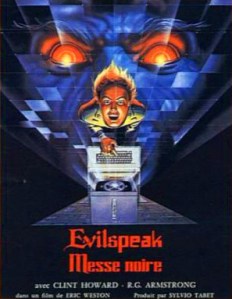
A few nights ago, I sat down and watched Evilspeak for the first time. It turned out to be, in many ways, typical of the horror films that were released in the early 80s. (Evilspeak came out in 1981.) However, thanks to a strong lead performance from Clint Howard and a few surprisingly dark touches on the part of director Eric Weston, Evilspeak turns out to be an oddly compelling little horror film.
Evilspeak opens with a lengthy prologue in which we see a Satanist named Esteban beheaded, along with several of his followers, by the Spanish Inquisition. Jump forward several hundred years to a soccer game being played by teams representing two separate military academies. The players are all typical jocks except for one pudgy, awkward fellow named Stanley Coopersmith (played by a very young Clint Howard). Coopersmith manages to lose the game for his team. The team’s angry response establishes that 1) this is not the 1st game that Coopersmith has lost and 2) all of his teammates are apparently psychotic. His fellow players complain to their coach about Coopersmith’s lack of ability. The coach replies that school policy requires that Coopersmith be allowed to play but if Coopersmith were to suffer some sort of injury (hint, hint) then they wouldn’t have to worry about school policy. Seriously, has anything good ever come from soccer?
In many ways, Stanley Coopersmith might seem typical of the horror movie pariahs who always seem to end up asking Satan to kill their peers. However, there are a few things that set Stanley apart.
First of all, he has one of the best last names in film history. Coopersmith. Just say it five times straight and see if it doesn’t get stuck in your head. I’ve known plenty of Coopers and more than a few Smiths but I’ve never known a Coopersmith. At first, I thought that maybe Stanley had one of those really cool hyphenated names and I was instantly jealous. I’ve always wished my mom had done that when she got married so I could introduce myself as “Lisa Marie Marchi-Bowman.” Of course, it’s probably for the best that she didn’t because if she had, I would have become obsessed with finding a mate with a hyphenated last name of his own just to see how long I could eventually make my last name. But I digress. Even though the film clearly establishes that there is not hyphen in Coopersmith, it’s still a great name. When Stanley’s classmates insist on calling him “Cooperdick,” it just makes them all the more loathsome because not only are the insulting Stanley but they’re failing to recognize the beauty of a good name.
The other thing that sets Stanley apart from other movie outcasts is that he actually looks like an outcast. He’s not a teen idol wearing a bad wig and prop glasses. This is largely because Stanley Coopersmith is played by Clint Howard (as opposed to Ron Howard). Pudgy with visible acne and a somewhat whiny voice, Clint Howard transforms Stanley Coopersmith into every kid that you ever felt sorry for but never dared to befriend. Watching the movie, you feel sorry for Stanley but you never quite like him. You’re on his side because every other character in the movie appears to be subhuman.
The film follows Stanley as he is continually attacked and humiliated by basically everyone else in the entire movie. Now, as someone who did time at more than one Catholic school, I have personally experienced the fact that private schools really are a world of their own. That said, however, Evilspeak’s military academy appears to be less a school and more some sort of elaborate and sadistic sociological experiment. Seriously, is there anyone at this school who isn’t obsessed with tormenting Stanley? (Actually, Stanley does have one friend but he’s kinda useless.)
Of course, one of the school’s problems might be that it has apparently been built on land that was once owned by — you guessed it — Esteban! As the film opens, Coopersmith has found himself assigned to clean up the school’s chapel as part of a “punishment detail.” While doing this, Coopersmith happens to stumble upon Esteban’s tomb and, in that tomb, he finds a lot of candles, what appears to be a fetus in a jar, and a black book that happens to have a Satanic symbol on the cover. Intrigued, Coopersmith steals the book despite the fact that it’s written in Latin.
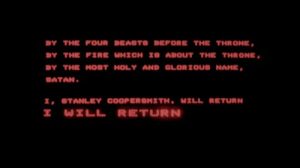
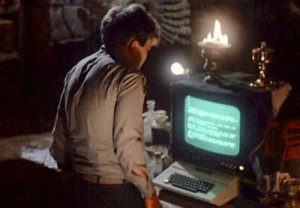
Luckily, this school has a computer! Admittedly, Evilspeak came out four years before I was born so perhaps I’m not capable of understanding what the world was like in the early 80s. Still, I’m always amazed to see the awe that computers were apparently regarded with back then. Apparently, at the time, a personal computer was the ultimate elite status symbol. All one needed to rule the world apparently was one bulky computer. Fortunately, Coopersmith doesn’t want to rule the world. He just wants to read his book. He does this by typing the latin phrases into the computer and magically getting an English translation in response. Thanks to his magic computer, Coopersmith discovers that the book was written by Esteban and that Esteban worshipped Satan.
Coopersmith, of course, is amazed to discover this but we, the viewers are not. After all, we’ve already sat through the entire prologue. Unfortunately, it takes Coopersmith almost the entire movie to catch up to where we are from the beginning. Fortunately, Clint Howard gives a good enough performance to keep the movie vaguely interesting even when it starts to drag.
Fortunately, after Coopersmith gets his translation, the action starts to pick up a bit. For one thing, the book is stolen by the headmaster’s secretary (who, in an amusingly odd moment, smiles to herself as she listens to the headmaster paddling Coopersmith in his office). For another thing, Coopersmith decides to get back at his enemies by conducting a black mass. He does this by turning on his computer (which has now somehow been moved down to the tomb) and asking what he needs for a black mass. Naturally enough, the computer tells him because it’s a computer and it knows everything.
But before Coopersmith can perform his black mass, he still has to be humiliated a few hundred more times by his classmates. He also has to deal with a drunk janitor (played by R.G. Armstrong). On top of that, he adopts a puppy. Unfortunately, since Coopersmith is the school outcast, that also means that the puppy is fair game too. After one night of heavy drinking, Coopersmith’s classmates (led by a kid named Bubba, so you know he’s evil) find his hideaway in the tomb and, for reasons that don’t quite make sense, they sacrifice his puppy.
(At this point, I was wondering if maybe it would turn out that the military academy was actually an insane asylum. I mean, seriously — on which level of Hell is this place located?)
Meanwhile, you remember that sadistic secretary that stole Coopersmith’s book? Well, for whatever reason, she is obsessed with trying to pry that Satanic symbol off the cover. Unfortunately, since she’s the only prominent female in an early 80s horror movie, this can only mean that she’s destined to meet a bloody end while taking a shower. Which, in this movie’s best known scene, is exactly what happens. However, she doesn’t meet her end at the hands of a knife-wielding psycho. Instead, she’s attacked and ripped to pieces by a bunch of rampaging pigs. And yes, the whole thing is faintly ludicrous and yes, the low-budget gore effects are undeniably crude, but it’s still an undeniably effective sequence. Perhaps its due to the fact that pigs, in general, are filthy. Don’t even get me started on pigs. However, it must also be admitted that, though his direction is often time uninspired, Eric Weston shows an undeniable talent for capturing chaos. I am not ashamed to admit that I had pig-related nightmares after seeing this movie.
Following the death of the secretary, the book mysteriously reappears in Esteban’s tomb. Coopersmith finds it the next morning along with the corpse of his puppy. Obviously, this is all it takes for Coopersmith (with the help of his computer) to carry out his black mass and to finally take his revenge.
Of course, the whole point of a Nerd-With-Powers movie is the finale where that nerd takes vengeance on his tormentors. If this scene is pulled off with even the slightest amount of panache, it can make up for almost everything that’s come before it. The prom inferno from Carrie pretty much set the standard by which all others are judged. Personally, it’s hard for me to think of any movie that could improve on the final house party massacre in The Rage: Carrie 2. After all, how can you top a blinded Rachel Blanchard accidentally shooting the oldest Home Improvement kid in the balls with a spear gun?
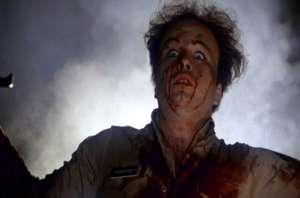
Evilspeak doesn’t quite reach those heights in its finale but it’s still pretty effective. If nothing else, the sight of Clint Howard wielding a sword while flying above his tormentors is a lot more effective than you might think. Over the next few minutes, spikes are drilled into foreheads, heads are chopped off, hearts are ripped out of chests, and those pigs show up again. The gore effects here are undeniably crude but oddly effective. This sequence (along with the previous pig shower attack) actually inspired a few nightmares the night after I saw Evilspeak.
In the end, Evilspeak is an odd little movie. While the plot should be familiar to anyone who has ever seen a horror film, there’s a real nastiness at the core of Evilspeak that distinguishes it from other genre offerings that came out during the same period. At times, Evilspeak almost feels like an Italian film which is probably why I found it to be so oddly compelling.
The Evilspeak DVD features a commentary track featuring both Clint Howard and the film’s director. I always feel some trepidation before listening to a commentary track. Too often, the track turns out to just be some jerk explaining how he financed the film for two hours while commenting not at all on the action on-screen. (For the most part, if a commentary track features any anecdote that begins with, “We had the same lawyer…” you know you’re in trouble.) However, the Evilspeak track is surprisingly enjoyable. Clint Howard comes across as a surprisingly likable, levelheaded guy and its interesting to contrast his odd wholesomeness with the action onscreen.
In the end, Evilspeak may be a piece of junk but it’s an enjoyable piece of junk.






 Through the Shattered Lens