Cleaning Out The DVR: Picnic (dir by Joshua Logan)


Original_movie_poster_for_the_film_Picnic

Tonight, I continued to clean out the DVR by watching the 1955 film Picnic.

Now, Picnic is kind of a strange film.  It’s one of those films from 50s that takes place in a small town where everyone is obsessed with sex but, since it’s the 1950s, nobody can just come out and say that they’re talking about sex.  So, instead, all of the dialogue is very discreet.  For instance, when Madge Owen (Kim Novak) talks to her mother, Flo (Betty Owens), about her date with her boyfriend, Alan (Cliff Robertson), Madge confesses that they spent the night kissing.  Flo asks if Madge if they have done anything more than kiss but, of course, she never comes straight out and says what “more” would be.  The audience knows what she’s talking about but it’s as if the world would actually end if anyone actually uttered the word.  “Oh mom!”  an embarrassed Madge says before confirming that she and Alan haven’t done anything more than kiss.

Flo desperately wants Madge to marry Alan because Alan is rich and his father owns the town’s grain elevator.  Marrying Alan would allow Flo to move up in the town’s strict social hierarchy.  However, Madge isn’t sure that she loves Alan.  Certainly, Alan seems to be a good man with a good future but he’s not a romantic.  Instead, he is someone who has his entire life already mapped out for him.

On Labor Day, a stranger comes to town.  His name is Hal Carter and he shows up riding on a freight train.  He’s come into town to see his old friend, Alan.  It turns out that Hal and Alan went to college together and were members of the same fraternity.  Hal was a star football player but he eventually flunked out of school and has spent the last few years drifting around the country.  However, Hal is now ready to settle down and he wonders if his old roommate Alan can get him a job at the grain elevator.

Now, here’s the strange part.  Hal is played by William Holden.  When he made Picnic, William Holden was 38 years old and looked closer to being 45.  (By contrast, Cliff Robertson, in the role of his former college roommate, was 32 and looked like he was 25.)  Hal spends a lot of time talking about his traumatic childhood and how he is finally ready to settle down and start acting like an adult.  In short, Hal talks like a 30 year-old but he looks like he’s nearly 50.  It’s odd to watch.  But even beyond the age issue, William Holden was an actor who always came across as being both confident and cynical.  Hal is a secret romantic with a deep streak of insecurity.  As great an actor as he may have been, William Holden is so thoroughly miscast here that it actually becomes fascinating to watch.  It brings a whole new subtext to the film as you find yourself wondering why no one is town finds it strange that a middle-aged man is still struggling to deal with his childhood.  When all the town’s young women ogle that shirtless Hal, it’s as if he’s wandered into a town populated only by teenagers with daddy issues.

(Paul Newman played the role of Hal in a Broadway production of Picnic.  And really, that’s who the ideal Hal would have been, a young Paul Newman.)

The majority of the film takes place at the town’s Labor Day picnic, where almost every woman in town is driven to distraction by the sight of Hal dancing.  Even the spinster teacher, Rosemary (Rosalind Russell), is so turned on by Hal’s masculinity that she makes a pass at him and accidentally rips his shirt.  Of course, some of Rosemary’s behavior is due to the fact that she’s drunk.  Her date, the befuddled Howard Bevans (Arthur O’Connell), made the mistake of being whiskey to the picnic.

Hal also dances with Madge’s 13 year-old sister, Millie (Susan Strasberg).  I have to admit that, even though I related strongly to Madge, Millie was my favorite character in the film.  Millie wears glasses and can recite Shakespeare from memory.  She knows that everyone around her is full of it and she’s willing to call them on it.  Of course, Millie herself ends up with a crush on Hal and it’s a dream for her when she finally gets to dance with him.

(Strasberg was 17 years old but is believable as a 13 year-old.  At the same time, since Hal appears to be nearly 50, his sudden closeness to Millie carries an icky, if unintentional, subtext.)

But then Madge suddenly appears, wearing a pink dress and literally emerging from the black night.  She starts to sway to the music.  As she slowly approaches Hal, he forgets about Millie and soon is dancing with Madge.  It’s actually a rather striking scene, one that so full of dream-like sensuality that it almost seems more like it was directed by surrealist David Lynch as opposed to the usually workmanlike Joshua Logan.

(In the video below, the scene freezes about 12 seconds in, before starting up again at the 16 second mark.  This is a glitch with the upload and is not present in the actual film.)

Needless to say, a drifter can’t just come into town and steal his ex-roommate’s girlfriend without drama following.  Picnic starts out as a slightly overheated examination of small town morality and then, after about an hour, it goes the full melodrama route, complete with police chases, stolen cars, a fist fight in an ornate mansion, and a lot of big speeches about the importance of love.  Needless to say, it’s all a lot of fun.

Picnic was nominated for best picture of the year.  However, it lost to the far more low-key Marty.

Horror On TV: Twilight Zone 3.33 — “The Dummy”


TheTwilightZoneLogo

In this episode of The Twilight Zone (which was originally aired on May 4th, 1962), a neurotic ventriloquist named Jerry (Cliff Robertson) has a bizarre relationship with his dummy. Not only does Jerry seem to hate his inanimate partner but the dummy doesn’t seem to be too fond of Jerry either.

You’ll probably already figured out The Dummy‘s twist but it’s still extremely well-done, featuring a great performance from Cliff Robertson and expressionistic direction from Abner Biberman.

Shattered Politics #20: The Best Man (dir by Franklin J. Schaffner)


Best_man22234

“Does The Best Man Always Get To The White House?” asks the poster for the 1964 film, The Best Man.

Of course, nowadays, that question seems incredibly naive.  Of course the best man doesn’t always get to the White House!  Some of my friends are Republicans and some of my friends are Democrats and a lot of my friends are Libertarians but they all have one thing in common: the belief that at least half of the past 4 elections were won by the wrong man.

But, as anyone who has done their research can tell you, 1964 was a far different time from 2015.  In general, people had greater faith in both government and their elected leaders.  Ineffective leaders and corrupt authority figures were viewed as being the exception as opposed to the rule.  We’re a lot more cynical now and, when we see political movies from the early 60s, all of that optimism and idealism often make them feel very dated.

Another big difference between the middle of the 20th Century and today is that, when it came to presidential nominating conventions, there was actually the potential for some suspense regarding who would win the nomination.  Occasionally, it took more than one ballot for a candidate to be nominated.  Last minute deals often had to be made and convention delegates were actually selecting an ideology along with a candidate.  Political conventions were contests and not coronations.

Again, it’s obvious that times have changed and, as a result, a film like The Best Man, which may have seemed very provocative and shocking in 1964, feels a bit like an antique today.  That doesn’t mean that it’s a bad film.  In fact, The Best Man is an interesting time capsule of the way things used to be.

The Best Man takes place at a presidential nominating convention.  The party is not specified but it feels like a Democratic convention.  There are several candidates competing for the nomination but the two front-runners are former Secretary of State William Russell (Henry Fonda) and Senator Joe Cantwell (Cliff Robertson).

Much like the character that Fonda played in Advise & Consent, Russell is an intellectual, a calm and rational liberal. Much like Spencer Tracy in State of the Union, Russell is separated from his wife (Margaret Leighton) but the two of them are pretending to be a happy couple for the sake of the campaign.

Meanwhile, Joe Cantwell is a paranoid and ruthless opportunist, a former war hero who will do anything to win.  The only person more ruthless than Joe Cantwell is his brother and campaign manager, Don (Gene Raymond).

(For those who enjoy history, it’s interesting to note that John F. Kennedy was a war hero-turned-senator who had a ruthless brother who doubled as his campaign manager.)

Both Cantwell and Russell come to the convention hoping to get the endorsement of former President Art Hockstader (Lee Tracy).  While the pragmatic Hockstader cannot stand Cantwell personally, he also views Russell as being weak and indecisive.

However, both Russell and Cantwell have secrets of their own.  When Cantwell discovers Russell’s secret and threatens to leak it, Russell has to decide whether or not to reveal Cantwell’s secret.

The Best Man was based on a stage play by Gore Vidal and the actual film never quite escapes its theatrical origins.  And, in many ways, it feels undeniably dated.  But it’s still a well-acted film, one that will probably be best enjoyed by political junkies and students of history.  Before watching the movie, be sure to read up on the 1960 presidential election and then see if you can guess who everyone is supposed to be.

Guilty Pleasure No. 18: Class (dir by Lewis John Carlino)


Tonight, I’ve got insomnia.

Since I realized I wasn’t going to get any sleep, I decided I might as well watch a random movie via Encore On Demand.  That movie turned out to be Class, a dramedy from 1983.  (I love dramedies, especially when I’ve got insomnia.)  I just finished watching it about 30 minutes ago and what can I say?  If there’s any film that deserves to be known as a guilty pleasure, it’s Class.

Class tells the story of two prep school roommates.  Skip (Rob Lowe) is rich  and spoiled.  Jonathan (Andrew McCarthy) is poor but brilliant.  As the result of getting a perfect score on his SAT, Jonathan has already received a scholarship to Harvard.  Their friendship gets off on a rocky start.  Skip locks Jonathan outside while Jonathan is wearing black lingerie.  Jonathan responds with a fake suicide.  (Boys are so weird.)  Not surprisingly, Jonathan and Skip become best friends and even share their darkest secrets.  Skip admits to killing a man.  Jonathan confesses to cheating on his SAT.  One of the two friends is lying.  Try to guess which one.

When Skip also discovers that Jonathan is a virgin, Skip makes it his mission to help his friend get laid.  Skip pays for Jonathan to spend a weekend in Chicago.  While there, Jonathan meets an older woman named Ellen (Jacqueline Bisset).  Soon, Jonathan and Ellen are having a torrid affair.

Once Christmas break arrives, Skip takes Jonathan home with him.  Jonathan meets Skip’s parents.  Guess who turns out to be Skip’s mom.

Meanwhile, an officious investigator (Stuart Margolin) has shown up on campus.  What is he investigating?  SAT fraud, of course.

Class is a weirdly disjointed movie.  On the one hand, it attempts to tell a rather melancholic coming-of-age tale, in which a naive young man learns about love from a beautiful but sad older woman.  (This part of the film perhaps would have been more effective if there had been a single spark of chemistry between Andrew McCarthy and Jacqueline Bisset.)  On the other hand, it also wants to be a heartfelt comedy about two best friends who come from opposite worlds.  And then, on the third hand (that’s right — this movie has three hands!), it wants to be a raunchy teen comedy, complete with a stuffy headmaster, misogynistic dialogue, gratuitous nudity, and a lengthy scene where all of the students attempt to get rid of all of their weed and pills because they’ve been incorrectly told that there’s a narc on campus.  That’s three different movies being crammed into a 90-minute film.  Not surprisingly, the end result is an uneven mishmash of different themes and styles.

And yet, as uneven as the film may be,  I still enjoyed it.  As I watched, I knew that I should have been far more critical and nitpicky about the film’s many flaws but the movie itself is just so damn likable that I found myself enjoying it despite myself.  Ultimately — like many guilty pleasures — Class is a film that is best appreciated as a portrait of the time it was made.  Everything from the questionable fashion choices of the characters to the film’s not-so-subtle celebration of wealth and narcissism, serves to remind the viewer that Class was made in the 80s.

Finally, Class should be seen just for its cast.  It’s undeniably odd to see an impossibly young and goofy-looking John Cusack making his film debut here as a rather snotty student named Roscoe.  While Andrew McCarthy doesn’t have much chemistry with Jacqueline Bisset, he still gives a good performance and is simply adorable with his messy hair and glasses.  And finally, who can resist young Rob Lowe, who was just as handsome in Class as he would be 30 years later in Parks and Recreation?

Class did not cure my insomnia.

But I’m still glad I watched it.

Previous Guilty Pleasures:

  1. Half-Baked
  2. Save The Last Dance
  3. Every Rose Has Its Thorns
  4. The Jeremy Kyle Show
  5. Invasion USA
  6. The Golden Child
  7. Final Destination 2
  8. Paparazzi
  9. The Principal
  10. The Substitute
  11. Terror In The Family
  12. Pandorum
  13. Lambada
  14. Fear
  15. Cocktail
  16. Keep Off The Grass
  17. Girls, Girls, Girls

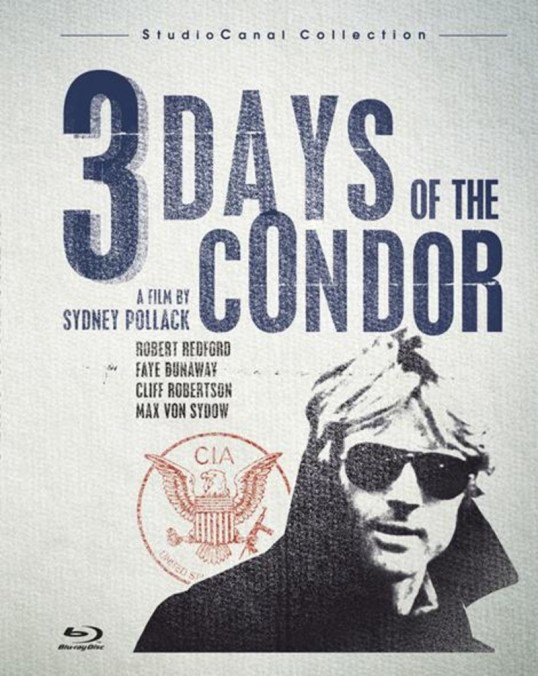
44 Days of Paranoia #8: Three Days of the Condor (dir by Sydney Pollack)


3DaysofTheCondor

When I first decided that I wanted to do the 44 Days of Paranoia, I went on Facebook and I asked my movie-loving friends to name some of their favorite conspiracy-themed films.  As the replies came flooding in, one thing that I quickly noticed was that a lot of them were naming films that had been made in the 1970s.

Usually, when I think about the 70s, I tend to assume that everyone in Texas was smoking weed in a high school parking lot, everyone in New York was snorting cocaine in Studio 54, and everyone in America was dancing nonstop.  And, to be honest, that doesn’t sound too bad to me.  If the 70s were just ten years straight of Dazed and Confused and Saturday Night Fever, then I would be the first one to hook up with anyone who could build a time machine.

However, the 70s were apparently also a very paranoid time.  When one looks over the most acclaimed and best-remembered films of the 70s, one is struck by the feeling that nobody trusted anyone and all official institutions were suspect.

Case in point: 1975’s Three Days of the Condor.

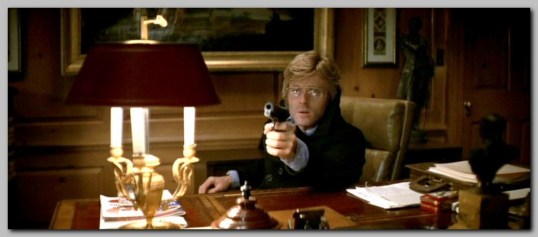
Robert Redford plays Joe Turner, a mild-mannered guy who works for the American Literary Historical Society in New York City.  The Society, however, is a CIA front and Turner’s job is to read cheap spy novels and analyze them to see if any real intelligence leaks might be found between the lines.  As the film opens, Turner arrives late for work.  He jokes with the chain-smoking secretary, shares a few curt words with his superior Martin, and flirts with fellow researcher Janice.  Then, Joe goes to lunch and, while he’s gone, Max Von Sydow shows up with a bunch of killers and guns down everyone else at the safe house.

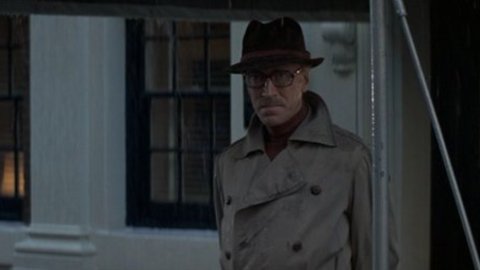
Max Von Sydow's courtly killer

Max Von Sydow’s courtly killer

The scene in which Von Sydow calmly kills all of Joe’s co-workers is one of the most disturbing that I’ve ever seen.  As directed by Sydney Pollack, the film’s violence comes in short, brutal bursts that are all the more nightmarish for lacking any of the flashy choreography that we, as viewers, have been conditioned to expect whenever we’re confronted by violent death on-screen.  Pollack also makes good use of Von Sydow’s kindly eyes and courtly manner, letting us know that, for him, murder is just a job.  Even though we’ve only spent a few minutes with Joe’s co-workers, we’ve still grown to like them and that makes Von Sydow’s matter-of-fact attitude all the more disturbing.

(It’s been a few days since I saw the film and I have to admit that I’m still haunted by the close-up of the burning cigarette still held in the dead secretary’s hand or the way that Martin’s toupee falls off his head after he’s shot.  Small as these details may seem, they stick in the mind and create a sickening feeling of life interrupted.)

When Joe returns from lunch, he finds all of his co-workers dead.  Fleeing the safe house, Joe calls the New York regional director of the CIA, Higgins (Cliff Robertson).  Higgins arranges for Joe to meet up with another agent and to be taken to safety.  However, when Joe arrives for the meeting, the other agent attempts to kill him.

Realizing now that the CIA specifically hit its own safe house and is now looking to kill him, Joe ends up kidnapping Kathy Hale (Faye Dunaway), a neurotic photographer, and forcing her to hide him while he desperately tries to figure out why he’s been targeted.

Thanks largely to Sydney Pollack’s thoughtful direction, Three Days of the Condor is an excellent, exciting, and thought-provoking thriller and, despite having been released close to 40 years ago, it features one major plot that’s probably even more relevant today than when the film was first released.  Redford and Dunaway both give excellent performances but the film really belongs to Max Von Sydow’s menacing and charming assassin.  Most of today’s “action” filmmakers could learn a lot from watching Three Days of the Condor.

end_office

Lisa Marie Reviews The Oscar-Winning Films: Charly (dir by Ralph Nelson)


It’s February and we all know what that means!  It’s Oscar month!  TCM is doing its 31 Days of Oscar and self-important film bloggers across the world are devoting themselves to reviewing the Oscar-winning films of the past.  That includes me because, as our longtime readers know, I love the Oscars and nobody is more self-important than me!

This month, I’m going to be devoting myself to reviewing films that were nominated for an Oscar.  Some of them won, some of them lost but all of them will forever be known as an Oscar nominee.  I am going to start things off by reviewing the 1968 tear-jerker Charly.

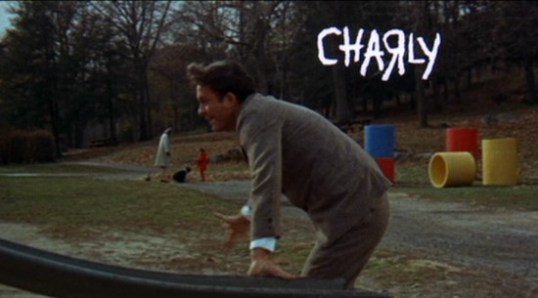
Charly_titleCharly opens with Charlie Gordon (Cliff Robertson) playing in a playground with a bunch of children.  Though Charlie appears to be middle-aged, it quickly becomes apparent that, in many ways, he’s still a child himself.  Charlie is mentally handicapped, an introverted man who works at a bakery where he’s frequently ridiculed and taken advantage of by his co-workers.

Charlie lives an isolated existence but he’s determined to better himself.  As the film begins, he’s been attending night school for two years and he had been taught to read and write by a sympathetic teacher named Alice (Claire Bloom). One night, Alice takes Charlie to the Nemur-Straus Clinic, a research lab run by the cold Dr. Nemur (Leon Janney) and the much more compassionate Dr. Straus (Lilia Skala).  Nemur and Straus think that they’ve discovered a surgical procedure that can increase human intelligence.  Though both doctors are initially reluctant, Alice convinces them to use Charlie as a test subject.

The surgery is a success and Charlie suddenly finds himself intelligent.  For the first time, he can understand a world that had previously only been a mystery to him.  Charlie finds himself falling in love with Alice but he also has to deal with the possibility that his newfound intelligence might only be temporary.  Even as the new Charlie starts to enjoy his life, he’s aware of the ghost of the old Charlie waiting behind every corner.

I have to admit that I have mixed feelings about Charly as a film.  On the one hand, it’s a generally well-acted film and it doesn’t shy away from considering the conflict between science  and nature.  On the other hand, Ralph Nelson directs the film in such a glib and showy manner that Charly often feels like a rather shallow exploration of some very deep issues.  As such, you’re often left feeling as if both the film and the title character deserve better than what Nelson gives them.

The 60s were transitional decade for cinema in general.  While European filmmakers were proving that a movie could be a work of art, American directors found themselves struggling to keep up.  Far too often, this led to American directors copying the techniques of their European counterparts without necessarily understanding what made those techniques were so important in the first place.  Whereas directors like Jean-Luc Godard, Francois Truffaut, and Federico Fellini used showy cinematic techniques to comment on the act of watching the movie itself, many of the older American directors used those same techniques simply because they felt they had no other choice.  One of my favorite games, when watching a mainstream American film from the late 60s, is to spot the random psychedelic moment that, as out-of-place or unnecessary as it may feel, was obviously put into the film “for the kids.”

Charly is full of such moments and very few of them add anything to the film.  Ralph Nelson, a veteran of television who was previously nominated for an Oscar for directing the extremely straight forward Lilies of the Field, comes up with several  self-conscious moments that seem to be there “for the kids” but which don’t necessarily move the story forward.  The film is full of random slow motion, still shots, and split screens and, unfortunately, they serve to distract from a very simple and very effective story.

The film’s saving grace, however, comes in the form of Cliff Robertson.  If you had asked me, before I saw Charly, just who exactly Cliff Robertson was, I would have told you that he played Uncle Ben in the first Spider-Man films and Hugh  Hefner in a disturbing film called Star 80.  However, after seeing Charly, Cliff Robertson will always be the tragic Charlie Gordon to me.

The genius of Robertson’s performance is that he not only captures Charlie’s sweet nature and desire to better himself but he captures Charlie’s anger as well.  As Charlie becomes more intelligent, he also becomes more aware of just how poorly the world has treated him up until that point.  When he can suddenly spell his own name and articulate his own feelings, it’s not just an individual triumph but a triumph for everyone who has ever been told that they can’t do something or that they should just be happy with whatever they’ve been given in life.  Robertson makes Charlie Gordon into a very real and very sympathetic character and, as a result, you care about whether the result of the surgery are permanent or only temporary.  Robertson’s performance is so strong and honest that it transcends the showiness of Nelson’s direction.  Charly works because Cliff Robertson gives the film a heart.

Given the power of his performance, it’s not surprising to discover that Charly,  as both a film and a role, was very important to Cliff Robertson.  It was so important to him that he bought the rights to the film’s source material (the novel Flowers for Algernon by Daniel Keyes) because he wanted to make sure that Charlie Gordon would never be played by anyone but him.  For both his performance and his determination to get the film made, Cliff Robertson won the Academy Award for Best Actor of 1968.

Charly may not be a perfect film but I’m not ashamed to say that I cried at the end of it.  Cliff Robertson’s heart-felt performance as Charlie Gordon transcends whatever other flaws the film may have.  If you haven’t seen Charly, you really should.

The Daily Grindhouse: Shoot (dir. by Harvey Hart)


As I explained yesterday in my review of the 1935 film version of Les Miserables, one of my resolutions for 2013 is to review a film a day, alternating between films that were nominated for an Oscar and film’s that most certainly were not.  Today’s film stars two Oscar winners (Cliff Robertson and Ernest Borgnine) but it was not nominated for any awards itself.  Along with being ignored by the Academy, this film is unfairly obscure and has an oddly bad reputation among cult movie fans.  The movie is a Canadian exploitation film from 1976 and it’s probably even more relevant today than when it was first made.  The name of the film?  Shoot.

Rex (played by Cliff Robertson) is a veteran of the National Guard, a respected community leader in his small town, and a man who loves his guns.  His house is full of guns of all shapes and sizes and he’s so proud of his military background that the living room even appears to have camouflage style wallpaper.  From the film’s opening shots, it quickly establishes that Rex is not comfortable being civilized.  The few attempts that he makes to speak to his wife are painfully awkward.  Rex only feels truly alive during the weekends that he spends out in the wilderness, hunting with his buddies, played by Ernest Borgnine and Henry Silva.  His friends look up to Rex as their leader, to the extent that one of them refers to Rex as being the “senior officer in charge.”

During one hunting trip, Rex and his heavily armed friends pause to rest next to a river.  Suddenly, on the other side of the river, another group of heavily armed strangers show up.  They stare at each other for a few minutes before suddenly, a shot rings out.  The two groups start shooting at each other.  One man is wounded and another is killed before Robertson and his group retreat to the security of Borgnine’s cabin.

Instead of going to the police, Robertson convinces his group to keep the incident a secret.  They return to town, swearing not to tell anyone about what’s happened.  However, Robertson’s paranoia gets the better of him.  Before long, he’s convinced himself that the other group is going to seek revenge and that the only way to survive is to kill them first.  Along with the hot-headed Silva, Robertson recruits a small army of townsfolk to return with him to the wilderness.  Only Borgnine questions the wisdom of Robertson’s plan.  The whole thing eventually leads to a genuinely shocking and disturbing climax.

Robertson and his friends are obviously meant to be representatives of American gun culture and to call Shoot heavy-handed would be a bit of an understatement.  That said, Shoot is still an undeniably effective piece of propaganda.  Robertson, Silva, and Borgnine all give excellent performances and director Harvey Hart  manages to generate and maintain a good deal of suspense concerning just what (if anything) Robertson is going to find waiting for him in the wilderness.  Though the film has its slow spots, the emphasis on characterization and suspense makes the surprise ending all the more effective.

Shoot is not an easy film to see.  It has never been released on DVD or Blu-ray and I only happened to learn of it because I was bored one day and I was flipping through one of my film reference books.  However, the film has recently been uploaded to YouTube and here it is: