Holiday Film Review: Die Hard (dir by John McTiernan)


Yes, Die Hard is a Christmas movie.

And, in an alternative universe, it was a Frank Sinatra movie.

Released into theaters in 1988, Die Hard was based on a novel called Nothing Lasts ForeverNothing Lasts Forever told roughly the same story as Die Hard, with one of the big exceptions being that the cop fighting the terrorists was not the youngish and quippy John McClane but instead was a weary, aging and retired detective named Joe Leland.  Leland previously appeared in another novel called The Detective.  In 1968, The Detective was turned into a film and the role of Leland was played by Frank Sinatra.  As a part of his contract, Sinatra had the right to play Leland in any sequels to The Detective.  When Die Hard was in pre-production, Sinatra could have demanded that the film be a Joe Leland film and that he be allowed to star in it.  Fortunately, Sinatra did not do that and Joe Leland was instead transformed into John McClane.  And, after the role was was turned down by Arnold Schwarzenegger, Sylvester Stallone, Clint Eastwood, Nick Nolte, Mel Gibson, Don Johnson, Harrison Ford, Burt Reynolds, Paul Newman, James Caan, Al Pacino, and Richard Dean Anderson, popular television actor Bruce Willis finally received the role.

Seriously, just consider that.  Bruce Willis was not only not the first choice for John McClane but even Richard Dean Anderson was offered the role before the filmmakers finally went with Willis.  It’s hard to imagine anyone else starring in Die Hard because, to most of us, Bruce Willis is John McClane.  Growing up and watching Die Hard on television every Christmas, it was very easy to assume that Willis probably spent all of his spare time fighting terrorists and coming up with snarky quips.  Definitely, it’s difficult to imagine Stallone and Schwarzenegger in the role.  What made McClane such a compelling hero was that he wasn’t superhuman.  He was just a blue collar guy who hurt his feet, got tired, and had his moments of frustration just like everyone else.  He was the relatable action hero.  It didn’t matter how many stories that one heard about Bruce Willis having an ego or occasionally being difficult to work with.  Bruce Willis was John McClane and, after everything that McClane had been though, he had every right to occasionally be difficult.

You’ll notice that I haven’t really discussed the plot of Die Hard because …. well, everyone knows that plot.  I mean, this is one of those films that has such a permanent place in pop cultural history that even people who somehow haven’t seen the film still know what it’s about.  John McClane is an NYPD cop who flies to Los Angeles to see his estranged wife, Holly, for Christmas.  Holly (Bonnie Bedelia) works for the Nakatomi Corporation.  During the company’s Christmas party, terrorists led by Hans Gruber (Alan Rickman) take over the skyscraper.  The terrorists claim to be politically-motivated but, actually, they just want to break into the building’s vault and make off with a lot of money.  McClane makes his way through the unfinished skyscraper, killing the terrorists one-by-one.  He only has two allies.  Al Powell (Reginald VelJohnson) is an LAPD sergeant who is outside the building and who communicates with McClane via radio.  Argyle (De’Veroux White) is the friendly limo driver who spends almost the entire siege oblivious in the parking garage.  (The first time I ever watched Die Hard, I was so worried something bad would happen to Argyle.)

McClane has a lot of enemies and not all of them are terrorists.  The Deputy Chief of the LAPD (Paul Gleason) thinks that McClane is making the situation worse.  Two FBI agent, both named Johnson (and played by Robert Davi and Grand L. Bush), seem to view the entire siege as being a game with the older Johnson talking about how much it reminds him of Vietnam.  A reporter (William Atherton) makes the situation worse with his on-the-spot reports.  Meanwhile, there’s Harry Ellis (Hart Bochner).  A coke-addled executive, Ellis actually thinks that he’s helping McClane by trying to negotiate with Gruber.  I know that some people can’t stand Ellis but I always feel sorry for him.  In his way, he was trying to help and you could tell that he was so proud of himself for not telling Gruber that McClane was in Los Angeles to see Holly.

Needless to say, there’s a lot of action in Die Hard.  A lot of people die.  One thing that I appreciate the movie is that the bad guys get as upset over their friends and family being killed as McClane gets over Holly being threatening.  No one in the film is one-dimensional and even the bad guys have their own distinct personalities.  Theo (Clarence Gilyard) gets so excited about the idea of opening the vault that you can’t help but relate.  Karl (Alexander Godonuv) appears to be nearly indestructible.  Hans Gruber may be totally evil but he has a quick wit and there’s something intriguing about how confident he is.  Alan Rickman, famously, was not happy that his first role led to him being typecast as an international villain and one can’t blame him.  Still, almost every action movie villain who has followed has owed something to Alan Rickman.  Just as it’s difficult to imagine anyone other than Bruce Willis as John McClane, it’s impossible to imagine anyone other than Alan Rickman as Hans Gruber.

(That said, I’m sure there’s another alternate universe out there, right next to the Sinatra universe, where Blade Runner was not as troubled a production as it was and, as a result, Die Hard was made with Ridley Scott directing, Harrison Ford starring as McClane, and Rutger Hauer playing Hans.)

For all of the action, there’s also a lot of moments that make me laugh out loud and I’m not just talking about McClane’s one liners.  The two FBI agents don’t get much screentime but Davi and Bush make the most of what they have.  Paul Gleason is wonderfully deadpan as the clueless Chief Robinson.  Even Rickman gets his share of laughs.  “I read about them in Time Magazine” indeed.

Die Hard is a Christmas tradition with my family and a lot of other families as well.  Does Die Hard count as a Christmas movie?  I would say yes.  The terrorists may not respect the holiday but John McClane does.  No one ruins McClane’s Christmas!

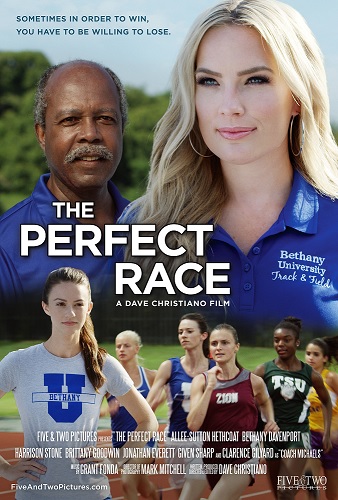
October Positivity: The Perfect Race (dir by Dave Christiano)


In this 2019 sequel to Remember The Goal, cross country coach Courtney Smith-Donnelly (Allee Sutton Hethcoat) finds herself coaching at the college level.  One of the runners that she coached in high school, Brittany (played by Bethany Davenport), is now the best runner at Bethany University.  In fact, she’s the second best runner in the nation!  Coach Michaels (Clarence Gilyard, Jr.) brings in Courtney to work with Brittany while he deals with some health complications.

So, pretty much all the stuff that happened during the first movie happens during the second.  Once again, everyone doubts Courtney’s training methods.  Once again, Courtney takes it upon herself to tell all of the runners how to live their lives.  Brittany’s father gets angry when Courtney tells Brittany to run slower than usual.  Considering that Courtney is now a local celebrity because of how well the cross country team did in Remember the Goal, you might think that the other coaches would know about her techniques and would prepare for them.  But nope.  No one has any faith in Courtney’s ideas but she’s vindicated in the end.  In fact, over the course of two movies, Courtney is never once incorrect about anything.  To be honest, that’s kind of annoying.

The main difference between Remember The Goal and The Perfect Race is that Courtney is a thousand times more preachy in the sequel.  In the first film, she cited a verse from Corinthians and later talked about Jesus raising a girl from the dead and that was about it.  In The Perfect Race, it’s rare that a scene goes by without Courtney saying, “Do you remember the story about….” and then offering up a Biblical lesson.  It gets a bit tiring and, again, it’s hard not to get bored with Courtney having all of the answers all of the time.  For example, when she’s told that the track team doesn’t practice when its raining, she promptly asks everyone in the room to raise their hand if their parents are divorced.  Courtney goes on to explain that, if you’re not willing to train while it’s raining, you probably won’t be able to make a marriage work either.  WHAT!?  You know what else might end a marriage?  Dying of pneumonia.

For a film about athletics, The Perfect Race is a very talky film.  Unfortunately, most of the conversations are very repetitive.  When Courtney tells Brittany to slow down during one of her races, we got several scenes in a row of people asking each other why Courtney did that.  Brittany’s father asks Brittany why Courtney told her to slow down.  Brittany replies that she doesn’t know.  In the very next scene, Brittany’s father tells Coach Micheals about what Courtney told Brittany to do.  Coach Michaels asks Brittany’s father why Courtney did that.  “I don’t know,” Brittany’s father replies.  Coach Michaels asks Brittany why Courtney did that.  “I don’t know,” Brittany replies.  In the next scene, two rival coaches talk about Brittany slowing down.  One coach asks, “Why did she do that?”  “I don’t know,” the other coach replies.  And it just kept going and going until eventually, I wanted to throw something at the TV.

Anyway, my frustrations aside, Courtney is triumphant at the end of the movie, largely because Courtney is perfect and never makes any mistakes.  Did I mention how annoying that can get?

This film inspired me to go for a run, if just to have an excuse to stop watching it.  And, before anyone asks, I do not like carrots.

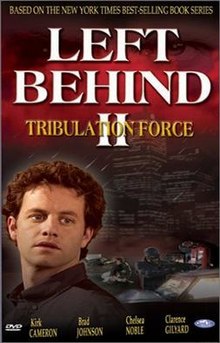
Film Review: Left Behind 2: Tribulation Force (dir by Bill Corcoran)


The 2002 film, Left Behind II: Tribulation Force, begins a week after the Rapture.  I have to admit that it took me by surprise when they mentioned that only a week had passed since the events that kicked off the first Left Behind film because the action in the original film seemed to go on for a lot longer than week.  I guess, if nothing else, that’s a lesson in the importance of keeping your film moving at a steady pace.

Speaking of pacing, Tribulation Force has a bit of quicker pace than the first film.  Now that everyone knows what happened, Rayford Steele (Brad Johnson) and Buck Williams (Kirk Cameron) can jump into action and start working to try to thwart the evil plans of Nicolae Carpathia (Gordon Currie).  Of course, at the start of the film, they’re told that it’s impossible to thwart the evil plans of Carpathia because the Bible has already predicted that he can’t be thwarted.  However, the Bible has also predicated that people will still try so I guess Rayford and Buck really don’t have that much of a choice.

Both Buck and Rayford get minor subplots that are designed to bring some humanity to all of the apocalyptic melodrama.  Rayford is still coming to terms with being left behind and struggling to forgive himself for not going to church with his wife and son.  To give some credit where credit is due, Brad Johnson is this film’s secret weapon.  He doesn’t really get to do much but Johnson brings just enough emotional reality to the role that his scenes have some depth that the rest of the film is missing.

As for Buck, he’s pursuing a tentative relationship with Rayford’s daughter, Chloe (Janaya Stephens).  Unfortunately, he’s also letting his assistant Ivy crash at his apartment and when Chloe stops by and discovers Ivy wearing a towel and an engagement ring, she assumes the worst.  Luckily, Buck’s able to say, “She’s my assistant” and that takes care of that.

Kirk Cameron is pretty much at the center of Tribulation Force, which is a problem because he’s totally miscast as a tough and respect journalist.  Carpathia, who really should have known better seeing as how he’s the son of Satan and everything, decides to turn Buck into the public face of his global news channel.  Unfortunately, there’s nothing about Kirk Cameron that suggests that any character he would play would ever have the gravitas or the charisma necessary to be the public face of any government.  As in the first film, Cameron comes across as being extremely earnest and a little bit dull.  He’s like the intern who accidentally screws up everyone’s lunch order.

Anyway, in Tribulation Force, everyone in the world loves Carpathia, even though he’s the most obviously evil dictator ever.  (The Rapture left behind not just the nonbelievers but also the extremely stupid.)  Carpathia announces the birth of a new world without borders and without religion.  Buck and Rayford plan to televise an interview with the Two Witnesses, who are waiting at the Wailing Wall.  But, to do that, they’re going to have to figure out a way to work around the fact that Carpathia controls all of the news channels….

Despite the fact that Tribulation Force is not as slow as the first film, the bulk of the film is still made up of people having long conversations about Biblical prophecy.  Like a lot of early faith-based films, Tribulation Force gets bogged down in explaining its message as opposed to showing the audience what that message means.  When Buck does finally reach the Wailing Wall, we do get to see some people get set on fire but, other than that, this is a very talky film.  As well, Tribulation Force can’t ever seem to decide just how powerful and all-knowing Carpathia is supposed to be.  At times, he has nearly supernatural powers and yet, at the same time, he’s totally incapable of seeing that Buck and Rayford are both plotting against him.  Is Carpathia a victim of his own hubris or is it just bad plotting on the part of the film?  I’ll leave it up to you decide.

Tribulation Force was followed by one more Left Behind film, World At War.  I’ll review that one in about 15 minutes!  Hope to see you then.


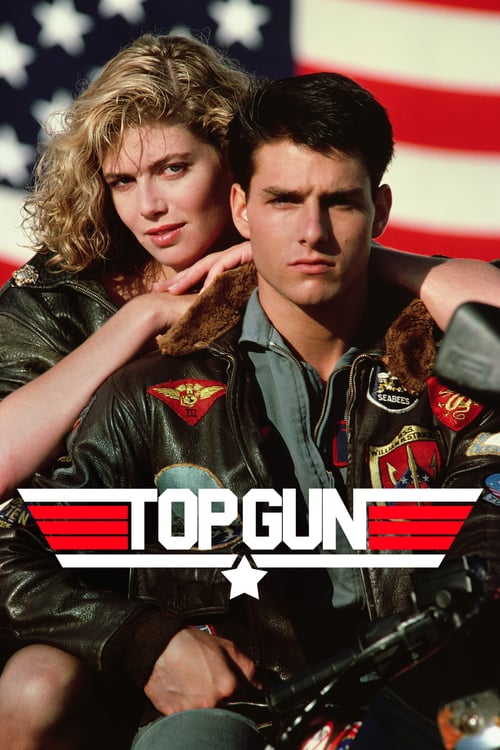
Film Review: Top Gun (dir by Tony Scott)


Oh, where to even begin with Top Gun?

First released in 1986, Top Gun is a film that pretty much epitomizes a certain style of filmmaking.  Before I wrote this review, I did a little research and I actually read some of the reviews that were published when Top Gun first came out.  Though it may be a considered a classic today, critics in 1986 didn’t care much for it.  The most common complaint was that the story was trite and predictable.  The film’s reliance on style over substance led to many critics complaining that the film was basically just a two-hour music video.  Some of the more left-wing critics complained that Top Gun was essentially just an expensive commercial for the military industrial complex.  Director Oliver Stone, who released the antiwar Platoon the same year as Top Gun, said in an interview with People magazine that the message of Top Gun was, “If I start a war, I’ll get a girlfriend.”

Oliver Stone was not necessarily wrong about that.  The film, as we all know, stars Tom Cruise as Pete “Maverick” Mitchell, a cocky young Navy flyer who attends the TOPGUN Academy, where he competes with Iceman (Val Kilmer) for the title of Top Gun and where he also spends a lot of time joking around with everyone’s favorite (and most obviously doomed) character, Goose (Anthony Edwards).  Maverick does get a girlfriend, Charlie (Kelly McGillis), but only after he’s had plenty of chances to show both how reckless and how skilled he can be while flying in a fighter plane.  Though the majority of the film is taken up with scenes of training and volleyball, the end of the film does give Maverick a chance to prove himself in combat when he and Iceman end up fighting a group of ill-defined enemies for ill-defined reasons.  It may not be an official war but it’s close enough.

That said, I think Oliver Stone was wrong about one key thing.  Maverick doesn’t get a girlfriend because he started a war.  He gets a girlfriend because he won a war.  Top Gun is all about winning.  Maverick and Iceman are two of the most absurdly competitive characters in film history and, as I watched the film last weekend, it was really hard not to laugh at just how much Cruise and Kilmer got into playing those two roles.  Iceman and Maverick can’t even greet each other without it becoming a competition over who gave the best “hello.”  By the time the two of them are facing each other in a totally savage beach volleyball match, it’s hard to look at either one of them without laughing.  And yet, regardless of how over-the-top it may be, you can’t help but get caught up in their rivalry.  Cruise and Kilmer are both at their most charismatic in Top Gun and watching the two of them when they were both young and fighting to steal each and every scene, it doesn’t matter that both of them would later become somewhat controversial for their off-screen personalities.  What matters, when you watch Top Gun, is that they’re both obviously stars.

“I’ve got the need for speed,” Tom Cruise and Anthony Edwards say as they walk away from their plane.  The same thing could be said about the entire movie.  Top Gun doesn’t waste any time getting to the good stuff.  We know that Maverick is cocky and has father issues because he’s played by Tom Cruise and Tom Cruise always plays cocky characters who have father issues.  We know that Iceman is arrogant because he’s played by Val Kilmer.  We know that Goose is goofy because his nickname is Goose and he’s married to Meg Ryan.  The film doesn’t waste much time on exploring why its characters are the way they are.  Instead, it just accepts them for being the paper-thin characters that they are.  The film understands that the the most important thing is to get them into their jets and sends them into the sky.  Does it matter that it’s sometimes confusing to keep track of who is chasing who?  Not at all.  The planes are sleek and loud.  The men flying them are sexy and dangerous.  The music never stops and the sun never goes down unless the film needs a soulful shot of Maverick deep in thought.  We’ve all got the need for speed.

In so many ways, Top Gun is a silly film but, to its credit, it also doesn’t make any apologies for being silly.  Instead, Top Gun embraces its hyperkinetic and flashy style.  That’s why critics lambasted it in 1986 and that’s why we all love it in 2020.  And if the pilots of Top Gun do start a war — well, it happens.  I mean, it’s Maverick and Iceman!  How can you hold it against them?  When you watch them fly those planes, you know that even if they start World War III, it’ll be worth it.  If the world’s going to end, Maverick’s the one we want to end it.