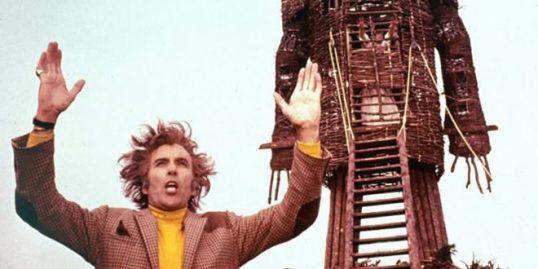
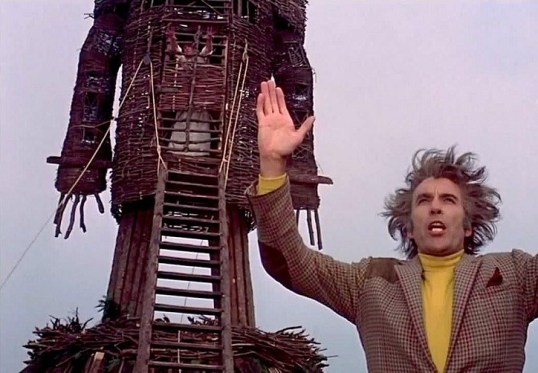
Over the course of his long career, Christopher Lee often cited his performance as the charismatic but ultimately sinister Lord Summerisle in 1973’s The Wicker Man as one of his personal favorites. It’s easy to see why. The role not only showcased Lee’s ability to be menacing but it was also one of the few films that allowed him to be witty as well. Lord Summerisle may be a pagan who maintains his power by sacrificing virgins but he’s still quite charming. With his longish hair, sideburns, and turtleneck, Lord Summerisle is the perfectly aristocratic 70s rogue.
Today’s scene that I love comes from the original The Wicker Man. (Sorry, the Nicole Cage “bees” scene from the remake will have to wait for next year’s horrorthon.) In this scene, Lord Summerisle expalins the ways of the island to a skeptical police detective. Little does the detective know that he’s already been selected to be the next sacrifice. Lee’s avuncular performance holds up wonderully.
4 Or More Shots From 4 Or More Films is just what it says it is, 4 shots from 4 of our favorite films. As opposed to the reviews and recaps that we usually post, 4 Shots From 4 Films lets the visuals do the talking!
Today, we honor the legacy of a man who was not just a great horror star but also a great actor. period Christopher Lee worked with everyone from Laurence Olivier to Steven Spielberg to Peter Jackson to Martin Scorsese. Though he turned own the chance to play Dr. No, Lee later did go play a Bond villain in The Man with The Golden Gun. He was one of those actors who was always great, even if the film wasn’t.
That said, it’s for his horror films that Lee is best known. He was the scariest Dracula and the most imposing Frankenstein’s Monster. He played mad scientists, decadent aristocrats, and even the occasional hero. Christopher Lee was an actor who could do it all and today, we honor him with….
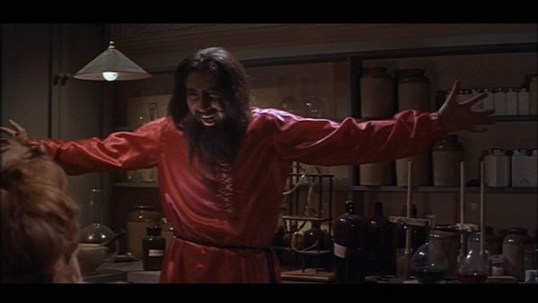
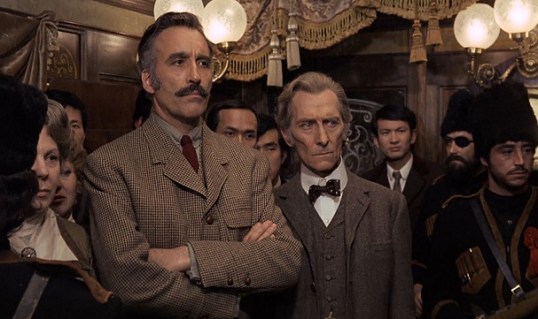
6 Shots From 6 Christopher Lee Films
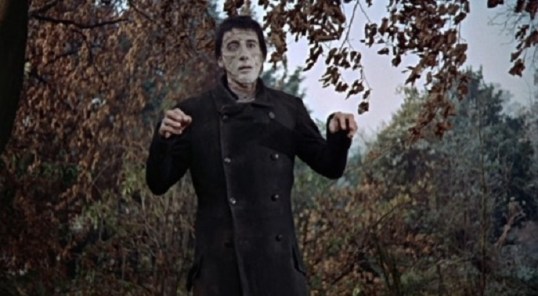
The Curse of Frankenstein (1957, dir by Terence Fisher, DP: Jack Asher)
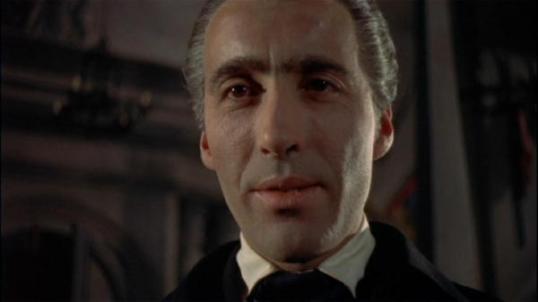
The Horror of Dracula (1958, dir by Terence Fisher, DP: Jack Asher)
Rasputin The Mad Monk (1966, dir by Don Sharp, DP: Michael Reed)
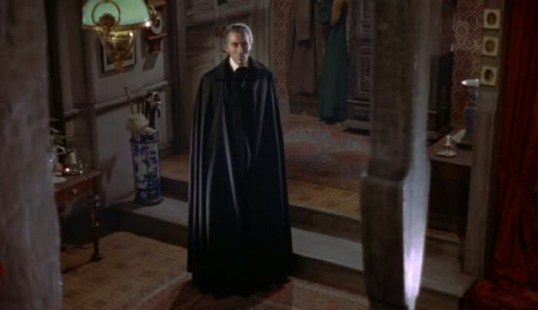
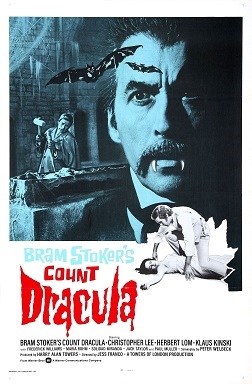
Count Dracula (1970, dir by Jess Franco, DP: Manuel Merino and Luciano Trasatti)
Horror Express (1972, dir by Eugenio Martin, DP: Alejandro Ulloa)
The Wicker Man (1973, dir by Robert Hardy. DP: Harry Waxman)
Since today is Boris Karloff’s birthday, I thought I would devote this edition to everyone’s favorite reanimated corpse, Frankenstein’s Monster! Over the years, there’s been a lot of movies about the Monster. Here are the trailers for six of them!
The Curse of Frankenstein (1957)
Believe it or not, there was a time when it was felt that the story of Frankenstein and his Monster has been played out. With the Universal films bringing in less and less money, many felt that the Monster’s days were behind it. Then, Hammer, Peter Cushing, and Christopher Lee came along and said, “No! This is what Frankenstein is all about!”
At least, I assume that’s what they said. I hope they did.
2. Jesse James Meets Frankenstein’s Daughter (1965)
You can’t keep a good Frankenstein down as Jesse James discovered in this 1965 western.
3. Lady Frankenstein (1971)
In this Italian film, the Baron’s daughter continues her father’s scientific experiments! I guess Jesse James wasn’t the only one to meet Frankenstein’s Daughter!
4. Flesh for Frankenstein (a.k.a. Andy Warhol’s Frankenstein) (1973)
Udo Kier is the Baron and Andy Warhol may have been the producer of this film. Or he may have just lended his name out for the money. It depends on who you ask.
5. Blackenstein (1973)
Of course, following the success of Blacula, there was a blaxploitation take on Frankenstein.
6. Frankenhooker (1990)
And, of course, who can forget Frankenhooker?
I hope that your Halloween is full of the type of creativity and scientific curiosity that made the Frankenstein family legendary!
Christopher Lee played Dracula in seven horror films and he often said that he hated almost every single one of them.
Christopher Lee, you have to understand, was a fan of Bram Stoker’s original novel and he always wanted to play Dracula the way that Stoker wrote him, as a member of the old nobility who got younger each time he drank blood. As Lee often explained it, he spent years vainly trying to convince Hammer to do a Dracula film that was faithful to Stoker’s novel but Hammer instead preferred to use Dracula as an almost generic villain, one who was frequently plugged into equally generic films.
At some point, in the late 60s, producer Harry Alan Towers approached Christopher Lee and asked him to play Dracula in a non-Hammer film about the world’s most famous vampire. At first, Lee refused. If he was bored with playing Dracula for Hammer, why would he want to play him for someone else? However, Towers then explained that his version of Dracula would be the first Dracula film to actually be faithful to Stoker’s book. In fact, along with the presence of Christopher Lee, that would be the film’s major selling point! Hearing this, Lee agreed.
The resulting film was 1970’s Count Dracula, a German-Spanish-British co-production that was directed by none other than Jess Franco. Jess Franco, of course, is a beloved figure among many fans of Eurohorror and a bit of a controversial filmmaker. Some people admired him for his ability to direct atmospheric films while spending very little money. Others complained that Franco’s films were frequently amateurish and narratively incoherent. When it comes to Franco, both camps can make a compelling argument. Personally, I tend to come down on the pro-Franco side of things, particularly when it comes to the films that he made with Towers in the 70s. For his part, Christopher Lee said he enjoyed working with Franco and they would go on to collaborate on several more films together.
So, what type of film is Jess Franco’s Count Dracula? Well, Towers did not lie to Lee. For the most part, Count Dracula remains faithful to plot of Bram Stoker’s Dracula. There’s a few minor differences, of course. A few characters are combined, which is understandable given that you sometimes need a scorecard to keep up with everyone in the novel. The ending is a bit more abrupt in the film than it is in the book. This probably has something to do with the fact that Franco ran out of money before he finished the film. That was a fairly frequent occurrence on Franco’s films.
That said, film sticks close to the novel. Jonathan Harker (Frederick Williams) goes to Transylvania and meets Dracula (Christopher Lee, with a mustache), an aging nobleman. Harker soon finds himself being held prisoner in the castle, a victim of Dracula and his brides. Though Harker does manage to escape (though not before finding Dracula asleep in his coffin), he ends up at a psychiatric hospital in London. He meets Dr. Seward (Paul Muller) and Prof. Van Helsing (Herbert Lom). Eventually, his fiancee Mina (Maria Rohm) and her best friend, Lucy (Soledad Miranda, who was Franco’s muse until he tragic death in a car accident) come to visit him. Accompanying Lucy is Quincy Morris (Franco regular Jack Taylor), who, in the film, is a combination of two of the novel’s characters, Quincy and Arthur Holmwood. Meanwhile, a madman named Renfield (Klaus Kinski) babbles about his master and eats bugs.
That said, while the story may stick close to Stoker, this is definitely a Franco film. The action plays out at its own deliberate pace. Depending on how much tolerance you have for Franco’s aesthetic, you’ll find this film to be either dream-like or slow. Personally, I liked the amospheric images and the somewhat ragged editing style. Whether it was Franco’s intention or not, they gave the film a hallucinatory feel, as if one was watching a nightmare being dreamt by Stoker himself. At the same time, I can imagine others getting frustrated by the film and I can understand where they’re coming from. Franco, with his habit of mixing the sensual with a deep sense of ennui, is not for everyone.
Still, it was interesting to see Lee giving a much a different performance as Dracula than he did in the Hammer films. The Hammer films portrayed Dracula as being animalistic, driven by only his craving for blood. In Count Dracula, Lee plays with the idea of Dracula being a relic of the old world, someone who has no choice but to watch as civilization changes around him. While Dracula is undoubtedly evil, Lee plays him with hints of dignity. Gone is the snarling and growling monster of the Hammer films and instead, this movie features a Dracula who takes an almost Calvinistic approach to his affliction. He’s accepted his fate. As he tells Harker, Harker can either choose to enter the castle or not. In the end, it makes no difference because eventually, someone will enter. The film also retains the idea of Dracula growing younger in appearance as he drinks blood, which adds a whole other dimension to Dracula’s cravings. Blood is life and youth, two things that Dracula no longer possesses.
As for the rest of the cast, Klaus Kinski, not surprisingly, throws himself into the role of Renfield. Reportedly, he ate real bugs for the role. Herbert Lom seems a bit bored with the role of Van Helsing. He doesn’t have any of the eccentric energy that we typically associate with the role. Of course, some of that is due to the fact that, because of scheduling conflicts, Lom and Lee were never on set at the same time. The scenes where Dracula and Van Helsing confront each other were created through some editing sleight-of-hand. As is typical with Franco films, sometimes it works and sometimes, it’s extremely obvious that Lom wasn’t actually looking at Lee (or anyone other than the cameraman) when he delivered his lines.
Count Dracula is an interesting take on the story. It’s a bit uneven, though that’s perhaps not a surprise considering that the production was apparently beset by budgetary problems from the start. This film is Franco at his least lurid and it’s hard not to miss some Franco’s more sordid impulses. Watching the film, you get the feeling that Franco was holding back. But, the visuals are wonderfully dreamy, Kinski is compelling in his insane way, and Lee finally appears to be enjoying the role of Dracula. It’s actually kind of nice to see.
4 Shots From 4 Films is just what it says it is, 4 shots from 4 of our favorite films. As opposed to the reviews and recaps that we usually post, 4 Shots From 4 Films lets the visuals do the talking!
Today, let us take just a few moments to pay tribute to one of the icons of Halloween. He was born into nobility but he never let that stop him from visiting the village at night and getting a taste of the common life. I’m talking, of course, about the original royal influencer, Count Dracula! Everyone knows Dracula. Everyone wants to either be with or even be Dracula. It’s no wonder that he’s been the subject of so many biopics.
In honor of the Count’s legacy, here are….
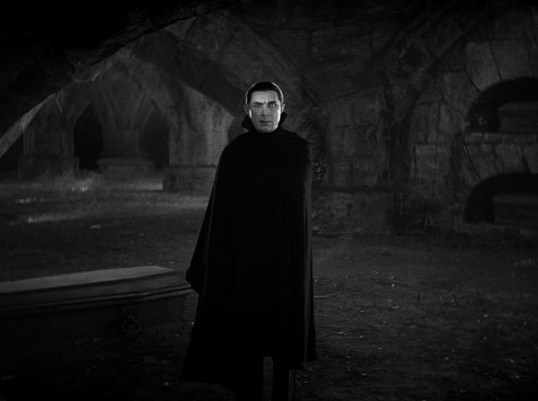
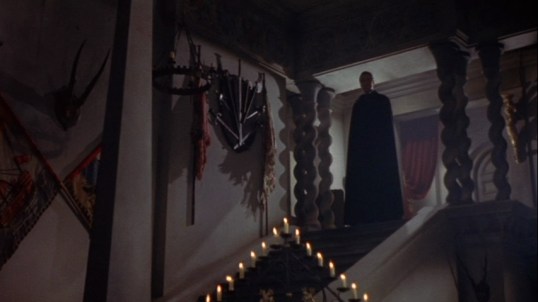
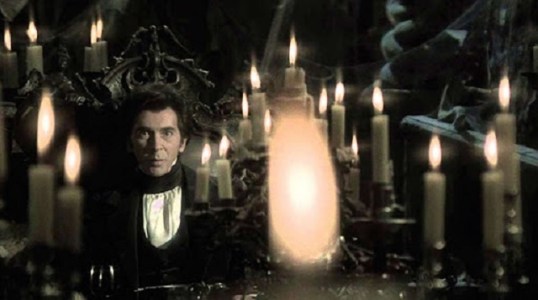
4 Shots From 4 Dracula Films
Dracula (1931, starring Bela Lugosi as the Count, Dir by Tod Browning, DP: Karl Freund)
Horror of Dracula (1958, starring Christopher Lee as the Count, Dir by Terence Fisher, DP: Jack Asher)
Dracula (1979, starring Frank Langella as the Count, Dir by John Badham, DP: Gilbert Taylor)
Dracula 3D (2012, starring Thomas Kretschman at the Count, dir by Dario Argento, DP: Luciano Tovoli)
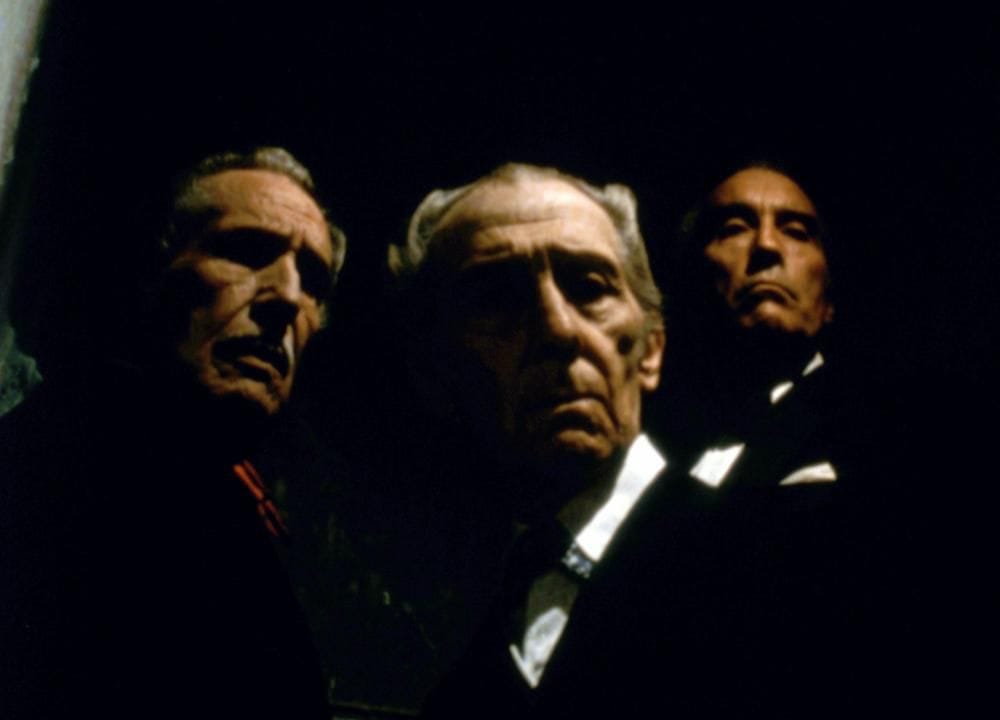
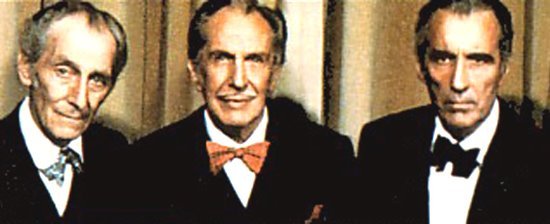
Today, the Shattered Lens honors the birth of three cinematic icons!
Vincent Price was born on May 27th, 1911 in St. Louis, Missouri.
Peter Cushing was born on May 26th, 1913 in Kenley, Surrey, England.
Christopher Lee was born on May 27th, 1922 in London, England!
These three gentlemen went on to not only become very good actors but also horror icons! Each, in their own way, is responsible for my own love of cinema. You could argue that, without them, there would be a lot less horror fans in the world. Just as Lee and Cushing introduced a new generation to Dracula and Frankenstein, Price helped to introduce a new generation to the works of Edgar Allan Poe.
On top of all the work they did in the movies, the three of them were apparently good friends off-screen as well!
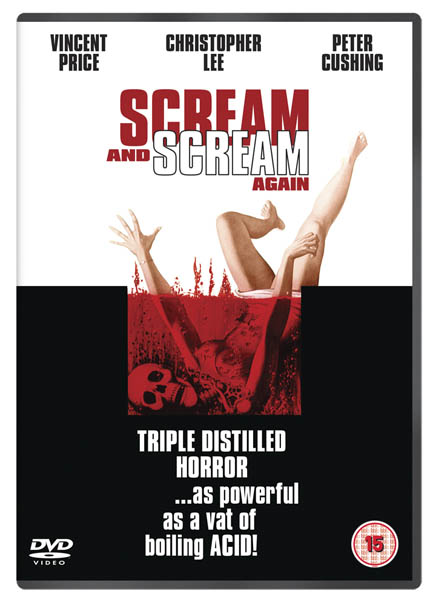
So, today, take a minute or two to remember three great actors! And, if you want to watch a movie with all three of them at their best, might I suggest Scream and Scream Again? It’s my favorite!
The 1970 film, Count Dracula, is unique in that it’s a film that stars Christopher Lee but it wasn’t produced by Hammer. Instead, it was directed by Lee’s friend, the Spanish director Jess Franco. It was sold as being a far more faithful adaptation of the Dracula story than anything that had been filmed up to that point. Lee, who frequently bemoaned the quality of the Hammer films, later described Count Dracula as being a personal favorite of the many films in which he appeared.
In the scene, Dracula confronts Herbert Lom’s Prof. Van Helsing. Lee gets more dialogue in this scene than he did throughout the entirety of Hammer’s Dracula, Prince of Darkness.
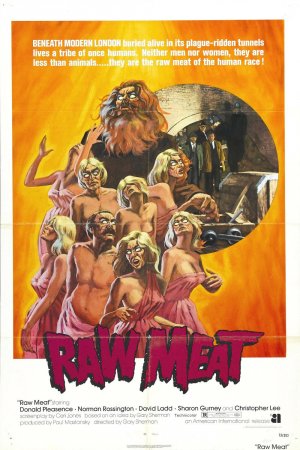
In the 1972 British horror film Death Line (released in the U.S. as Raw Meat), Donald Pleasence gives one of his best performances as Inspector Calhoun, an alcoholic, somewhat fascistic detective who discovers evidence of cannibals in the London Underground. Since the British government would rather this information not be revealed, a mysterious man played by Christopher Lee is sent to discuss things with Calhoun.
This scene features a meeting between two icons of horror so, of course, I love it. Pleasence is wonderfully obsessive and Lee is wonderfully menacing. Since the film is as much about the class struggle as it is about cannibalism, it’s interesting to see the automatic conflict between the working class Calhoun and the definitely upper class character played by Christopher Lee.
In ancient Rome, under the direction of Cassius (Richard Johnson), several members of the Senate conspire to kill Julius Caesar (John Gielgud), believing that his death is the only way to preserve the Republic. Even Caesar’s longtime friend, Brutus (Jason Robards), is brought into the conspiracy. Unfortunately for the conspirators, after Caesar’s murder, Mark Antony (Charlton Heston) gives his famous speech asking the Romans to lend him their ears and the Roman citizens turn against Caesar’s murderers and instead look to Antony and Octavius (Richard Chamberlain) to lead them.
This was the first adaptation of William Shakespeare’s play to be filmed in color and the assassination of Caesar was portrayed much more graphically than in previous productions. By the end of the attack, Caesar has been stabbed so many times and there’s so much blood on screen that it doesn’t seem like he should even have the strength to say, “Et tu, Brute?” Despite the then-modern innovations, this version still feels creaky and stiff. When Caesar makes his appearance on the Ides of March, all of the conspirators actually stand in a neat line while Caesar enters the Senate. When Mark Anthony and Brutus make their speeches, the extras playing the Roman citizens looked bored and disinterested.
For most viewers, the appeal of this version of Julius Caesar will be for the cast, which was considered to be all-star in 1970. Along with Gielgud, Robards, Heston, Johnson, and Chamberlain, the cast also features Robert Vaughn as Casca, Christopher Lee as Artemidorous, Jill Bennett as Calpurnia, and Diana Rigg as Portia. Surprisingly, it’s Jason Robards, the Broadway veteran, who struggles with Shakespeare’s dialogue, delivering his lines flatly and without much emotion. Meanwhile, Charlton Heston steals the entire film as Mark Antony, nailing Antony’s funeral oration and proving himself to be much more clever than the conspirators had originally assumed. (Of course, Mark Antony was the Charlton Heston of his day so I guess it shouldn’t be too much of a surprise that Heston is perfect in the role.) I also liked Diana Rigg’s performance in the small role of Portia and Robert Vaughn’s devious interpretation of Casca.
Though he plays Caesar here, John Gielgud previously played Cassius in the 1953 version of Julius Caesar, the one with James Mason and Marlon Brando. That is still the version to watch if you want to see the definitive adaptation of Julius Caesar.


 Through the Shattered Lens