Film Review: …. And Justice For All (Dir by Norman Jewison)


First released in 1979, ….And Justice For All will always be remembered for one scene.

Yell it with me, “YOU’RE OUT OF ORDER!  THE WHOLE TRIAL IS OUT OF ORDER!  THEY’RE OUT OF ORDER!”

When attorney Arthur Kirkland (Al Pacino) starts screaming in the middle of the courtroom, it’s a cathartic moment.  We’ve spent nearly two hours watching as Arthur deals with one insane situation after another.  One of Arthur’s partners, Warren (Larry Bryggman), cares more about his car than actually delivering the right documents to a judge.  Another of Arthur’s partners, Jay (Jeffrey Tambor), has a nervous breakdown and, after shaving his head, ends up throwing cafeteria plates at people in the courthouse.  Arthur has three clients, one of whom is indigent, one of whom is innocent, and one of whom is a wealthy and despised judge (John Forsythe) who has been accused of a rape that Arthur suspects he committed.  The system offers no mercy for Arthur’s innocent (or, at the very least, harmless) clients while going out of it’s way to defend the judge.  Meanwhile, another judge (Jack Warden), is driven to take suicidal risks, like flying a helicopter until it runs out of fuel and comes down in a nearby harbor.  The assistant district attorney (Craig T. Nelson) only cares about his political ambitions and finally, after one incident after another, Arthur snaps.  And it’s cathartic because we’re all on the verge of snapping as well.

That final moment, with its signature Al Pacino rant, is such a strong and iconic scene that it’s easy to forget that the film itself is actually rather uneven.  The script, by Barry Levinson and Valerie Curtin, owes a good deal to the work of Paddy Chayefsky.  Just as Chayefsky often wrote about men being driven mad by institutional failure, ….And Justice For All features character after character snapping when faced with the screwed-up realities of the American justice system.  The final “out of order” speech is obviously meant to be this film’s version of Howard Beale’s “I’m as mad as Hell and I’m not going to take it!” speech from Network and, much like George C. Scott in the Chayefsky-written The Hospital, Arthur spends a lot of time talking about what he doesn’t like about his job.  The thing that sets ….And Justice For All apart from the best works of Chayefsky is that Levinson, Curtin, and director Norman Jewison all take Arthur Kirkland at his word while one gets the feeling that Chayefsky would have been a bit more willing to call out Arthur on his self-righteousness.  Arthur has every right to be angry when Warren forgets to give a judge an important document while Warren is substituting for him in court.  At the same time, Arthur is the one who trusted Warren to do it.  In the end, the document was not about one of Warren’s client.  In fact, Warren knew absolutely nothing about the case or Arthur’s client.  The document was about Arthur’s client and Arthur was the one who decided trust someone who had consistently shown himself to not be particularly detailed-orientated.  One gets the feeling that Chayefsky would not have let Arthur off the hook as easily as Levinson, Curtin, and Jewison do.  Arthur’s perpetual indignation can sometimes be a little hard to take.

It’s a very episodic film.  Arthur goes from one crisis to another and sometimes, you do have to wonder if Arthur has ever had any human or legal interactions that haven’t ended with someone either going insane or dying.  There’s no gradual build-up to the film’s insanity, it’s right there from the beginning.  And while this means the narrative often feels heavy-handed, it also makes that final speech all the more cathartic.  It’s an uneven film and, of all of the characters that Pacino played in the 70s, Arthur is probably the least interesting.  But that final rant makes up for a lot and, fortunately, Pacino was just the actor to make it memorable.  For all it’s flaws, the final few minutes of ….And Justice For All make the film unforgettable.
 

Film Review: Swing Shift (dir by Jonathan Demme)


1984’s Swing Shift begins in 1941.  Kay (Goldie Hawn) and Jack Walsh (Ed Harris) are a young married couple in California.  At first glance, they seem to have the perfect life.  Jack works all day and comes home and has a beer and tells his wife how much he loves her.  Kay spends her day cleaning up around the house and when her husband comes home, she sits down next to him and tells him how much she loves him.  Whenever their neighbor, Hazel (Christine Lahti), walks by their bungalow, Jack mutters that she’s a tramp.  Hazel sings in a sleazy nightclub and dates a shady fellow named Biscuit (Fred Ward) and that’s just not what respectable people do!

When the Japanese bomb Pearl Harbor, Jack enlists in the Navy.  Kay suggests that she could get a job while he’s gone but Jack is firm.  He doesn’t want his wife working.  However, after Jack leaves, Kay is motivated by both boredom and her patriotic duty to apply for a job in an armaments factory.  With all of the men overseas fighting, their wives have been implored to do their part for the war effort.

Kay works the swing shift, along with Hazel and a trumpet player named Lucky (Kurt Russell).  (Lucky sweetly declines to explain why he’s called Lucky.)  Despite some early antagonism, Hazel and Kay becomes friends.  Kay starts to come out of her shell, especially where Lucky is concerned.  How will Jack react when he returns home?

The late director Jonathan Demme described directing Swing Shift as being one of the worst experiences of his career.  Demme’s original cut of the film was an ensemble piece that was a drama with comedic moments.  Star Goldie Hawn was reportedly not happy with Demme’s original cut and the film was essentially taken away from the director.  Screenwriter Robert Towne was brought in to write some additional scenes.  (Even before Towne was brought in, at least four writers had written a draft of the script and the screenplay itself was finally credited to a non-existent “Rob Morton.”)  Some scenes were reshot.  The film itself was reedited.  The end result was a film that focused primarily on Kay and made her relationships with Hazel, Jack, and Lucky far less complex.  Jonathan Demme walked away from the film, retaining his directorial credit but pointedly requesting that the film not be advertised as a “Jonathan Demme film.”  Later in life, Demme declined to discuss either Swing Shift or the experience of working with Goldie Hawn.

Watching the studio cut of Swing Shift on Prime, I could understand many of Demme’s objections.  It’s a film that’s full of good performances and some stylish visuals but it really doesn’t have much narrative momentum and, especially when it comes to Kay’s friendship with Hazel, it does feel like certain scenes are missing.  Hazel is remarkably quick to forgive someone who she believes has spent years calling her a tramp.  As well, there’s a lot of interesting characters in the background, many of whom are played by regular members of the Jonathan Demme stock company.  (Charles Napier, Susan Peretz, Holly Hunter, Roger Corman, Lisa Peilkan, Sudie Bond, and Stephen Tobolowsky all have small roles.)  Watching the film, one gets the feeling that they all probably had more to do in Demme’s original cut.

That said, I have to admit that I still enjoyed the studio cut of Swing Shift, flaws and all.  A lot of that is due to the performances of Hawn and Russell.  (Christine Lahti received a Supporting Actress Oscar nomination for her performance in this film.  She’s okay, though I don’t really think she deserved a nomination over someone like Elizabeth Berridge in Amadeus or Tuesday Weld in Once Upon A Time In America.)  Hawn does a wonderful job portraying Kay’s transformation from being a rather meek housewife to someone who can put a plane together without a moment’s hesitation.  Hawn and Russell began their legendary romance on the set of Swing Shift and their chemistry is strong enough to carry the film over plenty of rough spots.  At its best, Swing Shift inspired me to wonder what I would have done if I had been alive in the 1940s.  Would I have ended up cutting my hair and working in a factory?  Would I have waited at home from my ‘husband or sweetheart” (as the film refers to them) to come home?  Or would I have run off with Lucky and followed him from town to town?  Swing Shift is a good film that could have been great and, by many accounts, actually was great before it was recut.  (Even with the reediting, enough of Demme’s trademark humanity comes through to make the scenes in the factory memorable.)  In the end, Swing Shift isn’t perfect but I still enjoyed it.

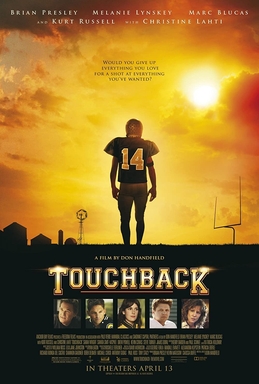
I Watched Touchback (2012, Dir. by Don Handfield)


When he was in high school, Scott Murphy (Brian Presley) was nicknamed “Mr. Football.”  He was the best high school player in Ohio and everyone knew he was going to make it far in the NFL.  His dreams of football stardom ended on the night of the big game when his leg was shattered during a running play.  Twenty years later, Scott is still living in his small town.  He owns a farm that he can’t make the payments on and crops that he can’t bring in.  When Scott learns that he is to he honored at the next high school football team for taking the team to the state championship years ago, it causes him to break down.  He attempts to commit suicide but, when he passes out from inhaling carbon monoxide, he doesn’t die.  Instead, he wakes up as a high school student in 1991.

Scott has his second chance.  The championship game is coming up and, if Scott can keep from getting injured, he’ll be able to accept his scholarship to Ohio State and go on to the NFL.  He makes sure to introduce himself to his future wife Macy (Melanie Lynesky) so he won’t lose her.  He befriends the kids that he picked on the first time he was in high school.  When a college scout tells him that his scholarship will not be rescinded if he chooses to sit out the big game, Scott decides to stay on the bench but then his coach (Kurt Russell) explains how much the game means to the people in the town.  Scott realizes he has to play for them but can he get through the game without getting injured a second time?

What would you do if you had a second chance?  That’s something that everyone wonders.  If I had a second chance to relive my senior year of high school, I would take more risks, worry less about the unimportant stuff, and try to be nicer to everyone and not just the members of my social circle.  If I knew I was going to suffer a life-changing injury, I would probably go out of my way to make sure it didn’t happen.  That’s where Touchback loses me because I just don’t think Scott would have played in that game, no matter how eloquent the coach was.  If Scott had sat out the game, the town might have lost the championship but Scott could have gone on to the NFL, still married Macy, and his family wouldn’t be struggling to make ends meet on the family farm.

If I didn’t really believe Scott would have made the decision that he made, there were still parts of Touchback that I liked.  Kurt Russell was a great coach.  I liked the way the town rallied to Scott, even when he was at his lowest and about ready to give up.  That’s one thing I love about close-knit communities.  They take care of each other.