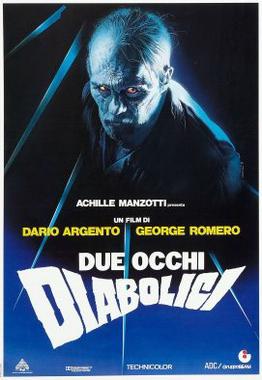
In 1990, long-time friends George Romero and Dario Argento collaborated on Two Evil Eyes, anthology film that was based on the writings of Edgar Allan Poe. An Italian-American co-production, Two Evil Eyes featured two stories. The first was directed by George Romero, while the second was directed by Argento.
The Facts In The Case of Mr. Valdemar
(Dir by George Romero)
The first story is Romero’s, a modernized version of The Facts In The Case of M. Valdemar.
Jessica Valdemar (Adrienne Barbeau) is the 40 year-old wife of 65 year-old, Ernest Valdemar (Bingo O’Malley). Jessica only married Ernest for her money and, now that he’s on his death bed, she and her lover, Dr. Robert Hoffman (Ramy Zada), have hypnotized to him to do and say whatever they tell him to say and do. Even though Ernest is essentially comatose, the hypnosis allows them to force Ernest to sign his name to legal documents and to tell his suspicious attorney (E.G. Marshall) that he indeed wants to leave all of his money to Jessica.
When Ernest dies while under the influence of hypnosis, Jessica and Robert attempt hide his body in the basement. But is Ernest really dead? Jessica is convinced that she hears groaning from the basement and she wonders if the hypnosis has somehow left Ernest in limbo, between life and death. Robert thinks that Jessica is being foolish but it turns out that she’s not. After much paranoia and betrayal, one conspirator is dead and the other is a part of the living dead.
Usually, I like Romero’s work but this one didn’t work for me. From the flat cinematography to the shallow performances, this film felt more like an episode of a television show than anything else. Perhaps if it had been a stand-alone film, Romero could have found a way to make the material a bit more cinematic. (The story’s final shot, of blood dripping on a hundred dollar bill, is the film’s strongest moment and the part that feels the most Romeroesque.) But as a shortened chapter of an anthology film, it fell flat.
The Black Cat
(Dir by Dario Argento)
The Dario Argento segment is based on several different Poe stories. While the majority of the story is taken from The Black Cat, it also contains elements of Annabel Lee, Telltale Heat, The Pit and the Pendulum, and Buried Alive. Though this segment doesn’t really work, it’s obvious that Argento is a fan of Poe’s work and, for other Poe fans, there’s a lot of fun to be found in all of the Poe references that Argento sneaks into his story.
Harvey Keitel stars as Rod Usher, a crime scene photographer who loves his work a bit too much. He’s excited about the fact that his book of photography is about to be published. He’s less happy about the fact that his girlfriend, Annabel (Madeleine Potter), has adopted a black cat that is constantly glaring at Rod. Rod is eventually driven mad by both the cat’s apparent hatred of him and the fact that the cat itself keeps showing up no matter how far he goes to get rid of it. (This film features violence against a cat, which I hated. But it also featured a cat getting revenge and I appreciated that.) Eventually, Rod’s paranoia leads to violence and murder.
Look, this is a film about a guy who has an obsessive hatred of a cat. Obviously, this is not a film that I’m going to enjoy because I love cats. That said, I can still judge the film on its merits, even if it’s not for me on a personal level. While Argento is able to build up a good deal of tension and suspense in this film, the overall film doesn’t work because Harvey Keitel, supremely talented actor that he is, was totally the wrong choice for Rod Usher. Keitel, who reportedly did not get along with Argento during filming, gave a self-indulgent performance that featured a lot of bellowing. It’s as if Keitel is trying to compete with the constantly moving camera. The problem is that a star of a film like this has to be the director and Keitel’s histrionics take the viewer right out of the story.
Considering all of the talent involved, Two Evil Eyes is a disappointment.
The (Reviewed) Films of Dario Argento:

 Through the Shattered Lens