Embracing The Melodrama: The Client List (dir by Eric Laneuville)


In 2010’s The Client List, Jennifer Love Hewitt stars as Samantha Horton.

Samantha’s a former beauty queen whose mother (Cybill Shepherd) always hoped would go on to win Miss Texas and then maybe appear in movies and on television.  Instead, Samantha got knocked up by her boyfriend, Rex (Teddy Sears).  Rex was a football star at UT so marrying him didn’t seem like it would be a dead-in but then Rex blew out his knee.  Now, they’re living in small town Texas, they’ve got three children, and they’ve got a bank threatening to foreclose on their home.  When Samantha and Rex head down to the bank, their loan officer spends the entire time staring at Samantha’s chest while Samantha reveals that she has a photographic memory.

Desperately needing a job and with Rex drinking away his troubles, Samantha gets a job at a massage parlor the next town over.  Naively, Samantha assumed that her job would actually just be to give men massages.  Instead, it turns out that the massage parlor is actually a brothel where the workers continually tell each other that it “beats the heck out of waitressing.”

(They don’t say “heck” but I gave up cursing for Lent.)

At first, Samantha is disgusted by the idea of working as a prostitute.  But, with Rex drinking too much and the house about to bet taken away, Samantha goes back to the parlor and soon becomes the most popular person working there.  She works herself to exhaustion but one of her clients has just the solution for that.  “I’ve never even smoked weed before,” Samantha says while looking at the baggie of cocaine.  I’m sorry …. you dated someone who went to UT without ever smoking weed?  I don’t buy that.

Samantha can now stay awake for hours, going to work and buying her family a lot of Christmas presents.  Samantha’s clients include some of the most powerful men in the county.  When one of her co-workers confesses to having doubts about the job, Samantha sends her to a church group so she’ll have someone to talk to.  Soon, words gets out that the massage parlor is a house of prostitution and Samantha is getting arrested and led out of the parlor in her underwear while TV cameras roll.  “That looks kind of like your wife,” someone says to Rex.

The Client List caused quite a stir when it aired on Lifetime back in 2010.  (It also led to a TV series where Jennifer Love Hewitt starred as a different character.)  It’s an enjoyably sordid story, one that embraces the melodrama and mixes morality and sex in a way that would have made Cecil B. DeMille proud.  The film takes place in my homestate and, fortunately, it stars a lot of Texas-born actors so the accents are authentic, even if the dialogue was obviously written by a Yankee.  (“She’s as busy as popcorn,” a character said at one point and I nearly went blind from rolling my eyes.)  That the film actually carries some emotional weight is totally due to the lead performance of Jennifer Love Hewitt, who I’ve always liked because we’re both Texas girls and we’ve both got big boobs so I feel like we share the same struggle.  Hewitt gives an authentic and heartfelt performance here, leaving no doubt that everything that Samantha does, she does for her family.  The Client List is a true Lifetime classic.

October True Crime: The Grim Sleeper (dir by Stanley M. Brooks)


It’s not known, for sure, how many people Lonnie David Franklin killed.

A residenct of Los Angeles and a former enlistee of the U.S. Army who was given a dishonorable discharge after doing time in prison for taking part in the gang-rape of a 17 year-old girl in Germany, Franklin was convicted of 10 murders but he was suspected of much more.  His earliest known murder was committed in 1984 and he was apparently very active up until 1988.  Then, much like the BTK Killer, Franklin appears to have taken a break for nearly two decades before returning to his murderous ways in 2002.  (It could be just as likely that Franklin was still killing but his victims were either not discovered or he was never linked to the crimes.)  Franklin’s murders didn’t get much attention, with the police not acknowledging that they were dealing with a serial killer until 2007.  Some of that can be blamed on the fact that many of Franklin’s murders were committed before DNA testing became a commonplace thing.  However, it has also been acknowledged that Franklin escaped detection because he targeted black women and tended to prey on sex workers, neither one of whom were a priority for the LAPD in the 80s.

2014’s The Grim Sleeper stars Dreama Walker as Christine Pelisek, the journalist who first reported on the existence of the Grim Sleeper and Ernie Hudson and Michael O’Neill as the detectives who investigated the murders and ultimately arrested Lonnie Franklin.  Franklin (played by James R. Baylis) only appears briefly in the film.  As The Grim Sleeper was made before Franklin had actually been convicted and sentenced to death for his crimes, the film does not actually state that the police arrested the right man.  Indeed, the film discusses very little about the man who was arrested for the crimes.

Instead, the film focuses on Pelisek and her attempts to get someone to take her seriously when she argues that there’s a serial killer on the loose and that the public has a right to know.  At first, everyone is skeptical of her claims.  Her editor tells her that she doesn’t have enough for a story.  The police tell her to mind her own business.  Her fellow reporters order her to get coffee.  The only people who really support Pelisek’s attempts to uncover the truth are the families of the victims, some of whom have spent over twenty years waiting for someone to tell them what happened to their loved ones.

The film is at its best when it focuses on the pain of the families, all of whom feel that they have been ignored and forgotten by the people who are supposed to be protecting them.  It’s at its least interesting when it focuses on Pelisek and her efforts to be taken seriously.  (Deama Walker has given good performances in films like Compliance and Once Upon A Time In Hollywood but she’s miscast here.)  Though flawed, the film honors the memories of those victimized by the Grim Sleeper and it reminds viewers that no one should be forgotten.

As for the real Grim Sleeper, he died suddenly while on Death Row.  The cause of death has never been released but he died in March of 2020, around the same time that COVID was spreading throughout the nation’s prisons and I’ve always assumed that he was an early fatality.  Regardless of the cause, the Sleeper met the Reaper and will never awaken again.


What Lisa and Erin Watched Last Night #149: Pretty Little Addict (dir by Monika Mitchell)


Last night, the Dazzling Erin and I watched the latest Lifetime film premiere, Petty Little Addict!

pla

Why Were We Watching It?

Yesterday was all about sisterly bonding time!  Erin and I basically told the rest of the world to get lost and then we spent the entire day hanging out together, talking about life, pondering the great questions of the universe, and laughing.  In fact, we probably spent more time laughing than pondering the great questions of the universe.  We also chased a chicken out of our backyard!  (He belongs to one of our neighbors.)

And really, what better way is there to bond than by watching a Lifetime movie!?  When my friend Trevor informed me that Pretty Little Addict would be premiering last night,  I knew that there was no way that Erin and I were going to miss it!

What Was It About?

It’s about a pretty little addict!

Her name is Jennifer (Andrea Bowen) and she has just lost her father to cancer.  To deal with her sorrow, she drinks.  Meanwhile, across town, Colin Brown (Keenan Tracy) is excited because he’s received a scholarship to run track in college.  Colin’s entire future is pretty much set and it all looks great, assuming that he never loses the ability to walk.

As fate would have it, Jennifer and Colin end up at the same party.  And, when a drunk Jennifer attempts to leave the party, she accidentally runs over Colin.  Colin is crippled and Jennifer is ordered to check into rehab.

While Jennifer is trying to get sober, Colin’s brother, Alex (Scott Lyster), is looking for revenge.  Alex is mentally unstable and has a drinking problem of his own.  He also has a long and violent criminal record.  When he discovers that Jennifer is in rehab, he gets a job working for the vending machine company that just happens to service the machines inside the rehab facility.  Soon, Alex is flirting with Jennifer while also trying to manipulate her into giving up her new found sobriety.

Meanwhile, Colin’s family is making plans to sue Jennifer’s mother…

What Worked?

One thing that you can definitely say about Pretty Little Addict is that it had its heart in the right place.  It sincerely did attempt to use its melodramatic storyline to say something meaningful about addiction and the struggle of recovery.  Both Scott Lyster and Keenan Tracy gave good performances and I also liked Morgan Taylor Campbell in the role of Jennifer’s paranoid roommate.

What Did Not Work?

Good intentions aside, this is one of those films that just never really seemed to come together.  It felt uneven and strangely paced and, even by the standards of Lifetime, the plot was full of obvious and glaring holes.  Alex’s plan seemed unnecessarily complicated.  Considering that he was an alcoholic, he could have just as easily checked himself into rehab and then he would have had much easier access to Jennifer than he did as a fake deliveryman.  It would have been a lot less trouble for him as well.

From the start of the movie to the end, Jennifer was a fairly unlikable character.  Even after she got sober, she never really seemed to understand just how much damage she had done.

“Oh my God!  Just like me!” Moments

I rarely drink so there was a definite shortage of “Oh my God!  Just like me!” moments.  However, I did cringe a little when the rehab patients had to engage in a trust exercise that deal with being blindfolded.  That’s because, in high school, I took part in a similar trust exercise.  My friend Jennifer was blindfolded and I was supposed to catch her when she fell backwards.  However, I’ve only got a three-minute attention span so, by the time she actually started to fall back, I was no longer paying attention and I kind of forgot to catch her.  Whoops!

Lessons Learned

Don’t drink and drive, which is actually a pretty good lesson.

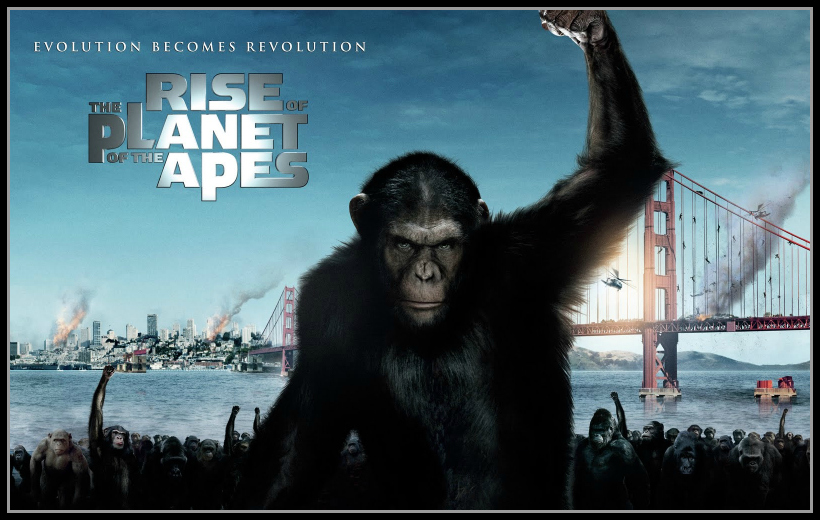
Review: Rise of the Planet of the Apes (dir. by Rupert Wyatt)


In 2001, Tim Burton released his highly-anticipated remake of the classic 1968 film adaptation of Pierre Boulle’s sci-fi novel which would ultimately be called, Planet of the Apes. Fans of the series were excited to see what idiosyncrasies Burton would add to the series which had petered out decades before. What people were hoping for and what they ended up getting were polar opposites. The film in of itself wasn’t an awful film, but it wasn’t a good one and many saw it as average at best and bad at it’s worst. Any plans to sequelize this remake fell by the wayside. It took almost a decade until a decision was made to continue the series in a different direction.

British filmmaker and writer Rupert Wyatt would be given the task to rejuvenate for a second time the Planet of the Apes franchise. He would be working with a screenplay written by Rick Jaffa and Amanda Silver which would take the 4th film in the series, Conquest of the Planet of the Apes, and rework it for a much more current setting. The film was to be called Rise of the Apes and would star James Franco, John Lithgow and Frieda Pinto. As time went by the film would be renamed Rise of the Planet of the Apes. Despite having such an awkward sounding titles the film would end up to be one of the best films of the summer of 2011, if not one of the best of the year.

The film begins with a harrowing sequence in the jungles of Central Africa as poachers capture several chimpanzees to be sold as medical test subjects. Some of these chimps end up at a genetics research lab outside of San Francisco where one Will Rodman (James Franco) is working to find a cure to Alzheimer. He sees the encouraging result in one chimp he has named “Bright Eyes” (due to the side-effect to the test subject’s eyes taking on green flecks to their irises) and pushes for the next step and that’s human testing. The ensuing pitch to the company’s board of directors doesn’t go as planned as Bright Eyes goes on a violent rampage leading to her being put down and the project shelved. Her reaction they soon find out has less to do with the breakthrough treatment and more of a maternal instinct to protect her baby she secretly gave birth to. Will takes the baby chimp home in secret temporarily, but soon becomes attached to it as does his Alzheimer stricken father (John Lithgow) who names it Caesar.

The first third of the film sees Caesar showing an inherited hyper-intelligence from his genetically-treated mother. Caesar becomes an integral part of the Rodman household even to the point that Will has taught Caesar to call him father. It’s a family dynamic which would help mold Caesar into something more than just a wild animal. He begins to show signs of humanity which would become bedrock of his decision later in the film to turn become the revolutionary that the film has been leading up to the moment Caesar gets sent to a primate sanctuary after a violent encounter with a boorish neighbor to end the first reel of the film.

It’s during the second reel which sees Caesar realize that while he may as smart (maybe even smarter) than the humans he would never be a part of that world. In the sanctuary he learns that his very uniqueness has set him apart from the other primates. He sees the abuse inflicted on his fellow primates and longing to be back to his “home” with Will turns to a focus need to free himself and his people. He does this in the only fashion he knows would succeed. With the help from a couple canisters containing the aerosol-based treatment which increased his mother’s intelligence, Caesar frees everyone from the sanctuary and takes the fight to the humans as they make for the wilds of the Muir Redwood Forest north of San Francisco.

Rise of the Planet of the Apes might look to be an action-packed film from how the trailers and tv spots has been pushing the film, but it actually only has three major action sequences and they’re integral to each third of the film in helping advance the story. These were not action for the sake of having action on the screen. Writers Jaffa and Silver do a great job in figuring out that the real strength of the film would be Caesar’s journey from precocious ape child, rebellious teen and then his final unveiling as the leader of a people who have shaken off the shackles of medical research and their forced sacrifice for the greater good.

The film was never about the humans played by Franco, Pinto and Lithgow. It was always about Caesar and the film hinged on the audience believing Caesar as a character. In that regard, the work by WETA Digital should be commended as should Andy Serkis’ performance as Caesar. Serkis’ motion capture performance goes beyond just mimicking the movement of an ape. His own acting as Caesar comes through in even in the digital form of Caesar. In fact, the film never had a real ape used during filming. From Caesar right up to the scarred ape Koba every ape in the film was the work of WETA Digital’s furthering the motion capture work they had done in Peter Jackson’s Lord of the Rings trilogy and James Cameron’s Avatar. Never once during the two hour running time of the film did I ever not believe I was watching apes on the screen. Every emotion Caesar goes through during the film was able to show through facial expressions and body language.

It’s the strength of Serkis’ mo-cap work and the overall execution of Caesar’s character by WETA which also highlighted the one major weakness of the film through it’s underdeveloped human characters. Whether it was Franco’s benevolent Dr. Frankenstein-like Will Rodman right up to his greedy, amoral boss in the company (played by David Oyelowo), all the human’s in the film were very one-note and mostly served to propel Caesar’s story forward. At times, Franco actually seemed to be just as he was during his hosting gig during the Academy Awards earlier in the year. These were not bad performances by the actors involved. They were just there and part of it was due to how underwritten their characters were.

To help balance out this flaw in the film’s non-ape character would be the beautiful work by the film’s cinematographer in Andrew Lesnie. He has always been well-known for beautiful, majestic panoramic shot of the world as he had demonstrated in Jackson’s Lord of the Rings trilogy. He does the same for this film as we see some beautiful shots of the Muir Redwood forest, of San Francisco’s skyline and in the climactic battle on the Golden Gate Bridge. The city of San Francisco and it’s iconic red-hued bridge and the surrounding area has never been shot as gorgeous as Lesnie has done with his DP work on this film.

Even with some of the characters in the film being underwritten the film succeeds through Rupert Wyatt’s direction which keeps the film moving efficiently, but also bringing out the emotional content of the film’s script in an organic way. Film has always been about manipulating the audience’s  emotions. It’s when a director does so and make it seem normal is when such manipulation doesn’t come through for those watching to feel. Then add to this Serkis’ exceptional work as Caesar with some major digital artistry from the folks over at WETA Digital and Rise of the Planet of the Apes does rise above it’s B-movie foundation into something that should live beyond the summer and for years to come.

Rise of the Planet of the Apes does a great job and a long way towards wiping off the bad taste left behind by Tim Burton’s failed attempt to remake the franchise. We didn’t need something exotic and idiosyncratic to give the franchise a fresh breath of life. It seems all it needed was a very good story, some exceptional work from Andy Serkis and WETA Digital and a filmmaker knowing how to tell the story in a natural fashion and not fall into the temptation to go into shock and awe to tell it. Rise of the Planet of the Apes is a film that could stand-alone, but it does something that many trying to create film franchises never seem to do right: it makes people want to see what happens next in the lives of Caesar and his apes.