Do you ever wonder why and how the great artists of the past first decided to become artists in the first place? Have you ever thought about why, since before recorded history, humanity has always had the same desire to record and recreate their existence in the form of art? I know I do and that’s why I was excited to see the new 3-D documentary The Cave of Forgotten Dreams.
The Cave of Forgotten Dreams is probably the only chance that most of us will ever get to see the oldest, preserved art created by our ancestors. The Chauvet Cave in Southern France was first discovered in 1994 and it is believed to contain the oldest known cave paintings in existence. (Some of the paintings are estimated to have first been created 32,000 years ago.) The Chauvet Cave has been very carefully preserved by the French government and the interior of the cave has remained so fresh and undisturbed that ancient footprints can still be seen on the cave’s floor.
For this documentary, German director Werner Herzog was allowed to film in the cave but, as he shows us, he had to work under several restrictions to preserve the cave. He could only work with a three-man film crew, he had to stay on a 2-foot metal walkway the entire time, and, because of the high levels of carbon dioxide in the caves, no one was allowed to stay in the cave for more than a few hours at a time. Once you see the film, you realize that all the restrictions are worth it to preserve the cave.
The paintings in the cave are so well-preserved that they seem as if they could have been painted just a year ago. While most prehistoric cave art sites have focused on paintings of animals that could be easily hunted — like horses and reindeer, the Chauvet Cave also features paintings of more dangerous animals, like lions, bears, and especially rhinos. What really struck me was how these paintings were created with a clear aesthetic purpose. Several of the animals are painted in such a way that creates the illusion of movement. The most famous of the Chauvet Cave paintings appears to feature a stampede of horses.
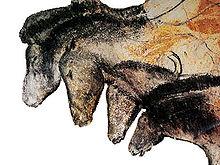
As Herzog makes clear in his narration, the perfectly preserved cave paintings show that “cave men” weren’t the simpletons we always assume they were. Instead, the paintings reveal that they were observant and actually had personality. One of my favorite parts of the movie was when Herzog and a paleontologist look at one wall that is covered with ancient hand prints. The paleontologist points out that we can tell one person made all the handprints because the hand has a crooked little finger. That hand print is also found throughout the entire cave and allows us, 32,000 years later, to follow the man with the crooked finger as he walks through the cave.
Because of the restrictions he had to film under, Herzog had to have his 3-D cameras custom-built and he and his 3-man crew had to put the cameras together inside of the cave. It was all worth the trouble because the 3-D effects truly make you feel as if you’re standing there in the cave with Herzog. Unfortunately, we probably won’t ever be able to see the world’s oldest paintings in person but The Cave of Forgotten Dreams is the next best thing.
 Through the Shattered Lens