Lisa Reviews An Oscar Nominee: The Grapes of Wrath (dir by John Ford)


(With the Oscars scheduled to be awarded on March 4th, I have decided to review at least one Oscar-nominated film a day.  These films could be nominees or they could be winners.  They could be from this year’s Oscars or they could be a previous year’s nominee!  We’ll see how things play out.  Today, I take a look at the 1940 best picture nominee, The Grapes of Wrath!)

How dark can one mainstream Hollywood film from 1940 possibly be?

Watch The Grapes of Wrath to find out.

Based on the novel by John Steinbeck and directed by John Ford, The Grapes of Wrath tells the story of the Joad family and their efforts to neither get sent to prison nor starve to death during the Great Depression.  When they lose their farm in Oklahoma, they head for California.  Pa Joad (Russell Simpson) has a flyer that says someone is looking for men and women to work as pickers out west.  The 12 members of the Joad Family load all of their possessions into a dilapidated old truck and they hit the road.  It quickly becomes apparent that they’re not the only family basing all of their hopes on the vague promises offered up by that flyer.  No matter how much Pa may claim different, it’s obvious that California is not going to be the promised land and that not all the members of the family are going to survive the trip.

Tom Joad (Henry Fonda) is the oldest of the Joad sons.  He’s just been released from prison and he’s killed in the past.  Having been in prison during the start of the Great Depression, Tom doesn’t realize how bad things truly are until he arrives home and sees someone he grew up with using a tractor to knock down a house.  (It’s just business, of course.  The owners of the house can’t pay their bills so the house gets destroyed.)  The film’s story is largely told through Tom’s eyes and Henry Fonda gives a sympathetic performance, one the gets the audience to empathize with and relate to a character who is a total outsider.

As for the rest of the Joad Family, Ma (Jane Darwell) is the glue who holds them together and who refuses to allow them to surrender to despair.  (And yet even Ma is forced to make some tough choices when the starving children of one work camp ask her to share her family’s meal with them.)  Rosasharan (Dorris Bowdon) is pregnant while Grandpa (Charley Grapewin) is too sickly for the trip but doesn’t have anywhere else to go.  And then there’s Casy (John Carradine), the former preacher turned labor organizer.  Casy is not blood-related but he soon becomes a member of the family.

The Joads have a healthy distrust of the police and other authority figures and that turns out to be a good thing because there aren’t many good cops to be found between Oklahoma and California.  Instead, the police merely serve to protect the rich from the poor.  Whenever the workers talk about forming a union and demanding more than 5 cents per box for their hard work, the police are there to break heads and arrest any troublemakers on trumped up charges.  Whenever a town decides that they don’t want any “Okies” entering the town and “stealing” jobs, the police are there to block the roads.

The Grapes of Wrath provides a portrait of the rough edges of America, the places and the people who were being ignored in 1940 and who are still too often ignored today.  John Ford may not be the first director that comes to mind when you think of “film noir” but that’s exactly what The Grapes of Wrath feels like.  During the night scenes, desperate faces emerge from the darkness while menacing figures lurk in the shadows.  When the sun does rise, the black-and-white images are so harsh that you almost wish the moon would return.  The same western landscape that Ford celebrated in his westerns emerges as a wasteland in The Grapes of Wrath.  The American frontier is full of distrust, anger, greed, and ultimately starvation.  (Reportedly, the film was often shown in the Soviet Union as a portrait of the failure of America and capitalism.  However, it was discovered that Soviet citizens were amazed that, in America, even a family as poor as the Joads could still afford a car.  The Grapes of Wrath was promptly banned after that.)  John Ford is often thought of as being a sentimental director but there’s little beauty or hope to be found in the images of The Grapes of Wrath.  (Just compare the way The Grapes of Wrath treats poverty to the way Ford portrayed it in How Green Was My Valley.)  Instead, the film’s only hint of optimism comes from the unbreakable familial bond that holds the Joads together.

As dark as it may be, the film is nowhere near as pessimistic as the original novel.  The novel ends with a stillborn baby and a stranger starving to death in a barn.  The film doesn’t go quite that far and, in fact, offers up some deus ex machina in the form of a sympathetic government bureaucrat.  (Apparently, authority figures weren’t bad as long as they worked for the federal government.)  That the book is darker than the movie is not surprising.  John Steinbeck was a socialist while John Ford was a Republican with a weakness for FDR.  That said, even though the film does end on a more hopeful note than the novel, you still never quite buy that things are ever going to get better for anyone in the movie.  You want things to get better but, deep down, you know it’s not going to happen.  Tom says that he’s going to fight for a better world and Fonda’s delivers the line with such passion that you want him to succeed even if you know he probably won’t.  Ma Joad says the people will never be defeated and, again, you briefly believe her even if there’s not much evidence to back her up.

Even when viewed today, The Grapes of Wrath is still a powerful film and I can only guess what it must have been like to see the film in 1940, when the Great Depression was still going on and people like the Joads were still making the journey to California.  Not surprisingly, it was nominated for best picture of 1940, though it lost to Alfred Hitchcock’s Rebecca.
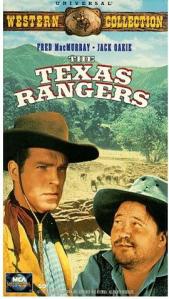
A Movie A Day #223: The Texas Rangers (1936, directed by King Vidor)


Sam (Lloyd Nolan), Jim (Fred MacMurray), and Wahoo (Jack Oakie) are three outlaws in the old west.  Wahoo works as a stagecoach driver and always lets Sam and Jim know which coaches will be worth holding up.  It’s a pretty good scam until the authorities get wise to their scheme and set out after the three of them.  Sam abandons his two partners while Jim and Wahoo eventually end up in Texas.  At first, Jim and Wahoo are planning to keep on robbing stagecoaches but then they realize that they can make even more money as Texas Rangers.
At first, Jim and Wahoo are just planning on sticking around long enough to make some cash and then split.  However, both of them discover that they prefer to be on the right side of the law.  After they save a boy named David from Indians, Jim and Wahoo decide to stay in Texas and protect its settlers.

The only problem is that their old friend Sam has returned and his still on the wrong side of the law.

Made to commemorate the Texas centenary (though it was filmed in New Mexico), The Texas Rangers is a good example of what’s known as an oater, a low-budget but entertaining portrayal of life on the frontier.   King Vidor does a good job with the action scenes and Fred MacMuarry and Jack Oakie are a likable onscreen team.  The best performance comes from Lloyd Nolan, as the ruthless and calculating Sam.  Sam can be funny and even likable but when he’s bad, he’s really bad.

Jack Oakie was better known as a comedian and The Texas Rangers provides him with a rare dramatic role.  Four years after appearing in The Texas Rangers, Oakie would appear in his most famous role, playing a parody of Benito Mussolini in Charlie Chaplin’s The Great Dictator.

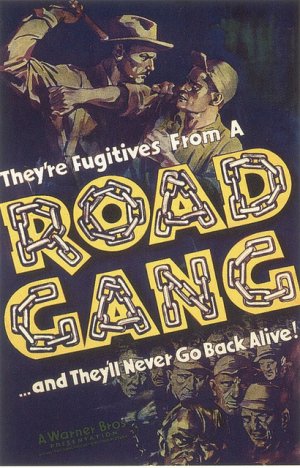
Lisa Cleans Out The DVR: Road Gang (dir by Louis King)


I was going to start this review with a quote from Gandhi: “A nation’s greatness is measured by how it treats its prisoners.”  That was something that I first heard from a perpetually stoned ex-seminarian who used to live in a trailer park in Lake Dallas.  I always figured that, being as stoned as he usually was, he probably knew what he was talking about but, upon doing research for this review, I have discovered that Gandhi actually didn’t say that.  What Gandhi said was, “A nation’s greatness is measured by how it treats its weakest members.”  Fortunately, it’s the same basic idea and, regardless of how you phrase it, it’s a quote that perfectly encapsulates the message of the 1936 film, Road Gang.

Road Gang tells the story of Jim (Donald Woods) and Bob (Carlyle Moore, Jr.).  Bob is fun-loving.  Jim is more serious and engaged to marry heiress Barbara Winston (Kay Linaker).  Jim and Bob live in an unnamed Southern state (though I’m going to assume that the state is supposed to be Georgia, just because).  Jim has just written an article that exposes the corruption of political boss, J.W. Moett (Joe King).  The article is so good that both Jim and Bob have been offered jobs in Chicago!  There’s a lot of corrupt political figures who can be exposed in Chicago!

However, while driving up north, Jim and Bob are arrested on trumped-up charges.  At first, Jim and Bob laugh off Moett’s desperation but, unfortunately, another criminal happens to be breaking out of jail at the same time that Jim and Bob arrives for booking.  That criminal kills the arresting officer and then forces Jim and Bob to drive him across the state.  Eventually, the police recapture the three of them.  However, the escaping criminal is killed and Jim and Bob are arrested as accessories.  Under the advice of their lawyer, Mr. Dudley (Edward Van Sloan), they plead guilty and accept a deal.  What they don’t know is that Dudley works for Moett and that, as a result of pleading guilty, they are going to be sentenced to five years in a prison camp.

Okay, so the film gets off to a pretty melodramatic start.  And, to be honest, the entire film is extremely melodramatic.  A lot of time is devoted to Barbara trying find evidence that Jim and Bob were set up, something that is made difficult by the fact that Barbara’s father, like Mr. Dudley, works for Moett.  Fast-paced and not-always-logical, this is a B-movie, in every sense of the term.

And yet, as melodramatic as it is, Road Gang is deadly serious when it comes to portraying the brutality of the prison camp.  From the minute that Bob and Jim arrive, they find themselves at the mercy of the corrupt warden and his sadistic guards.  The prisoners are largely used as slave labor and subjected to punishments that are often arbitrary and extreme.

Road Gang doesn’t flinch when it comes to portraying why prison often not only fails to rehabilitate but also helps to transform minor offenders into hardened criminals.  There’s a disturbing scene in which Jim, Bob, and the other prisoners are forced to listen as another prisoner is whipped.  The crack of the whip and his howls of agony explode across the soundtrack in a symphony of pain and sadism.  Jim and Bob have two very different reactions to being in prison.  One survives.  One allows himself to be killed rather than take one more day in confinement.

Road Gang is often compared to I Am A Fugitive From A Chain Gang.  Actually, beyond the theme of a fatally compromised justice system, there is no comparison.  The angry and fact-based I Am A Fugitive From A Chain Gang is a hundred times better and, quite frankly, Donald Woods was no Paul Muni.  However, Road Gang still has its moments of power.  Decades after it was made, the issues it raises continue to be relevant.  Do we send people to prison to rehabilitate them or to punish them and are the two goals mutually exclusive?  And how can we say that someone has “paid his debt to society” when, even after a prisoner serves his time, the stigma of having been imprisoned closes and locks most doors of opportunity?

Road Gang shows up occasionally on TCM.  There’s where I recorded it on January 23rd of this year.

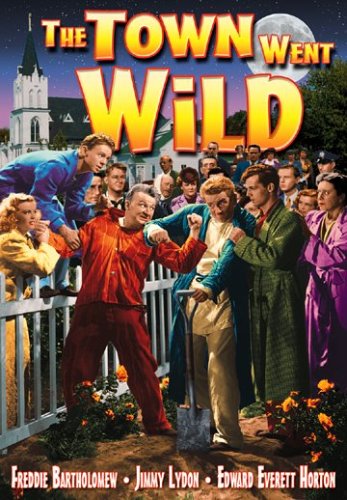
The Fabulous Forties #46: The Town Went Wild (dir by Ralph Murphy)


51BRWYTCMZL

The 46th film in Mill Creek’s Fabulous Forties box set was 1946’s The Town Went Wild!  Nice name, huh?

The name is actually a lot nicer than the movie, which is a bit incoherent.  Basically, David (Freddie Bartholomew) is a nice guy who has lived his entire life in the small town.  His best friend is Bob (Jimmy Lydon) and David is also in love with Bob’s sister, Carol (Jill Browning).  David is an engineer who has just been assigned to go work in Alaska.  Before he leaves, he is determined to marry Carol.

Unfortunately, Bob’s father (Edward Everett Horton) and Carol’s father (Tom Tully) hate each other.  They have been feuding for so long that they’re not even sure what they’re feuding about.  However, Carol and David are determined to get married so they decided to elope.  Getting a ride from their friend Mille (Roberta Smith), they go to the next town over and ask the justice of the peace to marry them,

However, before the justice of the peace can marry them, he needs them to publicly post their wedding plans in the local newspaper.  And before David can post those plans, he needs to get his birth certificate from the local registrar.  When David gets his birth certificate, he discovers something shocking.  There was a mix-up at the hosptial!  His Dad went home with the wrong baby.  David is actually … CAROL’S BROTHER!

So, what can they do?  How can David and Carol still get married despite apparently being related?  And will the fathers be able to set aside their feud long enough to help their children out?  The entire town wants to know!

I have to admit that I’m struggling a bit to come up with anything to say about The Town Went Wild.  The movie is a mess and David and Carol are such boring characters that they even make incest look dull.  Unfortunately, the version I saw of The Town Went Wild suffered from one of those infamously cheap Mill Creek transfers, complete with grainy picture, inconsistent sound, abrupt cuts, and the sneaky suspicion that certain scenes did not make the transfer from film to video.

With all that in mind, it’s hard to fairly judge The Town Went Wild but I can say that at least it provided good roles for Edward Everett Horton and Tom Tully.  If nothing else, these two character actors appeared to enjoy playing loud and frequently stupid rivals.  Otherwise, The Town Went Wild is one of those poverty row films that can safely be forgotten.

The Fabulous Forties #25: Jungle Man (dir by Harry L. Fraser)


40s

About a month ago, for reasons that I’m sure made sense at the time, I decided it would be fun to watch and review all 50 of the films included in Mill Creek’s Fabulous Forties box set.  If you know anything Mill Creek box sets, then you won’t be surprised to learn that the majority of these 50 films are public domain B-movies.  A few of them have been good, a few of them have been bad, and a few of them have been forgettable.

I have to admit that, as much as I love watching old movies, there’s a part of me that’s more than ready to move onto the next Mill Creek box set, the Nifty Fifties.  But, before I do that, I have to finish up the Forties.  Fortunately, I just watched the 25th film included in the Fabulous Forties and I am happy to say that I am now halfway done with this project!  Yay!

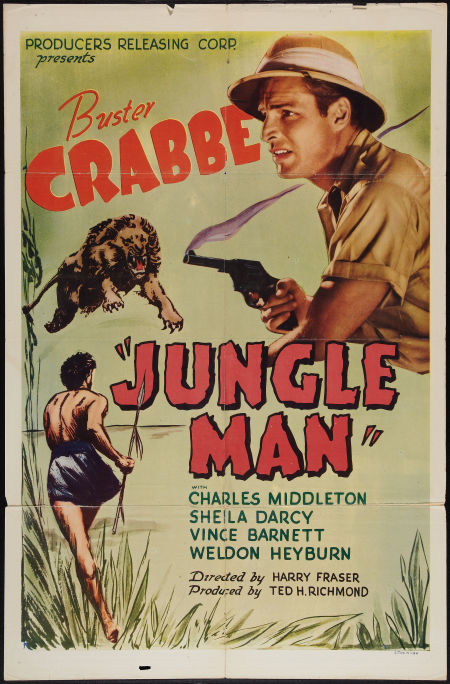
As for the film itself, it’s a 63-minute film from 1941.  Though it was later retitled Drums of Africa, it was originally called Jungle Man.

Jungle Man

As for what Jungle Man is about … well, it’s mostly about stock footage.

There is kind of a plot.  Wealthy Bruce (Weldon Heyburn) and his friend Alex (Robert Carson) want to go to Africa so that they can see the legendary City of the Dead.  Bruce’s fiancée, Betty (Sheila Darcy), decides to accompany them because she wants to visit her brother (Charles Middleton), a missionary.  Once they get to Africa, they also meet a doctor (Buster Crabbe) who is trying to find a cure for a fever that is wiping out the native population.

But really, the plot is mostly just an excuse for stock footage.  We watch as our explorers walk down a jungle trail.  Someone says, “Look up in that tree!”  We cut to grainy footage of a monkey in a tree.  Cut back to everyone looking upward.  Cut back to that monkey in the tree.  Suddenly, we hear a roar on the soundtrack.  Cut to slightly less grainy footage of a tiger running through a field.  Cut back to the explorers saying, “Look out, tiger!”  Cut back to the monkey climbing up higher in the tree.

(Of course, tigers don’t live in Africa but that’s just the type of film this is!)

Even when our heroes finally reach the City of the Dead, we don’t actually see them walking around the city.  Instead, we see them staring into the distance and then immediately cut to some still shots of what Wikipedia identifies as being Cambodia’s Angkor Wat.  Of course, no attempt is really made to match any of the shots.  If Jungle Man was made today, they could just CGI the Hell out of it.  But since it was made in 1941, audiences had to suspend their disbelief and accept shots that didn’t particularly match up with any other shots and a storyline that was pretty much determined by whatever stock footage the producers had available.

On the plus side, it’s only 60 minutes long and some of the stock footage is fun, particularly if you like cute monkeys or fierce tigers.  For the most part, it’s silly but inoffensive.

And you can watch it below!

http://www.youtube.com/watch?v=IUz4Vvay7so

(I should admit that, as I watched it, I kept thinking about those GEICO commercials where Jane and Tarzan are lost in the jungle and Tarzan refuses to ask for directions.  “Tarzan know where Tarzan go.”  “No, Tarzan does not know where Tarzan go.  Excuse me, do you know where the waterfall is?  The waterfall?”)

Cleaning Out The DVR #22: The Good Earth (dir by Sidney Franklin)


(For those following at home, Lisa is attempting to clean out her DVR by watching and reviewing 38 films by this Friday.  Will she make it?  Keep following the site to find out!)

Good_earth_(1937)

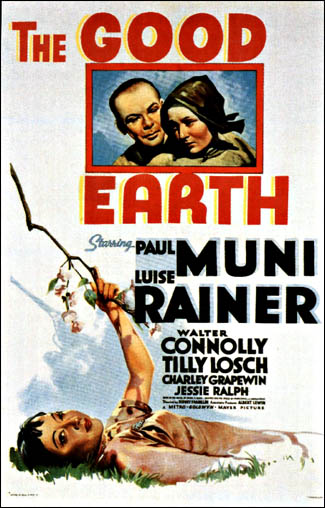
The 1937 film The Good Earth is a strange one.

It’s a big, epic film about life in China in the years before World War I.  It opens with a poor farmer named Wang (Paul Muni) marrying a servant girl named O-Lan (Luise Rainer).  O-Lan is quiet but strong and, with her support, Wang eventually starts to prosper.  He buys land and they have children.  Together, Wang and O-Lan manage to survive both famine and a political upheaval.  In fact, it’s China’s volatile politics that occasionally allow the family to survive.  When a revolutionary mob loots a mansion, O-Lan joins in just long enough to come across a bag of diamonds that the Wang uses to eventually buy the biggest house in town.  Once he’s become wealthy and complacent, Wang ends up taking on a younger, second wife (Tilly Losch) and O-Lan finds herself competing for his attention.  Ultimately, it’s only when Wang is again forced to tend to the Earth that he understands what is really important.

So, here’s the weird thing about The Good Earth.  It’s a film about China.  It covers several years of Chinese history and the story itself is rooted in Chinese culture.  All of the characters are meant to be Chinese.  When the movie was filmed, China was at war with Japan so it’s not surprising that the film was shot in California.  But what is interesting (though not really surprising when you consider the history of Hollywood) is that there are very few Chinese people in the cast and none of them play any of the major roles.

Instead, Wang was played by Austria-born, Chicago-raised Paul Muni.  O-Lan was played by German Luise Rainer.  Wang’s comic relief uncle was played by American character actor Walter Connolly while his father was played by a former vaudeville star from Ohio named Charley Grapewin.  All of the actors are heavily made up so that they’ll look Chinese but none of them act or sound Chinese.  It makes for a very strange viewing experience.

And it’s a bit unfortunate because there are some very good scenes in The Good Earth.  Technically, it’s a very strong film.  Towards the end, there’s a locust invasion that is still thrilling to watch.  The sets look great.  The costumes look great.  If you’re a history nerd like me, the story has the potential to be interesting.  But, whenever you start to get sucked into the film’s story, Wang starts to speak and sounds totally like a guy from Chicago and it takes you out of the movie.  The uneven mix of quality and miscast actors makes for a rather disjointed viewing experience.

As a big epic, it’s probably not surprising that The Good Earth was nominated for best picture.  However, it lost to another Paul Muni film, The Life of Emile Zola.

http://www.youtube.com/watch?v=3iEREqQjjzU

What the Hell is This? The Devil’s Cabaret.


The Devil's Cabaret

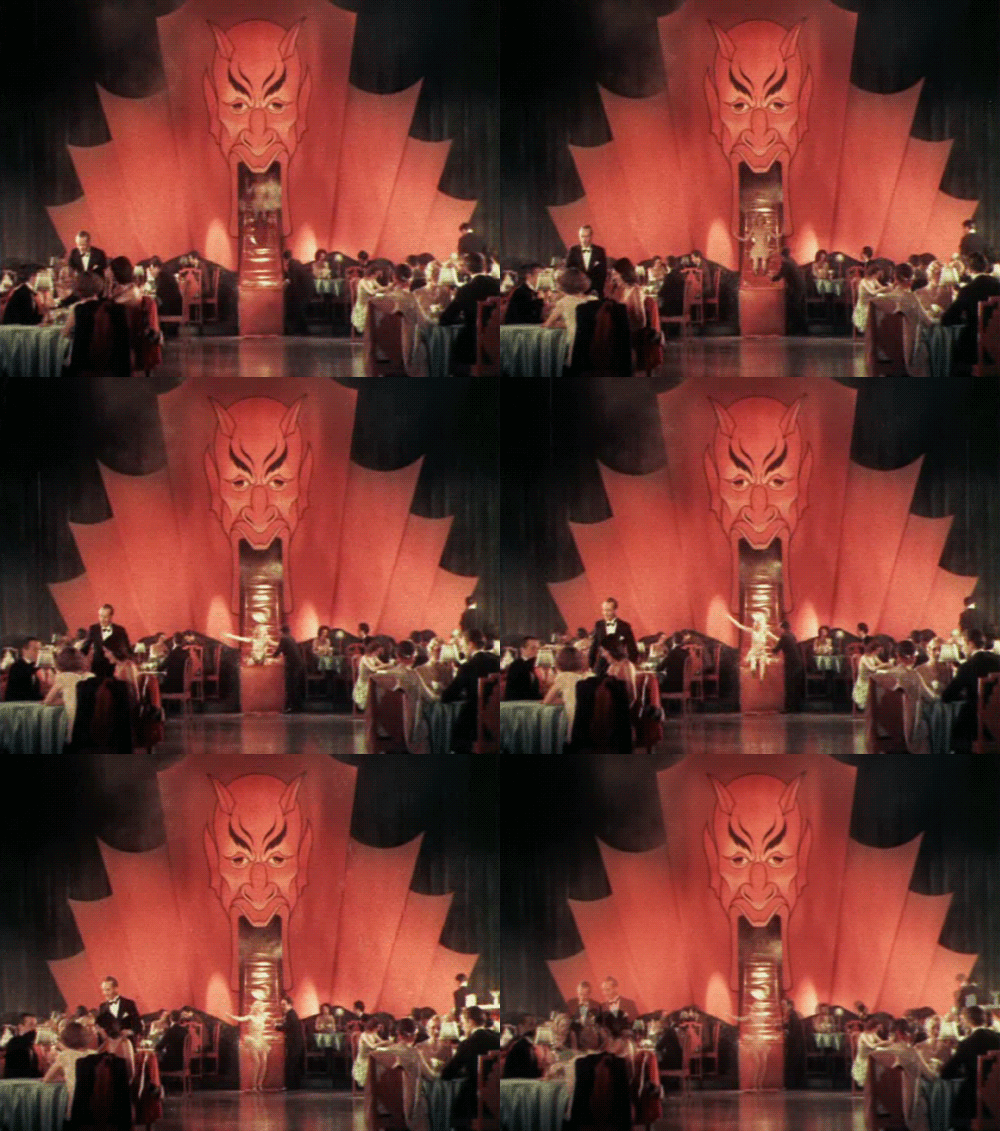
Today, I want to take about 18 minutes to share something with our readers.  The Devil’s Cabaret is an early color short film from 1930.  I recent caught it on TCM and my immediate reaction was that I simply had to share it.  Along with fitting in with the October theme of this site, The Devil’s Cabaret provides ample evidence of just how weird Hollywood could be before the production code was instituted.

Incidentally, the devil is played Charles Middleton who, nearly two decades later, would play The Strangler of the Swamp.

Enjoy The Devil’s Cabaret!

Horror On The Lens: Strangler Of The Swamp (dir by Frank Wisbar)


strangler_of_swamp_poster_02

Traditionally, October is a very special month here at the Shattered Lens.  October is the month that we devote the majority of our attention to the horror genre.  This month, along with all of the reviews that you’ve come to expect from the Shattered Lens, I will also be attempting to share a horror movie a day with all of our wonderful readers.

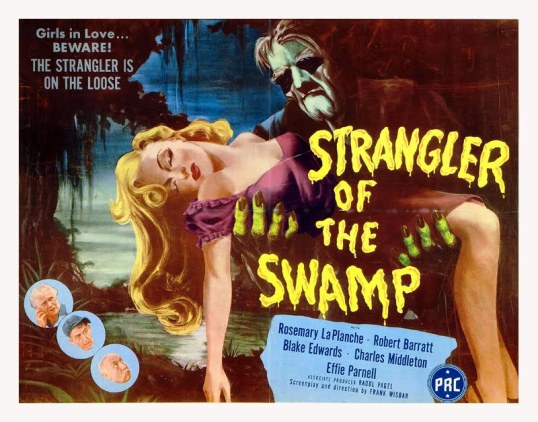
Let’s start things off with an odd little B-movie from 1946, Strangler Of The Swamp, a story of love, revenge, and ghosts.  A group of swamp men hanged an innocent man.  Now, the ghost of that man is having his revenge by strangling the descendents of the people who killed him.  One of those descendents is Chris Sanders (played by future director Blake Edwards) who just happens to be in love with Maria (Rosemary La Planche), the granddaughter of the vengeful ghost.

Clocking in at little less than an hour, Strangler Of The Swamp tells a familiar story but it’s still worth watching.  Charles Middleton is effective as the strangler and the German-born director Frank Wisbar deals with the restrictions imposed by a minsicule budget by emphasizing the film’s expressionistic atmosphere.  While it would be a mistake to call Strangler Of The Swamp a lost masterpiece (as some critics have done), it’s still an interesting example of low-budget, B-filmmaking.