The TSL’s Horror Grindhouse: Ted Bundy: American Boogeyman (dir by Daniel Farrands)


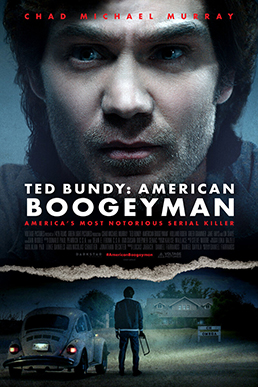
The 2021 film, Ted Bundy: American Boogeyman, is yet another film about the life and crimes of America’s first celebrity serial killer, Ted Bundy.

In this particular film, Bundy is played as being a handsome nonentity by Chad Michael Murray.  The film follows Bundy as he moves from Seattle to Utah to Colorado and eventually to Florida, leaving a path of death in his wake.  Investigating his crimes are Seattle Detective Kathleen McChesney (Holland Roden) and FBI profiler Robert Ressler (Jake Hays).  McChesney not only has to track down Bundy but she also has to deal with her sexist police chief and his idiot son, both of whom think that Bundy’s victims are to blame.

Ted Bundy: American Boogeyman is the latest true crime horror film to be directed by Daniel Farrands.  The frustrating thing about Farrands is that, if you can overlook the subject matter of his recent films, he’s actually a talented horror director who knows how to create suspense and who can be counted on to come up with at least one effective jump scare in all of his films.  That said, he keeps making films that are almost impossible to defend because they exploit real-life tragedy.  Farrands’s best film, The Haunting of Sharon Tate, worked because of Hilary Duff’s committed performance in the title role and the fact that the film itself was fully on Tate’s side.  However, Farrands’s The Murder of Nicole Brown Simpson was a tacky piece of exploitation that, despite Farrands’s strong visuals, appeared to have little compassion for the woman whose murder served as the film’s inspiration.

Ted Bundy: American Boogeyman is neither as effective as The Haunting of Sharon Tate nor as bad as The Murder of Nicole Brown Simpson.  For the most part, the film plays loose with the facts of the case.  At one point, McChesney even shows up at one of Bundy’s crime scenes and takes a shot at him as he flees.  (Tarantino also played around with history in Once Upon A Time In Hollywood but, by allowing Brad Pitt and Leonardo DiCaprio to kill the members of the Mason family, he also allowed their victims to live.  Ted Bundy: American Boogeyman, on the other hand, is willing to change history to allow McChesney to arrive at the crime scene but it’s not willing to change history to allow any of Bundy’s victims to survive.  It’s hard not to feel that the film would have benefitted from following Tarantino’s approach and allowing Bundy’s victims to beat him to death.)  There are a few odd scenes in which Bundy is showing fondling several mannequins.  The scenes appear to pay homage to William Lustig’s Maniac but again, it doesn’t seem to be based on anything the actual Bundy did.  The film hints at the intriguing idea of Ted Bundy being America’s first celebrity serial killer but it doesn’t really follow up on it.  The whole thing feels rushed and rather icky.  It certainly doesn’t add any insight into Bundy or killers in general.

That said, our longtime readers know that I hate to end on a totally negative note so I will say that the film uses its low budget to its advantage.  The sparse sets and the small cast give the film something of a surreal feel, with Bundy as an evil specter who randomly shows up to haunt the dreams of a nation.  Lin Shaye and Diane Franklin appear in small roles.  Franklin plays a distraught mom who asks McChesney to kill Bundy rather than arrest him.  Shaye plays Bundy’s overprotective mother and gives a nicely creepy performance.  As I said earlier, it’s not so much that the film is badly made as the subject matter is so icky and the script is so bereft of any new insight that most viewers will wonder why the film needed to be made at all.

Film Review: Fortress: Sniper’s Eye (dir by Josh Sternfeld)


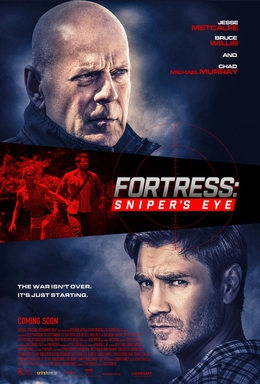
Fortress: Sniper’s Eye is a sequel to the 2021 film, Fortress.

If you haven’t seen Fortress, the plot goes something like this.  A group of mercenaries take over a resort that is populated by retired spies.  Robert Michaels (Bruce Willis) and his son, Paul (Jesse Metcalfe), have to set aside their difference and work together to defeat Frederick Balzary (Chad Michael Murray).

Meanwhile, the plot of Fortress: Sniper’s Eye goes something like this.  A group of mercenaries take over a now-closed resort that was once populated by retired spies.  Robert Michaels (Bruce Willis) and his son, Paul (Jesse Metcalfe), have to continue to set aside their difference and work together to defeat Frederick Balzary (Chad Michael Murray).

Now, to the film’s credit, Sniper’s Eye does admit that it’s largely recycling the plot of the first film.  When Balzary and his henchmen show up for a second time, Paul exclaims, “Didn’t any of you die!?”  It’s a funny line and one that shows that Sniper’s Eye is aware that it’s all a bit ludicrous.  Whatever other faults the film may have, you can’t complain that it’s not self-aware.

Unfortunately, when Balzary and his people invade for the second time, Paul is hosting a gathering with his fiancée and his future mother-in-law.  They’re all taken hostage.  Because Robert was wounded while rescuing Balzary’s wife from some killer Russians, he spends most of the the movie providing encouragement from a hospital bed.  Fortunately, towards the end of the movie, he is able to get out of bed and help out his son.  Paul is obviously happy to see his father and the viewers are happy to see Bruce Willis actually doing some action stuff.

Needless to say, Willis is going to be the main attraction for most viewers.  (I imagine a few One Tree Hill fans will be watching for Chad Michael Murray.)  Sniper’s Eye was one of the film that Willis completed before announcing his retirement from acting.  Knowing what we now know about Willis’s health and the conditions under which he made his final films, watching something like Fortress: Sniper’s Eye can feel awkward.  I cringed when I saw Willis in the hospital bed, looking tired and talking about how he was getting too old to play the hero.  At that moment, it felt as if the character and the actor became the same and it was a bit difficult to watch.

That said, Bruce Willis gives a convincing performance in Fortress: Sniper’s Eye.  He may not have the same charismatic swagger that he had when he was healthy but Willis does still look credible sneaking down a hallway while carrying a gun.  Even though the action scenes all use a rather obvious stunt double, Willis is still convincing in his role.

As for the rest of the film, the pacing is abysmal and the performances are uneven, with Jesse Metcalde making a bland hero and Chad Michael Murray going overboard as the main villain.  This is another film with a jumbled timeline so I feel sorry for anyone who is looking away from the screen whenever the “Two weeks later” title card flashes by.  On the plus side, the resort scenery was nice to look at and Natali Yura gave a convincing performance as Balzary’s wife.  As far as Bruce Willis’s later films are concerned, Fortress: Sniper’s Eye is superior to American Siege but comes in far below both Gasoline Alley and A Day To Die.

Here’s The Life-Affirming Trailer for Fortress!


I’m still struggling to get back into my non-Halloween routine of regular posting.  If I remember correctly, I think I’ve had to deal with post-Horrorthon exhaustion every year since we first started the Shattered Lens.  It’s worth it, though!

Fortunately, a trailer a film like Fortress can only encourage me to get back in the swing of things!  Bruce Willis, Shannen Doherty, and Chad Michael Murray!?  Hell yeah!

Anyway, here’s the trailer:

https://www.youtube.com/watch?v=Jdp4A8_QNgc

Horror (?) Review: Left Behind (dir by Vic Armstrong)


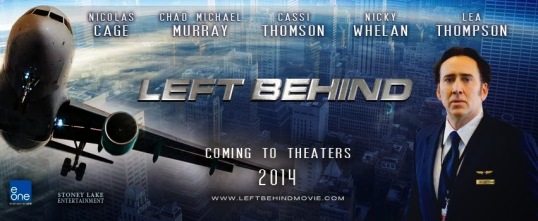
Left-Behind-banner

I have always felt that film critics and bloggers should be open and honest about their biases.  Most critics, of course, claim that their reviews are solely based on the merits of what they’ve seen and that they leave their personal political or religious beliefs out of it.  That, needless to say, is complete bullshit and I’ve never quite understood why some people are so terrified over the prospect of being revealed to be just as biased as everyone else in the world.  The fact of the matter is that critics are supposed to be opinionated and readers have a right to know exactly where those opinions are coming from.

With that in mind, allow me to let you know my mindset before I attempt to review Left Behind.

First off, you should know that I come from a Catholic family.  On my Dad’s side, I’m Irish.  On my mom’s side, I’m Italian and Spanish.  Put those three together and basically, you’ve got a big and fiercely Catholic heritage to deal with.  Therefore, I have to admit that I really don’t know a whole lot about the whole Evangelical Protestant background from which Left Behind apparently sprung.  (In fact, the only thing that I really knew about the Left Behind books is that, apparently, most of the book’s Catholics get left behind.)  So, who knows?  Maybe some of the issues that I had were just a case of me not being a member of the film’s target audience.

Secondly, you should know that I love being a contrarian.  I love any excuse to express an opinion that goes against the majority because, quite frankly, I think that there’s way too much groupthink going on when it comes to film reviewing.  Far too often, it seems that critics have already decided which films that they’re going to love and which films that they’re going to hate.  I knew that the critics were going to hate Left Behind so I was really hoping that the film would somehow be good.  That way, I could write a review defending it and, best of all, I could annoy a lot of people.  After all, the only thing worse than organized religion would be organized hipster douchebags.

(I’m looking in your direction, A.V. Club commenters….)

On the other hand, another part of me hoped that the movie would be really, really bad.  It’s been a while since I’ve seen a truly bad film and, in another few months, it’s going to be time for me to make out my list of the 16 worst films of 2014.  And since I can only list films that I’ve actually seen, I need to step up my game and see more bad movies.  I mean, A Million Ways To Die In The West and Transformers 4 are a good start but they can’t make up the entire list…

Fourth, I was really hoping that Nicolas Cage would somehow be responsible for redeeming Left Behind.  I hoped that he would either give a brilliant performance or he would give a performance so weird that the film itself would become oddly watchable.  A lot of this is because Cage was so good in Joe that it kind of breaks my heart to see him throwing away whatever critical respect he may have regained by appearing in Left Behind

And finally, I’m on vacation!  Why is that important?  Because it meant that, when Jeff and I went to Left Behind, we saw it in a theater that we’ll never have to visit again.  As such, we didn’t have to worry about running into anyone we knew.  Yay! (The theater, incidentally, was nearly empty.  Jeff and I were the youngest people there…)

So, with all that in mind, Left Behind was really, really bad.
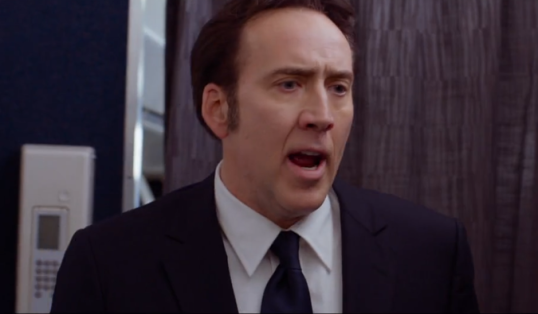
Nic

Nicolas Cage plays Rayford Steele and let’s just start with a bit of praise.  Rayford Steele is a great name!  Anyway, Rayford Steele is a pilot who, one day, is flying an airplane and thinking about cheating on his wife (Lea Thompson), who just happens to be an Evangelical Christian!  (How religious is Mrs. Rayford Steele?  So religious that she apparently carries her bible with her everywhere.)  Rayford has picked the flight attendant that he’s going to cheat with.  He’s even got brand new U2 tickets that he’s going to use for enticement because, apparently, Left Behind takes place in the 20th Century.

And then suddenly — his copilot vanishes!  Several passengers on the plane vanish!  Children all over the world vanish!  It’s the Rapture, a point that becomes clear as soon as Rayford takes a look at a vanished flight attendant’s date book and sees “BIBLE STUDY” written in all caps.

Even worse, apparently every flight controller in the world was a Christian because there’s nobody on the ground to help Rayford land his plane.  Uh-oh!

Also on the plane (and unraptured) is a reporter named Buck Williams (Chad Michael Murray) and, let’s just be honest — Buck Williams is not as good a name as Rayford Steele.  Shortly before boarding the plane, Buck met Rayford’s daughter, Chloe, (Cassi Thomson) and they bonded over their mutual atheism.

(Chloe might as well have been wearing a Neil deGrasse Tyson t-shirt.)

Of course, post-rapture, Chloe spends most of the day desperately searching for her mother and her younger brother.  Riots are breaking out down on the ground.  Airplanes are falling from the sky.  Will Chloe survive?

(Ha, Chloe!  Where’s your Neil deGrasse Tyson now!?)

One thing that I did find interesting is just how quickly society collapsed after the Rapture.  It’s almost as if everyone in the world decided, “Now that the children are gone, let’s burn this place down!”

To be honest, it all felt a bit like a SyFy original film.  SyFy films are almost always divided in half, with 50% of the film dealing with someone in either a plane or a boat while the other half of the film deals with that person’s son or daughter trying to lead a group of idiots to safety and hopefully avoid the monster.  It’s tempting to think of what a SyFy version of Left Behind would look like.  It would probably be a lot more fun than this one…

Anyway, the problem with Left Behind is that it’s just so boring.  The film takes forever to get going and then, once everyone vanishes, the film tries to generate some suspense as to what happened but we already know it was the Rapture so why drag it out?  The dialogue is flat, the performers do just enough to get by, and it’s obvious that the majority of the film’s budget was spent on Nicolas Cage.  This, of course, is what I expected but I was hoping that Nicolas Cage would at least go crazy.  Well, he doesn’t.  In fact, he’s remarkable restrained and this film, if nothing else, proves that Cage can deliver even the worst dialogue with conviction and a straight face.
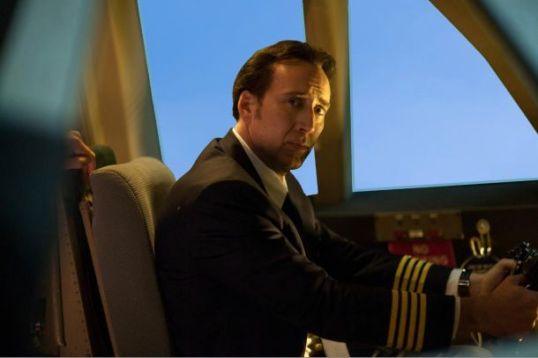
cage-left-behind-610x407

But we don’t want a restrained Cage in a film like Left Behind!  We not only wanted him to go crazy, we needed him to go crazy!  And he didn’t and, as a result, the film is even more disappointing than it would be otherwise.

Now, you may have noticed that I referred to Left Behind as being a “horror (?)” film in the title of this review.  My argument there is that the film is obviously meant to scare nonbelievers.  Indeed, this film was actually advertised with a pull quote from Satan.  (“Please don’t take nonbelievers to this film.” — Satan.)  Unfortunately, I think that Left Behind missed an opportunity.  If the filmmakers had strictly focused on the horrific implications of being left behind — as opposed to trying to be both a sermon and a disaster movie, it probably would have been a lot more effective.  Seriously, The Exorcist is probably the most effective religious film ever made.

Now, I do have to take issue with some of Left Behind‘s critics.  Quite a few critics have made it a point to say, “Even if you agree with the film’s worldview, you’ll be annoyed by the bad acting and the bad directing…”  Uhmmm …. no.  Sorry, it doesn’t work like that.  Usually, people will enjoy any film that supports their beliefs, regardless of how terrible it is.  That goes for all people regardless of religion or ideology.  We all enjoy having our beliefs confirmed.

But, yeah — Left Behind is pretty bad.  Is it the worst film of the year?

Well, the year’s not over yet.

left-behind-nicolas-cage

Film Review: Fruitvale Station (dir by Ryan Coogler)


On January 1st, 2009, a young man named Oscar Grant was executed in Oakland, California.  Grant was returning home from celebrating the New Year’s in San Francisco when he and several other young black man were pulled off a train by the Bay Area Rapid Transit Police.  According to the police, Grant had been involved in a fight on the train.  In a moment that was recorded by several cell phones (and later broadcast across the world), Grant was shot in the back by a BART policeman.  According to the police, Grant had been resisting arrest and his executioner had meant to use his taser but had grabbed his gun by mistake.

The death of Oscar Grant made the news even down here in Texas and I can still remember discussing it with my friends.  As a bunch of good, white liberals (and yes, believe it or not, I was once a little bit liberal, though even back then I was, at heart, more of a civil libertarian than anything else), we were all properly outraged by what happened.  At one point, I declared that this proved that police hide behind the power of their tasers.  We all agreed that it was a terrible thing that had happened and that the cop involved needed to be held responsible.

Only recently did I realize that, even as fashionably outraged as me and my friend were and even though we did feel that this was a classic case of police overreactions, we also automatically assumed that the cop was telling the truth when he said that he meant to grab for his taser.  For all of our righteous indignation, we — as a bunch of white people who had spent most of our time living in white neighborhoods and white towns — still had a hard time accepting the idea that a white police officer had intentionally executed a black man.  As outraged as we were, we were assumed that we were angry about an aberration.  As such, we assumed that the shooter would be held responsible and we went on with our comfortably sheltered lives.  Needless to say, we were incredibly naive.  While the death of Oscar Grant made national news, it made far less news when the man who shot him was eventually sentenced to only two years in prison.  (He was paroled after 8 months.)

I’ve been thinking about Oscar Grant (and the way that my friends and I initially reacted to the news reports of his death) ever since I saw Fruitvale Station, a devastating independent film that also marks the directorial debut of Ryan Coogler.

Starting in the early morning hours and ending in the first hours of 2009, Fruitvale Station follows Oscar Grant (played, in an award-worthy performance by Michael B. Jordan) as he lives the final day of his life.  In between doing such every day things as buying a birthday card for his mother (played, in a luminous performance, by the great Octavia Spencer) and picking up his daughter from daycare, Oscar worries about how he’s going to pay his rent and struggles against the temptation to return to his former life of dealing drugs.

While we watch the film knowing what Oscar doesn’t — that this is the last day of his life — the film itself manages to be a lot more than just a recreation of a tragic event.  There’s a vibrancy and sense of hope to the scenes where Oscar drives through Oakland or hangs out with his family.  That vibrancy makes the film’s inevitable conclusion all the more powerful and devastating.

As for the actual shooting, Fruitvale Station leaves it to the audience to decide whether Oscar was intentionally executed or if he was shot by a cop who thought he was holding a taser.  As the cop who shot Oscar, Chad Michael Murray is only on-screen for a split second.  As the other cop on the scene, Kevin Durand (who played Martin Keamy on Lost) shouts and bullies as only Kevin Durand can do.  If the film leaves it ambiguous about whether or not Oscar was intentionally shot, it’s not ambiguous about the fact that Oscar was killed because, as a black man, he was automatically viewed as being a potential threat by the white police officers.  Whether the intention was to tase him or to shoot him, the ultimate goal was to reassert the authority of the police.

As Fruitvale Station makes clear, the shooting was both an individual tragedy and a piece of the larger tragedy that’s still being played out across this country.   The film’s triumph is that it makes Oscar Grant into both a compelling individual and a powerful symbol of the struggle that many Americans face as they try to survive under a system that’s been designed to keep them down.

So, have you seen Fruitvale Station?  If you haven’t, you need to.  It’s one of the best films of 2013.