Film Review: The Cardinal (dir by Otto Preminger)


The 1963 film, The Cardinal, opens with an Irish-American priest named Stephen Fermoyle (Tom Tyron) being instituted as a cardinal.

In a series of flashbacks, we see everything that led to this moment.  Stephen starts out as an overly ambitious and somewhat didactic priest who, over the years, is taught to be humble by a series of tragedies and mentors.  It’s a sprawling story, one that encompasses the first half of the 20th Century and, as he did with both Exodus and Advice and Consent, Preminger tells his story through the presence of several familiar faces.  Director John Huston plays the cardinal who takes an early interest in Stephen’s career.  Burgess Meredith plays a priest with MS who teaches Stephen about the importance of remaining humble and thankful.  When Stephen is in Europe, Romy Schneider plays the woman for whom he momentarily considers abandoning his vows.  When Stephen is assigned to the American South, Ossie Davis plays the priest and civil rights activist who teaches Stephen about the importance of standing up for those being oppressed.  In the days leading up to World War II, Stephen is sent to Austria to try to keep the local clergy from allying with the invading Nazis.  Stephen also deals with his own family drama, as his sister (Carol Lynley) runs away from home after Stephen counsels her not to marry a good Jewish man named Benny (John Saxon) unless Benny can be convinced the convert to Catholicism.  Later, when his sister becomes pregnant and Stephen is told that she’ll die unless she has an abortion, Stephen is forced to choose between his own feelings and teachings of the Church.  Along the way, performers like Dorothy Gish, Cecil Kellaway, Chill Wills, Raf Vallone, Jill Haworth, Maggie McNamara, Arthur Hunnicut, and Robert Morse all make appearances.

All of the familiar faces in the cast are used to support Tom Tryon and Tryon needs all the support that he can get.  Despite Otto Preminger’s attempts to make Tom Tyron into a star, Tryon eventually retired from acting and found far more success as a writer of the type of fiction that Stephen Fermoyle probably would have condemned as blasphemous.  Tryon gives a stiff and unconvincing performance in The Cardinal.  The entire film depends on Tryon’s ability to get us to like Stephen, even when he’s being self-righteous or when he’s full of self-pity and, unfortunately, Tryon’s stiff performance makes him into the epitome of the type of priest that everyone dreads having to deal with.  Tryon gives such a boring performance that he’s overshadowed by the rest of the cast.  I spent the movie wishing that it would have spent more time with John Saxon and Burgess Meredith, both of whom give interesting and lively performances.

The Cardinal is a long and rather self-important film.  The same can be said of many of Preminger’s films in the 60s but Exodus benefitted from the movie star glamour of Paul Newman and Eva Marie Saint and Advice and Consent was saved by an intelligent script.  The Cardinal, on the other hand, is a bit draggy and makes many of the same mistakes that many secular films make when they try to portray Catholicism.  Oddly enough, The Cardinal received more Oscar nominations than either Exodus or Advice and Consent.  Indeed, Preminger was even nominated for Best Director for his rather uninspired work here.  Considering the number of good films for which Preminger was not nominated (Anatomy of a Murder comes to mind), it’s a bit odd that The Cardinal was the film for which he was nominated.  (Of course, in 1944, the Academy got it right by nominating Preminger for his direction of Laura.)  The Cardinal is largely forgettable, though interesting as a type of self-consciously “big” films that the studios were churning out in the 60s in order to compete with television and the counterculture.
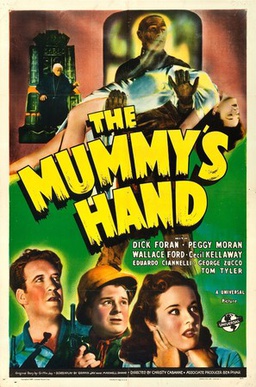
Horror Film Review: The Mummy’s Hand (dir by Christy Cabanne)


In 1940, having brought back The Invisible Man and Frankenstein’s Monster, Universal Pictures decided that it was also a good time to bring back The Mummy!

The Mummy’s Hand takes place in what we’re told is Egypt, though it’s obvious just a Universal backlot.  Two archeologists — Steve Banning (Dick Foran) and Babe Jenson (Wallace Ford) — are penniless and stuck in Egypt.  Babe wants to find a way to return to Brooklyn and his ex-girlfriend.  Steve is a bit more serious about archeology, though it must be said that he’s no Indiana Jones when it comes to discovering relics and taking them to museums.  If Indiana is the type who will risk his life to search a hidden cave in the Amazon Rain Forest, Steve is far more likely to just wander around an Egyptian market until he comes across someone selling an ancient vase.

Which is exactly what happens!  Steve finds someone selling a vase and, after he learns where it came from, he buys the vase.  He takes the vase to Prof. Andoheb (George Zucco), not knowing that Andoheb is an Egyptian high priest who has been sworn to protect the tomb of Princess Ananka.  When Andoheb realizes that the vase could lead to the discovery of the tomb, he lies and claims that it’s a forgery.  He then “accidentally” breaks it in order to keep Steve from showing the vase to anyone else.  Steve, however, is not deterred and a chance meeting with an American magician named Tim Sullivan (Cecil Kellaway) leads to Sullivan agreeing to finance Steve’s expedition to discover where the vase came from.  Sullivan’s daughter, Marta (Peggy Moran), worries that Steve and Babe are just trying to steal her father’s money so she insists on coming on the expedition with Steve.  Also following the expedition is Andoheb, who is himself starting to fall for Marta and who is hoping that he can use a secret serum hidden in the tomb to make both himself and Marta immortal.

Of course, the tomb itself is protected by Kharis (Tom Tyler, under a ton of bandages), a mummy who is immortal due to the serum and who has sworn to protect the tomb from any outsiders.  Kharis moves slowly but efficiently.  He’s a ruthless and silent killer, one whose eyes appears to just be two black holes, the better to reflect his own lack of a soul.

The main problem with The Mummy’s Hand is that it takes forever for the Mummy to actually show up.  This is only a 67-minute film and the Mummy mayhem doesn’t really start until around the 50 minute mark.  As a result, the viewer spends a lot of time watching Steve and Babe wander around Egypt and essentially act like stereotypical American tourists.  Even when the expedition finally gets started, the audience still has to sit through endless scenes of Marta accusing Steve of being some sort of con artist.  This is a movie that will truly leave you saying, “When is the mummy going to show up!?”

That said, The Mummy itself is a frightening creature, especially with his empty eyes.  Mummy’s are naturally frightening, especially when they’re walking towards you and dragging their decaying bandages  behind them.  The Mummy is effective, I just wish he had been featured in more of the movie.

Previous Universal Horror Reviews:

  1. Dracula (1931)
  2. Dracula (Spanish Language Version) (1931)
  3. Frankenstein (1931)
  4. Island of Lost Souls (1932)
  5. The Mummy (1932)
  6. The Invisible Man (1933)
  7. The Bride of Frankenstein (1935)
  8. Dracula’s Daughter (1936)
  9. Son of Frankenstein (1939)
  10. Black Friday (1940)
  11. The Invisible Man Returns (1940)
  12. The Wolf Man (1941)
  13. Ghost of Frankenstein (1942)
  14. Invisible Agent (1942)
  15. Frankenstein Meets The Wolf Man (1943)
  16. Son of Dracula (1943)
  17. House of Frankenstein (1944)
  18. The Invisible Man’s Revenge (1944)
  19. House of Dracula (1945) 
  20. Creature From The Black Lagoon (1954)

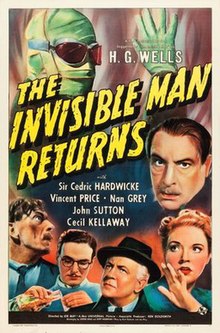
Horror Film Review: The Invisible Man Returns (dir by Joe May)


1940’s The Invisible Man Returns opens with Sir Geoffrey Radcliffe (Vincent Price) sitting on Death Row.  Convicted of the murder of his brother, Radcliffe is due to soon be executed.  Radcliffe claims that he was framed and his girlfriend, Helen Manson (Nan Grey), has spent the past week of her life begging for someone to order a stay on the execution.  However, with the home secretary out of the country, there is no hope of a reprieve.

Dr. Frank Griffin (John Sutton), brother of the original Invisible Man, visits Radcliffe in prison and gives him the same serum that his brother previously developed.  Now invisible, Radcliffe is able to escape from the prison.  Radcliffe is determined to prove his innocence but Dr. Griffin is more concerned with developing a way to reverse the serum’s effects before Radcliffe is driven insane, just as the original Invisible Man was.  Radcliffe becomes convinced that his brother was murdered by their cousin, Ricard Cobb (Sir Cedric Hardwicke) but is Radcliffe correct or is the serum just making him paranoid?  With Inspector Sampson (Cecil Kellaway) searching for Radcliffe and fully aware of what effects the serum are going to have on his mind, can Radcliffe clear his name before he loses his sanity?

The Invisible Man Returns went into production after the success of Son of Frankenstein proved that there was a market for sequels to previously successful horror films.  (Yes, there was a time when sequels were not an automatic thing.)  This was also one of the first horror films in which Vincent Price made an appearance.  (Today, we’re so used to the image of Vincent Price as a somewhat campy horror icon that it’s easy to forget that he originally started his career as a romantic leading man and was even seriously considered for the role of Ashley Wilkes in Gone With The Wind.)  As he spends the majority of the film wearing the same tight bandages that hid Claude Rain in the first film, Price’s actual face is only visible for slightly less than a minute and, without his famous mustache, it’s actually rather difficult to recognize him.  That said, there’s no mistaking Price’s voice, heard as the invisible Radcliffe bitterly complains about everything from a barking dog to other people’s doubts about Cobb being the murderer.  While this film does find Price in a slightly more subtle mood than many of us horror fans are used to, it still features plenty of hints of what the future would hold.

I enjoyed The Invisible Man Returns, which featured some witty invisibility sequences (watch invisible Vincent Price toss off those clothes!) and also managed to take the story’s violence about as far as it could without violating the production code.  While it’s always a pleasure to watch any film featuring Vincent Price, I also liked the performance of Cecil Kellaway, who played the inspector as being the epitome of the the upstanding but dryly humorous British policeman.  One gets the feeling that absolutely nothing could ever take the Inspector by surprise …. not even an Invisible Man!

Previous Universal Horror Reviews:

  1. Dracula (1931)
  2. Dracula (Spanish Language Version) (1931)
  3. Frankenstein (1931)
  4. Island of Lost Souls (1932)
  5. The Mummy (1932)
  6. The Invisible Man (1933)
  7. The Bride of Frankenstein (1935)
  8. Dracula’s Daughter (1936)
  9. Son of Frankenstein (1939)
  10. The Wolf Man (1941)
  11. Ghost of Frankenstein (1942)
  12. Frankenstein Meets The Wolf Man (1943)
  13. Son of Dracula (1943)
  14. House of Frankenstein (1944)
  15. House of Dracula (1945) 
  16. Creature From The Black Lagoon (1954)

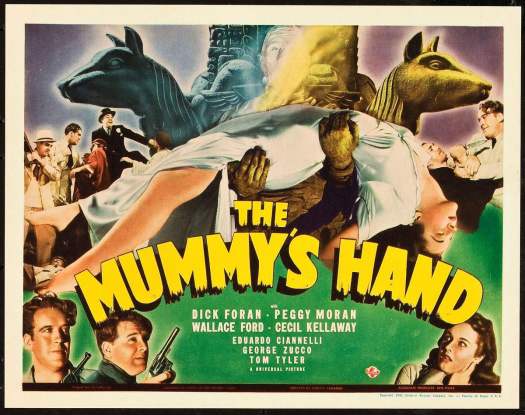
Halloween Havoc!: THE MUMMY’S HAND (Universal 1940)


gary loggins's avatarcracked rear viewer

Universal revived The Mummy in 1940’s THE MUMMY’S HAND, but except for the backstory (and judicious use of stock footage), there’s no relation to the 1932 Karloff classic . Instead of Imhotep we’re introduced to Kharis, the undead killing machine, as the High Priest of Karnak (Eduardo Cianelli in old age makeup) relates the tale of Princess Ananka, whose tomb is broken into by Kharis, who steals the sacred tanna leaves to try and bring her back to life. Kharis gets busted, and is condemned to be buried alive! For he “who shall defile the temple of the gods, a cruel and violent death shall be his fate, and never shall his soul find rest for all eternity. Such is the curse of Amon-Ra, king of all the gods”. So there!

The High Priest croaks, making Andoheb (George Zucco ) the new High Priest. Meanwhile in Cairo, Americans Steve…

View original post 591 more words

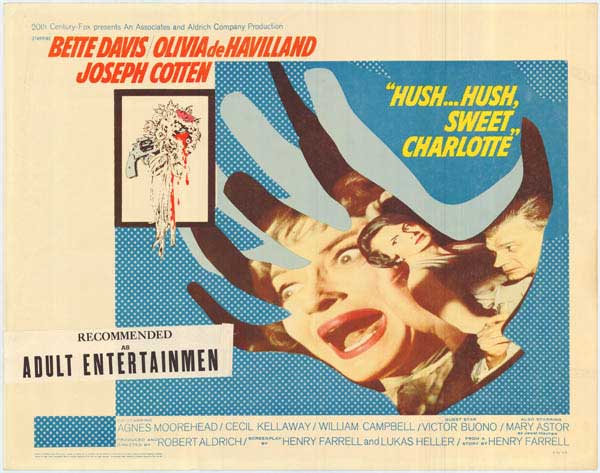
Happy 100th Birthday Olivia de Havilland!: HUSH… HUSH, SWEET CHARLOTTE (20th Century Fox 1964)


gary loggins's avatarcracked rear viewer

char1

Today marks the 100th birthday of one of the last true Golden Age greats, Olivia de Havilland. Film fans across the globe are celebrating the life and career of this fine actress, who fought the Hollywood system and won. Olivia is the last surviving cast member of GONE WITH THE WIND (Melanie Wilkes), won two Academy Awards (TO EACH HIS OWN, THE HEIRESS), headlined classics like THE SNAKE PIT and THE DARK MIRROR, and costarred with dashing Errol Flynn in eight exciting films, including CAPTAIN BLOOD , THE ADVENTURES OF ROBIN HOOD, SANTA FE TRAIL, and THEY DIED WITH THEIR BOOTS ON.

Olivia moved to Paris with her husband in the 1950’s and was semi-retired, acting in a handful of films. In 1962 director Robert Aldrich  scored a huge hit, a psychological horror thriller called WHATEVER HAPPENED TO BABY JANE?, starring screen veterans Bette Davis and Joan Crawford. A new genre was…

View original post 835 more words

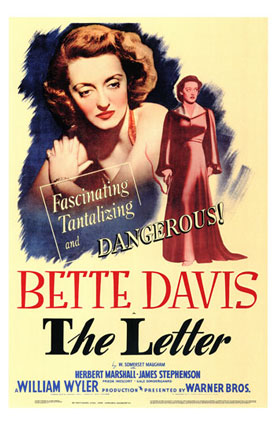
Cleaning Out The DVR #14: The Letter (dir by William Wyler)


The_Letter_poster

After watching Break-Up Nightmare, I watched one more film that was sitting on my DVR.  That film was 1940’s The Letter.  I had recorded it off of TCM and, up until last night, I had never seen it before.  I’m happy to say that I’ve seen it now because it’s a great movie, featuring a fascinating mystery, feverish atmosphere, excellent supporting performances, and a ferociously brilliant performance from the great Bette Davis.

Filmed in a dream-like noir style by William Wyler, The Letter opens on a rubber plantation in Malaysia.  It’s night and the camera pans over the native workers all trying to sleep through the hot night.  Eventually, the camera reaches the big house, where the plantation’s wealthy and, of course, white manager lives.  (The contrast between the wealthy Europeans interlopers and the natives who work for them is a reoccurring theme throughout The Letter.)  A gunshot rings out.  A man stumbles out of the house.  Following after him is Leslie Crosbie (Bette Davis).  She is carrying a gun and, as we watch, she shoots the man a few more times.  She shoots him until she’s sure that he’s dead.

Leslie is the wife of Robert Crosbie (Herbert Marshall, who also played Davis’s husband in The Little Foxes) and the man that she just killed is Geoff Hammond, a respected member of Malaysia’s European community.  When the police arrive, Leslie explains that Hammond “tried to make love to me” and that she was forced to kill him in self-defense.  Leslie is arrested for the crime and will have to face trial but everyone knows that she will be acquitted.  After all, Leslie and her husband are members are well-connected members of the upper, European class.

However, Leslie’s lawyer, Herbert Joyce (James Stephenson), has doubts about Leslie’s story.  He points out that she sounds just a little too rehearsed.  His suspicions are confirmed when his clerk, Ong Chi Seng (Sen Yung), tells him about the existence of a letter that Leslie wrote on the day that Hammond was killed.  In the letter, Leslie orders Hammond to come see her and threatens to reveal the details of their relationship if he doesn’t.  Ong explains that he only has a copy of the letter.  The original is in the hands of Hammond’s widow (Gale Sondergaard) and she’s willing to sell the letter for a substantial price.

Not surprisingly The Letter is dominated by Bette Davis but, for me, the most memorable character is the outwardly obsequies but inwardly calculating Ong Chi Seng.  Sen Yung plays him with such a polite manner and a gentle voice that it’s actually incredibly shocking when he reveals his true nature.  And yet, even after he’s been exposed as a potential blackmailer, his manner never changes.  Meanwhile, Gale Sondergaard only appears in a handful of scenes but she steals every one of them with her steely glare.

In order to get the letter away from Ong and Mrs. Hammond, Leslie and Joyce have to convince Robert to give them the money without allowing him to learn the letter’s content.  But, what neither one of them realizes, is that Mrs. Hammond has plans that go beyond mere blackmail.

The Letter is an atmospheric melodrama that plays out almost like a fever dream and it also features one of Davis’s best performances.  It was nominated for best picture but it lost to another atmospheric melodrama, Alfred Hitchcock’s Rebecca.

Film Review: Guess Who’s Coming To Dinner (directed by Stanley Kramer)


Sometimes, you just had to be there.

That was my reaction as I watched the 1967 Best Picture nominee Guess Who’s Coming To Dinner.  While this film may have been topical and even controversial when it was first released, when watched today it seems to be rather mild and tame.

In Guess Who’s Coming To Dinner, Spencer Tracy plays Matt Drayton.  Matt’s a San Francisco newspaper publisher, a respected member of the upper class establishment.  His wife, Christina (Katharine Hepburn), owns a trendy art gallery and Matt spends his spare time playing golf with Monsignor Ryan (Cecil Kellaway).  He’s the father of the free-spirited Joey (Katharine Houghton, who was Hepburn’s niece in real life).  He’s also, as we’re told repeatedly by every other character in the film, a liberal who supports the civil rights movement.

As the film begins, Joey is returning from a vacation in Hawaii and she has big news.  While in Hawaii, she met and fell in love with the widowed John Prentice, a highly succesful doctor who is literally on the verge of winning a Nobel Peace Prize.  Though he’s 16 years older than her and they’ve only known each other for 10 days, Joey and Prentice are planning on getting married.  While Joey thinks that she’s bringing Prentice to San Francisco just so her parents can meet their future son-in-law, Prentice has specifically come to ask Matt’s permission to marry Joey.  As Prentice explains to Matt, he’ll call the marriage off if Matt doesn’t approve.

John Prentice, by the way, is played by Sidney Poitier and that is the source of the film’s conflict.  Will Matt give his daughter permission to marry a polite, considerate, wealthy, saintly, world-renowned doctor despite the fact that he happens to be black?

Watching Guess Who’s Coming To Dinner was a bit of a culture shock to me, both because I’m the result of an interracial marriage myself (my mom was Spanish and my dad’s white) and because several of my friends are either in or have been a part of an interracial relationship or marriage.  For people my age, it’s not a big deal.  We take it for granted that if you find someone to be attractive, you can have a relationship with him regardless of whatever race he may happen to be.

While I was doing research on Guess Who’s Coming To Dinner, I was reminded that this wasn’t always the case.  When Guess Who’s Coming To Dinner was first released in 1967, interracial marriage was still illegal in 17 states.  In that same year, U.S. Secretary of State Dean Rusk offered to resign when his daughter married a black man.  When Guess Who’s Coming To Dinner was first released, interracial marriage still a controversial subject and when Spencer Tracy struggled with his feelings about it, he stood in for countless Americans who, though they may  have taken pride in how tolerant they were, still weren’t sure what they would do if a black man tried to join their family.

As you can probably guess, Guess Who’s Coming To Dinner is far more interested in teaching a lesson than telling a story.  It’s perhaps not surprising that the film was directed and produced by Stanley Kramer.  Kramer was one of the most prominent filmmakers of the 1960s.  He specialized in making big films that dealt with big issues, the type of films that were regularly nominated for an academy award but rarely honored with an actual win.  In many ways, Guess Who’s Coming To Dinner is a prototypical Kramer picture — its heart is in the right place but the film itself is so conventional and free of ambiguity that it never manages to truly challenge the status quo that it claims to be criticizing.*

In his excellent look at the 1967 nominees for best picture, Pictures At A Revolution: Five Movies And The Birth of The New Hollywood, Mark Harris provides a fascinating behind-the-scenes look at the filming of Guess Who’s Coming To Dinner.  Harris quotes Kramer as explaining that the character of John Prentice had to be perfect because, if the character had any flaws, then bigots in the audience would have seized on those flaws as the reason why Prentice and Joey should not be allowed to marry.  As Kramer explains it, the entire film was set up to make it clear that the only possible reason that Matt could have to object to Prentice would be the color of his skin.

To an extent, I can see Kramer’s point (and again, it’s hard to judge what was necessary to make a point in 1967 from the perspective of 2013) but, as I watched Guess Who’s Coming To Dinner, it was hard not to feel that the main problem with the film was that Prentice was just too perfect.  Certainly, he was too perfect to be in love with Joey who, as played by Houghton, simply seemed to be too naive and foolish to be a good match for a man who is on the verge of winning a Nobel Prize.  Even more importantly, it’s hard to escape the fact that this accomplished, confident black man still needs to get the permission of a well-meaning white liberal before he can marry the woman he claims to love.

Ultimately, despite the film’s noble intentions, it feels more than a bit condescending.  At no point is Prentice allowed to show any anger or frustration at having to prove himself.  There’s even a scene where Prentice criticizes his own father for being too hung up on racism.  “Not until you and you’re whole lousy generation lay down and die will the weight of you be off our backs … You think of yourself as a colored man … I think of myself as a man!” Prentice tells him, as if his success was due to ignoring racism as opposed to defying it.

If Guess Who’s Coming To Dinner has dated badly as a look at race relations in the United States, it remains watchable because of the performances of Katharine Hepburn and Spencer Tracy.  This was their 9th and final film together and the love that these two accomplished actors felt for each other shines through every scene.  Tracy was seriously ill while making the film (and died before it was released) but he gave one of his best and most heartfelt performances here.  He was nominated for a posthumous Oscar but lost to Rod Steiger, who co-starred with Poitier in the film that beat Guess Who’s Coming To Dinner for best picture, In The Heat of the Night.

In the Heat of the Night is best-remembered for the scene in which Poitier angrily declares, “They call me …. MISTER TIBBS!”  This line epitomized the righteous anger that he was not allowed to display in Guess Who’s Coming To Dinner.  If only Guess Who’s Coming To Dinner had its own “MISTER TIBBS” moment, it might be remembered as something other than a film that seems curiously out-of-place as a nominee for best picture.

* That said, Kramer’s post-Guess films were actually pretty interesting and a bit more daring.  Some day, I’ll have to get around to reviewing his 1970 campus unrest film, R.P.M.