4 Or More Shots From 4 Or More Films is just what it says it is, 4 shots from 4 of our favorite films. As opposed to the reviews and recaps that we usually post, 4 Shots From 4 Films lets the visuals do the talking!
Today is the birthday of the one and only Paul Schrader! It’s time for….
4 Shots From 4 Paul Schrader Films
Blue Collar (1978, dir by Paul Schrader, DP: Bobby Byrne)
American Gigolo (1980, dir by Paul Schrader, DP: John Bailey)
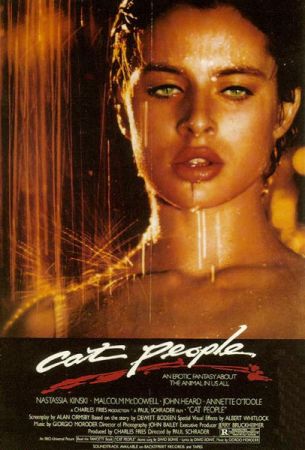
Cat People (1982, dir by Paul Schrader, DP: John Bailey)
First Reformed (2018, dir by Paul Schrader, DP: Alexander Dynan)
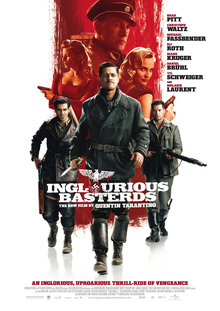
This is, without a doubt, one of the best sequences that Quentin Tarantino has ever directed. Along with the perfect visuals of Shoshanna getting ready for the premiere, Tarantino makes perfect use of Theme From Cat People, reinventing the song from a somewhat silly horror theme to an anthem of revolution and revenge.
4 Or More Shots From 4 Or More Films is just what it says it is, 4 shots from 4 of our favorite films. As opposed to the reviews and recaps that we usually post, 4 Shots From 4 Films lets the visuals do the talking!
This October, I’m going to be doing something a little bit different with my contribution to 4 (or more) Shots From 4 (or more) Films. I’m going to be taking a little chronological tour of the history of horror cinema, moving from decade to decade.
Today, we take a look at the 1940s.
8 Shots From 8 Horror Films: The 1940s
The Devil Bat (1940, dir by Jean Yarbrough, DP: Arthur Martinelli)
The Wolf Man (1941, dir by George Waggner, DP: Joseph Valentine)
Cat People (1942, dir by Jacques Tourneur, DP: Nicholas Musuraca)
I Walked With A Zombie (1943, dir by Jacques Tourneur, DP: J. Roy Hunt)
The Leopard Man (1943, dir by Jacques Tourneur, DP: Robert De Grasse)
House of Frankenstein (1944, dir by Erle C. Kenton, DP: George Robinson)
Spellbound (1945, dir by Alfred Hitchcock, DP: George Barnes)
The Picture of Dorain Gray (1945, dir by Albert Lewin, DP: Harry Stradling)
With Horrorthon underway, it’s time for a special October edition of Lisa Marie’s Favorite Grindhouse Trailers! Today, I bring you 6 spine-tingling trailers from the 30s and the 40s! Say hello to old school horror at its best!
Dracula (1931)
First off, here is the original trailer for the 1931 version of Dracula! Yes, it’s a bit grainy and it’s a bit creaky and …. well, it’s old. But listen, if I had been around in 1931 and I saw this trailer, I definitely would have been at the theater on opening day. “Do vampires exist?” the trailer asks. No, they do not but who knows? Maybe the trailer would have made me question my beliefs for at least a day or two.
Apparently, the odd scene with Edward Van Sloan and the mirror was taken from an outtake. The scene itself is not in the film and presumably, that mirror was not supposed to fall off the wall. Also, it’s interesting to note that Dracula was not a Halloween film but instead, it was released just in time for Valentine’s Day!
2. Frankenstein (1931)
Of course, Universal followed Dracula from Frankenstein. Again, this is one of the original trailers for the film and not a trailer that was put together and released in later years. The trailer does, at one point, say, “It’s coming back!,” so I’m assuming that this version was sent to theaters where the film had played previously. The trailer features a few scenes that were cut from the film and also a few alternate takes,
3. Bride of Frankenstein (1935)
If you have a weak heart …. you better leave now! The early Universal horror films are not necessarily thought of as being grindhouse films but this trailer is pure grindhouse.
4. The Wolf Man (1941)
In the 40s, Dracula and Frankenstein’s Monster were joined by a werewolf named Larry. Here is the original trailer for The Wolf Man.
5. Cat People (1943)
In 1943, horror took a new, psychological turn with the original Cat People!
6. House of Frankenstein (1944)
Finally, in 1944, all of the great monster came together. Before The Avengers, before the Justice League, before the Snyder cut, there was the House of Frankenstein!
4 Shots From 4 Films is just what it says it is, 4 shots from 4 of our favorite films. As opposed to the reviews and recaps that we usually post, 4 Shots From 4 Films is all about letting the visuals do the talking.
This October, I am going to be using our 4 Shots From 4 Films feature to pay tribute to some of my favorite horror directors, in alphabetical order! That’s right, we’re going from Argento to Zombie in one month!
Today’s director: Jacques Tourneur!
4 Shots From 4 Films
Cat People (1942, dir by Jacques Tourneur)
I Walked With A Zombie (1943, dir by Jacques Tourneur)
The Leopard Man (1943, dir by Jacques Tourneur)
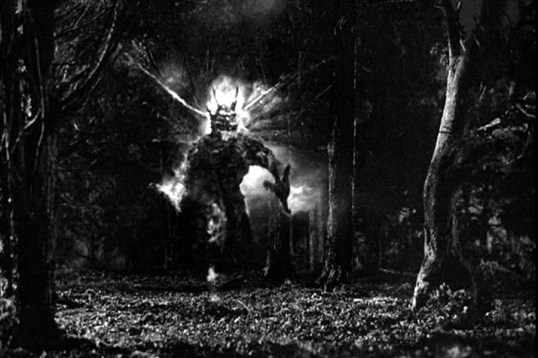
Night of the Demon (1957, dir by Jacques Tourneur)
This October, I’m going to be doing something a little bit different with my contribution to 4 Shots From 4 Films. I’m going to be taking a little chronological tour of the history of horror cinema, moving from decade to decade.
Today, we take a look at the first few years of 1940s.
4 Shots From 4 Films
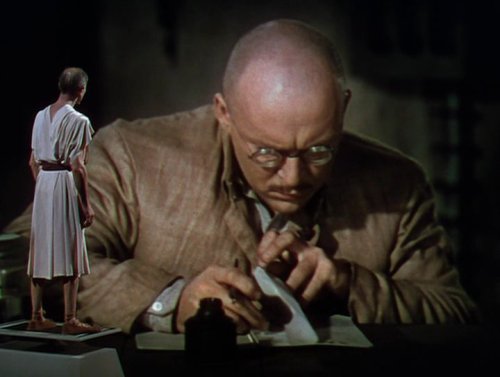
Dr. Cyclops (1940, dir by Ernest B. Schoedsack)
The Wolf Man (1941, dir by George Waggner)
Cat People (1942, dir by Jacques Tourneur)
I Walked With A Zombie (1943, dir by Jacques Tourneur)
Since I just reviewed Paul Schrader’s 1982 version of Cat People, I figured that I’d show a scene from the film that I love.
In this film, Irena (Natassja Kinski) has a dream in which her brother, Paul (Malcolm McDowell) explains the curse under which they both live. This dream leads directly into the first part of the film’s best sequence, in which Alice (Annette O’Toole) suspects that she’s being followed while out jogging.
Everything about this scene — from the music to the sets to the cinematography — is horror perfection as far as I’m concerned.
Before I get around to actually reviewing Paul Schrader’s 1982 reimagining of Cat People, I’m going to suggest that you take a few minutes to watch the film’s opening credits. Say what you will about Schrader’s Cat People, it has a great opening, one that perfectly sets up the rest of the film.
In this version of Cat People, Irena (Natassja Kinski) is a naive young woman (and virgin) who, after the death of her parents, has spent most of her previous life in foster care. Irena travels to New Orleans, where she reconnects with her older brother, Paul (Malcolm McDowell). From the minute that Irena meets her brother and his housekeeper (Ruby Dee), it’s obvious that something is off. When Paul looks at her, he does so with an unsettling intensity. At night, while Irena sleeps, Paul wanders the dark streets of New Orleans.
One morning, Irena wakes up to discover that Paul is missing. Having nothing else to do, Irena wanders around New Orleans. When she visits the zoo, she feels an immediate connection to a caged panther who stares at her with a familiar intensity. It turns out that the panther was captured the previous night, after he mysteriously appeared in a sleazy motel and mauled a prostitute.
It’s at the zoo that Irena meets zookeeper Oliver Yates (John Heard). Oliver gets Irena a job working at the zoo gift shop. where Irena is befriended by Oliver’s co-worker, Alice (Annette O’Toole). One day, Irena witnesses the panther kill another zookeeper before it then escapes from its cage.
That night, Paul suddenly shows up in Irena’s bedroom. He explains to her that they are a cursed species. Having sex causes them to turn into panthers and the only way to avoid the curse is through incest. A terrified Irena flees her brother and soon finds herself living with and falling in love with the increasingly obsessive Oliver, all the while knowing that giving herself to him physically will lead to her transformation.
From the very first second of the film. Schrader’s Cat People is an exercise in pure style. If the original Cat People was largely distinguished by its restraint, Schrader’s version is all about excess. Everything that was merely suggested in the original is made explicit in this version. As tempting as it may be to try, it’s somewhat pointless to try to compare these two versions. Though they may both be about a woman who turns into a panther when she has sex, they are two very different films.
Schrader’s Cat People walks a very fine line between moodiness and absurdity, which is perhaps why I enjoyed it. Making great use of both the sultry New Orleans setting and Giorgio Moroder’s atmospheric score, Cat People is compulsively dream-like and enjoyably over-the-top. Cat People is often described as being an example of a movie that could have only been made in the coked up 80s and truly, this is one of those films that’s so excessive that it’s becomes fascinating to watch.
(I think that often we are too quick to assume that excess is necessarily a bad thing. If you can’t be excessive when you’ve got Malcolm McDowell playing an incest-minded cat person in New Orleans, when can you be excessive?)
Schrader’s Cat People may not have much in common with the original version but the film’s best scene is the only one that is a direct recreation of a scene from the original. In fact, in recreating the scene where Alice is menaced while swimming in a public pool, Schrader actually improves on the original. Brilliantly performed by both Annette O’Toole and Natassja Kinski (whose cat-like features made her perfect for the role of Irena), it’s the only scene in the film that can truly be called scary. Starting with a tracking shock that follows Alice as she jogs, the stalking scene is practically a master class in effective horror cinema. If nothing else, you should see Cat People for that one scene.
And you should also see it for the wonderful soundtrack! Let’s end this review with David Bowie’s theme song, which you may also remember from Quentin Tarantino’s Inglourious Basterds.
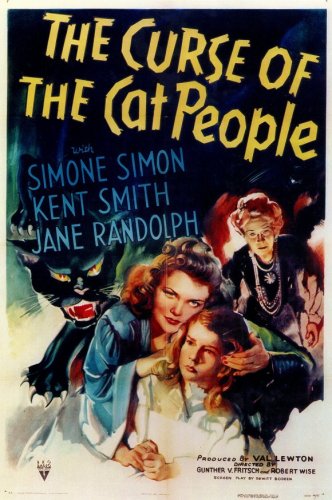
So, you can add the 1944 film The Curse of the Cat People to the list of films that made me cry.
And I know that you’re probably going to point out that it’s already a very long list and I know that some people believe that I cry at every movie that I see. (Listen, if I cried every time that I watched a movie, that would mean that not a single hour would pass without me shedding tears and … well, anyway, lets move on…) But seriously, The Curse of the Cat People is a wonderful and heartfelt film.
Technically, it’s a sequel to the original Cat People. Oliver (Kent Smith) and Alice (Jane Randolph) are married now and they have a six year-old daughter named Amy (Ann Carter). Irena (Simone Simon) does return but we’re never quite sure whether she’s a ghost or if she’s meant to be a figment of Amy’s imagination. There is no mention of Irena being cursed, though a hissing cat does make an appearance at the beginning of the film. In the original Cat People, Elizabeth Russell played a mysterious woman who asked if Irena was her sister. In The Curse of the Cat People, Russell appears in a different role but, interestingly enough, she’s still linked to the memory of Irena.
Instead, The Curse of the Cat People is about Amy. Amy is a shy girl who spends most of her time daydreaming and Ann Carter (who was 8 years old at the time) gives a very real and very authentic performance, one that is totally the opposite of the type of performance that we often expect from child actors. I was a shy child myself (I was famous for always hiding behind my mom whenever I saw a stranger approaching) and, from the minute Amy appeared, I knew exactly how she felt and what was going through her mind.
While Alice feels that Amy’s daydreaming is harmless, Oliver worries about her daughter. At one point, he says that he fears that she’ll never leave her fantasy world and that she’ll grow up to be like Irena. (Interestingly enough, this line suggests that Oliver still doesn’t believe that Irena was actually a cat person.) Amy, meanwhile, has a vision of Irena standing in the backyard and soon, the two of them are best friends.
At the same time, Amy has also become friends with Julia Farren (Julia Dean), an elderly woman who lives in the neighborhood. Just like Amy, Julia lives in a fantasy world. She treats Amy like her own daughter. Meanwhile, Julia refuses to acknowledge her true daughter, Barbara (Elizabeth Russell), accusing Barbara of being a spy and saying she is only pretending to be her daughter. Barbara grows more and more resentful of Amy and that resentment leads her to consider doing a truly terrible thing.
I guess it’s debatable whether or not The Curse of the Cat People can truly be called a horror film. While it does have elements of the horror genre, The Curse of the Cat People is ultimately both a coming-of-age story and a plea for adults to allow their children to be children. It’s all so heartfelt and so wonderfully performed by Ann Carter, Kent Smith, Jane Randolph, Elizabeth Russell, and Simone Simon that I couldn’t help but cry at the end of the film. The Curse of the Cat People is a great film to watch in October or any other month.






 Through the Shattered Lens