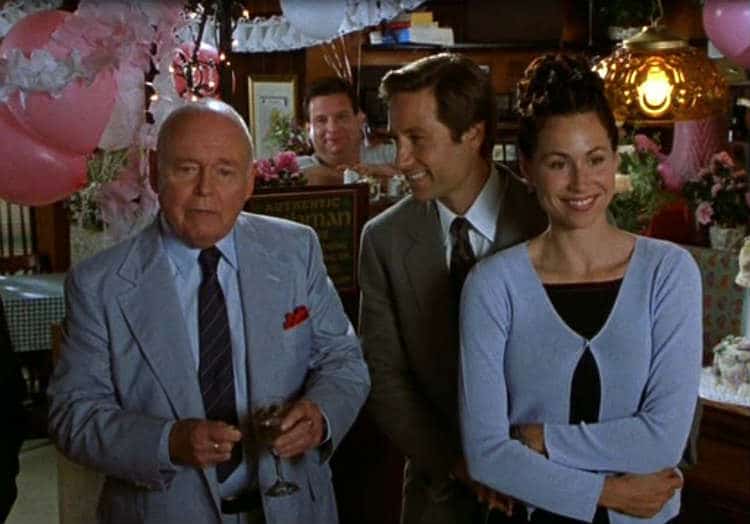
Brad reviews RETURN TO ME (2000), starring David Duchovny and Minnie Driver!


I’m a sucker for a good romance. Every year during tax season, I like to stream romantic films while I prepare my clients’ tax returns late into the evening. They make me feel good and help my mood as I work the necessary 80 to 90 hours every week leading up to April 15th. My list of favorites includes movies like HITCH (2005) with Will Smith, NOTTING HILL (1999) with Julia Roberts and Hugh Grant, and YOU’VE GOT MAIL (1998) with Tom Hanks and Meg Ryan. I also really enjoy the period romance movies based on the novels of Jane Austen, films like Ang Lee’s SENSE AND SENSIBILITY (1995) and the five-hour mini-series version of PRIDE AND PREJUDICE (1995) starring Colin Firth and Jennifer Ehle. There’s a decent chance that if you walk into my office at the end of one of these films you might even catch me wiping a tear from my eye as the obstacles finally clear, and we’re left with two people in love embarking on their specific “happily-ever-after” together. One such movie, that I don’t hear mentioned very often, but that I personally love, is the 2000 romantic film RETURN TO ME.

RETURN TO ME opens by introducing us to two families. First, we meet Bob Rueland (David Duchovny), a successful architect, and his wife Elizabeth (Joely Richardson), a kind-hearted zoologist, who are clearly very much in love. We follow the couple as they attend a fund-raising dinner that’s been organized to help expand the zoo’s gorilla habitat, a cause that’s very dear to Elizabeth’s heart, with Bob volunteering his own time and talents to design the new facility. The evening includes many sweet words and some quality slow dancing. Next, we meet Grace Briggs (Minnie Driver), who is very sick and in need of a heart transplant in the worst possible way. Her Catholic family and her friends, which includes her loving grandpa Marty O’Reilly (Carroll O’Connor) and her best friend Megan Dayton (Bonnie Hunt), are a wonderful support system, but without the new heart, she won’t be able to live much longer. On the same night that unspeakable tragedy strikes the Rueland’s on their way home from the fundraiser, Grace and her Grandpa’s prayers are answered when they get the call that a healthy heart is now available. A year later, Bob and Grace meet by chance at Marty’s business, O’Reilly’s Italian Restaurant. Bob has been a shell of the man he once was as he’s been unable to deal with his wife’s passing, while Grace has attempted to figure out life with her new heart. There’s just something about Grace though, so Bob asks her out and, after a series of sweet dates, it seems the two may be falling in love. But when Grace accidentally discovers that the heart that Bob is falling in love with was once beating inside the chest of his deceased wife Elizabeth, Grace doesn’t know how to tell him. Feeling guilty, as well as fearful of how Bob may respond to the shocking information, Grace decides she has no choice but to tell him. Will their blossoming love survive this unexpected and tragic revelation?

I love RETURN TO ME, and the main reason is that I love the characters, and especially the world that director Bonnie Hunt creates inside the film. The love story at the center is played well by Duchovny and Driver, but the greater love of family and friends is what sets this movie apart for me. In a way, Hunt creates a world that contains the kind of friends and family that we’d all love to have in real life. She does this by spending a lot of time with the entertaining supporting characters, showing them to be kind and decent people, the kind who make our lives valuable. As an example, O’Connor’s performance as the doting grandpa to Grace is wonderful, but we also get to see the interplay between Grace, Marty and their “family” at the restaurant, played by such great character actors as Robert Loggia, Eddie Jones, William Bronder and Marianne Muellerleile. Hunt herself is excellent in the role as Grace’s best friend Megan, but the time we spend with her blue-collar husband, played perfectly by James Belushi, and their kids are some of the best and funniest of the film. Based on the time and attention to these characters, as well as the time spent at “O’Reilly’s Italian Restaurant,” Hunt has created a scenario that feels like we’re watching real family and friends, in the best possible way. I never watch this film that I don’t want to go eat a big plate of spaghetti afterwards. The relationship between Bob and his best friend Charlie (David Alan Grier) isn’t quite as successful, but it has its moments as well.

RETURN TO ME is the kind of romantic film that we don’t get to see very often these days. A snarky, cynic would probably have a field day with this film, with its outrageous set-up, its old-fashioned values, and even older-fashioned characters. But that’s what I love about this film. As an example, this is the kind of movie where characters ask each other to pray, they do it, and the only purpose of it being shown is so we know how much these people care about each other. That feels very old-fashioned for 2025, but based on my own experiences in life, it’s something I can completely identify with.

Ultimately, RETURN TO ME is not a perfect film. Clocking in at almost 2 hours, there are definitely some scenes that could have been shortened or eliminated all-together. And it may seem like a criticism that I find the central love story of the film less appealing than the love shown by the main characters’ family and friends, but it’s really not. RETURN TO ME is a movie I return to every year because, at the end of the day, it’s an entertaining film that helps me appreciate the love of a family and the possibility that sometimes love is just meant to be.
Film Review: Kelly’s Heroes (dir by Brian G. Hutton)


1970’s Kelly’s Heroes takes place in France during the Second World War.  The American army is moving through the country, liberating it town-by-town.  Private Kelly (Clint Eastwood) is a former lieutenant who was busted down in rank after leading a disastrous raid on the wrong hill.  (It was the fault of the generals but Lt. Kelly was set up as a scapegoat.)  When Kelly learns that the Germans are hiding a huge amount of gold in an occupied town, he gathers together a team of weary soldiers, misfits all, and plans to go AWOL to steal the gold for themselves.

Kelly’s Heroes was one of the big budget studio films that Eastwood made after finding stardom in Europe with Sergio Leone’s Spaghetti westerns.  This is very much an ensemble film, in the vein of The Dirty Dozen.  Indeed, Eastwood’s co-star, Telly Savalas, was in The Dirty Dozen.  Here, Savalas plays Big Joe, the sergeant who isn’t sure that he wants to put his men in danger for gold that may or may not exist.  Don Rickles plays Crapshoot who is …. well, imagine Don Rickles in the middle of World War II and you have a pretty good idea of who Crapshoot is.  Stuart Margolin, Harry Dean Stanton, Perry Lopez, Gavin MacLeod shows up as soldiers.  Carroll O’Connor plays the bombastic general who mistakes Kelly’s attempts to go AWOL for a brilliant tactical maneuver,  Like all of the senior officers in this film, O’Connor’s general is a buffoon.  Kelly’s Heroes was made during the Vietnam War and, much like Patton (released the same year), it attempts to appeal to both the establishment and the counterculture by making the heroes soldiers but their bosses jerks.

And that brings us to Donald Sutherland, who plays a tank commander named Oddball.  You may not have know this but apparently, there were hippies in the 40s!  Actually, I don’t think that’s true but there’s really no other way to describe Oddball than as a Hollywood hippie.  He’s a blissed-out, spacey guy who thinks nothing of accidnetally driving his tank through a building.  The films ask us to believe that the long-haired and bearded Oddball is a World War II tank commander and Sutherland is such a likable presence that it’s temping to just go with it.  Oddball was obviously included to bring in “the kids” but he does generate some needed laughs.  This is a very long movie and the comedic moments are appreciated.

Kelly’s Heroes is two-and-a-half hours long and it definitely could have been shorter.  Director Brian Hutton allows some scenes to drag on for a bit too long and he sometimes struggles to balance the moments of comedy with the moments of violent drama (quite a few character dies) but he does get good performances from his ensemble.  Eastwood’s taciturn acting style is nicely matched with Savalas’s more expressive style and it’s hard not smile at Don Rickles, insulting everyone as if they were guests at Joe Gallo’s birthday party.  The film, at times, doesn’t seem to know if it wants to be a satire or a straight heist film but the cast keep things watchable.  Eastwood even gets to show a few hints of the dry sense of humor that always hid behind the perpetually bad mood that often seemed to hang over him in his early films.  Whatever flaws the film may have, it was a box office success.  One year after this release of Kelly’s Heroes, Eastwood would make history as Dirty Harry.

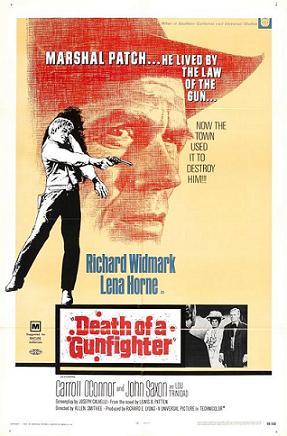
A Movie A Day #244: Death of a Gunfighter (1969, directed by Allen Smithee)


At the turn of the 20th century, the mayor and the business community of Cottonwood Springs, Texas are determined to bring their small town into the modern era.  The Mayor (Larry Gates) has even purchased one of those newfangled automobiles that have been taking the country by storm.  However, the marshal of Cottonwood Spings, Frank Patch (Richard Widmark), is considered to be an embarrassing relic of the past.  Patch has served as marshal for 20 years but now, his old west style of justice is seen as being detrimental to the town’s development.  When Patch shoots a drunk in self-defense, the town leaders use it as an excuse to demand Patch’s resignation.  When Patch refuses to quit and points out that he knows all of the secrets of what everyone did before they became respectable, the business community responds by bringing in their own gunfighters to kill the old marshal.
Death of a Gunfighter is historically significant because it was the very first film to ever be credited to Allen Smithee.  The movie was actually started by TV director Robert Totten and, after Widmark demanded that Totten be fired, completed by the legendary Don Siegel.  Since Totten worked for 25 days on the film while Siegel was only on set for 9, Siegel refused to take credit for the film.  When Widmark protested against Totten receiving credit, the Director’s Guild of America compromised by allowing the film to be credited to the fictitious Allen Smithee.

In the years after the release of Death of a Gunfighter, the Allen (or, more often, Alan) Smithee name would be used for films on which the director felt that he had not been allowed to exercise creative control over the final product.  The Smithee credit became associated with bad films like The O.J. Simpson Story and Let’s Get Harry which makes it ironic that Death of a Gunfighter is not bad at all.  It’s an elegiac and intelligent film about the death of the old west and the coming of the modern era.  It also features not only one of Richard Widmark’s best performances but an interracial love story between the marshal and a brothel madame played by Lena Horne.  The supporting cast is full of familiar western actors, with Royal Dano, Harry Carey, Jr., Larry Gates, Dub Taylor, and Kent Smith all making an impression.  Even the great John Saxon has a small role.  Though it may be best known for its “director,” Death of a Gunfighter is a film that will be enjoyed by any good western fan.

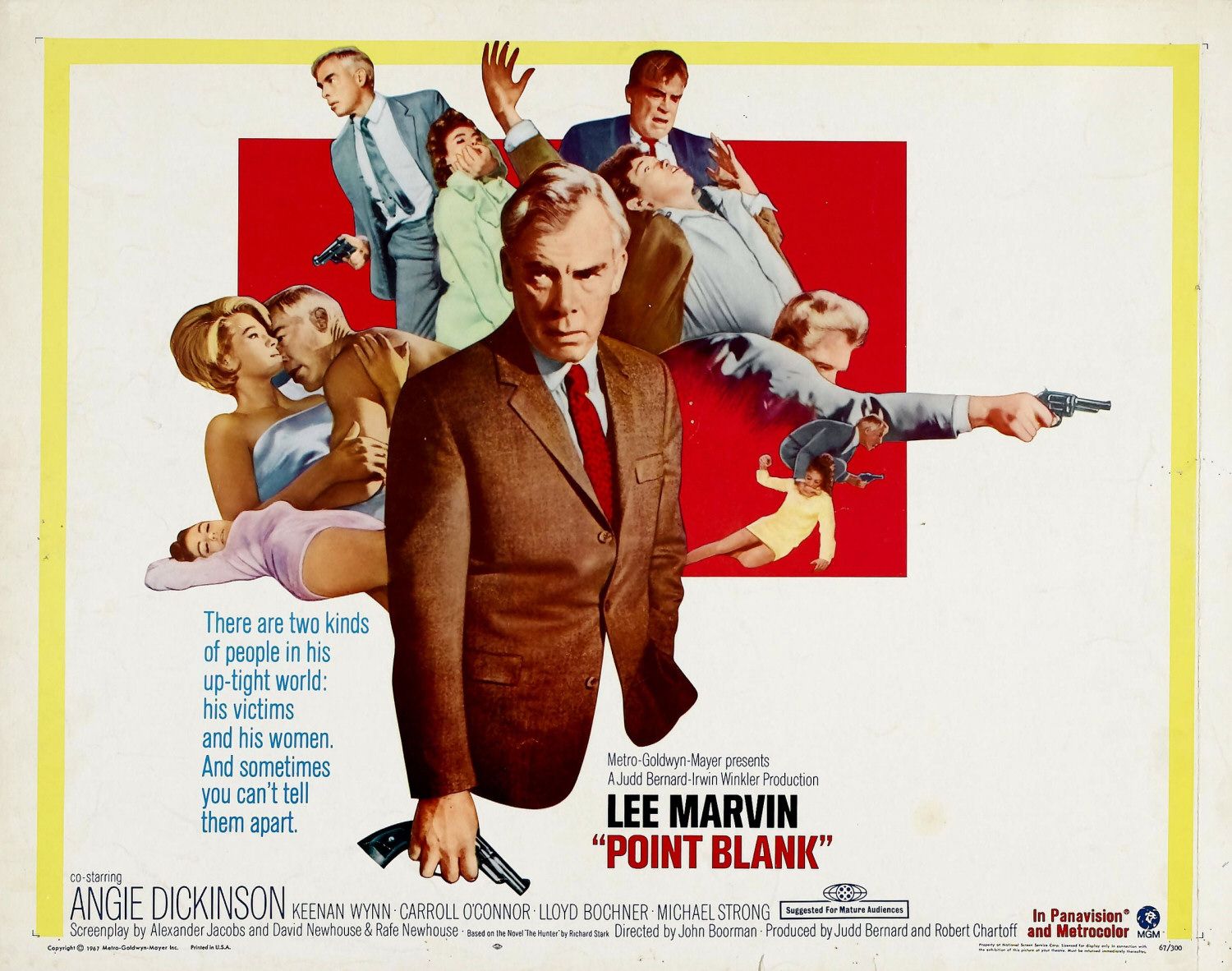
Let’s Get Physical: Lee Marvin in POINT BLANK (MGM 1967)


gary loggins's avatarcracked rear viewer

point1

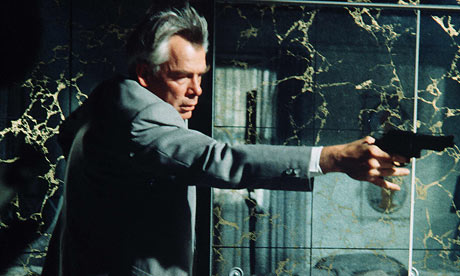
Lee Marvin  was one tough son of a bitch both onscreen and off, awarded the Purple Heart after being wounded by a machine gun blast in WWII.  The ex-Marine stumbled into acting post-war, and Hollywood beckoned in the 1950’s. His imposing presence typecast him as a villain in films like HANGMAN’S KNOT, THE BIG HEAT , and BAD DAY AT BLACK ROCK. A three season stint in TV’s M SQUAD brought Marvin more acclaim, and he solidified that with his Oscar-winning role in CAT BALLOU, parodying his own tough-guy image. Marvin was now a star that could call his own shots, and used that clout in POINT BLANK, throwing out the script and collaborating with a young director he had faith in, John Boorman.

point2

POINT BLANK is a highly stylized revenge drama centering on Marvin’s character of Walker. The nightmarish opening sequence shows how Walker was left for dead on deserted Alcatraz Island by…

View original post 488 more words

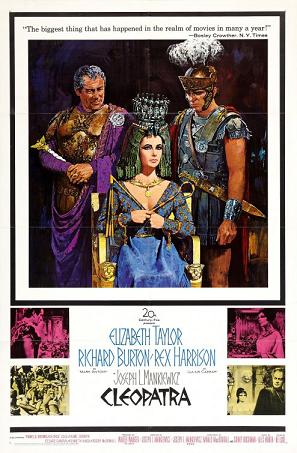
Embracing the Melodrama Part II #26: Cleopatra (dir by Joseph L. Mankiewicz)


Cleopatra_posterWhile watching the 1963 best picture nominee, Cleopatra, I had many thoughts.  The film lasts over 4 hours so I had a lot of time to think.

For instance, I often found myself impressed by the sheer size of the production.  I marveled at the recreation of ancient Greece and Rome.  I loved looking at the ornate costumes.  I loved feeling as if I was taking a look back at what Rome may have actually looked like at the height of the Roman Empire.  Making it all the more impressive was that this film was made in the days before CGI.  When the film’s Romans walked through the streets of Rome, they weren’t just actors standing in front of a green screen.  They were walking down real streets and surrounded by real buildings.  It reminded me of the awe and wonder that I felt when I was in Italy and I was visiting the ruins of ancient Rome.

(I don’t know if any of the cast accidentally flashed everyone like I did when I visited during Pompeii on a windy day but considering how short some of the skirts on the men were, it wouldn’t surprise me if they did!)

And, as I marveled at the recreation of Rome, I also thought to myself, “How long is this freaking movie?”  Because, seriously, Cleopatra is an amazingly long movie.  It’s not just the film is over four hours long.  It’s that the film feels even longer.  Gone With The Wind, The Godfathers Part One and Part Two, Once Upon A Time In America; these are all long films but, because they’re so great, you never find yourself checking the time while watching.  Cleopatra is the opposite of that.  Cleopatra is a film that, at its slowest, will make you very much aware of how many seconds are in a minute.

I found myself marveling at the lack of chemistry between Elizabeth Taylor and Richard Burton.  If anything, this is the most shocking thing about Cleopatra.  If Cleopatra is famous for anything, it’s famous for being the film where Elizabeth Taylor (cast in the role of Cleopatra) first met Richard Burton (who was playing Mark Antony).  Their affair dominated the gossip headlines.  (If TMZ and YouTube had been around back then, there would be daily videos of Richard Burton punching out paparazzi.)  Cleopatra was the first of many big-budgeted, overproduced films that Taylor and Burton co-starred in.

(Then again, they also starred in Who’s Afraid of Virginia Woolf, a film that is almost the exact opposite of Cleopatra.)

In the role of Mark Antony, Burton spends most of the film looking absolutely miserable.  Elizabeth Taylor, meanwhile, seems to be having a lot more fun.  It’s almost as if she understood what Cleopatra was going to become so she went out of her way to give the type of over-the-top performance that the film deserved.  The same can also be said about Rex Harrison, who plays Julius Caesar and who, perhaps because he appears to have shared her attitude, actually does have some chemistry with Taylor.

Actually, if anyone gives a truly great performance in Cleopatra, it’s Roddy McDowall.  McDowall plays the future Emperor Augustus with a mesmerizing intensity.  Again, McDowall’s performance is not exactly subtle but Cleopatra is not a film that demands subtlety.

As the film finally neared its end, I found myself wondering how Joseph L. Mankiewicz went from directing two close to perfect films, A Letter To Three Wives and All About Eve, to directing this.  Even more amazing, Mankiewicz had previously directed one of the best Roman Empire films ever, 1953’s Julius Caesar.  (When compared to Cleopatra, the low-key and thoughtful Julius Caesar appears to have been filmed on an entirely different planet.)  Well, in Mankiewicz’s defense, he was not the original director.  He was brought in to replace Rouben Mamoulian, who had previously attempted to make the film with Joan Collins, Ben-Hur‘s Stephen Boyd, and Peter Finch.  When Mankiewicz was brought in, the cast was replaced with Taylor, Burton, and Harrison.  Between the expensive stars, the troubled production, and all of the offscreen romantic melodrama, Mankiewicz probably did the best that he could.

Today, Cleopatra is mostly interesting as an example of a film from the “Only Gigantic Productions Will Save Us From Television!” era of Hollywood filmmaking.  Cleopatra started out as a $2,000,000 production and ended up costing $31,000,000.  It was the number one film at the 1963 box office and it still nearly bankrupted 20th Century Fox.  While the film does have some kitsch appeal, the critics hated it and it’s easy to see why.

And yes, it was nominated for best picture of the year, a tribute to the size of the production and the determination of 20th Century Fox to get something — anything — in return for their money.

Cleopatra is a bit of a chore to sit through but it can be fun if you’re in a snarky mood.  It’ll do until the inevitable Angelina Jolie remake comes along.