Retro Television Review: St. Elsewhere 3.10 “Girls Just Want To Have Fun”


Welcome to Retro Television Reviews, a feature where we review some of our favorite and least favorite shows of the past! On Fridays, I will be reviewing St. Elsewhere, a medical show which ran on NBC from 1982 to 1988.  The show can be found on Daily Motion.
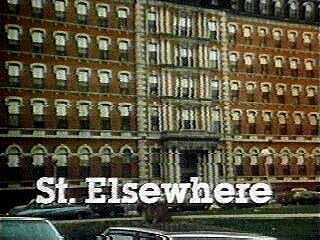
This episode proves that Dr. Cavanero is the worst.

Episode 3.10 “Girls Just Want To Have Fun”

(Dir by Bruce Paltrow, originally aired on November 28th, 1984)

The struggle is real.

Seriously, I am thankful that someone uploaded St. Elsewhere to Daily Motion.  With the show no longer on Hulu and Prime only having the first season available, Daily Motion is pretty much the only place where I can stream the show.  That said, the sound quality is not great.  The sound quality wasn’t particularly good when the show was on Hulu either but at least then I could turn on the captions.  The Daily Motion uploads don’t have that option.  I had to strain to hear the dialogue and, as a result, this review is not going to be as in-depth as it could be.

What I can tell you is that Dr. Cavanero is now one of the least sympathetic characters that I have ever seen on a television show.  Last week, Dr. Christine Holz (Caroline McWilliams) told Cavanero that she was a lesbian.  This week, Cavanero blabbed that information around the hospital, leading to a lot of homophobic comments from certain members of the stuff.  (Not surprisingly, Victor Ehrlich was there to say something stupid.)  Cavenero admitted to Christine that she found Christine’s lifestyle to be “unnatural.”  Christine smiled sadly and left Cavanero’s apartment and left the show.  Keep in mind, Dr. Holz was portrayed as being a brilliant surgeon and bone marrow expert.  It probably would have been good to keep her around the hospital for a little while but nope.  Sorry.  Dr. Cavanero — who really hasn’t done anything of note since the first season — felt uncomfortable.

(Originally, Christine and Cavanero were supposed to have a romantic relationship but Cynthia Sikes, the actress playing Cavavero, objected to the storyline.  As a result, the story was rewritten and perhaps it’s not a coincidence that Cavanero comes across as being a bit of a homophobe.)

Meanwhile, Dr. Chandler was concerned when he discovered that a neighborhood woman (Beah Richards) was practicing medicine out of her apartment.  This storyline at least gave Denzel Washington more to do than usual, which was good.  St. Elsewhere, at least so far, has often tended to underuse both Chandler as a character and Washington as an actor.

Jack’s friend (John Schuck) insisted on doing an experimental kidney procedure to try to save the life of his daughter (Brandy Gold) and Dr. Auschlander finally gave his approval for it to be done.  I would say that was a good thing except for the fact that Jack’s storylines hardly ever have a happy ending.  There’s a reason why Morrison is the most depressed resident in the hospital.

Nurse Rosenthal continued her affair with Richard Clarendon, even though Richard’s wife (Beverly Sanders) is now working at the hospital.  Wow, that’s going to be awkward.  In fact, I hope it’s really awkward.  I’m tired of Nurse Rosenthal and her holier-than-thou attitude.

Dr. Craig testified at a city council hearing.  The poor sound quality kept me from fully understanding what the hearing was about but at Dr. Craig told everyone off.  It’s always fun to watch William Daniels tell people off.

Here’s hoping the sound will be a bit less muddy next week!


Retro Television Review: St. Elsewhere 3.9 “Up On The Roof”


Welcome to Retro Television Reviews, a feature where we review some of our favorite and least favorite shows of the past! On Fridays, I will be reviewing St. Elsewhere, a medical show which ran on NBC from 1982 to 1988.  The show can be found on Daily Motion.

This week, an arrest is made.

Episode 3.9 “Up On The Roof”

(Dir by Eric Laneuville, originally aired on November 21st, 1984)

It’s another busy day at St. Eligius.

  • The last of the firemen (Stephen Elliott) is finally sent home.  At first, he’s bitter about all of the skin grafts and all the other work that Dr. Caldwell did on him.  But then his grandkids come in the hospital and room and shout, “Grandpa!”  And then he steps outside and is greeted by all the other firemen.  He leaves in a fire truck and Dr. Caldwell — the only angst-free doctor at St. Eligius — smiles and waves.  Finally, someone on this show gets a happy ending.
  • Ms. Hufnagel continues to get on everyone’s nerves with her constant complaints.  Dr. Fiscus dumps her on Dr. Axelrod.  While the show seems to want us to be as annoyed with Ms. Hufnagel as everyone else, I have to admit that I feel sorry for her.  Does she complain a lot?  Yes, she does.  But being in a hospital can really be scary.  I complained a lot whenever I was rushed to the ER because of my asthma.  I complained a lot when my mom was in the hospital.  I complained a lot when my dad was in the hospital.  I complained a lot when my aunt was in the hospital.  Sometimes, complaining is the only comfort you have.
  • Dr. Morrison is upset when a friend (John Schuck) is told that his daughter cannot be treated with an experimental dialysis machine.
  • Nurse Rosenthal continues to have an affair with Richard Clarendon, the labor negotiator.
  • Dr. Christine Holz (Caroline McWilliams) comes to the hospital to perform a bone marrow transplant.  Dr. Annie Cavanero invites Dr. Holz to come to her place for dinner.  Cavanero is shocked when Dr. Holz reveals that she’s a lesbian and the viewer is once again reminded that this show aired in the mid-80s.
  • According to what I’ve read online, the original plan was for Dr. Holz to become Cavanero’s romantic partner but Cynthia Sikes refused to kiss another woman onscreen.  This led to the storyline being hastily rewritten and it apparently also led to Sikes being fired from the show at the end of the third season.
  • Kathy Martin is still in the psych ward.  When Detective Alex MacGallen (Charles Lanyer) attempts to question her about where she was when Peter White was shot, he is informed by Kathy’s doctor that Kathy has an alibi.  Later, Shirley comes to the psych ward and slips Kathy a letter.
  • Shirley has been hiding the gun that she used to shoot Peter all over the hospital.  However, when the detective finally confronts her and reveals that he knows that she killed Peter, Shirley pulls the gun on him and then run up to the rooftop.
  • On the roof, Dr. Westphall and Jack take their turns trying to convince Shirley to surrender to the police.  After Shirley confesses and then demands to know why Jack didn’t make more of an effort to stop Peter, Shirley drops her gun and is taken into custody.

This was a depressing episode, even by the standards of St. Elsewhere.  Shirley has always been one of my favorite characters and I hate the idea that she’s now going to go to prison for killing Dr. White.  From a narrative point of view, someone had to shoot Peter.  That was really the only way his story could end.  Personally, I think it would have made more sense for Dr. Cavanero to be the shooter that Shirley.  I mean, if Cavanero was going to be written off the show anyway, killing Dr. White would have given her a decent exit.

Next week, I’m sure something else depressing will happen.  We’ll see!

October True Crime: Into Thin Air (dir by Roger Young)


Originally broadcast in 1985, Into Thin Air is a made-for-TV movie that is based on a true story.  It’s film that brings to life the horror of every family’s nightmare.  Brian Walker (Tate Donavon) is an intelligent, soft-spoken, and somewhat naive college student in Ottawa.  He’s been accepted into a summer writing program in Colorado.  As he gets in the van that he will be driving to Colorado, he promises his mother, Joan (Ellen Burstyn), that he’ll call her when he reaches Nebraska and again when he reaches Colorado.

Brian drives away and that’s the last time that Joan ever sees her son.  Brian calls from Nebraska and talks to his brother, Stephen (Sam Robards).  Joan arrives home just as Stephen is saying goodbye.  Brian never calls from Colorado.  He has vanished, seemingly into thin air.

Joan, Stephen, and Joan’s ex-husband, Larry (played the great character actor Nicholas Pryor) travel to America to search for him.  At one point, Stephen thinks that he’s spotted Brian’s van on the road and chase after it, just to discover that it’s a different van.  Joan talks to cops in Nebraska and Colorado and discovers that different jurisdictions don’t work together or share information.  As the days pass, Joan keeps hoping that Brian is somehow still alive….

I was about ten minutes into this film when I started sobbing.  I pretty much cried through the entire film.  Some of that was because I knew that they were never going to see Brian again.  Some of that was because of the powerful, heartfelt performances of Ellen Burstyn, Nicholas Pryor, and Sam Robards.  Most of it was because this film did such a good job of capturing the feeling of hopelessness and the dread that comes with not knowing what has happened to someone who you love.  I found myself crying for Brian’s lost potential.  He was a writer and he was engaging in a time-honored writing tradition.  He was taking a road trip and he was discovering the world.  He deserved better than whatever happened to him.  He deserved see his novel sitting in a bookstore.  Instead, he ran into the wrong people.

It’s the little details that really got to me.  Stephen flies into a rage when he sees his younger brother wearing one of Brain’s sweaters.  Joan momentarily gets her hopes up when she discovers that Brian reported some lost traveler’s checks, just to have that hope shot down when she’s told that the bank can’t reveal where Brian called them from unless Brian himself gives permission.  When the van eventually turn up in Maine, it’s been totally trashed by whoever took it from Brian.

Eventually, Joan hires a private detective and Robert Prosky is well-cast as Jim Conway, a seemingly cynical ex-cop who dedicates himself to trying to provide closure for the Walkers.  The scene where he finally discovers what happened to Brian is one of the strongest in the film and one of the most upsetting.  So many people could have saved Brian if they only had the courage to speak up.

Into Thin Air is a powerful film.  No one should ever be forgotten.