The TSL Grindhouse: Bummer (dir by William Alan Castleman)


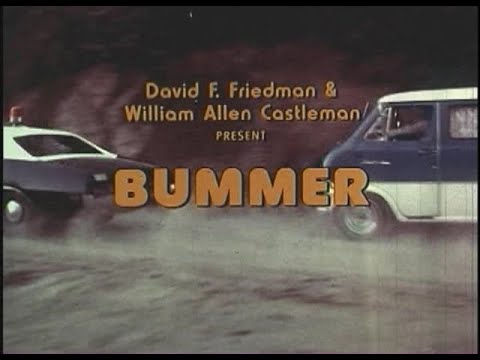
The 1973 film Bummer tells the story of a California rock band known as The Group.

The Group plays groovy music with a mellow feel.  The music they play doesn’t sound so much like actual 70s California rock as much as it sounds like what someone from the big band era would have assumed mellow 70s California rock sounded like.  The Group is led by the charismatic Duke (Kipp Whitman).  The lead guitarist and the drummer look like groovy dudes as well.  But then there’s Butts (played by the great character actor, Dennis Burkley), the bass player.  Butts is a big fat slop with a beard, unwashed hair, and a genuine aura of grime.  Duke’s girlfriend tells Duke that he really should kick Butts out of the band.  The problem is that Duke owns the van that the Group travels around in.  It’s the type of 70s van that was probably nicknamed “The Second Base Mobile.”

Well, Duke really should have considered kicking Butts out of the band because it turns out that Butts is crazy.  He’s a sociopath with a mother fixation and, when he realizes that he’s the only member of the band who isn’t getting laid on a regular basis, he goes crazy and starts assaulting and murdering groupies.

It’s a bummer!

This film was produced by David Friedman, the genial sexploitation producer who is best-known for his collaborations with Herschell Gordon Lewis.  Lewis did not direct Bummer and I have to say that I was a little bit surprised to discover that because there’s a scene at a strip club that goes on for so long and which features so many pointless close-ups of pervy men staring up at the dancers that I immediately assumed that Lewis must have, at the very least, snuck onto the set and supervised it.  Instead, the film was directed by William Allen Castleman, who also did directed Johnny Firecloud and The Erotic Adventures of Zorro.  So be it.  I’m still convinced that Lewis has something to do with this movie.

Bummer is one of those films about how wasteful the younger generation is, with their mellow rock music and their bongs and their groupies.  The film’s main message seems to be that anyone under the age of 30 is intellectually vapid and spiritually empty but at least they look good without their clothes on.  It’s a mix of exploitation and nostalgia.  “You know who didn’t murder groupies?” the film seems to be saying, “Glenn Miller, that’s who.”

The film is pretty dull.  Scenes drag.  It takes forever for any sort of plot to develop.  Most of the cast is forgettable but Dennis Burkley makes an impression as the unhinged bass player and watching him in this, it’s easy to understand why be became such a busy character actor.  There’s an authentic edge to Burkley, one that comes through even in this film.  One of the groupies is played by Carol Speed, who would later appear in Disco Godfather and warn people about the dangers of “whack attack.”  Oddly enough, the film looks surprisingly good.  Cinematographer Gary Graver worked on films like this in between working on Orson Welles’s The Other Side Of The Wind.

In the end, Bummer lives up to its title.
Retro Television Review: Getting Away From It All (dir by Lee Philips)


Welcome to Retro Television Reviews, a feature where we review some of our favorite and least favorite shows of the past!  On Sundays, I will be reviewing the made-for-television movies that used to be a primetime mainstay.  Today’s film is 1972’s Getting Away From It All!  It  can be viewed on YouTube.

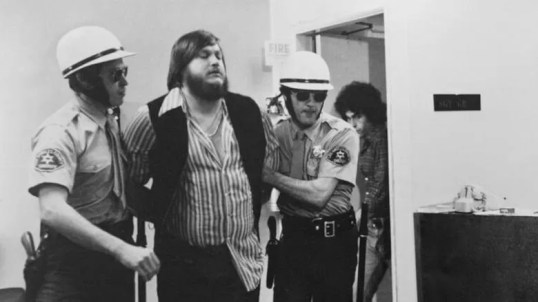
For Fred Clark (Larry Hagman) and Mark Selby (Gary Collins), life is New York City just isn’t that much fun anymore.  The weather is terrible.  The traffic cannot be navigated.  The only people ruder than the cabbies are the doormen.  Fred and Mark have come up with the perfect plan.  They’ve decided to move to a small country town and purchase a house on a small island.  In fact, they’re going to buy the entire island!  It’s surprisingly cheap.  Fred and Mark don’t ever really stop to wonder why the island is available for so little money.  Seriously, if you’re buying an island, you should probably ask yourself those questions.

Mark’s wife, Alice (E.J. Peaker), is enthusiastic about the idea.  Less excited is Fred’s wife, Helen (Barbara Feldon).  Helen enjoys living in the city and having a nice job in an office building.  She gets along with her boss (played by Jim Backus, one of many veteran actors to show up in a small role in this film).  Perhaps hoping that Fred will change his mind once he’s confronted with the reality of actually living in the country, Helen finally gives in.

It does turn out that the island is not quite the paradise that Fred and Mark were expecting.  The only way to get out to the island is in a leaky rowboat.  The house is falling apart and, as Helen is disgusted to learn, it also doesn’t have indoor plumbing.  There’s no electricity either but fortunately, the local handyman is working on it.  His name is Herbie and he’s played by a very young and thin Randy Quaid.  If you’ve ever wanted to hear Randy Quaid speak with an exaggerated New England accent, this is the film for you.  There’s nothing convincing about Quaid’s accent but it still seems only fair, considering all of the Yankee actors who have butchered the Southern accent over the years.

Just when it looks like Fred and Mark have managed to make the Island livable, they get a disturbing letter.  As the new owners of the Island, they owe 20 years worth of back taxes.  As Fred puts it, the tax bill is more than either of them can afford.  If they can’t raise the money, the town will take back the Island.   Fred and Mark consider trying to get jobs but it turns out that neither one of them knows much about being fisherman.  They then decide to charm the town into nullifying the tax bill.  That turns out to be more difficult than either man imagines.

Getting Away From It All is a comedy that deals with a universal theme, the desire to escape from the harshness of everyday life and find a perfect place to which to escape.  That said, the film’s main reason for existing is a parade of comedic cameos.  Jim Backus, Vivian Vance, Joe E. Ross, Burgess Meredith, Paul Hartman, and J. Pat O’Malley all appear in small roles, appearing just long enough for 1972 viewers to say, “Hey, I recognize that person!”  The end result is a rather shallow film that has a few chuckle-worthy moments.  (Again, Randy Quaid pretending to be from Maine has to be worth something.)

In the end, for all of the film’s celebration of getting away from it all, it’s hard not to feel that Gary, Mark, Alice, and Helen will all end up back in Manhattan sooner than later.  Some people are just city folks.

The TSL Horror Grindhouse: Abby (dir by William Girdler)


Some films are a hundred times more entertaining than they have any right to be and that’s certainly the case with 1974’s Abby.

A blaxploitation take on The Exorcist and Rosemary’s Baby, Abby opens with Bishop Garrett Williams (William Marshall, star of Blacula) taking a peaceful stroll with his students at seminary.  Garrett talks about how he will miss them all when he is off on archeological dig in Nigeria.  One of his students asks him some questions about Eshu, one of the spirits of the Yoruba religion.  Bishop Williams explains that Eshu is a trickster and a force of chaos and carnal excess.  Yes, the Bishop explains, he does believe that demons are real.

And indeed, no sooner has the Bishop gone to Nigeria and opened up a small puzzle box adorned with the symbols of Eshu than a demon claiming to be Eshu travels from Africa to Louisville, Kentucky.  Louisville is the new home of the Bishop’s son, Reverend Emmett Williams (Terry Carter).  Reverend Williams is a good and god-fearing man and his new wife, Abby (Carol Speed), is a devout Christian who sings in the choir, speaks out against drugs, and never curses.  That changes, however, once the demon claiming to be Eshu gets inside of her.  Soon, Abby is speaking in a very deep voice, laughing at inappropriate moments, demanding constant sex, and plunging a knife into her arm.  When the now possessed Abby disappears into the sordid nightlife of Louisville, Reverend Williams and his brother-in-law, Det. Cass Potter (Austin Stoker), try to find her.  Eventually, Bishop Williams joins them in their search, knowing that even if they find Abby, it will fall to him to perform the exorcism to save her life and soul.

Abby has so much in common with The Exorcist that Warner Bros. actually ended up suing the film’s producers and distributor for plagiarism.  That lawsuit is one reason why it’s not particularly easy to see Abby today.  Indeed, I had to resort to watching a washed-out upload on YouTube.  Of course, Abby was hardly the first or the last film to rip off The Exorcist.  Almost every horror released in the wake of William Friedkin’s classic shocker owes something to The Exorcist.  Abby, however, was one of the more finanically successful rip-offs of the film, or at least it was until the lawsuit led to it being removed from theaters.  It’s unfortunate that Abby is so difficult to see because it’s actually one of the more entertaining Exorcist rip-offs out there.

A lot of that is due to the confrontation between the dignified and stately William Marshall and the far more hyperactive Carol Speed.  Carol Speed gives a performance of amazing energy, whether she’s happily cackling after a woman drops dead of a heart attack or if she’s kicking her husband in the groin.  Carol Speed holds nothing back and basically tears through every scene like a force of uncontrollable nature.  She provides the perfect counterbalance to Marshall’s more measured performance as the Bishop.  Marshall delivers his lines with such authority and conviction that the viewer has no doubt he could probably scare the devil out of everyone.  Carol Speed, meanwhile, is so good at playing wild that the viewer wonders how, even if they can get Eshu out of here, Abby will ever be able to go back to being a demure preacher’s wife.  Setting Marshall and Speed loose in the seedy nightclubs of Loiusville leads to an occasionally horrific, occasionally silly, but always entertaining between good and evil.

Abby is an entertaining horror film.  It’s just unfortunate that we will probably never get to see a good print of it.  But then again, maybe that’s for the best.  The graininess of the version that I saw actually added to the experience of watching the film.  It made me feel like I was in some small theater in the middle of nowhere, watching a print of the film that had taken a long and difficult journey just so it could be seen and appreciated.

The TSL’s Grindhouse: Disco Godfather (dir by J. Robert Wagoner)


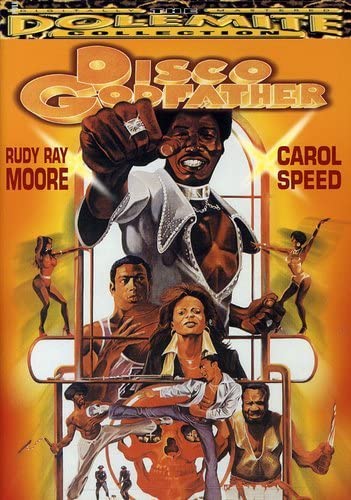
“Put your weight on it!” Tyrone Williams (Rudy Ray Moore) shouts at the start of 1979’s Disco Godfather.  It’s a phrase that he regularly employs as he encourages everyone at the local disco to hit the dance floor and show off their moves.  All Tyrone has to do to get people to dance is to shout out his catch phrase.  He’s such a beloved figure in the community that most people just call him, “Godfather.”

The Godfather is the uncle of Bucky Williams (Julius Carry), a promising young basketball star who seems to have his entire future ahead of him.  However, what the Godfather doesn’t know is that Bucky has fallen in with the wrong crowd and they’ve been pushing him to smoke …. ANGEL DUST!  Bucky’s girlfriend tries to warn him that he’s been smoking too much of “the whack” but Bucky doesn’t heed her warning.  Suddenly, Bucky is in the middle of the dance floor, freaking out as he imagines being attacked by zombie basketball players and a sword-wielding witch.  He also sees the Disco Godfather, telling him to calm down, but suddenly the Godfather is transformed into a skeleton!

After Bucky is subdued and taken down to the local PCP recovery center (which is full of users who are all screaming, rolling around on the floor, and generally acting whacked out), the Godfather decides that he can no longer stand by while his community is victimized by the PCP dealers.  With the help of Noel (Carol Speed), the Godfather starts a group called Angels Against Dust and starts a campaign to “attack the whack!”  While the Godfather tracks down the dealers, Noel holds a rally where, at one point, she announces that everyone is going to have to come together and “whack the attack.”

The fact that this obviously flubbed line was included in the final film tells you much about what makes Disco Godfather such an interesting viewing experience.  The film was shot very quickly and with very little money and, as such, second takes were a luxury that the film couldn’t afford.  However, there’s also an undeniable charm to the film’s low-budget style.  It’s amateurish but it’s amateurish in the most likable way possible.  Even in the case of the “whack the attack” line, it’s hard not to appreciate that Carol Speed didn’t let that one flub stop her from giving the rest of her speech.  By that same token, it’s also hard not appreciate that, later in the film, a never-before-seen character suddenly helps the Godfather fight off a bunch of pushers.  This character was played by Moore’s karate instructor and his appearance is totally random and yet totally appropriate.  In the world of Disco Godfather, the chaotic plotting is the point.  The more random the film becomes, the more it suggests a universe ruled by chance and coincidence.  The total lack of logic starts to make sense.  Werner Herzog would probably love this film if he ever saw it.

Rudy Ray Moore, of course, was a famously raunchy comic who was best-known for playing Dolemite in three films.  However, Disco Godfather finds him in a bit more of a dramatic mood, as he tours the local PCP ward and tells everyone he meets that they have to “attack the whack,”  Compared to the Dolemite films, there’s considerably less sex and profanity to be found in Disco Godfather.  There are several fight scenes and Rudy Ray Moore gets to show off his karate moves but the violence is never as over the top as it was in Dolemite.  The problem, however, is that Rudy Ray Moore was a natural-born comic and, as a result, every line that he utters, regardless of how serious the topic, sounds like its building up to a punchline.  Moore gets to do some dramatic acting at the end of the film, when the Godfather is himself force fed the whack and he starts to hallucinate various disturbing images.  “That’s not right, mama!” the Godfather says at one point and indeed, the trip sequence is the strongest part of the film, a genuinely surreal trip into the subconscious of a man who just wanted to encourage people to dance.

Disco Godfather is one of those films that you just have to see.  When Disco Godfather isn’t learning about PCP, he’s telling everyone to “put your weight on it” and, as a result, this film not only features a lot of anti-drug hysteria but it also features a lot of dancing.  This is very much a film of its time.  In one the film’s few deliberately funny moments, the album cover for the Saturday Night Fever soundtrack is seen covered in cocaine.  Of course, the Disco Godfather doesn’t need cocaine to have a good time and he certainly doesn’t need the whack.  He just needs the music and people willing to put their weight on it.

Disco Godfather was not a box office success when it was originally released, with Moore later saying that he made a mistake by toning down his persona for the film.  Moore was probably correct but, seen today, Disco Godfather is an enchantingly berserk time capsule.  Watch it and then be sure to watch Eddie Murphy play Rudy Ray Moore in the Netflix biopic, Dolemite Is My Name.