Today would have been the birthday of Burt Reynolds.
Our scene that I love is from 2018’s overlooked The Last Movie Star. In this scene, an elderly Burt Reynolds finds himself transported back to the days of Smokey and the Bandit, where he meets his younger self and takes a ride in a famous black sportscar. It turns out that the two Burts do not agree when it comes to observing the posted speed limit.
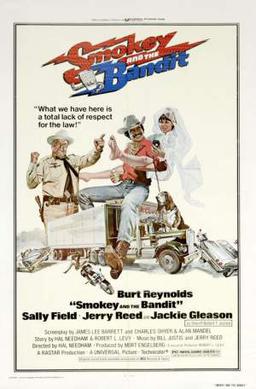
In honor of National Speed Limit Day, today’s scene that I love features Burt Reynolds breaking the speed limit over and over again in 1977’s Smokey and the Bandit. This scene is almost enough to make me want to go on a road trip.
BREAKING IN (1989) opens with veteran safecracker Ernie Mullins (Burt Reynolds) pulling a job at a rich guy’s house, only to be surprised when a young, amateurish thief named Mike (Casey Siemaszko) turns up at the same place to raid the fridge. Immediately taking a liking to the kid, Ernie decides to offer Mike a chance to learn his trade. Thus begins a partnership, and odd-couple friendship, where the two men pull a series of jobs together, with Ernie passing on his knowledge to his young protege who seems to be enjoying the sudden influx of cash into this life. Unfortunately, the generation gap causes some problems as Mike doesn’t necessarily take heed to Ernie’s advice to never being too greedy or flashy. Soon, Mike is renting high rise apartments and buying fancy cars with cash. When they pull a big job on the 4th of July, will Mike’s less than frugal ways drag them both down?!
Written by the excellent, independent writer and director John Sayles (MATEWAN, EIGHT MEN OUT) and directed by Scottish director Bill Forsyth (LOCAL HERO), BREAKING IN is a reminder of just how great Burt Reynolds is in the right role. In his 50’s at the time this was filmed, Reynolds gives a relaxed, lived-in, character performance that comes across as effortlessly cool, and he does it without having to rely on his trademark charm and big grin. The late 80’s were a time when Burt was no longer a box office superstar, and BREAKING IN seems to be an unjustly forgotten entry in his hugely successful career. After this, Burt would find TV success on EVENING SHADE, and he’d be nominated for an Oscar for his role in BOOGIE NIGHTS (1997), but his Ernie Mullins stands out to me as one of his last great film roles. Casey Siemaszko is good as Mike, but this is Reynolds’ show and he’s overshadowed even in a solid performance. As far as the other supporting performances, Sheila Kelley stood out to me as a sharp-tongued prostitute who Siemaszko falls in lust with. The poem she shares about a man’s “balls” is a highlight of the film as far as I’m concerned, and further illustrates the quality of Sayles’ screenplay!
I like the way that BREAKING IN feels low-key, even as the characters engage in their various criminal heists. This can be credited to director Bill Forsyth who turns what could have been a standard master / apprentice crime film into something that feels somewhat realistic. The pacing is slow as Reynolds passes on his knowledge, and for some people it may be too slow, but that’s one of the things I really liked about the movie. The two men really get to know each other. That way, when they have disagreements and blow ups a couple of times, they’re still able to respect each other and patch things up. That’s how things are in the real world, as opposed to most movies where a simple disagreement will almost certainly lead to ridiculous consequences. BREAKING IN respects its characters in a way that’s unique to most crime films.
At the end of the day, BREAKING IN is a gem that is at its best as a lighthearted character study of a professional thief whose time is passing him by. Burt Reynolds rarely got to play roles this subtle, and I think he made the most of the opportunity. As a big fan of Reynolds, I highly recommend this one.
Today, the Shattered Lens wishes a happy 78th birthday to actor Robert Englund.
Englund will forever be identified with the horror genre and Freddy Krueger. That said, before he first played Krueger in the first Nightmare on Elm Street, he was a busy character actor who appeared in roles both big and small. He was considered for Star Wars. He even played some sympathetic characters!
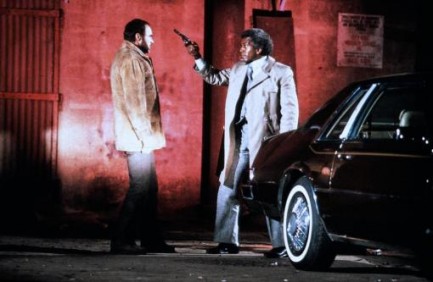
Of course, he’s not particularly sympathetic in today’s scene that I love. Here he is in 1975’s Hustle, bringing his intense style to the small role of a thief who pulls a gun on Burt Reynolds. This scene stands out for both Englund’s menace and Reynolds’s trademark cool. Of course, if you’ve seen the film, you know what this scene is going to lead to. The 70s were a dark time!
In 1984’s CityHeat, Clint Eastwood plays Lt. Speer, a tough and taciturn policeman who carries a big gun, throws a mean punch, and only speaks when he absolutely has to.
Burt Reynolds plays Mike Murphy, a private investigator who has a mustache, a wealthy girlfriend (Madeleine Kahn), and a habit of turning everything into a joke.
Together, they solve crimes!
I’m not being sarcastic here. The two of them actually do team up to solve a crime, despite having a not quite friendly relationship. (Speer has never forgiven Murphy for quitting the force and Murphy has never forgiven Speer for being better at everything than Murphy is.) That said, I would be hard-pressed to give you the exact details of the crime. CityHeat has a plot that can be difficult to follow, not because it’s complicated but because the film itself is so poorly paced and edited that the viewer’s mind tends to wander. The main impression that I came away with is that Speer and Murphy like to beat people up. In theory, there’s nothing wrong with that. Eastwood is legendary tough guy. Most people who watch an Eastwood film do so because they’re looking forward to him putting the bad guys in their place, whether it’s with a gun, his fists, or a devastating one-liner. Reynolds also played a lot of tough characters, though they tended to be more verbose than Eastwood’s.
That said, the violence in CityHeat really does get repetitive. There’s only so many times you can watch Clint punching Burt while various extras get gunned down in the background before it starts to feel a little bit boring. The fact that the film tries to sell itself as a comedy while gleefully mowing down the majority of the supporting cast doesn’t help. Eastwood snarls like a pro and Reynolds flashes his devil-may-care smile but, meanwhile, Richard Roundtree is getting tossed out a window, Irene Cara is getting hit by a car, and both Kahn and Jane Alexander are being taken hostage. Tonally, the film is all over the place. Director Richard Benjamin was a last-minute replacement for Blake Edwards and he directs without any sort of clear vision of just what exactly this film is supposed to be.
On the plus side, CityHeat takes place in Kansas City in 1933 and the production design and the majority of the costumes are gorgeous. (Unfortunately, the film itself is often so underlit that you may have to strain your eyes to really appreciate it.) And the film also features two fine character actors, Rip Torn and Tony Lo Bianco, are the main villains. For that matter, Robert Davi shows up as a low-level gangster and he brings an actual sense of menace to his character. There are some good things about CityHeat but overall, the film is just too messy and the script is a bit too glib for its own good.
Burt Reynolds and Clint Eastwood had apparently been friends since the early days of their careers. This was the only film that they made together. Interestingly enough, Reynolds gets the majority of the screentime. Eastwood may be top-billed but his role really is a supporting one. Unfortunately, Reynolds seems to be kind of bored with the whole thing. As for Clint, he snarls with the best of them but the film really doesn’t give him much to do.
A disappointing film, CityHeat. Watching a film like this, it’s easy to see why Eastwood ended up directing himself in the majority of his films.
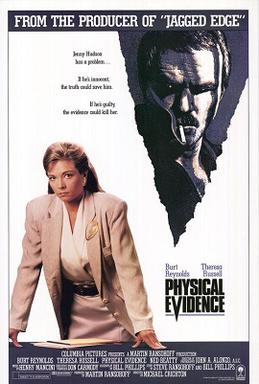
Ex-cop Joe Paris (Burt Reynolds) is arrested for the murder of a small-time criminal. Joe swears that he’s being framed but his public defender, Jenny Hudson (Theresa Russell), isn’t sure that she believes him. While Jenny’s boyfriend (Ted McGinley) makes a fortune trading stocks and Joe’s former mistress (Kay Lenz) tries to keep her mobster boyfriend from finding out about the affair, Jenny tries to outsmart prosecutor James Nicks (Ned Beatty) and Joe tries to find the real killer.
Tubi sent me to this film after I finished up RawJustice. When I saw that it was a Burt Reynolds films, I figured that I would take a chance with it but this one turned out to be one of Burt’s lesser films. Joe Paris feels like he might be distantly related to the cop that Burt played in Sharky’s Machine but PhysicalEvidence doesn’t have any of that movie’s style or grit. Burt doesn’t come across like he wants to be in the movie and he and a very miscast Theresa Russell have next to zero chemistry onscreen. This was Michael Crichton’s last film as a director and he directs in a stolid, made-for-television manner.
Supposedly, this was originally meant to be a sequel to the thriller JaggedEdge, with Glenn Close and Robert Loggia reprising their roles from the earlier film. When that fell through, the movie was refurbished into PhysicalEvidence, with Theresa Russell and Burt Reynolds replacing Close and Loggia. I think the film would have worked with Close and Loggia because, based on JaggedEdge, they were believable as people who had a close relationship and would do anything to help each other. Burt Reynolds and Theresa Russell come across like they can’t even stand to be in the same room together. Better get a new lawyer, Burt! This one seems like she might be planning on framing you herself.
1992’s The Player tells the story of Griffin Mill (Tim Robbins).
It’s not easy being Griffin Mill. From the outside, of course, it looks like he has the perfect life. He’s a studio executive with a nice house in Hollywood. He’s young. He’s up-and-coming. Some people, especially Griffin, suspect that he’ll be the president of the studio some day. By day, he sits in his office and listens to pitches from respected screenwriters like Buck Henry. (Henry has a great idea for The Graduate II!) During the afternoon, he might attends dailies and watch endless takes of actors like Scott Glenn and Lily Tomlin arguing with each other. Or he might go to lunch and take a minute to say hello to Burt Reynolds. (“Asshole,” Burt says as Griffin walks away.) At night, he might go to a nice party in a big mansion and mingle with actors who are both young and old. He might even run into and share some sharp words with Malcolm McDowell.
But Griffin’s life isn’t as easy as it seems. He’s constantly worried about his position in the studio, knowing that one box office failure could end his career. He fears that a new executive named Larry Levy (Peter Gallagher) is after his job. Two new screenwriters (Richard E. Grant and Dean Stockwell) keep bugging him to produce their downbeat, no-stars anti-capitol punishment film. His girlfriend (Cynthia Stevenson) wants to make good movies that mean something. Even worse, someone is sending Griffin threatening notes.
It doesn’t take long for Griffin to decide that the notes are coming from a screenwriter named Dave Kahane (Vincent D’Onofrio). Griffin’s attempt to arrange a meeting with Dave at a bar so that Griffin can offer him a production deal instead leads to Griffin murdering Dave in a parking lot. While the other writers in Hollywood mourn Dave’s death, Griffin starts a relationship with Dave’s artist girlfriend (Great Scacchi) and tried to hide his guilt from two investigating detectives (Whoopi Goldberg and Lyle Lovett). Worst of all, the notes keep coming. The writer, whomever they may be, is now not only threatening Griffin but also seems to know what Griffin did.
After spend more than a decade in the industry wilderness, Robert Altman made a critical and commercial comeback with The Player. It’s a satire of Hollywood but it’s also a celebration of the film industry, featuring 60 celebrities cameoing as themselves. Everyone, it seems, wanted to appear in a movie that portrayed studio execs as being sociopathic and screenwriters as being whiny and kind of annoying. The Player both loves and ridicules Hollywood and the often anonymous men who run the industry. Largely motivated by greed and self-preservation, Griffin may not love movies but he certainly loves controlling what the public sees. In the end, only one character in The Player sticks to her values and her ideals and, by the end of the movie, she’s out of a job. At the same time, Griffin has a social life that those in the audience can’t help but envy. He can’t step out of his office without running into someone famous.
The Player is one Altman’s most entertaining films, with the camera continually tracking from one location to another and giving as a vision of Hollywood that feels very much alive. Tim Robbins gives one of his best performances as Griffin Mill and Altman surrounds him with a great supporting cast. I especially liked Fred Ward as the studio’s head of security. With The Player, Altman mixes melodrama with a sharp and sometimes bizarre comedy, with dialogue so snappy that the film is as much a joy to listen to as to watch. That said, the real attraction of the film is spotting all of the celebrity cameos. (That and cheering when Bruce Willis saves Julia Roberts from certain death.) Altman was a director who often used his films to explore eccentric communities. With The Player, he opened up his own home.
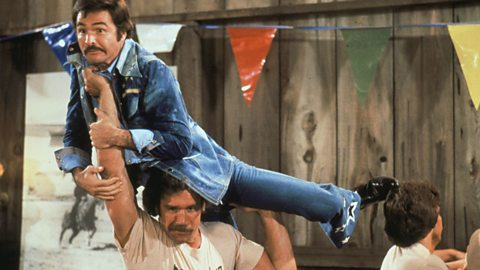
4 Shots From 4 Films is just what it says it is, 4 shots from 4 of our favorite films. As opposed to the reviews and recaps that we usually post, 4 Shots From 4 Films lets the visuals do the talking!
Burt Reynolds has his own section in my massive physical media collection. I love the guy. And he was massively popular in his prime. From 1978 – 1982, Reynolds was named the number one box office star in the United States by the Quigley Poll, an annual survey of movie exhibitors. He was a true movie star. Happy Birthday in heaven, Burt! Thanks for all the great entertainment you’ve provided in my life!
Deliverance (1972, directed by John Boorman, DP: Vilmos Zsigmond)
“Machines are going to fail!” Lewis Medlock says in Deliverance, delivering a line that feels even more relevant today than it might have in 1972. Lewis is the athlete and self-styled alpha male who drags his friends on a canoeing trip that involves some dangerous rapids. When Lewis suffers a compound fraction, it’s a shocking moment because, up until that point, Lewis seemed invulnerable to harm. Even when they return to civilization and Lewis learns he might lose his leg, he remains defiant.
Lewis was played by the late Burt Reynolds, who born 89 years ago today. In this scene that I love, Lewis explains his philosophy to his best friend and eventual savior, Ed Gentry (Jon Voight).
I love watching movies that are filmed in my home state of Arkansas. There’s something cool about seeing places I’ve been before showing up on the big screen, and if I haven’t been there before, I can go visit. We’ve had our share of big stars show up in the Natural State. Burt Reynolds, Billy Bob Thornton, Bill Paxton, Robert De Niro, Dennis Quaid, Matthew McConaughey, Tom Cruise, and Andy Griffith have all filmed really good movies here. Heck, Martin Scorsese directed one of his very first movies in southern Arkansas. It’s going to be fun revisiting some of my favorites and sharing them with you!
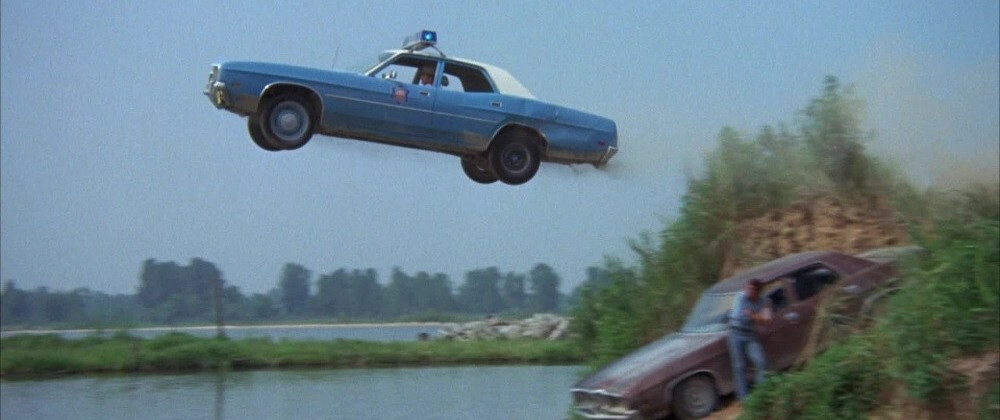
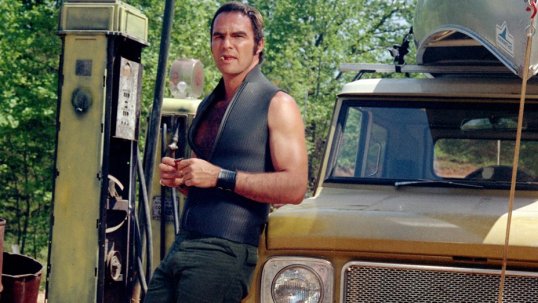
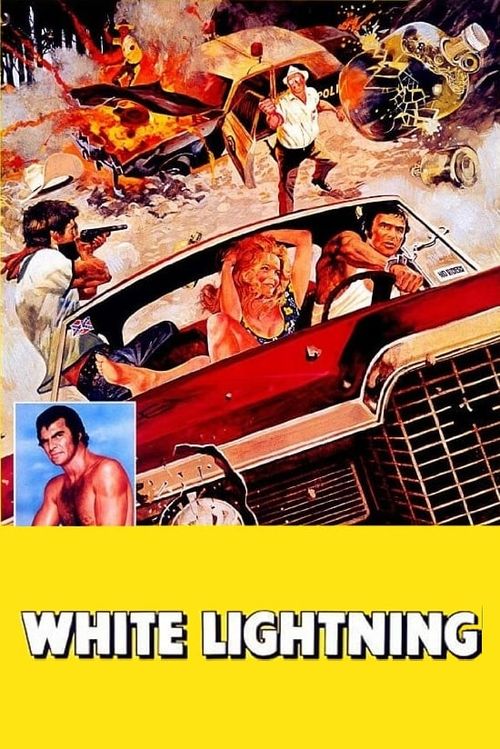
I’m kicking off #ArkansasMovies with WHITE LIGHTNING, the 1973 film from director Joseph Sargent that was filmed almost entirely within 30 minutes of my house in central Arkansas. Burt Reynolds is Gator McKlusky, a good ol’ boy who happens to find himself serving a stint in prison for “stealin’ cars, runnin’ cars, and runnin’ moonshine whiskey.” One day a cousin comes to visit him in prison and tells him that his younger brother Donny has been killed in Bogan County. Suspecting foul play, Gator first tries to escape. When that doesn’t work, he agrees to go stool pigeon and work with the federal authorities to infiltrate the world of illegal moonshining in Bogan County and provide them the names of the big money people in the area. This includes the crooked county Sheriff J.C. Connors (Ned Beatty), who Gator immediately zeroes in on as the key person responsible for his brother’s death.
In my opinion, WHITE LIGHTNING is one of the best of the good ‘ol boy, southern redneck films that were so popular in the 1970’s. One of the main reasons I like WHITE LIGHTNING so much is that while it does has some of the clowning that’s expected in these types of films, the tone gets deadly serious as McKlusky zeroes in on what happended to his brother. Reynolds is especially badass when he stops his signature laughing and goes into vengeance mode. And Ned Beatty is perfect casting as the small-town sheriff who is completely and irredeemably evil. The opening scene shows Beatty boating a couple of bound and gagged young men out into the middle of the lake, shooting a hole in the their boat, and then casually paddling away as the boat sinks. If you came up on him a little later, you’d think he was just heading in from a day of crappie fishing. For a guy that doesn’t look menacing at all on first glance, we know just how dangerous Sheriff J.C. Connors is. And so does Gator. We have a rooting interest in seeing Gator get his revenge.
The primary filming locations in WHITE LIGHTNING are practically in my backyard. My wife and I got married at the Saline County Courthouse in downtown Benton, which is featured very prominently in the film. It’s a beautiful courthouse, with a distinctive clock tower. They decorate it so beautifully for the Christmas season (see picture below). Burt also spends time at the “Benton Speedway” in the film. This is actually the old I-30 Speedway that was in operation in Little Rock for 66 years. Sadly, the Speedway held its final race on October 1, 2022, which is almost 50 years after filming completed. The rest of the locations used were also in central Arkansas in the towns of North Little Rock, Keo, Scott, Wrightsville, and Tucker. FYI, I don’t recommend poking around Tucker if you’re into film tourism. Tucker is the primary prison unit for the Arkansas Department of Corrections. If you do head that way, just don’t pick up any hitchhikers!
All in all, WHITE LIGHTNING is a movie I whole-heartedly recommend, and it’s especially meaningful to me since it’s so close to home. Billy Bob Thornton would be back in this same area in 1996 to film SLING BLADE.




 Through the Shattered Lens