Late Night Retro Television Review: Good Morning, Miss Bliss 1.1 “Summer Love”


Welcome to Late Night Retro Television Reviews, a feature where we review some of our favorite and least favorite shows of the past!  On Saturdays, I will be reviewing Good Morning, Miss Bliss, which ran on the Disney Channel from 1988 to 1989 before then moving to NBC and being renamed Saved By The Bell.  The entire show is currently streaming on Prime!
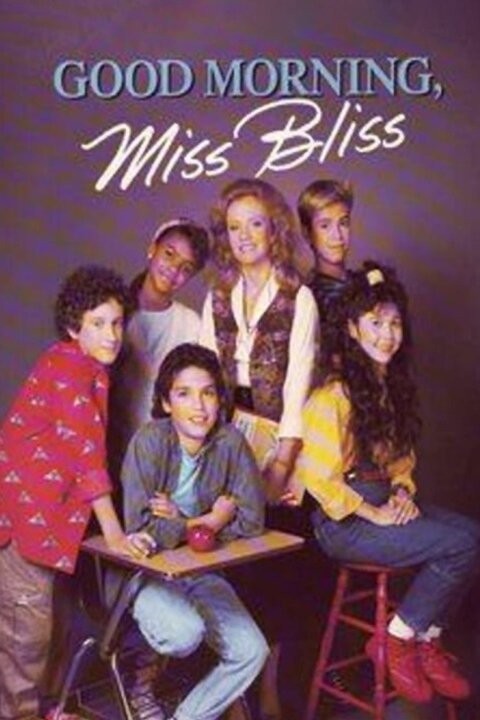
With Check It Out! finished, it’s time to review a new show.  Continuing this feature’s tradition of highlighting the work of executive producer Peter Engel, it’s time for Good Morning, Miss Bliss, the show that would eventually become Saved By The Bell!

Episode 1.1 “Summer Love”

(Dir by Burt Brinckerhoff, originally aired on November 30th, 1988)

It’s the first day of school at JFK Junior High, located in beautiful Indianapolis, Indiana.

Miss Carrie Bliss (Hayley Mills), our narrator, is looking forward to a new year as a history teacher.  The school’s principal, Richard Belding (a surprisingly thin Dennis Haskins) is worried about a new year of out-of-control students and angry parents.  Miss Bliss’s best friend, Ms. Tina Palladino (Joan Ryan), worries that Mr. Belding has given her a bad schedule because of a disappointing school play she directed the previous year.

Miss Bliss has a date, the first one since her husband died.  Brian (Barry Jenner) is handsome and successful but romance will have to wait as Miss Bliss deals with the problems of her homeroom students.  Over the summer, pathological liar Zack Morris (Mark-Paul Gosselaar) told a girl named Karen (Carla Gugino, in one of her first roles) that he would soon be starting the 9th grade.  Of course, Zack is actually starting the 8th Grade but he figured that he would never see Karen again so why not…. oh my God, this kid is a terrible human being!  Anyway, Karen transfers to JFK and Zack has to pretend to be in the 9th Grade.  He does this despite the fact that all of his friends, Mickey (Max Battimo), Nikki (Heather Hopper), Lisa (Lark Voorhees), and the nerdy Screech (Dustin Diamond), are in the 8th Grade and Zack’s homeroom is in an 8th grade classroom.

Got all that?

Needless to say, this episode would not be remembered today if not for the fact that it was the first appearance of Mr. Belding, Zack Morris, Lisa Turtle, and Screech Powers.  These characters were, of course, later retconned to be Californians when Saved By The Bell started.  Miss Bliss did not make the transition to California and for that, we should all be happy.  Even in this first episode, Miss Bliss comes across as being a self-righteous know-it-all who obviously feels that she’s too good for a junior high in Indiana.  In her first scene, she brags about getting a good class schedule, dismisses Tina’s concerns about her own class schedule, and then smirks as Mr. Belding talks about his anxiety.  This would pretty much be Miss Bliss’s signature style for the rest of the short life of Good Morning, Miss Bliss.

How do our regulars do in their first appearance as the characters that would make them famous?  Dennis Haskins gives a semi-realistic performance as Belding, playing him as being a harried pencil-pusher as opposed to the cartoonish figure he would become later on.  Mark-Paul Gosselaar and Lark Voorhies do well-enough as Zack and Lisa, though both of their characters are far more simpler here than they would become later.  Dustin Diamond was only 11 year old when he was cast as Screech and he looked and comes across as being several years younger.  (I recently saw an interview with Mark-Paul Gosselaar where he explained that the main reason why Diamond struggled to fit in with the rest of the cast was because he was considerably younger than everyone else on the show.  I would say that he was probably too young.  Imagine looking back on your life as an actor and realizing that you were permanently typecast by a role you first played when you were 11.)

Anyway, this was a forgettable but historically important episode.  Just imagine if it had never aired.
Film Review: Acapulco Gold (dir by Burt Brinckerhoff)


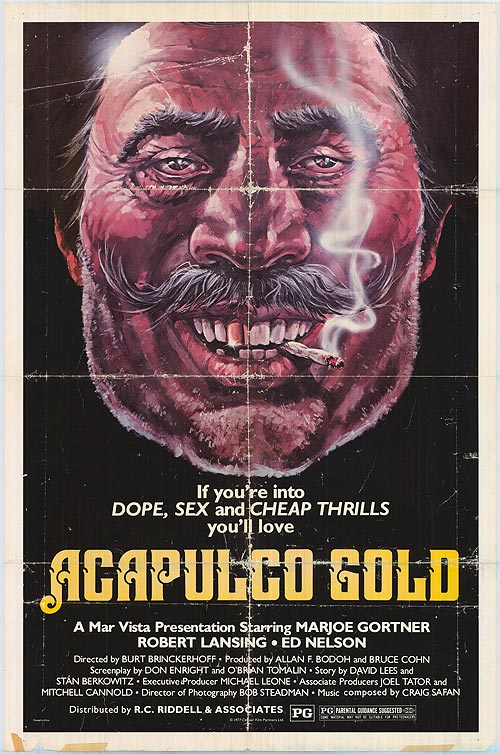
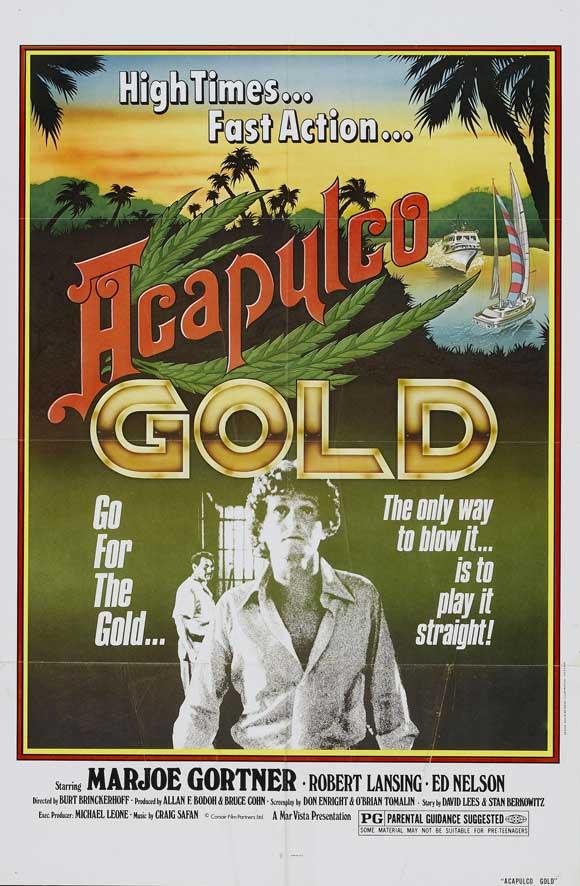
The poster is better than the film.

I just finished watching Acapulco Gold, a rather goofy 1976 film about …. well, who knows?

The film starts with some well-shot footage of marijuana farmers checking out their crop but then it abruptly abandons all of that to follow an American insurance salesman named Ralph Hollio (Marjoe Gortner). Ralph is at an airport in Acapulco, waiting to board a flight back to America. He’s approached by a nun who asks him to carry a piñata for her. Ralph says sure but — oh no! — that piñata is actually full of heroin! Ralph’s an unwitting drug mule and not a very good one because it doesn’t take long for him to get himself arrested and sentenced to 40 years in a Mexican prison.

Despite this run of bad luck, Ralph remains surprisingly cheerful. One is tempted to almost describe him as being a Candide-like figure but that would probably be giving this film too much credit. In prison, he meets another prisoner, a boat captain named Carl Solberg (Robert Lansing). Carl is sprung from jail by local businessman, Morgan Frye (John Harkins). Frye wants Carl to sail a boat from Mexico to Hawaii. Carl agrees but he insists that Morgan also pull some strings so that Ralph can serve as his first mate. Morgan, of course, agrees.

The film’s “action” shifts to Hawaii, where it turns out that Ralph and Carl are being used as a part of a much bigger plot. Or something. To be honest, it’s a bit difficult to figure out just what exactly is going on. Acapulco Gold has a make-it-up as you go along feel to it. Occasionally, it’s amusing. Often, it’s frustrating. As soon as you start to get in any way interested in one storyline, it gets abandoned. The film doesn’t have a plot as much as it has a bunch of scenes that we’re left to assume are meant to be somehow connected.

For instance, there’s an elderly couple who keep showing up at inopportune times, providing what I guess is meant to be comedic relief. At one point, it appears that the couple is surely doomed but, several scenes later, they show up at a golf course and they look none the worse for wear. There are lengthy sailing scenes, mixed in with lengthy helicopter scenes. None of them add much to the plot but the Hawaiian scenery is frequently nice to look at. Ralph falls for Morgan’s girlfriend (Randi Oakes) while a Congressman and a corrupt DEA agent use huge, oversized walkie-talkies to communicate with two people who we occasionally see wandering around in the jungle. There’s a golf cart chase, which ends with a labored joke about a two-strike penalty. And, since this is a low-budget 70s film, there’s a day-for-night sequence that is so ineptly lit that we can barely see anyone for several minutes of the movie. (Though his face may not be visible, one can always spot Marjoe Gortner by his hair. 70s Marjoe had a lot of hair.)

At its best, Acapulco Gold is a charmingly incoherent time capsule, a chance to hop in a time machine and go back to 1976. At its worse, it’s a total mess. That said, it’s short enough that it’s never exactly boring and the randomness of it all occasionally lends the film a dream-like atmosphere (albeit one of those dreams that you forget about after you’ve been awake for 87 minutes). As I previously stated the Hawaiian scenery is lovely and some members of the cast — Robert Lansing and Ed Nelson, in particular — do the best that they can with their inconsistently written characters. The whole thing is such a slapdash affair that it becomes oddly fascinating to watch.

As for the film’s star, Marjoe Gortner was a former child evangelist whose claim to fame was being the subject of Marjoe, a documentary in which he admitted that he didn’t believe in anything that he preached and that he was just scamming people out of their money. Perhaps not surprisingly, Gortner was usually best-cast as villains or unpredictable rogues. (His best performance was as a morally ambiguous space pirate in Starcrash.) In Acapulco Gold, Gortner is playing a normal, ordinary guy who finds himself caught up in the drug underworld. Gortner is miscast as a naive innocent and, instead of projecting any sort of shock over anything tht he experiences, Gortner’s laid back performance suggests that there were multiple reasons why this film was called Acapulco Gold.

Acapulco Gold is currently viewable on Prime. It’s not a particularly good film but Hawaii has always looked great.