Film Review: The Doors (dir by Oliver Stone)


I like The Doors.

That can be a dangerous thing to admit, about both the band and Oliver Stone’s 1991 film.  Yes, both the band and the film could be a bit pretentious.  They both tended to go on for a bit longer than necessary.  They were both centered around a guy who wrote the type of poetry that I used to love back in my emo days.  It’s all true.

But, with The Doors as a band, I find that I can’t stop listening to them once I start.  Even if I might roll my eyes at some of the lyrics or if I might privately question whether any blues song really needs an organ solo, I can’t help but love the band.  They had a sound that was uniquely their own, a psychedelic carnival that brought to mind images of people dancing joyfully while the world burned around them.  And say what you will about Jim Morrison as a poet or even a thinker, he had a good voice.  He had the perfect voice for The Doors and their rather portentous style.  From the clips that I’ve seen of him performing, Morrison definitely had a stage presence.  Morrison died young.  He was only 27 and, in the popular imagination, he will always look like he’s 27.  Unlike his contemporaries who managed to survive the 60s, Morrison will always eternally be long-haired and full of life.

As for The Doors as a movie, it’s definitely an Oliver Stone film.  It’s big.  It’s colorful.  It’s deliberately messy.  Moments of genuinely clever filmmaking and breath-taking visuals are mixed with scenes that are so heavy-handed that you’ll be inspired to roll your eyes as dramatically as you’ve ever rolled them.  Stone loved the music and that love comes through in every performance scene.  Stone also loves using Native Americans as symbols and that can feel a bit cringey at times.  Why would Jim Morrison, whose was of Scottish and Irish ancestry, even have a Native American spirit guide?  At its best The Doors captures the chaos of a world that it’s the middle of being rebuilt.  The 60s were a turbulent time and The Doors is a turbulent movie.  I’ve read many reviews that criticized The Doors for the scene in which Morrison gets involved in a black magic ceremony with a journalist played by Kathleen Quinlan.  I have no idea whether or not that scene happened in real life but the movie is so full of energy and wild imagery that the scene feels like it belongs, regardless of whether it’s true or not.  Stone turns Jim Morrison into the warrior-artist-priest that Morrison apparently believed himself to be and the fact that the film actually succeeds has far more to do with Oliver Stone’s  enthusiastic, no-holds-barred direction and Val Kilmer’s charismatic lead performance than it does with Jim Morrison himself.

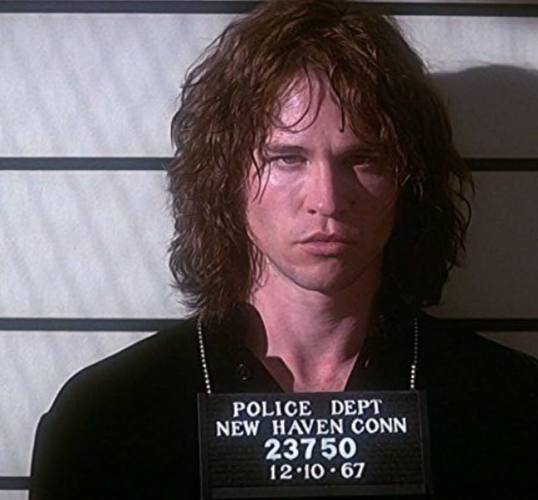
The Doors spent several years in development and there were several actors who, at one time or another, wanted to play Morrison.  Everyone from Tom Cruise to John Travolta to Richard Gere to Bono was considered for the role.  (Bono as Jim Morrison, what fresh Hell would that have been?)  Ultimately, Oliver Stone went with Val Kilmer for the role and Kilmer gives a larger-than-life performance as Morrison, capturing the charisma of a rock star but also the troubled and self-destructive soul of someone convinced that he was destined to die young.  Kilmer has so much charisma that you’re willing to put up with all the talk about opening the doors of perception and achieving a higher consciousness.  Kilmer was also smart enough to find the little moments to let the viewer know that Morrison, for all of his flamboyance, was ultimately a human being.  When Kilmer-as-Morrison winks while singing one particularly portentous lyric, it’s a moment of self-awareness that the film very much needs.

(When the news of Kilmer’s death was announced last night, many people online immediately started talking about Tombstone, Top Gun, and Top Secret.  For his part, Kilmer often said he was proudest of his performance as Jim Morrison.)

In the end, The Doors is less about the reality of the 60s and Jim Morrison and more about the way that we like to imagine the 60s and Jim Morrison as being.  It’s a nonstop carnival, full of familiar faces like Kyle MacLachlan, Michael Madsen, Crispin Glover (as Andy Warhol), Frank Whaley, Kevin Dillon, and a seriously miscast Meg Ryan.  It’s a big and sprawling film, one that is sometimes a bit too big for its own good but which is held together by both Stone’s shameless visuals and Val Kilmer’s charisma.  If you didn’t like the band before you watched this movie, you probably still won’t like them.  But, much like the band itself, The Doors is hard to ignore.
Lisa Marie Reviews An Oscar Nominee: Born On The Fourth of July (dir by Oliver Stone)


In 1989, having already won an Oscar for recreating his Vietnam experiences in Platoon, director Oliver Stone returned to the war with Born On The Fourth Of July.

Based on the memoir of anti-war activist Ron Kovic, Born on the Fourth of July stars Tom Cruise as Kovic.  When we first meet Kovic, he’s growing up on Long Island in the 50s and 60s.  He’s a clean-cut kid from a nice family.  He’s on the school wrestling team and he’s got a lot of friends.  When he was just 15, he heard John F. Kennedy telling people to ask what they can do for their country and he was inspired.  He decided he wanted to join the Marines, despite the fact that his father (Raymond J. Barry) was still haunted by the combat that he saw in World War II.  (In one of the film’s better scenes, a young Kovic notices that the elderly veterans marching in the Independence Day parade still flinch whenever they hear a firecracker.)  He enlists in the Marines after listening to a patriotic speech from a recruiter (played by Tom Berenger).  Ron runs through the rain to attend his prom and has one dance with Donna (Kyra Sedgwick), on whom he’s always had a crush.  There’s nothing subtle about the way that Stone portrays Kovic’s childhood.  In fact, one might argue that it’s a bit too idealized.  But Stone knows what he’s doing.  The wholesomenss of Kovic’s childhood leaves neither him nor the viewer prepared for what’s going to happen in Vietnam.

Vietnam turns out not to be the grand and patriotic adventure that Kovic thought it would be.  After Sgt. Kovic accidentally shoots one of his own men in a firefight, he is ordered to keep quiet about the incident.  After he is wounded and paralyzed in another firefight, Kovic ends up in a Hellish VA hospital, surrounded by men who will never fully recover from their mental and physical wounds.  Kovic is eventually returns home in wheelchair.  The film then follows Kovic as he goes from defending the war in Vietnam to eventually turning against both the war and the government.  At one point, he ends up with a group of disabled vets in Mexico and there’s a memorable scene where he and another paraplegic (Willem Dafoe) attempt to fight despite having fallen out of their chairs.  Eventually, Kovic returns to America and turns his anger into activism.

There’s nothing subtle about Born On The Fourth Of July.  It’s a loud and angry film and Oliver Stone directs with a heavy-hand.  Like a lot of Stone’s films, it overwhelms the viewer on a first viewing and it’s only during subsequent viewings that one becomes aware of just how manipulative the film is.  Tom Cruise gives a good performance as Ron Kovic but his transformation into a long-haired, profane drunk still feels as if it happens a bit too abruptly.  A good deal of the film centers on Kovic’s guilt about accidentally killing one of his men but the scene where he goes to the soldier’s family and asks them for forgiveness didn’t quite work for me.  If anything, Kovic came across as being rather self-centered as he robs the man’s mother and father of the belief that their son had at least died heroically in combat as opposed to having been shot by his own sergeant.  Did Kovic’s need to absolve himself really give him the right to cause this family more pain?  Born on the Fourth Of July is an effective work of agitprop.  On the first viewing, you’ll want to join Kovic in denouncing the military and demanding peace.  On the second viewing, you’ll still sympathize with Kovic while also realizing that he really owes both his mother and father an apology for taking out his anger on them.  By the third viewing, you’ll be kind of like, “Wow, I feel bad for this guy but he’s still kind of a jerk.”  That said, when it comes to making an effective political film, Adam McKay could definitely take some lessons from Oliver Stone.  Born On The Fourth of July is at its best when it simply captures the feeling of living in turmoil and discovering that the world is not as simple a place as you once believed.  As idealized as the film’s presentation of Kovic’s childhood may be, anyone who has ever felt nostalgia for an earlier and simpler world will be able to relate.

Oliver Stone won his second Best Director Oscar for Born On The Fourth Of July.  The film itself lost Best Picture to far more genteel version of the past, Driving Miss Daisy.


Retro Television Review: Miami Vice 2.3 “Whatever Works”


Welcome to Retro Television Reviews, a feature where we review some of our favorite and least favorite shows of the past!  On Mondays, I will be reviewing Miami Vice, which ran on NBC from 1984 to 1989.  The entire show is currently streaming on Tubi!

This week, we learn how Sonny affords all of those wonderful toys.

Episode 2.3 “Whatever Works”

(Dir by John Nicolella, originally aired on October 4th, 1985)

Have you ever wondered how Sonny Crockett afford that nice Ferrari on just a cop’s salary?  To be honest, it hadn’t really occurred to me.  I just assumed that everyone in the 80s owned a Ferrari.  I’ve been more concerned with how Sonny manages to maintain his undercover identity despite the fact that he spends almost all of his time hanging out with his fellow cops.  I mean, surely, someone in the Miami underworld has noticed that “Sonny Burnett” sure does seem to have a lot of friends who worked Vice.

Regardless, in this episode, we learn that Sonny doesn’t actually own the Ferrari.  Instead, it’s a vehicle that the department loans to Sonny so that he can maintain his cover.  Apparently, the Ferrari once belonged to an actual drug dealer.  Unfortunately, the Miami Police Department desperately needs to make some money at their next police auction so Maxwell Dierks (Robert Trebor), a weaselly bureaucrat, decides to repossess Sonny’s Ferrari and auction it off.

Sonny spends most of this episode obsessing on his car.  While the rest of the Vice Squad laughs at Sonny’s misfortune, local informant Izzy Moreno tries to trick Dierks into giving him the car so that he can return it to Sonny.  I hope Sonny appreciates who his true friends are.  Anyway, Castillo eventually pulls some strings to save Sonny’s car.  Maybe Sonny should have gone to him in the first place but, then again, Castillo is kind of intimidating.  He literally never smiles.

While Sonny is obsessing on his car, someone is killing cops and leaving behind Santeria charms.  Despite having grown up in Florida and being a veteran vice detective, it appears that Sonny has never before heard of Santeria.  However, Castillo and Tubbs know all about it.  Castillo is even friends with a Santeria priestess (Eartha Kitt) who explains that the killers did not view the cops as being policemen but instead as being fellow criminals.

It turns out that there’s a group of cops who have been shaking down drug dealers and now, they’re being killed one-by-one.  For all the talk of Santeria, the solution to the problem is actually pretty straight forward.  The Vice squad tracks down the people doing the killing and, after a shoot-out, the bad guys surrender.  And that’s the end of that.

Oh, this episode.  It had potential but it just fell flat.  The Santeria stuff felt tacked on and it was pretty obvious that the episode’s writers were more interested in Sonny trying to get his car back than in the episode’s main storyline.  Even the Eartha Kitt cameo felt a bit perfunctory.

On the plus side, this episode did feature a band singing Bang A Gong in the middle of a bar fight.  That was pretty cool.  The band was called Power Station and apparently, it was an off-shoot of Duran Duran.  What’s interesting is that the members of the band are portrayed as being old friends of Sonny, to the extent that they applaud him as he beats up a bad cop.  It brings a real “The name is Dalton” energy to the scene.

This week’s episode was a bit disappointing but next week’s episode is apparently a classic.  I look forward to watching and reviewing Out Where The Buses Don’t Run.

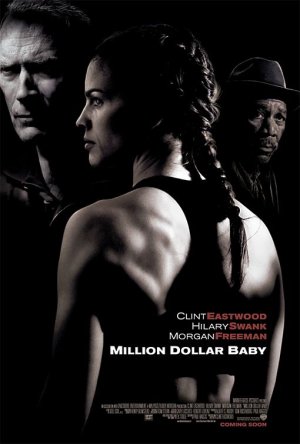
Embracing the Melodrama Part II #105: Million Dollar Baby (dir by Clint Eastwood)


Million_Dollar_Baby_poster

(This review and the Spanish trailer below are dedicated to mi madre, who saw Million Dollar Baby when it was first released and told me that, even though the film had been nominated for lots of Oscars, I shouldn’t watch it until I was in a better and more stable place emotionally.  She was right.)

Two months ago, I started Embracing the Melodrama Part II.  At the time, I announced that I would be reviewing 126 cinematic melodramas and I would get it all done in 3 weeks time!  Well, here we are 8 weeks into it and we are just now approaching the finish line.  That’s okay, though.  Even if it’s taken me longer than I thought it would, I’ve still been having fun writing and sharing these reviews.

I’ve been posting these reviews in chronological order.  Though it may be hard to remember, we started with a 1927 silent classic called Sunrise.  From Sunrise, we’ve worked our way through history and we’ve taken a look at films that are both famous and obscure.  And now, 104 reviews later, we finally reach the 2004 best picture winner, Million Dollar Baby.

When I first saw Million Dollar Baby, I had two reactions.  On the one hand, I thought it was a great film.  I thought it was a film that featured great performances and which gave me a chance to experience a world that I did not know much about.  I thought to myself, “This is a film that future directors will cite as an influence.  This is a film that proves that, even if he does sometimes make movies like Hereafter or Jersey Boys, Clint Eastwood still deserves to be known as a great American filmmaker.”  On the other hand, I thought to myself, “This film is so damn depressing that there’s no way I’m ever going to watch it again.”

And really, it is an amazingly sad film.  When the film starts, of course, you don’t think it’s going to be sad.  You think it’s going to be your standard sports film, the one where the underdog beats the odds and becomes a champion.  For one thing, the film is narrated by Morgan Freeman and Morgan’s got that voice that makes you believe that there is some justice to the universe.  Secondly, Hillary Swank is so appealing in the role of Maggie, a waitress who wants to become a boxer, that you just know she deserves a happy ending.  At first, veteran trainer Frankie (Clint Eastwood) refuses to work with her but her determination wins him over.  And soon, Frankie — who, in typical Clint movie fashion, has a strained relationship with his daughter — becomes a father figure for Maggie.

And as you watch Maggie find success as a boxer, you’re so happy for her.  I certainly was, despite the fact that I know next to nothing about boxing beyond the fact that it’s something that I would never want to do.  And when Clint starts to soften up to her, you’re not surprised.  After all, he’s craggly old Clint Eastwood.  He’s scary but we all know he has a heart of gold.  Add to that, Morgan Freeman’s still telling the story and surely the voice of God would not allow anything bad to happen…

And then … tragedy.  By the time that I finally saw Million Dollar Baby, I already knew the story’s big twist.  I knew that, as a result of a brutal fight, Maggie would be left paralyzed.  I knew that she would beg Frankie to euthanize her.  But seriously, imagine what a shock it must have been for audiences when this film first came out.

I mean, everything’s going perfectly and then suddenly, it’s not.

To a certain extent, I was jealous of those who got to see Million Dollar Baby without any advanced knowledge of the tragedy that defines the final third of the film.  When I watched the film, I found myself dreading the thought of enjoying any of Maggie’s triumphs because I knew what was going to happen.  Those who watched the film with know knowledge may have been shocked but at least they got to believe, for a few scenes, that Maggie could find that perfect sports film ending.

Then again, Million Dollar Baby is a great film because it refuses the temptation to give us the ending that we all want and expect.  Instead, it’s a movie that celebrates the people who will be there for you even when thing’s suddenly aren’t perfect.

That’s why Million Dollar Baby works as well as it does.  Unfortunately, it’s also why it’s a film that I could only watch once.

http://www.youtube.com/watch?v=Sva4p3E6p4o