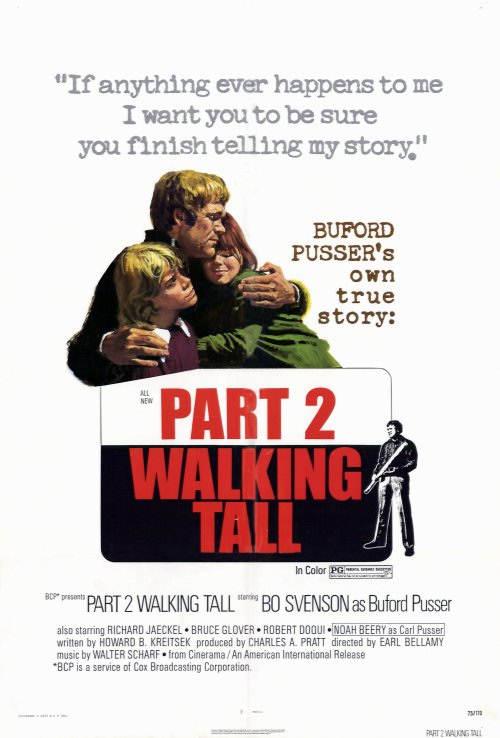
Embracing the Melodrama Part II #51: Walking Tall Part 2 (dir by Earl Bellamy)


Film_Poster_for_Walking_Tall_Part_2The 1975 southern melodrama Walking Tall Part 2 opens with a voice over telling us that we’re about to see more of the true of story Sheriff Buford Pusser, the Tennessee lawman who carried a big stick, battled the Dixie Mafia, and whose wife was killed in an ambush.  Pusser, we learn, died under suspicious circumstances shortly after the release of the film Walking Tall.

Mere hours before he died, Pusser had signed a contract to play himself in Walking Tall Part 2.  As a result of Pusser’s car “accident,” the film’s producers were forced to cast an actor as the lawman.  Now, it would have made sense to, once again, give the role to Joe Don Baker.  After all, he played the role in Walking Tall and I imagine that to most audiences at that time, he was Buford Pusser.  However, for whatever reason, Baker was not given the role for a second time.  Instead, the role was given to Bo Svenson and, while Svenson does not necessarily do a bad job in the role, he’s still no Joe Don Baker.  The difference between Baker and Svenson is the difference between someone being a redneck and someone just pretending.

The film opens almost immediately where Walking Tall ended.  Terribly wounded in the ambush that took his wife’s life, Buford is in the hospital and his face is covered in bandages.  Townspeople gather outside both his room and his farm and they wonder whether he’ll run for reelection as sheriff.  Someone else mentions that Buford has had massive facial reconstructive surgery.

Finally, the bandages are removed and we discover that Buford has turned into Bo Svenson.  Now, Svenson and Baker do have enough facial similarities that you can force yourself to believe that surgery could lead to Baker having Svenson’s features.  I mean, this isn’t like Mark Ruffalo taking over the role of Bruce Banner from Edward Norton.  At the same time, it’s hard not to wonder how reconstructive surgery could have led to Buford Pusser becoming a blonde or, for that matter, apparently growing by 5 inches between Walking Tall and Walking Tall Part 2.

Anyway, Buford’s out of the hospital and, of course, he’s reelected as sheriff.  One thing that quickly becomes apparent is that everyone in the world totally loves Buford Pusser.  I lost track of how many characters specifically walked up to Buford to tell him that he was a great man and a great sheriff.  Nobody complains about Buford’s habit of ignoring civil liberties while enforcing the law.  Instead, everyone cheers for him.

(And, just in case the viewer is uncomfortable with the sight of the very white Buford taunting the mostly black moonshiners that he spends the film arresting, Buford’s black deputy constantly says stuff like, “Buford, you’re my kind of sheriff!”)

The only people who don’t like Buford are the local crime lords.  They still want Buford dead so they hire a race car driver (Richard Jaeckel) to kill him.  The race car driver’s girlfriend (Angel Tompkins) attempts to hit on Buford but Buford has no interest in her.  Buford’s about enforcing the law and avenging his wife…

Walking Tall Part 2 is a pretty standard film.  Whereas the original Walking Tall had a raw and unpredictable vibe to it, the sequel is predictable and boring.  On the plus side, the film was made on location in rural Tennesee and some of the countryside is nice to look at.

As for Buford Pusser, he died before Part Two was released but the character would return in Walking Tall — The Final Chapter.
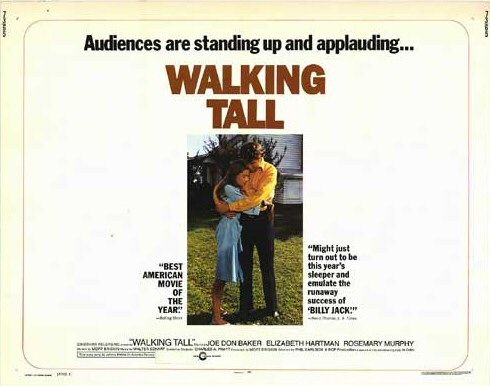
Embracing the Melodrama Part II #46: Walking Tall (dir by Phil Karlson)


Walking_Tall_(1973_film)About 50 minutes into the 1973 film Walking Tall (not to be confused with the 2005 version that starred Dwayne Johnson), there’s a scene in which newly elected sheriff Buford Pusser (Joe Don Baker) gives a speech to his deputies.  As the deputies stand at attention and as Pusser announces that he’s not going to tolerate any of his men taking bribes from the Dixie Mafia, the observant viewer will notice something out-of-place about the scene.

Hovering directly above Baker’s head is a big, black, almost phallic boom mic.  It stays up there throughout the entire scene, a sudden and unexpected reminder that — though the film opens with a message that we’re about to see the true story of “an American hero” and though it was filmed on location in rural Tennessee — Walking Tall is ultimately a movie.

And yet, somehow, that phallic boom mic feels oddly appropriate.  First off, Walking Tall is an almost deliberately messy film.  That boom mic tells us that Walking Tall was not a slick studio production.  Instead, much like Phil Karlson’s previous The Phenix City Story, it was a low-budget and violent film that was filmed on location in the south, miles away from the corrupting influence of mainstream, yankee-dominated Hollywood.  Secondly, the phallic implications of the boom mic erases any doubt that Walking Tall is a film about men doing manly things, like shooting each other and beating people up.  Buford does have a wife (Elizabeth Hartman) who begs him to avoid violence and set a good example of his children.  However, she eventually gets shot in the back of the head, which frees Buford up to kill.

As I said earlier, Walking Tall opens with a message telling us that we’re about to watch a true story.  Buford Pusser is a former football player and professional wrestler who, after retiring, returns to his hometown in Tennessee.  He quickly discovers that his town is controlled by criminals and moonshiners.  When he goes to a local bar called The Lucky Spot, he is unlucky enough to discover that the bar’s patrons cheat at cards.  Buford is nearly beaten to death and dumped on the side of the road.  As Buford begs for help, several motorists slow down to stare at him before then driving on.

Obviously, if anyone’s going to change this town, it’s going to have to be Buford Pusser.

Once he recovers from his beating, Buford makes himself a wooden club and then goes back to the Lucky Spot.  After beating everyone up with his club, Buford takes back the money that he lost while playing cards and $50.00 to cover his medical bills.  When Buford is put on trial for armed robbery, he takes the stand, rips off his shirt, and shows the jury his scars.  Buford is acquitted.

Over his wife’s objections, Buford decides to run for sheriff.  The old sheriff, not appreciating the competition, attempts to assassinate Buford but, instead, ends up dying himself.  Buford is charged with murder.  Buford is acquitted.  Buford is elected sheriff.  Buford sets out to clean up his little section of Tennessee.  Violence follows…

On the one hand, it’s easy to be snarky about a film like Walking Tall.  This is one of those films that operates on a strictly black-and-white world view.  Anyone who supports Buford is good.  Anyone who opposes Buford is totally evil.  Buford is a redneck saint.  It’s a film fueled by testosterone and it’s not at all subtle…

But dangit, I liked Walking Tall.  It’s a bit like a right-wing version of Billy Jack, in that it’s so sincere that you can forgive the film’s technical faults and frequent lapses in logic.  Walking Tall was filmed on location in Tennessee and director Phil Karlson makes good use of the rural locations.  And, most importantly, Joe Don Baker was the perfect actor to play Buford Pusser.  As played by Baker, Pusser is something of renaissance redneck.  He’s a smart family man who knows how to kick ass and how to make his own weapons.  What more could you ask for out of a small town sheriff?

In real life, Buford Pusser died in a mysterious car accident shortly after the release of Walking Tall.  Cinematically, the character of Buford Pusser went on to star in two more films.

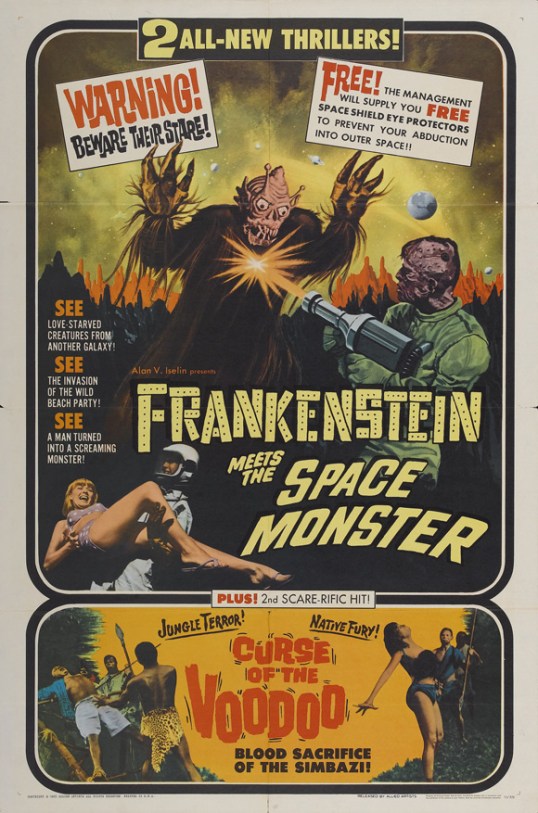
Horror on the Lens: Frankenstein Meets The Space Monster (dir by Robert Gaffney)


Frankenstein_Meets_the_Space_Monster

For today’s selection of horror on the lens, we offer up the odd 1965 horror/sci-fi/beach movie hybrid, Frankenstein Meets The Space Monster.  Despite the movie’s title, it’s not about Frankenstein.  Instead, it’s about an astronaut named Frank who is actually an android.  When his latest mission into space goes wrong, Frank ends up crashing in Puerto Rico.  Now malfunctioning, Frank causes some major chaos.  Can his creator, Dr. Adam Steele (played by character actor James Karen, who years later would appear in Return of the Living Dead), track Frank down and put an end to his reign of terror?

And what about the Martians?  Android Frank isn’t the only threat in Puerto Rico.  A group of Martians have landed and are determined to kidnap any girl wearing a bikini so that they can use them to repopulate their race.  We’re told that every woman on Mars — with the apparent exception of Princess Marcuzan, played with evil haughtiness by Marilyn Hanold — has been killed as the result of an atomic war.  Assisting Princess Marcuzan is Dr. Nadir (Lou Cutell), a short, bald Martian with pointy ears.

One of the oddest things about Frankenstein Meets The Space Monster is that, despite being a standard — if wonderfully nonsensical — low-budget B-movie, it features a great soundtrack!

Enjoy!

James Bond Review: Diamonds Are Forever (dir. by Guy Hamilton)


I think it’s a well-known fact that the Austin Powers series was spoofing the spy film of the 60’s and 70’s with it’s main target for laughs being the iconic James Bond character and his international adventures of action and intrigue. The James Bond films with each successive entry became more and more fantastic as the megalomania of each new villain became more and more cartoonish and over-the-top and the gadgets themselves started entering the realm of science-fiction (for that time and era, at least) and back-of-the-comic-book ingenuity. I think the tipping point for the series that took James Bond from action thriller to spoofing it’s own past was with Sean Connery’s last official film as James Bond with Diamonds Are Forever.

To say that Sean Connery was truly getting tired and bored with playing the character James Bond on the big screen would be an understatement. His previous Bond entry with You Only Live Twice showed him pretty much disinterested with the role and one would almost think he was phoning in his performance. After that film Connery had announced his retirement from playing Bond, but after George Lazenby also retired from the role after just one film Connery was soon back for one more ride on the James Bond train.

Diamonds Are Forever once again pits James Bond against his arch-nemesis, the leader of SPECTRE and feline connoisseur, Ernst Blofeld. This time around the role of Blofeld was played by the actor Charles Gray and the film does a good job in explaining why the character has been played by so many different actors in each entry he appeared in. It is in this early sequence in the film that we begin to see that this latest James Bond entry had jumped the shark when it came to trying to keep things even remotely believable. It’s the film’s biggest flaw an, at the same time, what made it such an interesting, fun ride.

Even the plot of the film owes more to the spoofs of the Blofeld character by way of the Austin Powers films as Bond must try to stop SPECTRE from using smuggled South African diamonds from being used to create  weaponized satellite with a massive “laser” that SPECTRE will use to destroy the nuclear arsenal of every superpower then auction off the rights to be the only nuclear power to the highest bidding country. It’s pretty much the the basic foundation of what would be the plot for the first Austin Powers, but with this film filmmaker Guy Hamilton still tried to treat the script as something that was of the serious Bond when it was more 60’s camp through and through.

Diamonds Are Forever may be the weakest of all the Connery Bond films, but it’s groovy sensibilities that celebrated the 60’s (despite the film having been made in 1971) psychedelic, swinging lifestyle poked fun at Bond’s predilection as a suave and charismatic womanizer that wouldn’t have looked out of place in a 60’s love-in. Even the action sequences was something that looked more humorous than thrilling whether it was Bond escaping SPECTRE henchmen on a moon buggy to the inept duo assassins Mr. Wint and Mr. Kidd looked more at home in an action comedy than a series that was known for serious action.

I would be remiss to not mention that this was the only time the Bond series had a redhead as a Bond Girl in the vivacious form of Jill St. John as Tiffany Case. I would also like to think that the other Bond Girl in the film, played by Lana Wood (Natalie Wood’s younger sister), was also a redhead but I’m not entirely sure since most audiences probably didn’t pay too close attention to Plenty O’Toole’s hair color. Either way this would be the only Bond film that would cast what fellow writer Lisa Marie calls the 2%.

Diamonds Are Forever might not have been the sort of return Sean Connery envisioned for himself when he agreed to return as James Bond after taking a film off, but then again this wouldn’t be the first time he would retire from the role only to come back again. Yet, despite all it’s flaws (there were many of them) the film does entertain though probably not in the way it’s filmmakers hoped it would. I do believe that it was this film that finally brought in Roger Moore as the next Bond, but also convinced the film’s producers to tailor the Bond films using some of the humorous aspect of Diamonds Are Forever but tempered to accompany the action in the story.

James Bond will soon return in Live And Let Die….