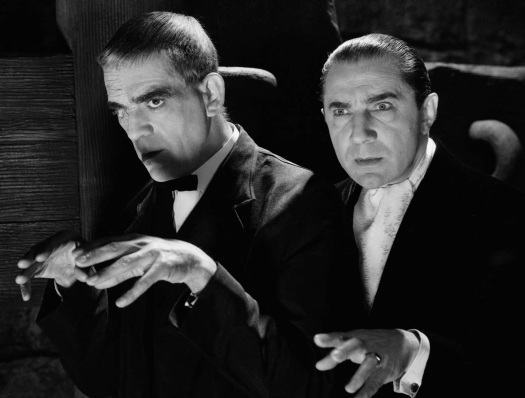
Bobby “Boris” Pickett’s 1962 hit “The Monster Mash” was not only a graveyard smash, but has become an annual Halloween tradition here on Cracked Rear Viewer. This season, I’ve picked out a Monster Mash-Up of clips starring Universal Horror icons Boris Karloff and Bela Lugosi set to Pickett’s groovy ghoulie tune. Break out your dancing shoes and get ready to Do The Mash with Boris and Bela:
Happy Halloween! One of my favorite Halloween traditions is hearing Bobby “Boris” Pickett sing his 1962 smash THE MONSTER MASH, and this year I’ve discovered a real treat. Bobby doing a live performance at the Chiller Theater con in 2005 with none other than the late, great Zacherley! Enjoy!
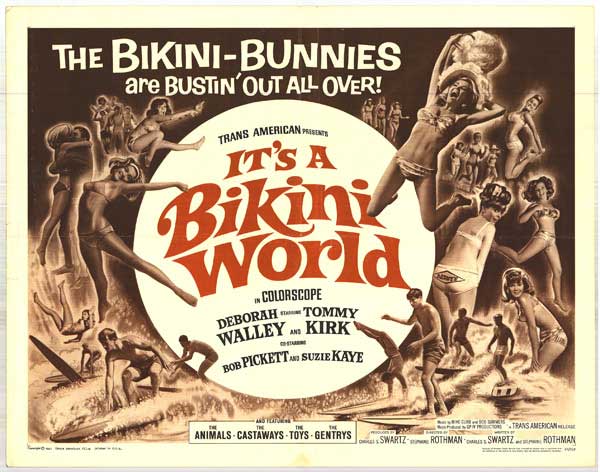
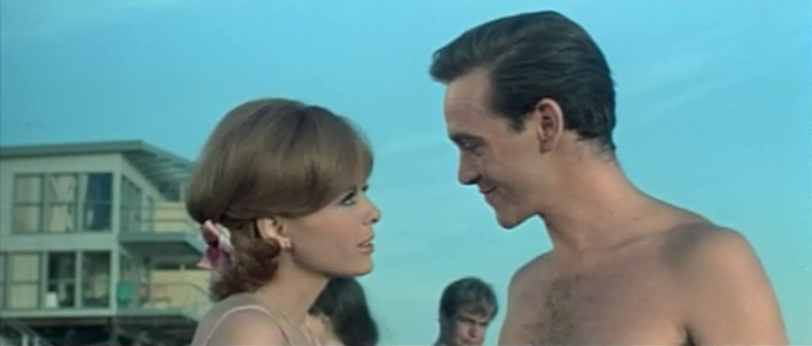
IT’S A BIKINI WORLD is one of the lowest of the low-budget “Beach Party” ripoffs you’ll ever see. Yet it has a certain charm to it, a likeable little “battle of the sexes” soufflé featuring some great 60’s rock acts and the undeniable appeal of beach bunny Deborah Walley.
Beach stud Mike Samson goes gaga for knockout new redhead Delilah Dawes (Samson and Delilah, get it?). She thinks he’s an egotistical jerk and gives him the big freeze-out, telling him she prefers the “serious type”, so Mike dons a pair of thick glasses and some nerdy duds, passing himself off as intellectual brother “Herbert”. Herbert takes her to museums and zoos, while Mike competes with her in skateboarding and boat races run by local customizer Daddy, owner of hangout The Dungeon. Delilah discovers Mike’s scam, and they compete in a final Cross Country Race that consists of car racing, motorcycles…
I suppose if I asked most people what music they identified with horror, John Carpenter’s “Halloween Theme” and Mike Oldfield’s “Tubular Bells” (The Exorcist) would come up first. After that, you’d get a lot of Rob Zombie and Glenn Danzig. So right off the bat, you’re looking at an enormous variety of sounds and styles connected mainly by association. While John Carpenter’s work was intentionally composed for the film in which it appeared, “Tubular Bells” was originally a 50 minute progressive rock opus that was anything but sinister or foreboding in its full form. Misfits was a goth punk band that happened to favor horror themes. White Zombie’s horror imagery was more a matter of crudeness and vulgarity in the spirit of GWAR; their sound was a frontrunner in the emergence of industrial groove metal, and the greatest “horror” associated with Rob was the countless terrible nu metal spinoffs. A couple of “top ten horror songs” lists I stumbled upon even list Bobby Boris Pickett’s “Monster Mash” and Richard O’Brien’s “Time Warp”. I mean, “Monster Mash” is a fun Halloween song, sure, but horror? Really? And the Rocky Horror Picture Show does make me want to vomit, but we have to draw the line somewhere.
Suffice to say, “horror” music is not a genre at all. Simply associating a song with a scene or theme is enough to relate them; Huey Lewis and the News will probably make me smile and think of Christian Bale chopping people to bits in his apartment for the rest of my life. But there are definitely certain musical attributes that conjure in us a less glitzy feeling of dread than Hellbilly Deluxe. That skittering cockroach beat in the background of Halloween is completely unnerving; Carnival music is way creepier than Stephen King’s It; Black Sabbath’s appreciation for diabolus in musica virtually invented heavy metal; and it took a firm dose of the blues in 1988 for Danzig to capture a sense of the sinister that Misfits could never convey.
I don’t believe that any particular musical formula is the coalescence of evil. The music we find most haunting is derived from association too, but it connects in more subtle ways than say, the fact that a particular song appears in a horror film or mentions witches in the chorus. The real deal distorts what comforts us, denies our sense of order, and pries upon our innocence. Through a musical medium as through any other, horror focuses on shattering the lens through which we perceive reality as an ordered, logical construct. It reminds us of the real nightmares in life while nullifying our means to counteract them. It takes us to the world of the child, where emotional extremes enhance our senses of comfort and terror alike.
The carnival tune and music box are prime targets, conjuring in our minds a time when fear was more potent. The brief piano loop, the simple hum, the monotone drone–these bring us to solitude and isolation through minimalism. Effective horror themes offer no comforting symphony or rock ensemble to encase us in a nuanced world. They surround us with something singular and far from warm, or with nothing at all. The wind chimes warn of a storm; when none is coming, the darkness is all the more unnatural. The cathedral bell, a sign of fellowship on a Sunday morning, also tolls for death. A twitch, a buzz, a repeated knocking, a bit of static–things that would otherwise annoy us–exploit the close connection between discomfort and tension.
Or else we can completely overwhelm the senses with noise that strips away the familiarity which typically diminishes extreme music’s effect, leaving us a nervous wreck. When Blut Aus Nord chose to employ programmed, industrial blast beats in their 777 trilogy, they effectively eliminated the one element of the music that would have sounded too familiar to disturb. Instead, the epileptic guitar finds companionship in a persistent, unnatural clatter designed to place us permanently on edge.
Other bands have found other means to the same end. Peste Noire’s unique “black ‘n’ roll” sound enlivens a standard formula for “evil” music with a pep and a grin, giving the brutalizer a human face in the spirit of medieval sadism. Sunn O))) are inclined to drone on for ages, developing a false sense of comfort before infusing their deep buzz with a caterwaul of shrill pitches and clattering chimes. (I actually had a guy start freaking out on me at work one day when “Cry For The Weeper”, which he didn’t even notice playing, hit the 3:55 mark.)
And lastly, we can’t forget the power of lyrics to render a song gruesome. The stereotypical lines of a black metal song–nonsense about necromoonyetis and an appeal to Satanism far less disturbing than the average Christian commentator on Fox News–are pure cheese, and they entertain us in a manner similar to your typical zombie flick. But when you first heard Smashing Pumpkin’s “x.y.u.”, you probably got a feeling more akin to Henry: Portrait of a Serial Killer.
Horror in lyrics is something a bit the opposite of horror in sound; it strikes us most deeply when we can be convinced that there is absolutely nothing supernatural about it. There are certainly a few exceptions–Townes Van Zandt’s tall tale in “Our Mother the Mountain” chills me to the bone–but generally speaking, the real atrocities committed throughout human history far exceed the limits of our imaginations. Vlad Tepes was worse than any vampire, and from Elizabeth Bathory and Ariel Castro to Hernando Cortes and Adolf Hitler, we are flooded by examples of direct personal cruelty and dehumanized mass slaughter. When a song manages to make us think of these individuals and events beyond the safety blanket of historical narrative, an authentic feeling or horror is hard to deny.

 Through the Shattered Lens