Film Review: Stay Hungry (dir by Bob Rafelson)


In the 1976 film Stay Hungry, Jeff Bridges plays Craig Blake.

When we first meet Craig, he doesn’t have much of a personality, though we still like him because he’s played by Jeff Bridges.  Living in Alabama, he’s a young rich kid who, after the death of his parents, divides his time between his nearly empty mansion and his country club.  Craig suffers from a good deal of ennui and seems to spend a lot of time writing letters to his uncle in which he promises that he’s going to eventually get his life together.  Craig eventually gets a job at a real estate firm that is managed by Jabo (Joe Spinell).  We know that the real estate firm is shady because Joe Spinell works there.

Craig is assigned to handle the purchase of a small gym so that he can eventually close the place and allow it to be torn down to make room for an office building.  However, Craig soon falls for the gang of colorful eccentrics whose lives revolve around the gym and bodybuilder Joe Santo (Arnold Schwarzenegger, who gets an “introducing” credit, even though this was his fourth film).  The friendly Franklin (Robert Englund) is Santo’s “grease” man.  Anita (Helena Kallianiotes) is tough and can kick anyone’s ass.  The receptionist, Mary Tate (Sally Field), is a free spirit with whom Craig soon falls in love.  In fact, the only less than likable person at the gym is the former owner, Thor Erickson (R.G. Armstrong), a heavy-drinking perv who has a hole in the floor of his office that he uses to peek down at the women’s locker room.

There’s not much of a plot here.  Instead, the film plays out in a rather laid back manner, with Santo befriending Craig and showing him the joy of embracing life.  Arnold Schwarzenegger actually won an award (well, a Golden Globe) for his performance here and it must be said that he’s very good as the gentle and easy-going Santo.  Because he’s huge and he’s Schwarzenegger, we expect him to be intimidating.  Instead, he’s a soft-spoken guy who is quick to smile and who doesn’t even get upset when he finds out that Mary Tate and Craig are now involved.  There’s even a surprising scene where Joe Santo picks up a fiddle and starts playing with a bluegrass band.  Schwarzenegger is so likable here that it’s easy to wonder where his career might have gone if he hadn’t become an action star.  Even early in his career (and when he was still speaking with a very thick accent), Schwarzenegger shows off a natural comic timing.  He’s fun to watch.

In fact, he’s so much fun that the rest of the film suffers whenever he’s not onscreen.  The cast is full of talented people but the film’s loose, plotless structure keeps us from truly getting too invested in any of them.  (Santo is training for Mr. Universe so at least he gets an actual storyline.)  Sally Field and Jeff Bridges are cute together but their romance is never quite as enchanting as it seems like it should be.  The main problem with the film is that, when it ends, one still feels like Craig will eventually get bored with the gym and return back to his mansion and his country club.  One doesn’t get the feeling that Craig has been changed so much as Craig just seems to be slumming for the heck of it.

There are charming moments in Stay Hungry.  I’m a Southern girl so I can attest that the film captured the feel of the South better than most films.  If you’re a Schwarzenegger fan, you have to see this film because it really does feature Arnie at his most charming and natural.  Unfortunately, despite all that, the film itself never really comes together.

Scenes That I Love: Jack Nicholson’s Freeway Performance in Bob Rafelson’s Five Easy Pieces


Today, the Shattered Lens wishes a happy 89th birthday to Bob Rafelson, who was one of the first directors to not only truly recognize the genius of Jack Nicholson but also one of the co-creators of the Monkees.  (In fact, Rafelson brought the Monkees and Nicholson together when he made his directorial debut with 1968’s Head.  The Monkees starred in the film while Nicholson wrote the script.)  After getting his start on television, Rafelson became one of the leading figures of the Hollywood counterculture that came to power in the late 60s and the early 70s and a business partner of producer Bert Schneider, Rafelson also played a role in the creation of such classic films as Easy Rider, The Last Picture Show, and Hearts and Minds.  Like Nicholson, Rafelson was never a hippie.  Instead, his vision was closer to the vision of Jack Kerouac and Neal Cassady.  Rafelson and Nicholson brought the sensibility of the Beat Generation to Hollywood and, for a while at least, they changed the face of American culture.

In honor of Bob Rafelson’s birthday, today’s scene that I love comes from his 1970 film, Five Easy Pieces.  In this Oscar-nominated film, Jack Nicholson plays Bobby Dupea.  Born to a wealthy and music-obsessed family, Bobby currently works in an oil field and is alternatively angry, cynical, and idealistic.  (That both the main character and the director shared the same first name is probably not a coincidence as Rafelson also came from an artistic family.  Though many of Bobby’s famous outbursts — especially the famous one involving a chicken sandwich — were based on things that had actually happened to Nicholson, the character was equally based on Rafelson.)  After Jack Nicholson’s Oscar-nominated turn in Easy Rider, Five Easy Pieces featured Nicholson playing the type of role for which he would be best-known in the 70s, the wayward rebel who must choose between being a part of society or being forever an outcast.  

In this scene, Bobby and his oilfield co-worker find themselves stuck in a traffic jam.  Bobby gets a chance to show off both his temper and his talent.  It’s a great scene and Nicholson gives such a strong performance that it’s only later that you realize that Bobby’s anger didn’t really accomplish much.  That was a recurring theme in Nicholson’s early films.  With this scene, Bob Rafelson captures both a man and a country in conflict.

Five Easy Pieces would be nominated for Best Picture, though it would lose to Patton. After his supporting nomination for Easy Rider, Nicholson received his first best actor nomination for this role here. (Again, Patton triumphed, though George C. Scott famously refused to accept his Oscar.) Sadly, Bob Rafelson was not nominated for Best Director.

Equally sadly, Rafelson’s subsequent films received mixed reviews (though most have been positively reevaluated in recent years) and struggled at the box office. With Hollywood becoming more concerned with finding the next blockbuster than producing films about existential wanderlust, Rafelson often struggled to bring his vision to the screen. He hasn’t directed a film since 2002’s No Good Deed. However, his work lives on amongst serious film students and historians of the 70s. If any director’s work is worthy of rediscovery and reevaluation, it’s Bob Rafelson’s.

10 Bloody Essential if Lesser Known Michael Caine Films


A Shock to the System (1990, directed by Jan Egleson)

Today is the 88th birthday of the great actor and British cultural icon, Sir Michael Caine!

As I did with Chuck Norris earlier this week, I want to commemorate Michael Caine’s birthday by sharing ten of his essential roles.  Since 1950, Michael Caine has appeared in over 130 films and countless TV productions.  Trying to narrow his long and prolific career down to just ten films is not easy, nor is it really necessary.  All of Caine’s films are worth watching, even the ones that he made during the period where he basically accepted every part that he was offered.  Because he’s so prolific and because so many of his films are already well-known and regarded as classics, I’ve decided to focus of listing ten of his lesser-known but no less essential roles.

  1. A Hill in Korea (1956, directed by Julian Aymes) — This nearly forgotten war film is significant because it featured Michael Caine in his first credited screen role.  (He had appeared in three previous films but wasn’t credited.)  A veteran of the Korean war, Caine was hired to serve as a technical advisor and he was given the small role of Private Lockyer.  Years later, Caine would say that, “I had 8 lines in that picture and I screwed up 6 of them.”  The film is a standard war film and Caine is barely onscreen but everyone had to start somewhere and this film did allow Caine to appear opposite Stanley Baker, Robert Shaw, and Harry Andrews.
  2. Billion Dollar Brain (1968, directed by Ken Russell) — In 1965, Michael Caine shot to stardom by playing the working class secret agent, Harry Palmer, in The Ipcress File.  Caine went on to play Palmer in four more films.  Billion Dollar Brain finds Harry trying to keep a computer and a mad millionaire from starting World War III.  This was Ken Russell’s first major feature film and, through not as flamboyant as some of his later films, Billion Dollar Brain still feels like Harry Palmer on acid.  Caine gives a typically good performance, as does Karl Malden in a key supporting role.  Caine’s future Eagle Has Landed co-star, Donald Sutherland, has a small, early role.
  3. Zee and Co. (1972, directed by Brian Hutton) — Caine is married to Elizabeth Taylor and having an affair with Susannah York.  This is the type of movie that probably could have only been made at a time when studio system veterans like Elizabeth Taylor were trying to prove that they could keep up with the new wave of filmmakers and stars.  Providing proof of his acting abilities, Caine somehow keeps a straight face and gives a credible performance while Taylor emotes all over the place.  The end result is loud, vulgar, and undeniably entertaining.
  4. Beyond The Poseidon Adventure (1979, directed by Irwin Allen) — I’m including this film as a stand-in for all of the films that Caine made strictly for the money.  It’s a ludicrous film but hard not to enjoy.  Michael Caine plays a tugboat captain who, with the help of Sally Field, attempts to salvage the cap-sized Poseidon before the luxury liner finally sinks.  Also showing up: Telly Savalas, Slim Pickens, Peter Boyle, and Billion Dollar Brain‘s Karl Malden.
  5. Mona Lisa (1986, directed by Neil Jordan) — The same year that Michael Caine appeared in his Oscar-winning role in Hannah and Her Sisters, he also played a gangster named Mortwell in Mona Lisa.  Caine is chillingly good in a rare villainous role.
  6. The Fourth Protocol (1987, directed by John MacKenzie) — This underrated spy thriller features Michael Caine as a world-weary British spy who has to stop KGB agent Pierce Brosnan from detonating a nuclear device.  This is a well-made spy thriller and it’s interesting to see Caine (who started his career as the anti-James Bond in the Harry Palmer films) acting opposite future Bond, Pierce Brosnan.
  7. Without A Clue (1988, directed by Thom Eberhardt) — This genuinely funny comedy stars Caine as Sherlock Holmes and Ben Kingsley as Dr. Watson.  The catch is that Holmes is actually a clueless actor who was hired by Watson to pretend to be a great detective.  When Prof. Moriarty targets Watson, Holmes is forced to actually solve a case on his own.  Caine and Kingsley make for a surprisingly good comedy team.
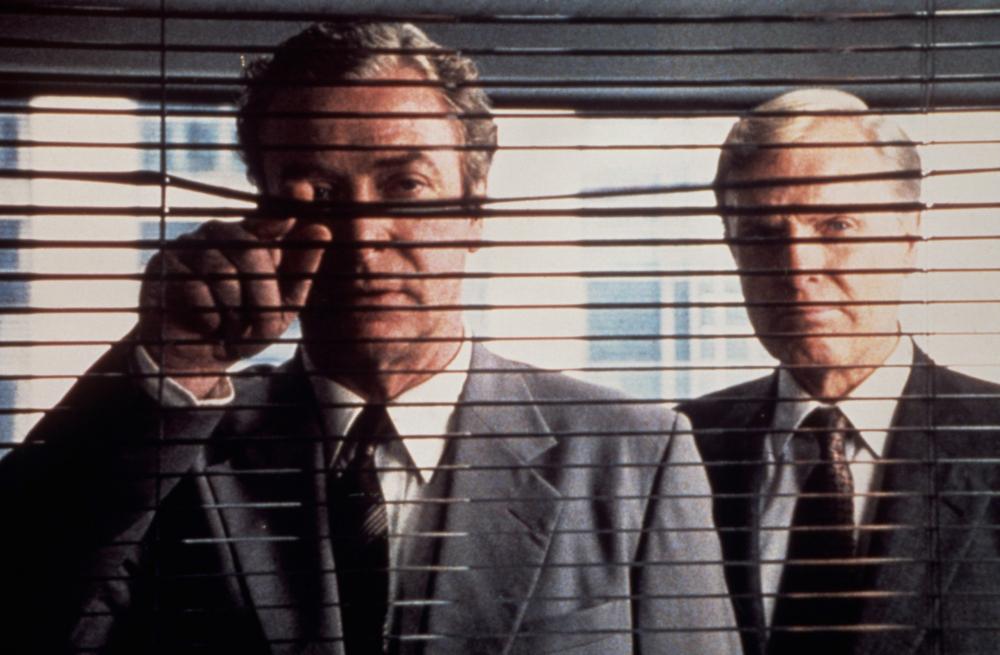
  8. A Shock to the System (1990, directed by Jan Egleson) — In this very dark comedy, Caine plays an executive who, sick of being passed over for promotions and criticized by his wife, decided to just kill everyone who annoys him.  This is one of Caine’s best performances and this underrated film’s satire feels just as relevant today as when it was released.
  9. Blood and Wine (1997, directed by Bob Rafelson) — This underrated neo-noir gave Michael Caine a chance to act opposite Jack Nicholson.  The two iconic actors bring out the best in each other, playing partners in a jewelry heist gone wrong.
  10. Is Anybody There? (2008, directed by John Crowley) — In this low-key but emotionally effective film, Caine plays an elderly magician who is suffering from the early stages of dementia.  Having entered a retirement home, he befriends the son of the home’s manager and the two of them search for evidence of life after death.  Though the film didn’t get much attention in the States, Caine described it as a favorite in his most recent autobiography, Blowing The Bloody Doors Off.  75 years-old when he appeared in the film, Caine proved that he could still take audiences by surprise and create an unforgettable character.

Lisa Reviews An Oscar Nominee: Five Easy Pieces (dir by Bob Rafelson)


First released in 1970, Five Easy Pieces tells the story of a lost man named Bobby Dupea (Jack Nicholson).

When we first meet Bobby, he’s working at a California oil field.  He likes to go bowling.  He has a girlfriend named Rayette (Karen Black), who is a country music-obsessed waitress.  His best friend is Elton (Billy “Green” Bush), a friendly redneck with a memorable laugh.  Bobby may have a girlfriend and Elton may be married but that doesn’t stop either one of them from going out at night, getting drunk, and trying to pick up women.

Bobby seems to be just another blue-collar guy with a grudge against the bosses but it doesn’t take long to realize that there’s something different about him.  Bobby may be friends with Elton but it’s obvious that the two of them come from very different background.  No matter how much he tries to hide it, Bobby is smarter than everyone else around him.  When he and Elton get stuck in a traffic jam, Bobby spots a piano sitting on the back of a pickup truck.  Getting out of his car, Bobby yells at everyone who is honking and then climbs up to the piano.  He sits down, he puts his fingers to the keys and he starts to play.  Knowing Bobby, you’re expecting him to just bang the keys and make noise.  Instead, he plays beautiful music.

Later, Bobby steps into a recording studio.  Paritia (Lois Smith), a neurotic woman, is playing the piano.  The recording engineers joke about her lack of talent.  Bobby glares at them, annoyed.  It quickly becomes apparent why Bobby is so protective.  Paritia is Bobby’s sister.

Bobby, it turns out, comes from a wealthy family of musicians.  Everyone in the family has dealt with the pressure to succeed differently.  Paritia continues to play, despite not having much talent.  Bobby’s older brother, the buffoonish Carl (Ralph Waite), plays violin and has staid home with their father (William Challee).  Bobby, on the other hand, ran away from home.  He’s spent his entire life trying to escape from both his talent and his family.  However, when Paritia explains that their father has suffered from two strokes and might not live much longer, Bobby reluctantly decides to return home and try to make some sort of peace with his father.

It’s not as easy a journey as Bobby would have liked.  For one thing, Rayette demands to go with him.  On the drive up to Washington, they pick up two hitchhikers (Helena Kallionetes and Toni Basil), one of whom is obsessed with filth.  In the film’s most famous scene, an attempt to get a simple lunch order modified leads to Bobby losing control.

See, that’s the thing with Bobby.  In many ways, he’s a jerk.  He treats Rayette terribly.  While his family is hardly perfect, the film doesn’t hide from the fact that Bobby isn’t always the easiest person to deal with.  And yet, you can’t help but sympathize with Bobby.  If he seems permanently annoyed with the world … well, that’s because the world’s annoying.  And, to Bobby’s credit, he’s a bit more self-aware than the typical rebel without a cause.  When one of the hitchhikers praises his temper tantrum at the diner, Bobby points out that, after all of that, he still didn’t get the order that he wanted.

In Washington, Bobby tells Rayette to stay at a motel and then goes to see his family.  Bobby seems as out-of-place among his wealthy family as he did hanging out in the oil fields with Elton.  He ends up cheating on Rayette with Carl’s fiancee, a pianist named Catherine van Oost (Susan Anspach).

And then Rayette shows up for dinner…

Five Easy Pieces is a sometimes funny and often poignant character study of a man who seems to be destined to always feel lost in the world.  Bobby spends the whole movie trying to find a place where he can find happiness and every time, reality interferes with his plans.  Nicholson gives a brilliant performance, playing Bobby as a talented guy who doesn’t really like himself that much.  Bobby’s search for happiness leads to a rather haunting ending, one that suggests that some people are just meant to spend their entire life wandering.

Five Easy Pieces was nominated for Best Picture but lost to Patton.

Rockin’ in the Film World #12: The Monkees in HEAD (Columbia 1968)


gary loggins's avatarcracked rear viewer

The Monkees (Davy Jones, Mickey Dolenz, Peter Tork, and Mike Nesmith) brought rock’n’roll to TV with their mega-successful 1966-68 musical sitcom. Inspired by The Beatles’ onscreen antics in A HARD DAY’S NIGHT and HELP!, producers Bob Rafelson and Bert Schneider cast four fresh-faced youths (Jones was a Tony nominee for OLIVER!, Dolenz had starred in TV’s CIRCUS BOY, Tork and Nesmith were vets of the folk-rock scene), hired some of the era’s top songwriters (Gerry Goffin & Carole King, Tommy Boyce & Bobby Hart, Neil Diamond, Harry Nilsson) and session musicians (Hal Blaine, James Burton, Glen Campbell  , Carol Kaye), and Monkeemania became a full-fledged teenybop pop phenomenon.

Detractors (and there were many) in the music biz called them ‘The Pre-Fab Four’, looking down their noses at The Monkees while looking up as hits like “I’m a Believer”, “Daydream Believer”, and “Pleasant Valley Sunday” climbed to the top of the…

View original post 422 more words

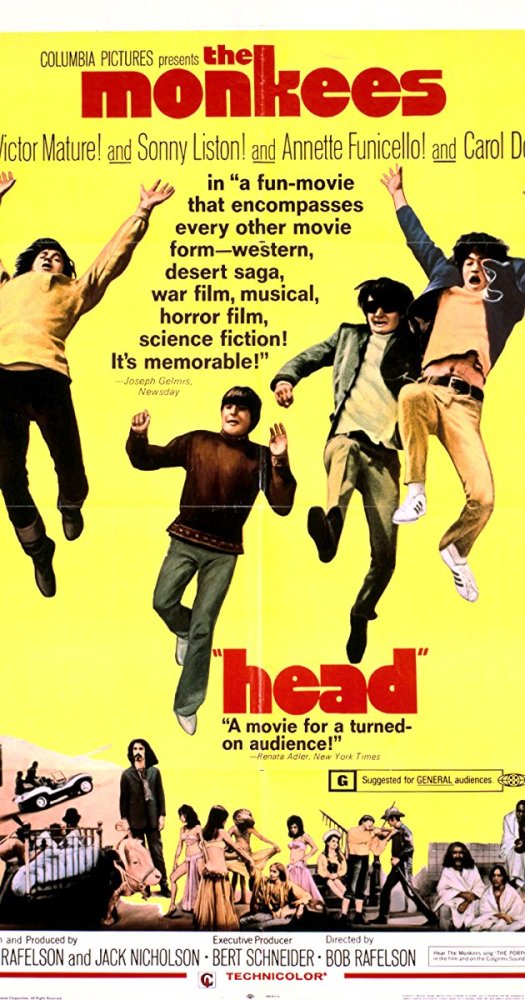
What Lisa Marie Watched Last Night: Head (dir. by Bob Rafelson)


Last night, I turned over to TCM and I watched the 1968 film Head.

Why Was I Watching It?

Though Head was a notorious box office bomb when it was released in 1968, it has since become notorious as one of the most incomprehensible movies ever made.  Every book that I’ve ever read about film or pop culture in the 1960s makes mention of Head.  Not only was the film written by a pre-Easy Rider Jack Nicholson, but the film also featured The Monkees literally acting out against their stardom by committing career suicide by appearing the film that was apparently conceived while Nicholson and director Bob Rafelson were tripping on LSD.  I’ve read about Head in dozens of books and I’ve seen it described as being “a surreal masterpieces,” “an incomprehensible, pretentious mess,” and “a total head trip of a film.”  Having now seen the film, I can say that’s all true. 

I do have to admit that before I saw Head, I didn’t know who the Monkees were.  Don’t get me wrong — I knew that there was a band in the 60s called The Monkees and I knew that they had their own TV show.  Thanks to the fact that The Brady Bunch Movie played on cable for like two months straight earlier this year, I knew which one was Davey Jones.  But, that was about it.  Even after seeing Head, I’m still not really sure I could tell you which was one was Mickey Dolenz and which one was Peter Tork.  I also have to admit that I spent the first half of the film referring to Michael Nesmith as the “Texan with the sideburns.”

Fortunately, I watched Head with two wonderful groups of people on twitter — the TCM Party and the Drive-In Mob.  They came together last night and provided a very entertaining live tweet session devoted to the film.  Unlike me, they actually knew one Monkee from another and following their tweets helped me survive the film’s rough first half.  To all of them, I say “Thank you for the education.”

What’s It About?

That’s not an easy question to answer but I’ll try.

The Monkees jump off a bridge and plunge into the psychedelic waters below but they’re saved from drowning by a bunch of mermaids.  This, of course, leads to the four members of the groups finding themselves in scenes from a war film, a boxing film, a western film, and eventually they discover that they’re actually dandruff on the head of actor Victor Mature.  Ultimately, they end up wandering around on a studio backlot where they’re menaced by veteran scary actor  Timothy Carey and an ominous black box that seems to intent on trapping them.  The Monkees react to this by running for their lives, complaining to Jack Nicholson and Bob Rafelson about the script, and telling everyone that they meet that they’re just actors in a film.  Eventually, it appears that the Monkees don’t have any options left beyond committing public suicide but Rafelson has other ideas…

What Worked?

If you’re as obsessed with pop cultural history as I am, Head is one of those films that simply you have to see.  Even if you find the film to be totally incomprehensible and just a tad bit pretentious, Head is a valuable artifact of its time.  Head is a film that could have only been made in the late 60s and it epitomizes everything about the age that produced it.  It’s like a cinematic Pompeii.

Now, I have to admit that most of the enjoyment I got out of the first half of the film came more from my own curiosity as a secret history nerd than from the film itself.  However, the second half of the film is often times genuinely entertaining.  The satire is a bit sharper and the overall theme (i.e., the struggle to maintain your own unique individuality in a world that demands conformity) starts emerge from the film’s mix of surreal images.

For me, the film really picked up with Davy Jones’ performance of Daddy’s Song:

The woman dancing with Davy Jones was Toni Basil, who choreographed all the dance numbers in this film.

Here’s another sequence that I particularly enjoyed.  This came towards the end of the film and, as I said on twitter, who doesn’t enjoy a little psychedelic dancing?

What Did Not Work?

While Head had all the virtues of its time, it also had all the flaws.  It’s a definite hit-and-miss affair, with the stronger (and occasionally insightful) moments uneasily balanced with plenty of sequences that dragged.  As you may have guessed, Head is the type of film that’s brilliant if you’re in the mood for it but it’s rather annoying if you’re not.


“Oh my God! Just like me!” Moments

I would have loved to have been Toni Basil, dancing with Davy Jones in the Daddy’s Song number.

Lessons Learned

Watching Head, I realized that I had discovered this year’s perfect Christmas present.  I’m going to get a 100 copies of Head on DVD and give them out to everyone I know.  That way, I’ll have an excuse to call everyone up in November and tell them, “Don’t worry, I’m giving you Head for Christmas.”  I think, if nothing else, that’ll make me a very popular girl come December.