Review: Wake Up Dead Man (dir. by Rian Johnson)


“Grace isn’t cheap. It’s bought with blood and fire, not your weak-kneed handshakes with sin.” Monsignor Jefferson Wicks

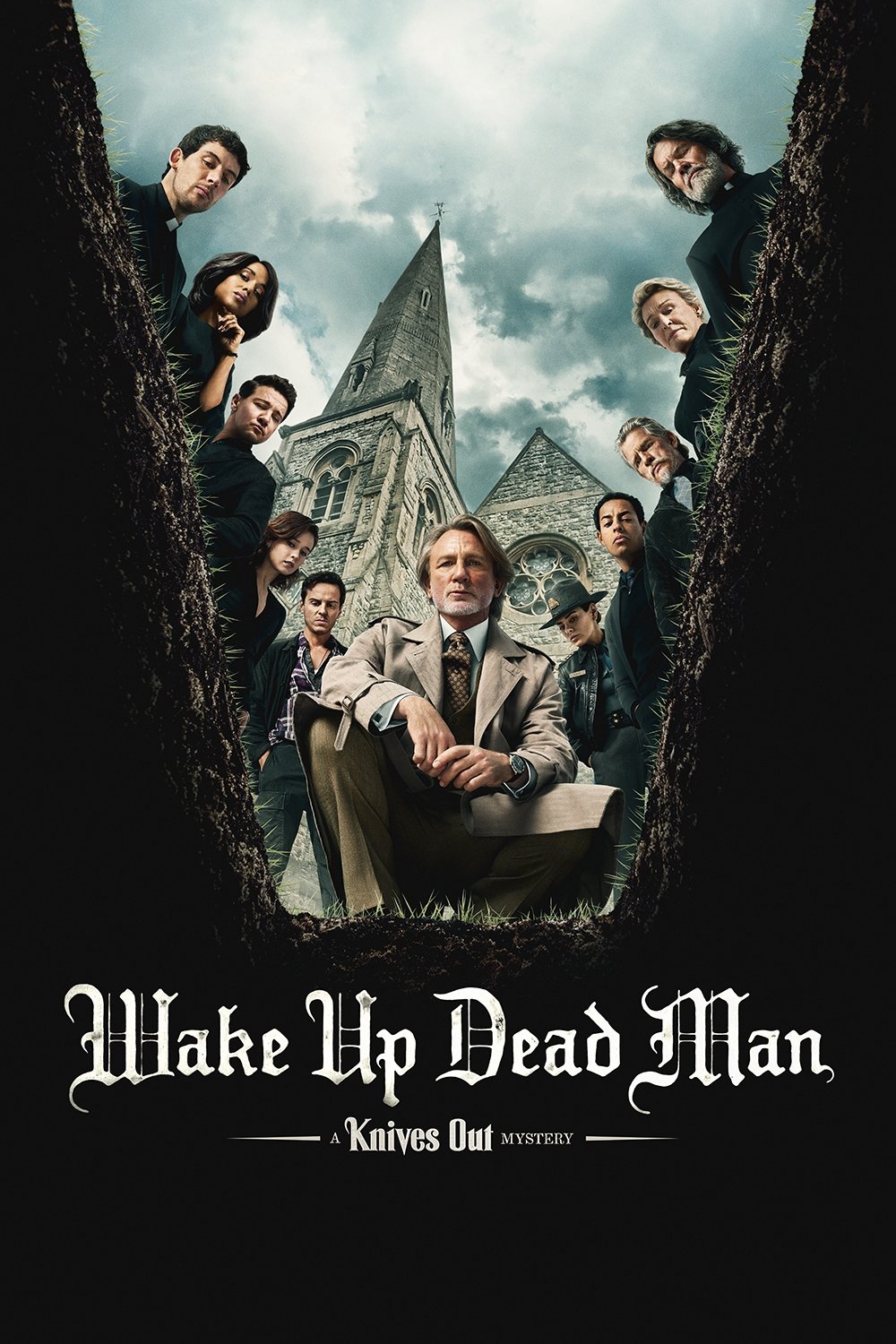
Wake Up Dead Man: A Knives Out Mystery is Rian Johnson’s latest entry in his whodunit series. It reunites Daniel Craig with his charismatic detective Benoit Blanc. The film trades the intimate family drama of the first movie and the over-the-top glamour of the second for a tense, small-town tale of faith, secrets, and an impossible crime at a rural church. It’s an ambitious evolution. Yet it doesn’t always land every punch in the trilogy.

To appreciate where this fits, glance back at the predecessors. The original Knives Out from 2019 burst onto the scene. It updated classic mystery tropes cleverly. The story centered on the death of a wealthy author. The dysfunctional Thrombey family circled like vultures over his estate. Blanc’s folksy charm cut through the lies with surgical precision. He delivered razor-sharp twists. His commentary bit into privilege and entitlement. All this wrapped in a snug, stage-play setup. It felt like a modern And Then There Were None. Every character popped—from Chris Evans’ smirking man-child to Ana de Armas’ wide-eyed nurse. The script’s misdirections kept you guessing until the final gut-punch reveal. It was tight, surprising, and endlessly rewatchable. Humor, heart, and social satire blended into a perfect whodunit package.

Glass Onion: A Knives Out Mystery followed in 2022. It cranked up the scale dramatically. A billionaire’s private island became the playground. A squad of self-important influencers played at being geniuses. The satire shifted gears. It skewered tech elites and performative allyship. Bigger laughs came from set pieces like the glass onion puzzle. Wilder ensemble clashes featured Edward Norton’s bumbling Miles Bron. Blanc unraveled the chaos with gleeful theatricality. Sure, it leaned heavier into farce than the original’s grounded tension. But those oh-so-satisfying reveals kept the momentum roaring. Janelle Monáe’s layered turn helped too. Each film stands alone as a self-contained puzzle. Yet they build Blanc’s legend incrementally. They refresh the murder-mystery playbook. Johnson’s signature flair nods to Agatha Christie roots.

Wake Up Dead Man arrives a few years after those events. Blanc looks more rumpled—bearded and brooding. He carries the visible weight of prior investigations. These have chipped away at his unflappable facade. Detective Benoit Blanc dives into a fresh case. It orbits a magnetic priest, Monsignor Jefferson Wicks. His tight-knit parish sits at Our Lady of Perpetual Fortitude. This is a fading rural church in snow-dusted upstate New York. A baffling death strikes right in the middle of services. It’s a stabbing during a Good Friday ritual. The congregation watches it unfold. It’s framed as an impossible crime with no clear entry or escape. Blanc must sift through hidden motives. He navigates frayed bonds and simmering tensions in the flock. His goal is to expose the culprit. Young assistant priest Rev. Jud Duplenticy becomes an unlikely ally.

Josh O’Connor stands out as Jud. He’s the earnest, ex-boxer priest. He brings raw vulnerability and quiet intensity. This grounds the film’s more outlandish elements. The powerhouse lineup fuels suspicion and sparks. Josh Brolin plays the commanding, domineering Wicks. His sermons blend fire-and-brimstone charisma with manipulative control. Glenn Close is the loyal church pillar Martha Delacroix. She’s his steely right-hand woman. She hides decades of devotion and resentment. Mila Kunis is police chief Geraldine Scott. She’s tough and skeptical but out of her depth. Jeremy Renner plays local doc Dr. Nat Sharp. His bedside manner conceals shadier dealings. Kerry Washington is attorney Vera Draven. She’s sharp-tongued and protective. Thomas Haden Church is reserved groundskeeper Samson Holt. He observes everything with cryptic folksiness. Andrew Scott plays best-selling author Lee Ross. He peddles scandalous exposes on the parish. Cailee Spaeny is the disabled former concert cellist Simone Vivane. Her ethereal presence masks deeper pain. Daryl McCormack is aspiring politician Cy Draven. He’s ambitious and entangled in family webs. Noah Segan pops up as sleazy Nikolai. It’s a fun callback to his earlier roles. This adds series continuity without stealing focus. The ensemble ignites every scene. Clashing agendas and barbed dialogue keep the paranoia boiling.

This installment carves its own distinct path. It embraces a darker, more introspective tone. Think faith-versus-reason noir laced with locked-room impossibility. The setting is a snow-dusted upstate New York parish. This contrasts the polished puzzle-box feel of the originals. The church throbs with simmering divisions. They feel palpably real. Fiery sermons alienate younger parishioners. They drive attendance into the dirt. Whispers hint at buried family fortunes. These tie to the church’s crumbling foundations. Rituals mask exploitation, abuse of power, and grudges. All hide under a veneer of piety.

Cinematographer Steve Yedlin works masterfully. He captures stark contrasts. Candlelit services flicker against vaulted ceilings. Shadowy mausoleums hide grisly secrets. Fog-shrouded grounds host midnight confessions that turn sinister. A cold, wintry palette amplifies isolation. Nathan Johnson’s score blends ominous orchestral swells. It adds subtle choral hints and dissonant organ tones. This creates a haunting vibe. It underscores spiritual unease without overpowering dialogue. Blanc prowls with trademark wit and theatrical flourishes. But a deeper layer emerges. He grapples with existential questions. These involve belief, deception, and waking from illusions. The title ties in directly. It calls amid apparent miracles, staged resurrections, and devilish symbolism. This blurs divine intervention and human malice.

The storyline thrives on classic misdirection. It piles on clues like a stolen devil’s-head knife from the altar. Vanished evidence dissolves in acid. Eerie occurrences hint at the otherworldly. Ghostly apparitions and bleeding statues appear. Then it snaps back to human frailty and greed. The film peels back the parish’s seedy underbelly. Hypocrisy rules the pulpit. Opportunism infects the flock. Buried sins span generations. It avoids preachiness or heavy-handedness. Instead, it fuels interpersonal fireworks. These erupt in confessionals, potlucks gone wrong, and heated vestry arguments.

Highlights abound. Blanc holds probing chats during tense masses. A single hymn masks frantic whispers. Late-night graveyard prowls use flashlights. They reveal half-buried scandals. A pulse-pounding chase winds through labyrinthine catacombs. Jud’s raw confession scenes blend vulnerability with defiance. The unmaskings cascade like dominoes. They form a brilliantly orchestrated finale. This echoes the first film’s precision. But it adds emotional stakes. Themes of redemption, forgiveness, and blind faith’s cost hit hard. They linger longer.

Flaws exist. The runtime stretches past two hours, leading to noticeable drag in the back half where explanatory flashbacks overstay their welcome and blunt the mounting tension. The crowded suspect list feels star-studded to a fault, with the expanded cast and their distinct personalities—from Renner’s oily doc to Washington’s sharp lawyer—often coming across more as a parade of familiar cameos than fully fleshed-out suspects. This dilutes the razor-sharp individual motivations that made the earlier entries so airtight, as some characters blend into the background despite the name recognition.

Craig remains the beating heart. He refines Blanc into a weary yet unbreakable warrior. Twinkling eyes hide hard-earned cynicism and quiet scars. This bridges the series’ growth perfectly. He evolves from wide-eyed newcomer to seasoned truth-seeker. Notably, his performance dials back bombastic Foghorn Leghorn bluster. It drops the scenery-chewing antics from Glass Onion. Instead, it opts for nuanced eccentricities. Subtle drawl inflections shift from playful to piercing. Haunted pauses carry unspoken regrets. Layered glances reveal a detective worn by deceptions. He keeps infectious charm and deductive brilliance.

He bounces off O’Connor’s conflicted priest. Their electric, buddy-cop chemistry grounds the mystery. It adds human connection amid supernatural tinges. Brolin chews scenery as tyrannical Wicks. His booming voice and piercing stare dominate. Close brings steely devotion to Martha. She layers quiet menace under pious smiles. The ensemble delivers scene-stealing turns. Renner’s oily doc has subtle tics. Washington’s lawyer cuts through BS like a blade. Church’s groundskeeper drops cryptic wisdom. Spaeny’s cellist haunts the score. The group dynamic crackles. Suspicion, snark, and alliances build tension. It doesn’t fully match Knives Out‘s intimacy. Nor does it rival Glass Onion‘s ego clashes. Raw charisma and sharp writing carry it far. Tighter arcs would elevate it further.

Behind the camera, Johnson amps visual and thematic style. It reflects the trilogy’s arc masterfully. The debut had cozy, rain-lashed Thrombey manor confines. The sequel brought flashy, tropical island excess. This film offers brooding parish grit. Sacred spaces twist into battlegrounds. Production design captures ecclesiastical opulence turned sinister. Vibrant stained glass casts blood-red shadows. Ancient relics whisper curses. Fog-shrouded grounds pulse with menace. It avoids campy parody. The balance feels reverent yet unsettling.

Dialogue pops with Blanc’s poetic rants. Extended musings explore faith’s illusions. They mirror “dead men walking” through empty rituals. This weaves personal growth into procedural beats. It never halts the pace. Screenplay-wise, it remixes boldly. It expands from domestic squabbles to global posers. Now it targets a fractured flock in dogma and greed. Subtle nods hint at Blanc’s odyssey. No direct sequel hook burdens it. No franchise baggage weighs it down.

In the end, Wake Up Dead Man solidifies the saga. It spins timeless whodunits freshly and vitally. Each outing sharpens the social knife. Targets evolve—from greedy kin to tycoons to holy hypocrites wielding faith. Pacing hiccups hit the bloated third act. The overwhelming ensemble poses challenges. Still, it grabs from the opening sermon-gone-wrong. It rewards with twists, depth, and a hopeful close. This lingers like a benediction. Devotees find layers to chew. Mystery fans geek over mechanics. Newcomers benefit from earlier starts. But this standalone shines. Johnson’s vision evolves fearlessly. Craig’s magnetism deepens. The door cracks for more mayhem. Pop the popcorn. Dim the lights. Let confessions begin.
Review: Glass Onion: A Knives Out Mystery (dir. by Rian Johnson)


“Everyone loves a puzzle until it’s time to solve it.” — Benoit Blanc

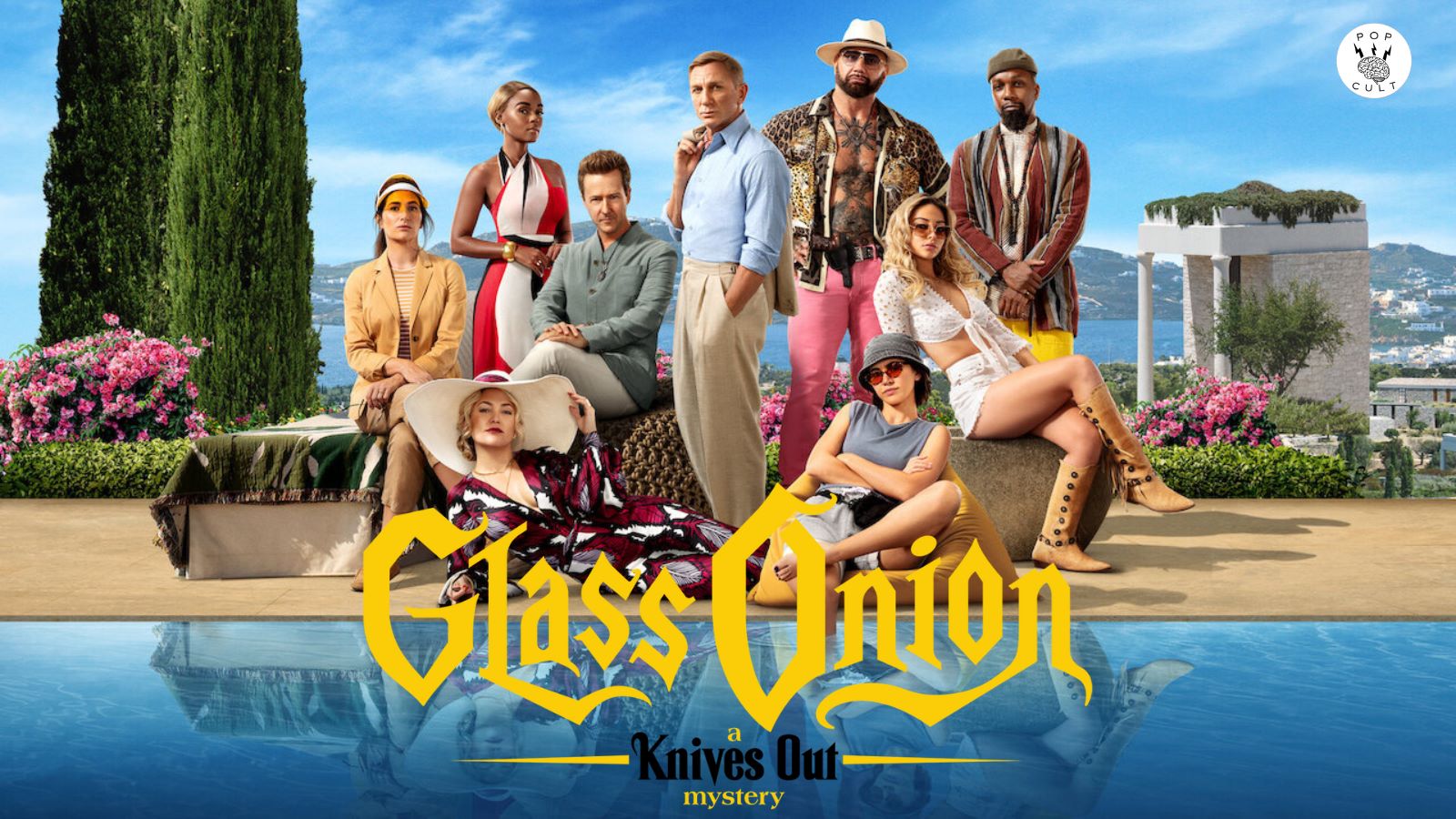
Glass Onion: A Knives Out Mystery is a follow-up to the original Knives Out film, starring Daniel Craig as the ingenious detective Benoit Blanc. It builds on the premise of a murder mystery but wraps it inside a colorful, satirical commentary on wealth, influence, and the human condition. Set on the private island of a tech billionaire named Miles Bron, the story assembles a quirky cast of characters, all entangled in complicated relationships that unravel layer by layer. The casual tone of the movie masks a sharp, incisive look at the absurdities of the ultra-rich and the moral compromises they often make.

From the outset, Glass Onion shines with its clever blending of classic whodunit tropes and contemporary social critique. The gathering on the island is ostensibly for a murder mystery party, but the tension quickly escalates when the lines between game and reality blur. As detective Benoit Blanc begins to peel back the layers, it becomes clear that the story is much more than just a puzzle; it’s a reflection on fame, fortune, intellectual theft, and the lengths people will go to protect their reputations and secrets. The mystery itself is engrossing, delivering plenty of twists and turns that keep viewers guessing without feeling predictable.

The characters are vividly drawn, each embodying a certain archetype of privilege and excess, yet crafted with enough depth to avoid caricature. Miles Bron, in particular, captures the archetypal tech mogul—brash, arrogant, and unapologetically wealthy—but his flaws and vulnerabilities make him an intriguing focal point. His colorful group of friends each contribute their quirks and motives, creating a dynamic interplay that enriches the plot. Through their interactions, the film deftly explores themes of betrayal, sycophantic behavior, and the moral decay that can accompany unchecked power.

Edward Norton’s portrayal of Miles Bron has often been linked to Elon Musk, mostly because Bron’s flamboyant personality and billionaire tech mogul status seem reminiscent of Musk. However, director Rian Johnson and Norton himself have been clear that the character is not based specifically on Musk. Instead, Miles embodies the broader archetype of “tech bros”: exceedingly wealthy, extremely arrogant, and more than a bit sociopathic. Norton’s portrayal blends charm, obliviousness, and bravado, embodying this tech mogul stereotype more than mimicking any particular real-life figure. This approach allows the film to critique the broader billionaire culture, using Miles as a symbol of its excesses and absurdities, rather than targeting one individual.

A distinctive feature of Glass Onion is how it incorporates the reality of its production during the height of the COVID-19 lockdown. Set in May 2020, during global lockdowns, the film naturally weaves in social distancing and mask-wearing as part of its narrative fabric. This not only adds an element of authenticity but also becomes a device to reveal character traits—whether sincere compliance or performative adherence. The pandemic protocols also shaped production logistics, reducing extras and focusing tightly on the main cast, creating an intimate but tense atmosphere. By anchoring the isolation of its characters in a real-world health crisis, the film echoes classic mystery confinements while feeling relevant and immediate.

Emotional stakes in Glass Onion are amplified through Helen, who arrives on a personal mission to uncover the truth behind her sister’s death. Unlike many self-interested guests on the island, Helen represents a disruptive force challenging the privileged elite. Her story adds urgency and depth, highlighting themes of justice, accountability, and silence’s costs. This subplot weaves seamlessly into the larger narrative, enriching the mystery’s resolution with meaningful emotional weight.

Visually, the film dazzles with opulent settings and a vibrant color palette that amplify the sense of excess and detachment characterizing the guests’ lives. The private island itself almost becomes a character—a lush, insular playground where drama explodes amid luxury. Production design and cinematography balance whimsy with darker undertones, while costumes and set details root satire in an authentic world.

Craig returns as Benoit Blanc with a mix of charm, wit, and gravitas, anchoring the film amidst eccentric chaos. Blanc’s character delights as a master detective who enjoys intellectual puzzles but wrestles with moral questions. Meanwhile, the supporting cast gives nuanced performances that capture their characters’ complexities and motivations.

Narratively, Glass Onion triumphs by delivering an engaging mystery while embedding incisive social commentary on inequality and hypocrisy. The film compellingly probes how wealth and influence can obscure truth and the costs endured by those who confront power. The sharp, often humorous writing makes it both entertaining and thought-provoking.

Whether viewed casually or analyzed deeply, Glass Onion offers much to enjoy. Plot twists, sharp dialogues, visual style, and strong performances combine for an engrossing experience. At its core, the story emphasizes how the pursuit of personal gain can harm others, and reckoning with uncomfortable truths demands courage and sacrifice.

Ultimately, Glass Onion is a skillfully crafted, entertaining mystery that surpasses typical genre fare. It balances suspense, humor, and social critique naturally and compellingly. Cementing Rian Johnson’s success in the Knives Out franchise, it reclaims his reputation after the contentious backlash to The Last Jedi. While fan expectations proved insurmountable in that galaxy far, far away, Glass Onion confirms Johnson as a brilliant filmmaker capable of crafting sharp, layered stories. The film invites audiences to not only solve a crime but also reflect on integrity, power, and humanity’s search for justice and meaning. Its impact lingers long after the credits roll.

Review: Knives Out (dir. by Rian Johnson)


“The family is truly desperate. And when people get desperate, the knives come out.” — Benoit Blanc

After shaking up galaxies far, far away with Star Wars: The Last Jedi, Rian Johnson returned to solid ground in 2019 with Knives Out, a film so self-assured and inventive it practically felt like a director catching his breath while reminding the world what made him exciting in the first place. It was his first movie after that polarizing Star Wars entry, and he used the opportunity not to go bigger, but smarter—to take something intimate, character-driven, and refreshingly old-school and make it gleam again. Knives Out landed as a kind of palate cleanser for both him and the audience: a modern mystery that leaned into genre nostalgia while reinventing it with sharp humor and social bite. The result wasn’t just a change of pace—it was a confident display of craft from a filmmaker unbothered by his critics, operating with absolute control over every frame, every line, and every perfectly timed smirk.

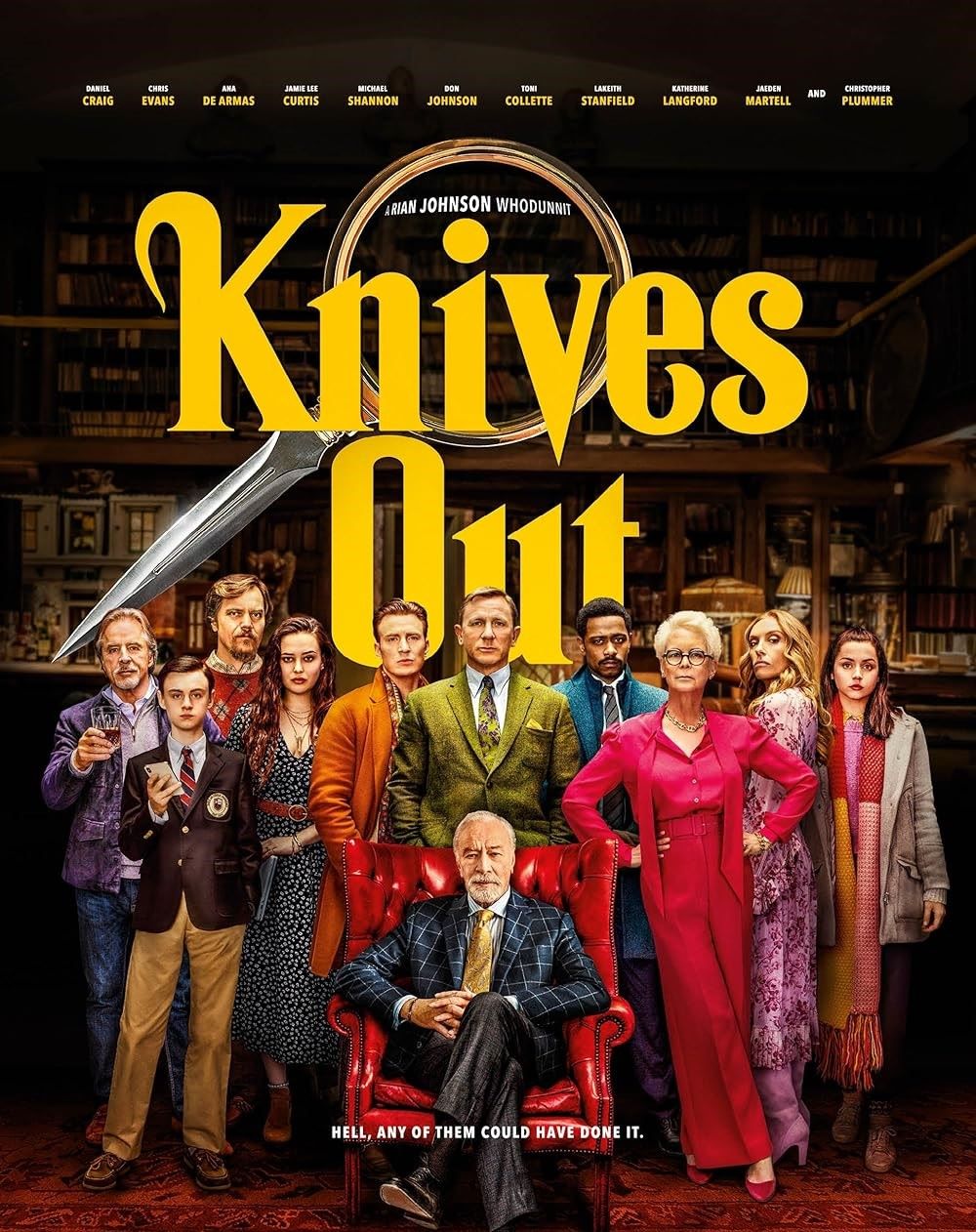
The setup couldn’t be more classic: a wealthy family patriarch, Harlan Thrombey, turns up dead after his 85th birthday, leaving behind a tangled household of suspects, secrets, and strained smiles. His death looks like suicide, but something isn’t right. Enter Benoit Blanc, a Southern gentleman detective hired anonymously to snoop through the wreckage of lies and grievances. The scenario drips with vintage whodunit flavor, but Johnson’s genius lies in retooling that familiarity into something electrifyingly modern. The Thrombeys aren’t just eccentric millionaires—they’re avatars of American entitlement, each convinced of their own superiority while quietly dependent on the man they pretend to revere. By building his mystery around a clan that mirrors contemporary divisions of money, politics, and self-deception, Johnson injects wit and purpose into the genre without ever losing the fun of the game.

Jamie Lee Curtis plays the confident matriarch Linda, Michael Shannon the resentful son Walt, Toni Collette the spiritual grifter Joni, and Don Johnson the smirking son-in-law Richard—all of them playing heightened but recognizable shades of selfishness. Their sniping exchanges during the first act are among the film’s best sequences, packed with fast banter, political jabs, and casual hypocrisy. Johnson directs these moments like a verbal tennis match, letting personalities bounce and clash until the family’s shiny façade cracks enough for true frustrations to spill out. It’s sharp, funny, and chaotic, showing early on that no one in the Thrombey family is as self-made or self-aware as they claim to be.

Amid that colorful ensemble, the performance that most stunned audiences came from Chris Evans as Ransom Drysdale, Harlan’s playboy grandson and the family’s unapologetic black sheep. Coming off years of playing Marvel’s resolutely noble Steve Rogers, Evans dives into Ransom with visible glee, turning him into a figure of charm and mystery whose motives are never quite clear. He’s magnetic from the moment he appears—witty, cynical, a little dangerous—and Johnson clearly relishes using Evans’s clean-cut image to toy with expectations. Ransom strides into the story radiating confidence, but there’s a guarded, almost predatory intelligence behind his grin. His scenes crackle because the audience can’t quite decide where to place him: is he the rare Thrombey who sees through the family hypocrisy, or is he spinning his own kind of manipulation? That tension between self-awareness and deceit gives his every line an edge. Watching Evans in this role feels like a release for him and a thrill for viewers, a testament to both his range and Johnson’s intuitive casting.

Opposite that moral uncertainty stands Ana de Armas’s Marta Cabrera, Harlan’s kind and soft-spoken nurse who suddenly finds herself at the heart of the story. Marta grounds the entire film emotionally, her decency cutting through the Thrombeys’ arrogance like sunlight in a dusty room. She’s the migrant caretaker who everyone claims to love while casually condescending to, a detail Johnson uses to expose how often politeness masks prejudice. Marta’s inability to lie without vomiting, played initially for laughs, gradually becomes symbolic—a kind of moral honesty that makes her unique in a house ruled by deception. De Armas brings layered vulnerability to the role, balancing fear, guilt, and compassion with natural ease. Through her, Johnson turns the whodunit into something more human and emotionally resonant. She isn’t just a witness or a suspect; she’s the beating heart around which all the greed, paranoia, and privilege revolve.

Then there’s Daniel Craig’s Benoit Blanc, whose arrival shifts the film into another gear entirely. His Southern drawl—equal parts poetic and perplexing—sets the tone for what becomes one of Craig’s most playful performances. After years of portraying the stoic James Bond, he’s clearly having the time of his life as a detective who investigates with both intellect and intuition. Blanc operates less like a hard-nosed cop and more like a philosopher; he believes that solving a crime means understanding human weakness as much as evidence. His famous “donut hole” speech perfectly captures the balance Johnson strikes between earnestness and absurdity. Blanc may revel in his own melodrama, but he also brings heart to chaos, observing people’s contradictions without losing his sense of wonder. The result is a detective who’s less about revelation and more about revelation’s moral cost.

Visually, Knives Out belongs to a rare category of films that are so meticulously crafted they could be paused at any frame and still look compelling. Johnson and cinematographer Steve Yedlin transform Harlan’s mansion into a breathing character—an architectural echo chamber of secrets. The walls are lined with strange trinkets, elaborate paintings, and heavy mahogany furniture that suggest old money’s suffocating weight. There’s something both cozy and claustrophobic about the space, which mirrors the tension between family warmth and poisonous resentment. The camera glides through it with purpose, lingering on small details that gain meaning later, and the autumn-colored palette—deep reds, browns, and golds—wraps everything in an inviting melancholy. It’s as much a visual experience as it is a narrative one, and few modern mysteries feel as tactile.

Johnson’s writing keeps that sense of precision. The plot unfolds like clockwork, but the mechanics never feel mechanical. Instead, he keeps viewers off-balance by blending humor with genuine suspense. Instead of relying entirely on high-stakes twists, Johnson builds tension through empathy, giving us access to characters’ doubts and stakes rather than just their clues. The result is a mystery that keeps the audience guessing in emotional and moral dimensions, not just logical ones. Every revelation says as much about character as it does about the crime.

Underneath the quick humor and ornate mystery structure, Knives Out doubles as a satire of class and entitlement. Johnson sketches the Thrombeys as people who talk endlessly about fairness, morality, and self-reliance yet collapse into panic when their material comfort is threatened. Through them, he captures a peculiar American irony: the people most obsessed with earning their status are often those most insulated from real struggle. When the family gathers to argue over wealth and loyalty, Johnson doesn’t need to exaggerate—they expose themselves with every smug phrase and self-justified rant. It’s social commentary that’s biting but never heavy-handed because it plays out through personality instead of sermon.

Nathan Johnson’s score carries the story forward with playful precision, shifting from tension to whimsy in sync with the characters’ shifting loyalties. There’s something almost dance-like about the film’s rhythm: scenes of laughter can spiral into confession, and interrogations can dissolve into comedy without losing a beat. The editing supports that agility, cutting crisply between overlapping dialogue and close-ups that reveal just enough expression to keep us alert. Johnson’s sense of pacing feels theatrical in the best way—it’s about timing and tone rather than spectacle.

As with many of Rian Johnson’s works, contradiction fuels the story’s appeal. Knives Out is cynical about human greed but oddly hopeful about individual decency. It mocks arrogance but rewards empathy. Even when it toys with genre clichés, it does so out of affection, not scorn. Johnson clearly understands that mystery storytelling is as much about character and morality as deduction, and he uses humor and chaos as tools to explore who people become under pressure. The movie’s sophistication lies in how effortless it feels—its layers unfold smoothly, but the craft behind them is razor sharp.

The film’s ending closes with a visual that redefines power without needing words. After a story filled with deceit, pretension, and the scramble to control a legacy, it concludes on an image that says everything about perspective—who actually holds the moral high ground and how quietly dignity can win. Like the rest of the movie, it’s both playful and pointed, leaving you smiling while still turning the characters’ behavior over in your mind.

Looking back, Knives Out stands as a defining moment in Rian Johnson’s career. After the spectacle and dialogue storms of The Last Jedi, this lean, ensemble-driven mystery reaffirmed his strengths as a writer-director who thrives on structure, rhythm, and human contradictions. It’s a film that takes as much pleasure in observation as revelation, brimming with sly humor and performances that sparkle across the moral spectrum. Anchored by Ana de Armas’s poignant sincerity, Daniel Craig’s eccentric brilliance, and Chris Evans’s unpredictable charisma, it became one of the most purely enjoyable movies of its time. Witty without pretense, political without lecturing, and perfectly balanced between cynicism and heart, Knives Out remains proof that the old whodunit can still cut deep—and that Rian Johnson’s sharpest weapon is still his storytelling.

Wake Up Dead Man: A Knives Out Mystery Trailer


Wake Up Dead Man: A Knives Out Mystery is the third movie in Rian Johnson’s fun and twisty murder mystery series. Daniel Craig is back as the sharp detective Benoit Blanc, who’s got his work cut out for him with a seemingly impossible case this time. The movie is set in a small-town church with some pretty creepy secrets, and Blanc teams up with a young priest to crack the case. The cast is packed with great talent like Josh O’Connor, Glenn Close, Josh Brolin, Mila Kunis, Jeremy Renner, and Kerry Washington, so there’s a lot of star power mixed with sharp writing and those clever twists Johnson’s known for.

The movie mixes mystery, drama, and a bit of dark humor while diving into themes like faith, secrets, and lies. Benoit Blanc has to navigate a tangled web of hidden motives and dark pasts—all wrapped in the spooky atmosphere of the church and its community.

It’s dropping in theaters on November 26, 2025, and then hitting Netflix worldwide on December 12, so it’s definitely one to keep an eye out for whether you’re already a fan or just love a good whodunnit.

Here Are The Eddie Nominations!


The SAG weren’t the only folks announcing their nominees today!

The American Cinema Editors (ACE) announced their Eddie nominations today, for the best edited films and television of 2019!  Here are the film nominees!

(Click here for the television nominations.)

BEST EDITED FEATURE FILM (DRAMA)

Ford v Ferrari
Michael McCusker, Andrew Buckland

The Irishman
Thelma Schoonmaker

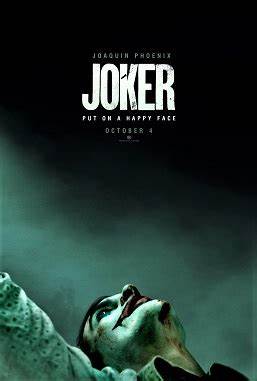
Joker
Jeff Groth

Marriage Story
Jennifer Lame

Parasite
Jinmo Yang

BEST EDITED FEATURE FILM (COMEDY):

Dolemite Is My Name
Billy Fox

The Farewell
Michael Taylor, Matthew Friedman

Jojo Rabbit
Tom Eagles

Knives Out
Bob Ducsay

Once Upon a Time in Hollywood
Fred Raskin

BEST EDITED ANIMATED FEATURE FILM:

Frozen 2
Jeff Draheim

I Lost My Body
Benjamin Massoubre

Toy Story 4
Axel Geddes

BEST EDITED DOCUMENTARY (FEATURE):

American Factory
Lindsay Utz

Apollo 11
Todd Douglas Miller

Linda Ronstadt: The Sound of My Voice
Jake Pushinsky, Heidi Scharfe

Making Waves: The Art of Cinematic Sound
David J. Turner, Thomas G. Miller