Wizards of the Lost Kingdom (1985, directed by Hector Olivera)


The kingdom has been conquered by an evil sorcerer named Shurka (Thom Christopher).  Young Simon (Vidal Peterson), the son of the king’s wizard, barely escapes with his best friend and pet, the white fur-covered Gufax (Eugenio Martin).  In the wilderness, they meet warrior Kor (Bo Svenson), who teams up with them to free the kingdom.

This is another Roger Corman-produced sword and sorcery film from Argentina.  Corman did a lot of these in the 80s.  Wizards of the Lost Kingdom stands out by being considerably more kid-friendly than the rest of them.  There’s no nudity.  The violence is not excessive and is largely directed at fake looking giant insects.  There’s no nudity and no scenes of the bad guys forcing themselves on women.  The hero even has a toy-friendly companion!

Wizards of the Lost Kingdom also has a lot of stock footage.  The entire pre-title sequence is stock footage lifted from movies like Death Stalker to explain how “King Tyler” came to control the kingdom.  (King Tyler sounds like someone who would be the kegger king of the local college.)  Wizards of the Lost Kingdom is a short movie with a barely 72-minute run-time.  Fourteen of those minutes is footage from other movies.

Wizards of the Lost Kingdom takes a lighter approach to the sword-and-sorcery genre and it pays off with a simple and easy-to-watch movie featuring swords, magic, and monstrous insects.  It’s not a film that demands much of the audience and Bo Svenson looks convincing grunting and carrying a sword.  It wasn’t a box office hit but found a second life on video.  Of course, it got a sequel.  None of the original cast returned.

Join #MondayMuggers For THE DELTA FORCE!


Hi, everyone!  Guess is who is guest hosting the #MondayMuggers live tweet tonight?  That’s right …. me!

Tonight’s movie will be The Delta Force (1986), starring Chuck Norris, Lee Marvin, Robert Forster, George Kennedy, Robert Vaughn, Steven James, Hanna Schygulla, Shelley Winters, Martin Balsam, Bo Svenson, Joey Bishop, Susan Strasberg, Kim Delaney …. well, you get the idea.  There’s a lot of people in this movie!  Jedadiah Leland swears that this is the greatest film ever made.  We’ll find out tonight!

You can find the movie on Prime and then you can join us on twitter at 9 pm central time!  (That’s 10 pm for you folks on the East Coast.)  See you then!

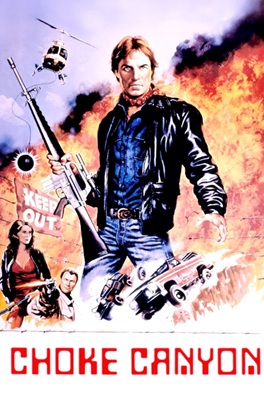
Choke Canyon (1986, directed by Chuck Bail)


Evil businessman John Pilgrim (Nicholas Pryor) and his assistant Brooke Alistair (Lance Henriksen) want to turn Utah’s Choke Canyon into a dumping ground for toxic waste.  The only problem is that Dr. David Lowell (Stephen Collins), a cowboy scientist, has signed a 99-year lease and is using the canyon as a place to conduct experiments that are designed to turn the soundwaves from Halley’s Comet into an alternative energy source.  Pilgrim sends pilot Oliver Parkside (Bo Svenson) to get Lowell out of the canyon by any means necessary.  However, Pilgrim’s rebellious daughter, Vanessa (Janet Julian), has also gone to the canyon because she finds Dr. Lowell to be intriguing.  Lowell’s reaction is to kidnap Vanessa and hold her hostage but, of course, they fall in love while trying to fly a giant ball of toxic waste out of the canyon.

Directed by the legendary stuntman Charles Bail, Choke Canyon is at its best when it focuses on Parkisde using his plane to chase Lowell’s helicopter.  Some of the aerial sequences are really exciting, even if they don’t make much sense.  (Surely, someone as powerful and rich as John Pilgrim could have afforded to send more than three guys and a cropduster to take care of Lowell.)  Stephen Collins, years before his career would collapse after he admitted to inappropriately touching three minor-aged girls, is as personable and bland here as he was in the first Star Trek movie.  The idea of a cowboy scientist is interesting but Collins really didn’t have the screen presence to pull it off.  It doesn’t help that Collins was having to act opposite a certifiable badass like Bo Svenson.  This is one of the rare movies where I wanted the bad guys to win because they were just so much cooler than the hero.

Some of the stunts are impressive, as they should be with Chuck Bail behind the camera.  Stephen Collins is boring and Janet Julian feels miscast.  (She would give a much better performance as Christopher Walken’s lawyer and girlfriend in King of New York.)  I don’t understand how a power source based on Halley’s Comet would work.  It might have worked for a few months in 1986 but what are they going to for energy until 2061 rolls around?

Live Tweet Alert: Watch Snowbeast with #ScarySocial


As some of our regular readers undoubtedly know, I am involved in a few weekly live tweets on twitter.  I host #FridayNightFlix every Friday, I co-host #ScarySocial on Saturday, and I am one of the five hosts of #MondayActionMovie!  Every week, we get together.  We watch a movie.  We tweet our way through it.

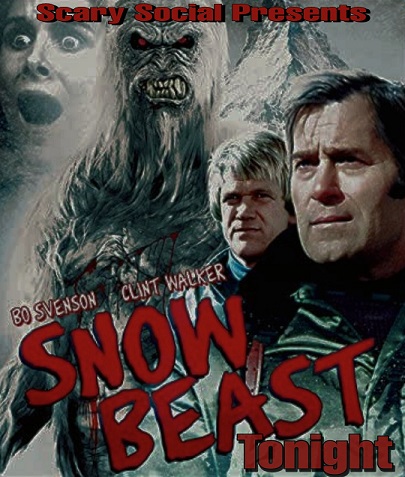
Tonight, for #ScarySocial, I will be hosting 1977’s SNOWBEAST!

In SNOWBEAST, Bo Svenson and Clint Walker team up to try to stop a monster that is threatening to disrupt the winter carnival!  It’s a surprisingly bloody made-for-TV movie.  You will be Team Snowbeast all the way!

If you want to join us on Saturday night, just hop onto twitter, start the film at 9 pm et, and use the #ScarySocial hashtag!  The film is available on Prime, Tubi, YouTube, and a few other streaming sites.  I’ll be there co-hosting and I imagine some other members of the TSL Crew will be there as well.  It’s a friendly group and welcoming of newcomers so don’t be shy.

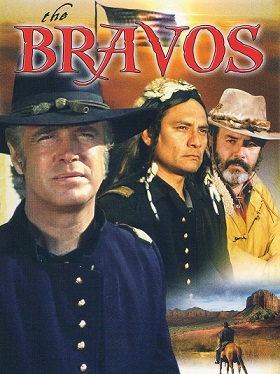
The Bravos (1972, directed by Ted Post)


Major John David Harkness (George Peppard) is the commander of Fort Bravo, a small and ill-equipped frontier fort.  Despite having only 77 soldiers and not many supplies, Harkness has managed to keep an uneasy peace between the local Indian tribes and the settlers who move through the area.  The peace, however, is disturbed when an arrogant wagon master (Pernell Roberts) kills the son of the tribal chief.

That’s not all that Harkness has to worry about.  A German outlaw (Bo Svenson) is hiding out at the camp.  His head scout (L.Q. Jones) suspects that something is forcing the local tribes out of the area.  Two settlers from Missouri (played by Barry Brown and Belinda Montgomery) are at the fort and trying to decide whether they should continue westward or return to Missouri.  Finally, Harkness’s 12 year-old son, Peter (Vincent Van Patten), has been expelled from his New England boarding school and is being sent to Fort Bravo to live with his father.  When Major Harkness refuses to turn the wagon master over to the Indians, they kidnap his son instead.

The Bravos was made for television and originally aired on ABC in 1972.  It was apparently meant to serve as the pilot for a television series, one that would have followed the daily adventures of the Major, his son, and all of the men at Fort Bravo (who were played by television mainstays like Dana Elcar, Randolph Mantooth, and George Murdock.)  For all intents and purposes, Pernell Roberts, Bo Svenson, Belinda Montgomery, and Barry Brown are all “special guest stars” and are meant to serve as examples of the type of television-friendly actors who would visit Fort Bravo on a weekly basis.  That the pilot didn’t lead to a series isn’t surprising.  TV westerns may have dominated the ratings in the 50s and the 60s but they quickly went out of fashion in the 70s as networks realized that they could make more money selling ad space for Norman Lear sitcoms and cop shows.  In the 70s, the people that advertisers were wanting to reach were watching Archie Bunker and Starsky and Hutch, not George Peppard.

Because of its TV origins, The Bravos is a fairly bland western.  It would be a few years before George Peppard would reinvent himself as a grizzled character actor and he’s sincere but fairly dull here.  Pernell Roberts is more effective as the headstrong wagon master and perhaps The Bravos would have worked better if Roberts and Peppard had switched roles.  In the end, the main reason to see the film is for the chance to see L.Q. Jones play a heroic role for once.  A member of Sam Peckinpah’s stock company, Jones brings some authentic grit to his role as the fort’s only scout.  Jones played a lot of villains but I always preferred him as one of the good guys.

The Bravos ends with a few major subplots unresolved.  Maybe they would have been resolved during the show’s first season but it was not to be.

Did You See The Sun Rise? (1982, directed by Ray Austin)


Ivan (Bo Svenson) is a KGB colonel who, working under the guise of being a diplomat, has set up operations on Hawaii.  During the Vietnam War, Ivan tortured and brainwashed an American POW named TC (Roger E. Mosely), placing a hypnotic suggestion in his brain on just the off-chance that Ivan would need a Manchurian candidate to do some dirty work at some point in the future.  With the help of another former POW, Sebastian Nuzo (James Whitmore, Jr.), Ivan plans to activate TC and then use him to assassinate the visiting prime minister of Japan.  What Ivan hasn’t counted on is that TC has two friends looking out for him, a club owner named Rick (Larry Manetti) and a laid-back, Hawaiian-shirt loving private investigator named Magnum (Tom Selleck).

Did You See The Sun Rise?  Is it a movie or is it just a two-hour episode of the original Magnum P.I.?  I think it’s both because, while it’s definitely an episode of TV series (it was, in fact, the premiere episode of Magnum‘s third season and the fact that it was a special, extra-long episode shows how popular Magnum was back in the 80s), it’s also good enough that it can stand on its own and be viewed and appreciated even by those who have never seen any other episodes of the show.  For the most part, Magnum P.I. was a breezy detective show that mixed comedy and mystery-solving.  Occasionally, though, the show would do a more serious episode and, more of than not, that episode would deal with Magnum, T.C., and Rick’s time in Vietnam.  (At the time it premiered, Magnum was unique in that it was one of the only shows to feature characters who had served in Vietnam without portraying them as being unhinged, unemployable, or potential threats to society.  Magnum and his friends had been effected by their experiences in Vietnam but, unlike someone like Rambo, they were not solely defined by their status as being veterans of what was then America’s least popular war.)  Of those serious shows, Did You See The Sun Rise? is the best example.

There’s a lot to recommend Did You See The Sun Rise?  It’s well-acted by series regulars Selleck, Manetti, Mosely, and John Hillerman.  Bo Svenson plays a great villain and even his Russian accent is more credible than you’d probably expect it to be.  The Vietnam flashbacks are handled well.  The episode has an unexpected twist, one that daringly kills off one of the show’s semi-regular supporting characters.  Even the entire Manchurian candidate plot, even if it is a little more out there than Magnum usually got, is handled well.

And then there’s that final scene.  Did You See The Sun Rise? ends with a freeze frame of Magnum doing something that TV show heroes didn’t normally do in 1982.  You can’t blame him, of course.  It’s a satisfying ending but it still leaves you knowing that nothing is ever going to be same for any of these characters ever again.  In that final scene, Did You See The Sun Rise? takes things further than most shows would have the guts to do.  The ending may not seem as shocking today but you have to remember that this episode aired long before networks like HBO regularly challenged the assumptions of what a show’s main character could or could not do on television.

The original Magnum P.I., including Did You See The Sun Rise?, is available for free on Amazon Prime.


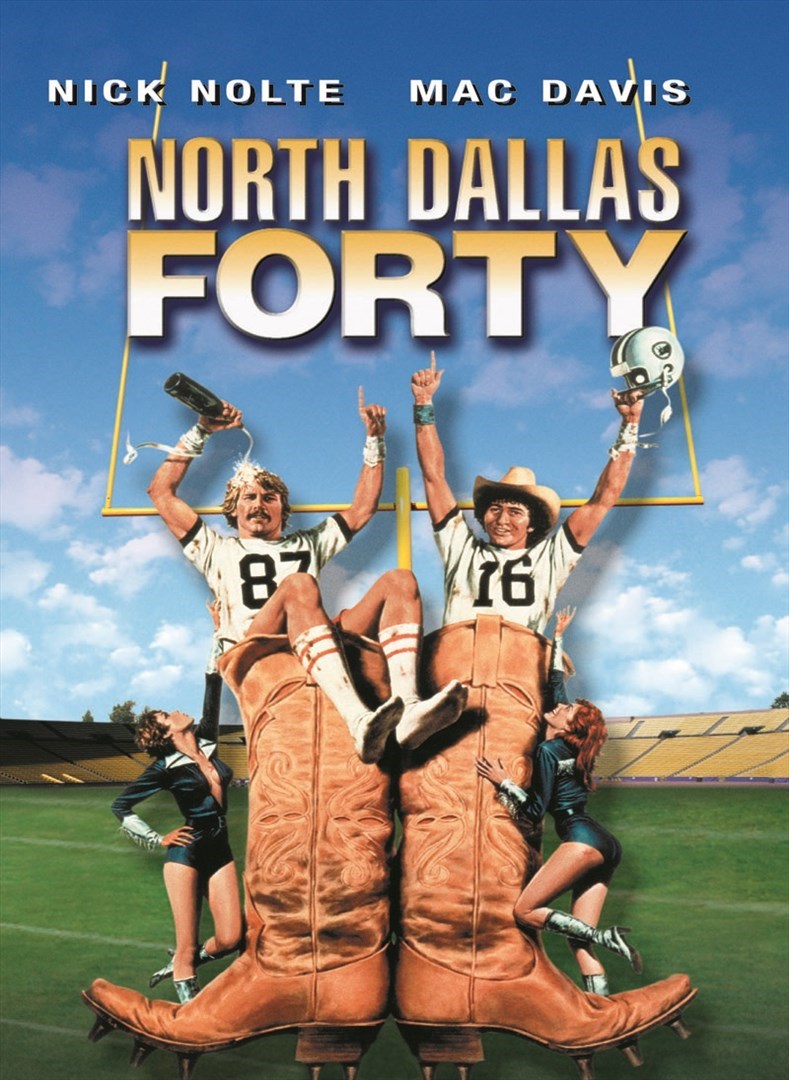
North Dallas Forty (1979, directed by Ted Kotcheff)


Pete Gent was a college basketball star at Michigan State University who, in 1964, received a tryout with the Dallas Cowboys.  Intrigued by the $500 that the team was offering to any player who attended training camp that summer, Gent accepted.  Despite the fact that Gent had never before played football, the Cowboys were impressed with his athleticism and they signed him to the team.

For five seasons, Gent played wide receiver.  During that time, he caught a lot of balls, became close friends (or so he claimed) with quarterback Don Meredith, and got under the skin of Coach Tom Landry with his nonconformist attitude.  After several injuries kept him off the field during the 1968 season, Gent was traded to the Giants who waived him before the next regular season began.

Out of work and with no other team wanting to sign him, Gent wrote a thinly veiled autobiographical novel about his time with the Cowboys.  North Dallas Forty was published in 1973 and it immediately shot up the best seller charts.  When the book was published, football players were still regularly portrayed as being wholesome, all-American athletes and the Dallas Cowboys were still known as America’s Team.  North Dallas Forty shocked readers with its details about groupies, drugs, racism, and gruesome injuries.  The NFL, of course, claimed that Gent was just a disgruntled former player who was looking to get back at the league.  When asked about the book (which portrayed him as being a marijuana-loving good old boy), Don Meredith was reported to have said, “If I’d known Gent was as good as he says he was, I would have thrown to him more.”

Meredith had a point, of course.  In the book, Pete Gent portrays himself as not only being the smartest man in football but also as having the best hands in the league.  Men want to be him.  Women want to be with him.  And the North Dallas Bulls (which is the book’s version of the Dallas Cowboys) don’t know what they’re losing when they release him for violating the league’s drug policy.  Today, when you read it and you’re no longer shocked by all of the drugs and the sex, North Dallas Forty comes across as mostly being a case of very sour grapes.

Luckily, the film version is better.

Nick Notle plays Phil Elliott, a broken-down receiver who wakes up most mornings with a bloody nose and who can barely walk without first popping a hundred pills.  Phil is a nonconformist and a rebel.  He loves to play the game but he hates how it’s become a business.  Mac Davis plays Seth Maxwell, the team’s quarterback and Phil’s best friend.  Seth is just as cynical as Phil but he’s better at playing politics.  G.D. Spradlin is B.A. Strother, the cold head coach who is a thinly disguised version of the legendary Tom Landry.  In the novel, B.A. Strother was portrayed as being a hypocritical dictator.  The film’s version is more sympathetic with Strother being portrayed as stern but not cruel.  Strother even tells Phil that he “can catch anything.”

Both the film and the book take place over the course of one week leading to a big game against Chicago.  In the book, Phil says that he and Seth don’t care about whether or not they win.  In the movie, they much do care but, at the same time, they know that they’re being held back by a system that cares more about whether or not they follow the rules than if they win the game.  While Phil’s teammates (including Bo Svenson as Joe Bob Priddy and John Mantuszak as O.W. Shaddock) behave like animals, Phil falls in love with Charlotte Caulder (Dayle Haddon), who doesn’t care about football.

Pete Gent was originally hired to write the film’s screenplay but left after several disagreements with producer Frank Yablans.  (The screenplay was completed by Yablans, directed Ted Kotcheff, and an uncredited Nancy Dowd.)  The movie loosely follows the novel while dropping some of its weaker plot points.  As a result, the film version has everything that made the novel memorable but without any of Gent’s lingering bitterness over how his career ended.  The novel used football as a metaphor for everything that was going wrong in America in the 60s and 70s but the movie is more of a dark comedy about one man rebelling against the system.

There’s only a few minutes of game footage but North Dallas Forty is still one of the best football movies ever made, mostly because Nick Nolte is absolutely believable as an aging wide receiver.  He’s convincing as someone who can still make all the plays even though he’s usually in so much pain that it’s a struggle for him to get out of bed every morning.  He’s also convincing as someone who loves the game but who won’t give up his freedom just to play it.  This is a definite improvement on the novel, in which Phil seemed to hate football so much that it was hard not to wonder why he was even wasting his time with it.  Country-and-western signer Mac Davis is also convincing as Seth Maxwell and fans of great character actors will be happy to see both Charles Durning and Dabney Coleman in small roles.

Whether you’re a football fan or not, North Dallas Forty is a great film.  Coming at the tail end of the 70s, it’s a character study as much as its a sports film.  It’s also one of the few cinematic adaptations to improve on its source material.  As a book, North Dallas Forty may no longer be shocking but the movie will be scoring touchdowns forever.

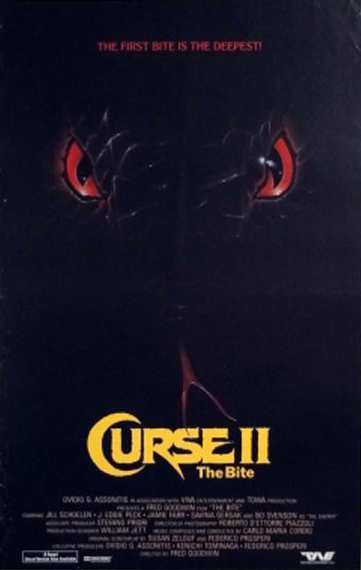
Snakes On A Vacation: Curse II: The Bite (1989, directed by Frederico Prosperi)


Clark (J. Eddie Peck) and his girlfriend, Lisa (Jill Schoelen), are vacationing in New Mexico.  It’s a romantic getaway, except for all of the snakes.  Clark manages to save Lisa from one snake through the use of his trusty rifle but then he himself gets bitten once they go to a motel.  Luckily, traveling salesman Harry Morton (Jamie Farr!) has a suitcase that’s full of anti-snake venom antidotes.  Unfortunately, the one that Harry gave to Clark doesn’t do much good because not only does the bite on Clark’s arm get worse but it starts to turn into a snake!  In fact, his entire body is full of snakes, just trying to slither out!  It’s a vacation from Hell as Lisa tries to find a cure for Clark, Clark tries to control his serpent-like instincts, and Harry tries to find the young couple so that they don’t sue him.

This is an unrelated sequel to a film called The Curse.  In fact, it’s probable that this film was just called The Bite until the first Curse did slightly better at the box office than anyone expected.  The two films share not a single character or plot point in common.  There’s not really even a curse in this so-called sequel!  Clark’s problems are all due to the snake being radioactive.  (Once again, science is to blame.)  It’s a typically cheesy, low-budget 80s horror film but it does have a few things to recommend it.  The special effects range between being enjoyably cheap and effectively gross.  Jamie Farr is entertaining as Harry Morton and seems to be happy to not be playing Klinger again.  The truckers that Harry enlists to help him search for Lisa and Clark are all colorful characters and they are a little more interesting than the usual horror movie canon fodder.  Bo Svenson also has a good cameo as the sheriff.

Best of all, the film features one the greatest scream queens of the late 80s and early 90s, Jill Schoelen.  Schoelen is best remembered for her role in The Stepfather but she actually appeared in several horror movies between 1987 and 1993.  As she was in almost all of her roles, Jill Schoelen is both sexy and believable in The Bite.  She had a talent for making even the worse dialogue sound natural and that was a talent that The Bite gave her many chances to display.

The Bite is hardly a great film but, by the standards of late 80s cable fare, it’s undeniably entertaining.


Horror Film Review: Butcher, Baker, Nightmare Maker (by William Asher)


http://www.youtube.com/watch?v=jO8Djh7gk7I

This is an unexpectedly odd psychological thriller from 1981.

Okay, well, actually, I guess the technical term for this film would be “slasher” because it does feature a dark secret from the past and a series of gruesome murders and some 20-something teenagers getting naked.  That said, calling this movie a slasher brings to mind thoughts of Friday the 13th and Halloween and, as much as I’ve defended those films in the past, it’s hard to compare them to a film like Butcher, Baker, Nightmare Maker.  Nor is the film comparable to more giallo-influenced slashers that came out in the late 70s and the early 80s.  The identity of the murderer is revealed too early for that.

The murderer is Cheryl Roberts (Susan Tyrrell), who may seem like a perfectly normal suburban widow but who has some bad habits.  For instance, when she’s sexually rejected by television repairman Phil Brody (Caskey Swaim), she reacts by grabbing a knife and stabbing him to death in the kitchen.  When the police arrive, she says that he attempted to rape her.  When it’s later revealed to her that Phil was gay and in a committed relationship with the local high school basketball coach, she snaps that “Homosexuals are very sick people!”  Cheryl goes on to murder several more people, all because she views them as a threat to her relationship with her nephew, Billy (Jimmy McNichol).

Billy is a senior in high school.  His parents died in a mysterious car crash when he was an infant and he’s been raised by his aunt Cheryl.  Billy has an opportunity to go away to college on a basketball scholarship but Cheryl isn’t happy about that.  Cheryl never wants Billy to leave and she’s not above drugging his milk to make sure that he has a bad game while the college scouts are watching.  Cheryl is also not happy that Billy has a girlfriend, Julia (Julia Duffy).  When she finds out that Billy and Julie are sexually active, Cheryl’s response is to trap Julia in the basement.

Aunt Cheryl is not Billy’s only problem.  There’s also Detective Joe Carlson (Bo Svenson).  Carlson has been assigned to investigate the murder of Phil and he quickly becomes fixated on the fact that Phil was gay and that he was in a relationship with Billy’s coach, Tom Landers (Steve Eastin).  Despite all of the evidence that Cheryl’s killing people left and right, Carlson becomes obsessed with proving that Billy’s gay and that he murdered Phil as the result of a love triangle.  It quickly becomes clear that Carlson, who brags about his own military service, is incapable of going for more than five minutes without accusing someone of being gay.  (Of course, Carlson never says “gay.” Instead, he uses a slur that begins with the letter F and he uses it a lot.)

What sets this film apart from other horror films of the era is that the rampant homophobia is not played for laughs or for shock value.  Traditionally, being gay in a 1980s horror film meant that the character was either going to be held up as an object of ridicule or, in many cases, turn out to be the murderer.  Instead, in Butcher, Baker, Nightmare Maker, the gay characters are literally the only fully sympathetic people in the entire film.  Instead, the film’s villains are homophobes like Carlson, Cheryl, and Eddie (Bill Paxton!), a bully who gives Billy a hard time over his friendship with the coach.  As many people as Cheryl kills over the course of the film, the bigger monster is Carlson, who is so determined to indulge his prejudices that he’s blind to everything that’s happening in front of him.

It makes for an unexpectedly thoughtful slasher film.  Butcher, Baker, Nightmare Maker has its flaws, to be sure.  I wish, for instance, that Julia and Billy weren’t such bland characters.  (They’re well-acted but neither is written with much depth.)  There’s some pacing issues as well.  But overall, this is an unexpectedly good thriller which features two horrifyingly plausible performances from Susan Tyrrell and Bo Svenson.


A Movie A Day #356: The Delta Force (1986, directed by Menahem Golan)


Last year, at this time, I set a goal for myself.

I decided that, in 2017, I would review a movie a day and I nearly succeeded. I didn’t review a movie on the day Chris Cornell died.  I missed a few days in March due to a sinus infection.  Including the review that I’m posting below, I reviewed 356 movies in 2017.  According to the year-end stats, my most popular reviews were for Heavy Metal Parking Lot, Slaughter, Body Chemistry 3, Body Chemistry 4, and Beatlemania.

Since tomorrow will be the start of a new year, this is going to be the end of my A Movie A Day experiment.  In 2018, I’ll still be watching movies and posting reviews on this site but this is my final daily review.  For my final Movie A Day, I picked the greatest movie of all time, The Delta Force!

Produced by Cannon Films, The Delta Force starts in 1980, with a helicopter exploding in the desert.  America’s elite special missions force has been sent to Iran to rescue the men and women being held hostage in the embassy.  The mission is a disaster with the members of Delta Force barely escaping with their lives.  Captain Chuck Norris tells his commanding officer, Col. Lee Marvin, that he’s finished with letting cowardly politicians control their missions.  Chuck heads to Montana while Lee spends the next few years hitting on the bartender at his local watering hole.

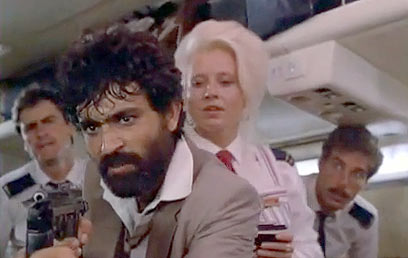
In 1985, terrorists led by Robert Forster hijack an airplane and divert it to Beirut.  Among those being held hostage: Martin Balsam, Shelley Winters, Lainie Kazan, Susan Strasberg, Kim Delaney, and Bo Svenson.  The great George Kennedy plays a priest named O’Malley who, when the Jewish passengers are moved to a separate location, declares himself to be Jewish and demands to be taken too.  Jerry Lazarus is a hostage who spends the movie holding a Cabbage Patch doll that his daughter gave him for luck.  Former rat packer Joey Bishop plays a passenger who says, “Beirut was beautiful then.  Beautiful.”  Fassbinder favorite Hanna Schygulla is the stewardess who refuses to help the terrorists because, “I am German!”

In America, General Robert Vaughn activates The Delta Force to rescue the hostages and take out the terrorists.  As Lee Marvin prepares everyone (including Cannon favorite, Steve James and, in a nonspeaking role, Liam Neeson) to leave, the big question is whether Chuck Norris will come out of retirement for the mission.  Of course, he does.  Even better, he brings his motorcycle with him.

Anyone who has ever seen The Delta Force remembers Chuck’s motorcycle.  Not only did it look incredibly cool but it was also mounted with machine guns and it could fire missiles at cowardly terrorists.  It didn’t matter whether you agreed with the film’s politics were or whether you even liked the movie, everyone who watched The Delta Force wanted Chuck’s motorcycle.  As the old saying goes, “You may be cool but you’ll never be Chuck Norris firing a missile from a motorcycle cool.”

The Delta Force is really three different films.  One film, shot in the style of a disaster film, is about the hostages on the plane and their evil captors.  The second film is Lee Marvin (in his final movie role) preparing his men to storm the airplane.  The third movie is Chuck Norris chasing Robert Forster on his motorcycle.  Put those three movies together and you have the ultimate Cannon movie.  The Delta Force was even directed by Cannon’s head honcho, Menahem Golan.  (Years earlier, Golan also directed Operation Thunderbolt, an Israeli film about the raid on Entebbe, which features more than a few similarities to The Delta Force.  Golan received his first and only Oscar nomination when Operation Thunderbolt was nominated for Best Foreign Language Film.)

The Delta Force is also the ultimate 80s movie.  It opens with the Carter administration fucking everything up and it ends with the Reagan administration giving Lee Marvin and Chuck Norris the greenlight to blow up some terrorists.  There is not much nuance to be found in The Delta Force but it still feels good to watch Chuck beat the bad guys.  Top that off with a shameless score from Alan Silvestri and you have one of the greatest action movies of all time.

At the end of The Delta Force, as cans of Budweiser are being passed out to rescued hostages, an extra is clearly heard to shout, “Beer!  America!”  Then everyone sings America The Beautiful.

That says it all.