A Blast From The Past: What About School Spirit? (dir by Herk Harvey)


Director Herk Harvey

The 1958 short film, What About School Spirit?, introduces us to the greatest high school in all of Kansas.  The entire state is envious of Lawrence High.  Not only are they champions in basketball but they’re champions in academics as well!  What is it that makes Lawrence High so special?

Well, as one student explains, Lawrence High was’t always the wonderful institution that it is today.  It’s not that the school didn’t have school spirit.  In fact, it had too much school spirit!  The students were driving fast and painting the school’s initials “where they had no business to be!”  Everyone was so crazy about the school that they didn’t stop to think about how their rambunctious behavior was making life annoying for everyone else!

Then, luckily, the basketball team captain, Bob Corby, spoke at a student assembly and what Corby said changed the entire direction of the school.  I’m not sure how that happened exactly because, judging from what we see of his speech, it’s nothing that special.  In fact, I think Bob Corby’s kind of overrated.  That’s right, I said it.  Of course, after giving the speech, Bob Corby got sick and died.  The students, of course, continued to display properly controlled school spirit in his memory.

I guess the message here is that teenagers should be proud of their school without being too loud about it.  To be honest, though, Bob Corby and all of his followers kind of come across as being little fascists who are determined to quash any hint of nonconformity or rebellion.  The next time that they say, “It couldn’t happen here,” you tell them that it already happened at Lawrence High.

This film was directed by Herk Harvey, who made a career out of doing educational films like this one.  However, horror fans will always know Harvey best for directing the massively influential Carnival of Souls.  That’s a film that we’ll watch later this month.  For now, enjoy the legend of Bob Corby!

A Blast From The Past: Responsibility (dir by Herk Harvey)


Director Herk Harvey

The year is 1953 and a rural high school — maybe one that’s a lot like yours — is in chaos!

That’s the idea behind Responsibility, a short film that was apparently designed to make students think about the importance of …. well, responsibility.  Narrated by a rather judgmental principal, Responsibility tells the story of two teenagers.  Lloyd is responsible and mature and boring and probably is destined for a middle management job at the local feed store.  Hank is a new student with a chip on his shoulder and a haircut that screams “trouble.”  Hank is irresponsible but charismatic and, in the real world, there’s absolutely no question who would be the more popular of the two.

However, this is a short film from the 50s so we’re thrown into this weird fantasy world where students actually give serious thought to their options before voting in student elections.  It’s a world where everyone might like Hank better but they just can’t forgive him for blowing off class and losing the big debate tournament.  It’s world where boring old Lloyd could possibly be a more appealing choice than a rebel in a leather jacket.

Lloyd and Hank are friends but that doesn’t stop them from both running for president of the student body.  The initial vote is tied but there is one absentee ballot.  That ballot will determine who will become the new president — unless, of course, the absentee student has a sense of humor and wrote in their own name, like I always used to do.

“Who would you vote for?” the principal asks.

Me?  Why, Gary Johnson, of course!

This is yet another educational short film from Herk Harvey.  Harvey made a career out of doing films like this but, today, he’s best remembered for directing the classic horror film, Carnival of Souls.  We’ll be watching Carnival of Souls later this month.  For now, enjoy Responsibility and ask yourself …. “Who would you vote for?”

A Blast From The Past: The Good Loser (dir by Herk Harvey)


Director Herk Harvey

What’s more important?  Being a good winner or a good loser?

Does being a good winner make it more difficult to be a good loser?

Should an individual loss matter if it contributes to a team victory?

When your child loses, is it a good idea to relentlessly taunt them about it?

These questions and more are explored in the 1953 short film, The Good Loser.  This is one of those films that they used to show in schools in order to teach students how to …. well I’m not sure what anyone learns in The Good Loser.  It tells the story of Ray, who is the best public speaker in all of Kansas or, at least, he is until he makes the mistake of agreeing to mentor Marilyn.  After Marilyn beats him at the speech and debate tournament, Ray throws a little hissy fit.  It doesn’t help that everyone — from his classmates to his own father — is making fun of him for losing to his protegee.

“What do you think?” the narrator asks and I’ll tell you.  I’ve never been a good loser so I totally think that Ray has every right to drop out of school and spend the rest of his life wandering around the country, drifting from job-to-job and refusing to trust anyone.  “Second place just means you’re the best loser.”  A teacher said that to me once and the end result was …. well, actually, I think I was kinda like, “Really?  The best?”  Anyway….

Now, if you’re wondering why I’m sharing this video in October, it’s because this film was directed by Herk Harvey.  Harvey made a career out of directing short educational films but, to horror audiences, he’s best known for directing a classic horror film called Carnival of SoulsCarnival of Souls is a film that I’ll be sharing on later in the month.  On the surface, The Good Loser may not appear to have much in common with Carnival of Souls.  However, I think you can compare Ray’s insensitive classmates to the insensitive ghosts who haunted Candace Hilligoss in Carnival.  If nothing, they’re all similarly relentless.  They’re also all jerks, if you ask me.

What do you think?

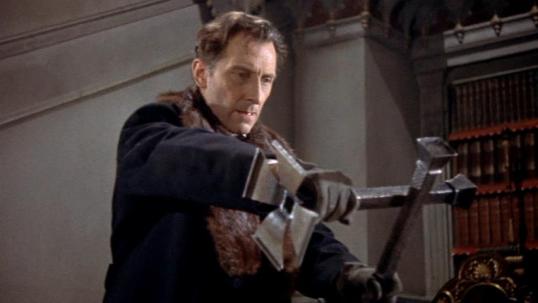
A Blast From The Past: Peter Cushing — A One Way Ticket To Hollywood


I’m not sure if you can be a true fan of horror (especially British horror) without loving Peter Cushing.

The actor played many roles over the course of his long career.  In fact, the first film in which he and Christopher Lee both appeared was not a horror film but instead Laurence Olivier’s 1948 production of Hamlet.  (They both also appeared in 1952’s Moulin Rouge.)  However, Cushing will probably always be best known for his Hammer roles and, of course, his villainous performance in Star Wars.  Peter Cushing was not only the virtuous Prof. Van Helsing but also the far less virtuous Baron Frankenstein.

According to almost every interview that I’ve read, Peter Cushing was a genuinely nice and professional person, one who didn’t personally care for horror films but who never took it personally when he was recognized for appearing in them.  Though they regularly played rivals on screen, he was close friends with Christopher Lee.  I once read an interview with Lee where he said that, decades later, he still hadn’t recovered from Cushing’s death in 1994.

Below, you’ll find a documentary from 1989.  It was called Peter Cushing — A One-Way Ticket To Hollywood.  It’s basically just Peter Cushing talking about his life and career for 49 minutes but it’s a charming little documentary.  Peter Cushing comes across as being very nice and very British.  He discusses not only his horror films but also his work in Star Wars and his performance as Winston Smith in a 1954 production of 1984.

It’s a nice documentary and I offer it up on Halloween as a tribute to one of horror’s gentlemen.

(Thank you to VintageTreats for uploading this!)

A Blast From The Past: The Marfa Lights


Marfa Lights

Did you know that we are regularly visited by UFOs down here in Texas?

Well, maybe.  To be honest, I tend to be a skeptic about most of these things, just because I can’t imagine any aliens wanting to visit this planet.  However, it is true that — for centuries — mysterious lights have been spotted hovering over the desert that surrounds Marfa, Texas.

Some people down here prefer not to talk about the Marfa Lights, because they kind of play into the whole “Everyone in Texas is crazy” stereotype that certain folks have.  If nothing else, we’re a state that loves to do business and sometimes aliens aren’t good for business.

The Gribbles in Marfa

But, honestly, most of us love the idea of aliens regularly visiting Marfa!  If nothing else, those aliens have earned themselves a right to one of those “I wasn’t born in Texas but I got down here as fast as I could” bumper stickers!

Of course, it’s totally possible that the Marfa Lights are not UFO-related.  There’s plenty of explanations that have been offered up but none of them are as much fun as aliens.  So, let’s go with aliens.

The video below tells you all about The Marfa Lights and it’s pretty interesting.  It has an interview with a Marfa old timer who claims her ancestors spotted the lights back in the 19th century.  I’m not sure when the video is shot but judging from the cars and the fashion, I’m going to guess it’s from either the late 70s or the 80s.  That said, Marfa pretty much still looks the same.

Except, of course, Marfa is now a leading artist’s colony and the home of a famous (and fake) Prada store.  In fact, a few years ago, 60 Minutes did a whole story on Marfa and didn’t even mention the Marfa Lights.  I guess the reporters were shocked to discover art in Texas.  People up north are always so shocked to discover that there’s a world below Manhattan.

Prada Marfa

Anyway, enjoy The Marfa Lights!

A Blast From The Past: Archival Newsreel Footage of D-Day!


Today is the 74th anniversary of D-Day, a day in which thousands sacrificed themselves so that the world could live free of Hitler’s tyranny.

Now, back in 1944, they didn’t have the nightly news.  They didn’t have CNN or MSNBC or Fox News.  There was no 24-hour news channels.  And certainly, there was no internet.  No one live tweeted the invasion of Normandy.  No one blogged about it.  No one marked themselves safe on Facebook.  Instead, for many of the citizens back home, their first knowledge of D-Day came from the newsreels that often ran before movies.

The newsreel below is from June 9th, 1944, three days after the invasion.  Take a look:

Also, be sure to check out some of our previous D-Day posts:

  1. The D-Day Photos of Robert Capa
  2. Film Review: The Longest Day
  3. Scenes I Love: Saving Private Ryan
  4. A Second Scene I Love From Saving Private Ryan


A Blast From The Past: Patriotism


Flag (Erin Nicole Bowman, 2010)

Today is Loyalty Day!

If you haven’t ever heard of Loyalty Day before … well, then you’re probably a subversive or something.  Loyalty Day has been a real holiday since 1955.  That was when President Dwight D. Eisenhower proclaimed May 1st to be Loyalty Day.  (I’m going to guess that this was done largely to provide an alternative to International Workers Day or Communist New Year or whatever May Day was known as back then.)  The official statutory definition reads as follows:

(a) Designation.— May 1 is Loyalty Day.(b) Purpose.— Loyalty Day is a special day for the reaffirmation of loyalty to the United States and for the recognition of the heritage of American freedom.(c) Proclamation.— The President is requested to issue a proclamation—

(1) calling on United States Government officials to display the flag of the United States on all Government buildings on Loyalty Day; and
(2) inviting the people of the United States to observe Loyalty Day with appropriate ceremonies in schools and other suitable places.

So, in honor of Loyalty Day, here’s a short film from 1972.  It’s called Patriotism and it was apparently made to teach school children what it meant to be a patriot.  Apparently, it means working as a crossing guard and wearing a vaguely fascist-looking vest while doing so.  It also means keeping an eye out for weeds and trash in your neighborhood.  My favorite part of this film is when the kid spots the turned over garbage can and gets a look of disgust on his face.  You can just tell he’s thinking, “Those goddamn hippies.”

(For the record, that’s what I always think whenever I can’t find a pen at work.)

Personally, I agree that making a good neighborhood is the first step in making a good country so I definitely applaud the kids for taking the time to clean their neighborhood up.  Still, I have to wonder: where are the adults?  How many grown ups walked past the overturned trash can and just ignored it?  Perhaps all the adults in the neighborhood were so disillusioned by George McGovern dumping Tom Eagleton as his running mate that they just gave up on life.  Who knows?  1972 was apparently a pretty traumatic year for some people.  Myself, I just find it amusing that there was a politician named McGovern.  That’s like a seminarian named McClergy.

Speaking of adults, this short film was hosted by actor Bob Crane, who would be murdered six years later and whose life would serve as the basis for a rather depressing movie called Auto Focus.

Anyway, in the immortal words of Team America: World Police, “America!  Fuck yeah!”  Let’s make this the best Loyalty Day ever!


A Blast From The Past: I Just Don’t Dig Him (produced by The Department Of Mental Health, State of Connecticut)


The haunting opening scene of I Just Don’t Dig Him…

Ah, parents and their children!

It doesn’t matter what year it is or where they live or who they are.  Parents never understand their children and children never understand their parents and, ultimately, there’s always that one friend who ends up nearly chopping his finger off.

At least, that’s the message that I got from watching the 1970 educational film, I Just Don’t Dig Him.

This film was produced by the state of Connecticut’s Department of Mental Health and apparently, it was designed to show that adults and teenagers actually had more in common than they realized.  For instance, in this film, both groups share an intense loathing for each other.

The film is about a father and his son.  The father spends all of his time complaining about his son.  The son spends all of his time complaining about his father.  For some reason, we’re treated to a really gross close-up of the son’s bare feet.  Meanwhile, the father applies aftershave as if the fate of the world depended upon it.  The son’s best friend assures him that his father isn’t so bad.  The father’s best friend assures him that his son isn’t so bad.  And then the son’s friend accidentally chops off his finger while fooling around with a car engine.  The father helps to stop the bleeding while his son stares at him resentfully.  The message appears to be that adults and children need to communicate better but, ultimately, you want an adult around if anyone starts bleeding.

I like films like this, largely because I’m an unapologetic history nerd and I Just Don’t Dig Him is such a product of its time that it might as well be wearing bell bottoms and dropping brown acid.  Watching the film today, it’s hard not to be amused by how intense both the father and the son are about … well, everything.  When the father shaves, you’re first thought is, “That man should not be allowed to handle anything sharp.”  When the son talks on the phone, you feel bad for whoever’s having to listen to him whine.  Generations are at war, this film seems to say, and there’s no hope until the younger generation realizes that they have no business working on cars.

With this being 4/20 and the world currently being caught up in its own increasingly tedious generational war, today seems like the perfect time to share I Just Don’t Dig Him!

A Blast From The Past: Sacheen Littlefeather Crashes The Oscars


The year was 1973 and Marlon Brando was the obvious front-runner to win the Oscar for Best Actor.  His performance in The Godfather had not only provided an important anchor to that sprawling film but it also rejuvenated his career.

No one was surprised when Liv Ullman and Roger Moore announced that Brando had won the Oscar.  The shock came when a young woman named Sacheen Littlefeather approached the stage.  The rest is Oscar history:

Brando had actually given Sacheen a 15-page speech that he wanted her to read from the stage.  However, the show’s producers — realizing what Brando was planning — told Sacheen that, if she stayed on stage for longer than 60 seconds, she would be forcibly removed.  Hence, Sacheen improvised her stage comments and then read Brando’s speech backstage.  As a result of this incident, the Academy banned proxy acceptances.

As for Brando’s Oscar, Roger Moore took it home with him and kept it until, a few days later, armed guard showed up to take it back from him.

A Blast From The Past: You Are The One (dir by Andy Warhol)


Pop artist Andy Warhol wasn’t just a painter and a celebrity.  He was also a filmmaker.

Below, you’ll find Warhol’s final film.  In 1985, using a type of early computer known as an Amiga, Warhol made a 2 and a half-minute movies called You Are The One.  It’s a strange little movie, one that features Marilyn Monroe and a disembodied voice repeating, “You are the one.”  It’s atmospheric and, when viewed under the right circumstances, kind of creepy.

This movie was believed to be lost until 2007, when it was found hidden away in Warhol’s studio.

Here is Andy Warhol’s final film: