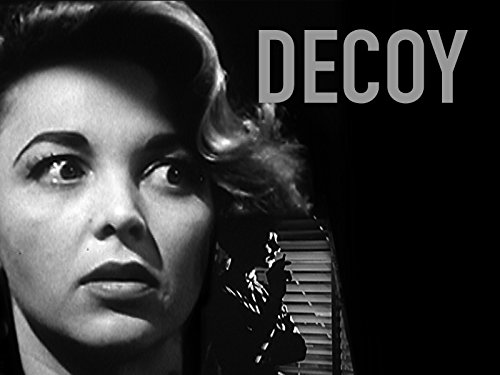
Welcome to Retro Television Reviews, a feature where we review some of our favorite and least favorite shows of the past! On Thursdays, I will be reviewing Decoy, which aired in Syndication in 1957 and 1958. The show can be viewed on Tubi!
This episode, Casey searches for a man who has abandoned his daughter so he can pursue a career as a painter of clowns.
Episode 1.2 “The Red Clown”
(Dir by Teddy Sills, originally aired on October 21, 1957)
Mike Foley (John McLiam) has quit has job and left his New York home. His wife (Barbara Barrie) suspects that Mike has returned to Greenwich Village so that he can pursue his dream of being a painter. Normally, this wouldn’t be a police manner but Mike has also left behind his daughter, Bobby (Barbara Myers), and is facing charges of child abandonment unless he starts paying child support. Policewoman Casey Jones (Beverly Garland) works undercover, pretending to be a bourgeois art collector who wants to buy one of Mike’s horrid clown paintings.
This episode featured some wonderful on-location footage of New York City in the 1950s. The history nerd side of me loved that. I have to admit, though, that I found myself wondering whether or not Casey is actually that good at her job. Bobby managed to follow Casey all the way to Greenwich Village without Casey noticing. When Casey did notice, she did the whole thing where she went to a phone booth and told Bobby, “Stay here while I make a call.” Well, of course, Bobby didn’t stay there. Bobby went running off to look for her father.
(Was Bobby’s mother not concerned that her daughter was basically wandering around the city?)
Of course, if Bobby hadn’t followed Casey to Greenwich Village, they never would have found Mike. Mike, it turned out, was living in a shabby building and spending all of his time painting. He was pursuing his dream. When Bobby asked him to come home, Mike replied that he had no interest in his old life and that he didn’t want anything to do with his family. Mike’s harsh words left Bobby in tears. The episode ended with Bobby playing in a playground a few wees later, with Casey watching her and telling us, “I think she’ll be okay.” Yeah, I don’t think so, Casey.
The episode was depressing! But I have to give the show a lot of credit for not having Mike have a sudden change of heart. The truth of the matter is that he left his family because he was self-centered. He didn’t become any less self-centered when he was confronted by his daughter. After listening to Mike’s self-serving crap, Bobby dropped the clown doll that she carried with her as she searched for Mike, saying that she didn’t like clowns anymore. It’s a painful lesson and a sad one but at least Bobby now knows that truth about her father. Other than that playground coda, this episode had the guts not to give into false hope.
Next week: Casey deals with an obscene phone caller!
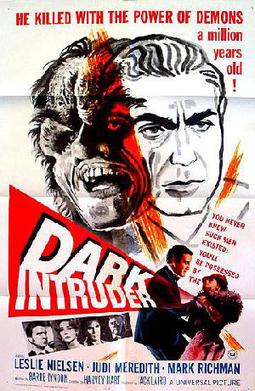
The 1965 film, Dark Intruder, takes place in San Francisco in 1890.
Murders are being committed on the foggy streets of the city that was once known as Yerba Buena. Women are being stalked through allies and attacked by a caped figure who seems to thrive on the darkness. At each murder, a hideous statuette is left behind. The statuette seems to depict a winged demon emerging from the back of a man’s head. With each murder, the demon appears to be growing closer and closer to fully escaping from the man.
The police are baffled and the press is suggesting that London’s infamous Jack the Ripper has come to California. (Well, where else would he go? I kid, California, I kid! I love you, California. Well, I love some parts of California, at least.) As the police often due when they have a case with supernatural overtones, they turn to local socialite and bon vivant, Brett Kingsford (Leslie Nielsen).
Brett lives in a mansion, where he wakes up nearly every morning with a hangover. He enjoys life but he’s also found time to become an expert on the occult. He even has a giant plant in his library that perks up whenever there’s a paranormal presence nearby. Brett is engaged to Evelyn Lang (Judi Meredith), who speaks in an annoyingly high voice. When the police bring the statuettes to Brett, he takes them to a psychic named Chi Zeng for advice. Chi Zeng (played by Peter Brocco, who you may have guessed was not Chinese) reveals that the statuette represent a Sumerian demon that is inhabiting the body of a human. The demon has to commit seven murders so that it can freed from its host and then allowed to commit as many terrible acts as it wants.
Who is the demon possessing? Brett’s friend, Robert Vandenburg (Peter Mark Richman), fears that it could be him. Brett tries to assure Vandenburg that he has nothing to worry about but as Brett continues his investigation, he comes to realize that Vandenburg actually may have a lot to worry about….
Dark Intruder is a short film, clocking in at a little under an hour. It was originally developed as a pilot for a television series that would have featured Leslie Nielsen solving occult crimes on a weekly basis. Unfortunately, the series wasn’t picked up (it sounds like it would have been fun!) and Dark Intruder was given a theatrical release as part of a double feature with William Castle’s I Saw What You Did. It’s an effective little film, full of gothic atmosphere, misty streets, and a frightening (and clawed) villain. The murder that opens the scene seems as if it would have been quite graphic by the standards of 1966 television. Perhaps that’s why the pilot didn’t lead to a series.
Of course, for a lot of people, the main appeal here is Leslie Nielsen, playing one of his “serious” roles. Usually, it’s difficult to watch Nielsen’s dramatic work because it’s impossible not to be amused at his signature deadpan line delivery. But he’s actually very good in Dark Intruder. It helps that Brett Kingsford was written as being someone who had a sense of humor, as opposed to the stiff characters that Nielsen usually played in his dramatic roles. Nielsen appears to be having fun in the role, which is not something you can say about most of Nielsen’s dramatic work. Again, it’s a shame that Dark Intruder was apparently too ahead of its time for 1965.
Tonight’s episode of One Step Beyond features Jocelyn Brando (sister of Marlon) as a purported psychic who warns a skeptical man that he will soon be traveling by train, that he will meet a woman with an usual, snake-design ring, and that she will end up chasing him with a knife.
The man laughs her off. Why, he never travels by train! Sure, he has a trip coming up but he’s already paid for his plane tickets. This just proves what the man has always suspected, that psychic’s are all phony! But then he gets a message that his flight has been cancelled and he’s going to have to travel to his destination by …. TRAIN!
CAN YOU PROVE IT DIDN’T HAPPEN!?
This episode originally aired on February 3rd, 1959.
Welcome to Late Night Retro Television Reviews, a feature where we review some of our favorite and least favorite shows of the past! On Thursdays, I will be reviewing Highway to Heaven, which aired on NBC from 1984 to 1989. The entire show is currently streaming on Tubi and several other services!
It’s time for a Christmas episode!
Episode 1.13 “Another Song For Christmas”
(Dir by Michael Landon, originally aired on December 19th, 1984)
Oh, that Fast Eddie!
Played by the familiar character actor Geoffrey Lewis, Fast Eddie is a wealthy used car salesman. He knows how to turn on the charm. He knows how to close the sale. Fast Eddie may have grown up poor but now he’s rich and he’s determined to not sacrifice one cent. It’s the day before Christmas but Fast Eddie has no problem refusing to give money to charity. He has no problem ripping off an elderly couple looking for an affordable car. He has no problem firing Dave Ratchett (Jeff Doucette) when Dave refuses to roll back a car’s mileage. Fast Eddie doesn’t care that Dave’s son is sick and Fast Eddie certainly doesn’t care that it’s Christmas Eve. He even orders his butler (Ivor Barry) to work on Christmas Day.
Jonathan and Mark stop by Fast Eddie’s car lot but they don’t buy a car. They just observe Fast Eddie at work. After they leave, Mark watches as Jonathan has a brief conversation with Santa Claus (Don Beddoe). It turns out that, like Fast Eddie, Mark doesn’t really have the Christmas spirit. Jonathan suggests that Mark should re-read A Christmas Carol. Mark starts to read it but falls asleep after the first page.
Meanwhile, at his mansion, Fast Eddie also falls asleep but is soon awakened by Jonathan who takes him to the past and shows Eddie how his poor childhood led him to grow up to become overly obsessed with money. Mark then appears and shows Eddie what’s happening in the present. Eddie’s lawyers are trying to shut down a charity so that Eddie can buy their headquarters. Poor Dave Ratchett is having to explain to his family that he lost his job. Eddie is moved by the sight of Dave’s wheelchair-bound son, who will die unless he gets the operation that Dave will now never be able to afford. Finally, Jonathan takes him to the future and shows Eddie that no one will visit his grave after he dies.
Eddie wakes up infused with the spirit of Christmas and soon, he’s running around town and giving people, including Dave, all of his money and other gifts. Interestingly enough, Mark also wakes up and he tells Jonathan that he had a dream in which he was the Ghost of Christmas Present. Just like Eddie, Mark wakes up with a new appreciation for the Christmas holidays.
I’ve lost track of how many different version of A Christmas Carol that I’ve seen. The idea of turning Scrooge into a used car salesman is an interesting one and I liked the fact that Eddie and Mark apparently both had the same dream. This may be the only time in which one of the “ghosts” learned a lesson as well as Scrooge. That said, Geoffrey Lewis — who was good in so many different films — goes a bit overboard as Fast Eddie. He’s so desperate and twitchy that it’s easy to believe him as a used car salesman but not as a successful one.
Next week, Jonathan and Mark search for a missing friend.
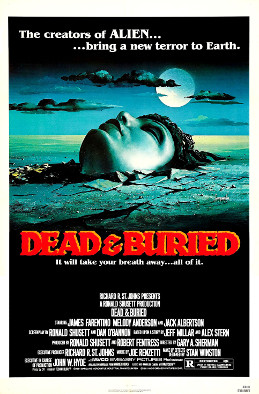
The 1981 horror film, Dead & Buried, takes place in the small town of Potters Bluff. It seems like it should be a nice place to live. The people are friendly. The scenery is lovely. The town is right on the coast of the ocean so the view is great. It’s a bit of an artist’s colony, the type of place where you would expect to find Elizabeth Taylor painting the sunset while Richard Burton battles a hangover in the beach house. It’s the type of small town that used to by very popular on television. It’s just one Gilmore girl away from being an old CW show.
It’s such a nice town. So, why are so many people dying?
That’s the mystery that Sheriff Dan Gillis (James Farentino) has to solve. Actually, it’s one of the many mysteries that Dan has to solve. There’s also the mystery of why his wife, Janet (Melody Anderson), has been acting so strangely. And then there’s the mystery of what happened to the person who, one night, Dan ran into with his car. The person ran away but he left behind his arm. When Dan gets some skin from the arm analyzed, he’s told that the arm belongs to someone who has been dead for at least four months!
Who can explain all of this? How about William G. Dobbs (Jack Albertson), the folksy coroner who seems to enjoy his work just a little bit too much. In fact, Dr. Dobbs seems to be a bit more than just a tad eccentric. One would necessarily expect a coroner to have a somewhat macabre view of life but Dr. Dobbs seems to take things to extreme. Is it possible that Dr. Dobbs knows more than he’s letting on?
Dead & Buried has a reputation for being something of a sleeper, a deliberately-paced and often darky humorous horror film that had the misfortune to be released at a time when most horror audiences were more interested in watching a masked man with a machete kill half-naked teenagers. Because the studio wasn’t sure how exactly to market Dead & Buried, it failed at the box office and it was only years later, after it was released on home video, that people watched the film and realized that it was actually pretty good. And make no mistake about it, Dead & Buried is a fairly clever horror film, one that is full of effective moments and which does a good job of creating a creepy atmosphere. If I’m not quite as enthused about this film as others, that’s because I do think that it’s occasionally a bit too slow and the film’s twist ending, while well-executed, didn’t particularly take me by surprise. This is one of those films that you enjoy despite the fact that you can see the surprise conclusion coming from a mile away.
In the end, Dead & Buried fills like a particularly twisted, extra-long episode of one of those old horror anthology shows, like Night Gallery, Twilight Zone, or maybe even Ghost Story. It’s a nicely done slice of small town horror, featuring a study lead performance from James Farentino and an enjoyably weird one from Jack Albertson. Though the film is not heavy on gore, Stan Winston’s special effects are appropriate macabre. Even if it’s not quite up there with Gary Sherman’s other films (like Vice Squad and Death Line, to name two), Dead & Buried is an entertainingly eccentric offering for Halloween.
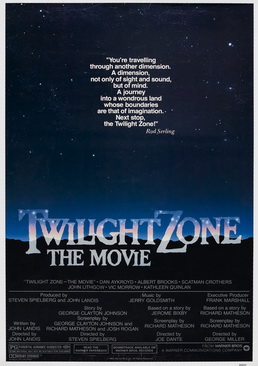
1983’s Twilight Zone: The Movie is meant to be a tribute to the classic original anthology series. It features four “episodes” and two wrap-around segments, with Burgess Meredith providing opening and closing narration. Each segment is directed by a different director, which probably seemed like a good idea at the time.
Unfortunately, Twilight Zone: The Movie is a bit of a mess. One of the episodes is brilliant. Another one is good up until the final few minutes. Another one is forgettable. And then finally, one of them is next too impossible to objectively watch because of a real-life tragedy.
With a film that varies as wildly in tone and quality as Twilight Zone: The Movie, the only way to really review it is to take a segment at a time:
Something Scary (dir by John Landis)
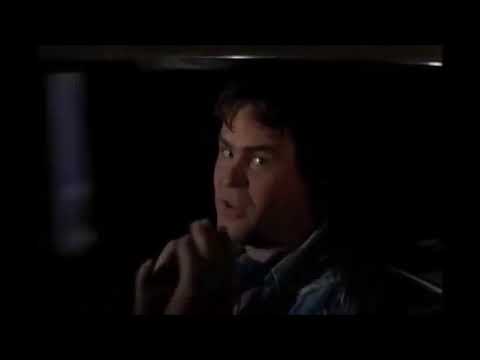
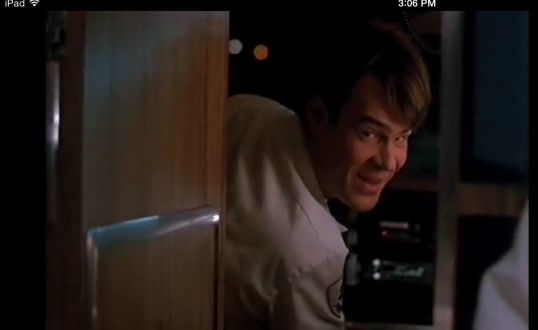
Albert Brooks and Dan Aykroyd drive through the desert and discuss the old Twilight Zone TV series. Brooks claims that the show was scary. Aykoyd asks if Brooks wants to see something really scary. This is short but fun. It’s tone doesn’t really go along with the rest of the movie but …. oh well. It made me jump.
Time Out (dir by John Landis)
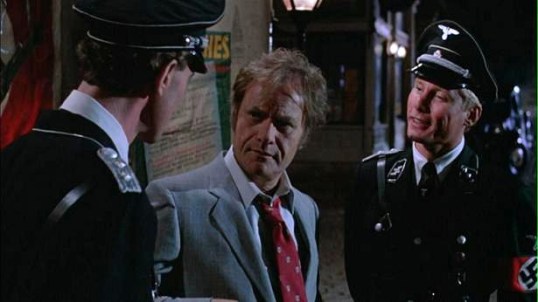
Vic Morrow plays a racist named Bill Connor who, upon leaving his local bar, finds himself transported to Nazi-occupied France, the deep South, and eventually Vietnam.
How you react to this story will probably depend on how much you know about its backstory. If you don’t know anything about the filming of this sequence, you’ll probably just think it’s a bit heavy-handed and, at times, unintentionally offensive. Twilight Zone often explored themes of prejudice but Time Out just seems to be using racism as a gimmick.
If you do know the story of what happened while this segment was being filmed, it’s difficult to watch. Actor Vic Morrow was killed during filming. His death was the result of a preventable accident that occurred during a scene that was to involve Morrow saving two Vietnamese children from a helicopter attack. The helicopter crashed, killing not only Morrow but the children as well. It was later determined that not only were safety protocols ignored but that Landis had hired the children illegally and was paying them under the table so that he could get around the regulations governing how many hours child actors could work. It’s a tragic story and one that will not leave you as a fan of John Landis’s, regardless of how much you like An American Werewolf in London and Animal House.
Nothing about the segment feels as if it was worth anyone dying for and, to be honest, I’m kind of amazed that it was even included in the finished film.
Kick The Can (dir by Steven Spielberg)
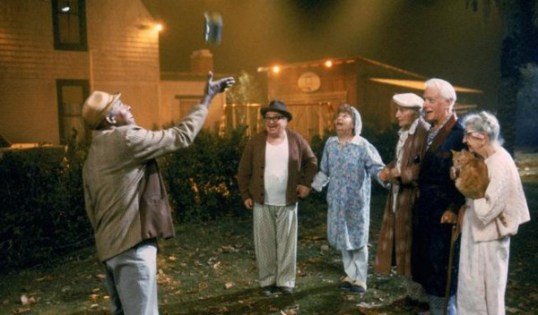
An old man named Mr. Bloom (Scatman Crothers) shows up at Sunnyvale Retirement Home and encourages the residents to play a game of kick the can. Everyone except for Mr. Conroy (Bill Quinn) eventually agrees to take part and, just as in the episode of the Twilight Zone that this segment is based on, everyone becomes young.
However, while the television show ended with the newly young residents all running off and leaving behind the one person who refused to play the game, the movie ends with everyone, with the exception of one man who apparently became a teenager istead of a kid, deciding that they would rather be old and just think young. That really doesn’t make any damn sense but okay.
This segment is unabashedly sentimental and clearly calculated to brings tears to the eyes to the viewers. The problem is that it’s so calculated that you end up resenting both Mr. Bloom and all the old people. One gets the feeling that this segment is more about how we wish old people than how they actually are. It’s very earnest and very Spielbergian but it doesn’t feel much like an episode of The Twilight Zone.
It’s A Good Life (dir by Joe Dante)
A teacher (Kathleen Quinlan) meets a young boy (Jeremy Licht) who has tremendous and frightening powers.
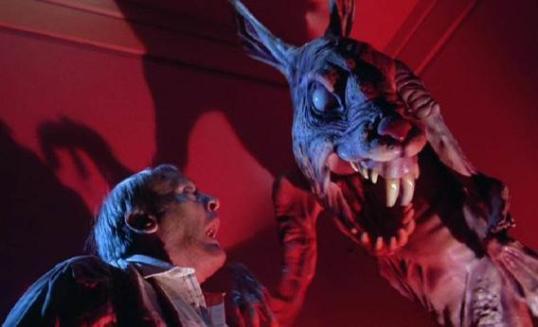
This is a remake of the classic Twilight Zone episode, It’s A Good Life, with the difference being that young Anthony is not holding an entire town hostage but instead just his family. This segment was directed by Joe Dante, who turns the segment into a cartoon, both figuratively and, at one point, literally. That’s not necessarily a complaint. It’s certainly improvement over Spielberg’s sentimental approach to the material. Dante also finds roles for genre vets like Kevin McCarthy, William Schallert, and Dick Miller and he provides some memorably over-the-top visuals.
The main problem with this segment is the ending, in which Anthony suddenly reveals that he’s not really that bad and just wants to be treated normally, which doesn’t make much sense. I mean, if you want to be treated normally, maybe don’t zap your sister in a cartoon. The teacher agrees to teach Anthony how to be a normal boy and again, what the Hell? The original It’s A Good Life worked because, like any child, Anthony had no conception of how adults felt about him. In the movie version, he’s suddenly wracked with guilt and it’s far less effective. It feels like a cop out.
Still, up until that ending, It’s A Good Life worked well as a satire of the perfect American family.
Nightmare at 20,000 Feet (dir by George Miller)
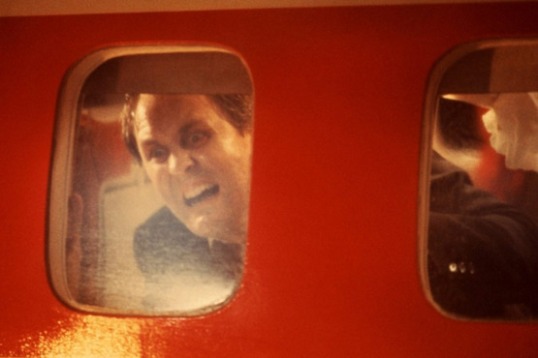
In this remake of Nightmare at 20,000 Feet, John Lithgow steps into the role that was originally played by William Shatner. He plays a man who, while attempting to conquer his fear of flying, sees a gremlin on the wing of his airplane. Unfortunately, he can’t get anyone else on the plane to believe him.
Nightmare at 20,000 Feet is the best of the four main segments. It’s also the one that sticks closest to its source material. Director George Miller (yes, of Mad Max fame) doesn’t try to improve on the material because he seems to understand that it works perfectly the way it is. John Lithgow is also perfectly cast in the lead role, perfectly capturing his increasing desperation. The one change that Miller does make is that, as opposed in the TV show, the gremlin actually seems to be taunting John Lithgow at time and it works wonderfully. Not only is Lithgow trying to save the plane, he’s also trying to defeat a bully.
Something Scarier (dir by John Landis)
Dan Aykroyd’s back as an ambulance driver, still asking his passenger if he wants to see something really scary. It’s an okay ending but it does kind of lessen the impact of Nightmare at 20,000 Feet.

 Through the Shattered Lens