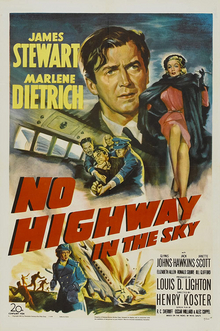
Film Review: No Highway In The Sky (dir by Henry Koster)


In 1951’s No Highway In The Sky, James Stewart stars as Dr. Theodore Honey.

In many ways, Theodore Honey is similar to the other roles that Stewart played after he returned from serving in World War II.  Dr. Honey is intelligent, plain-spoken, and good-hearted.  He’s eccentric and he sometimes has a difficult time relating to other people.  He’s also deeply troubled.  Dr. Honey is an engineer, one who specializes in determining how many hours an airplane can fly before it starts to fall apart.  Dr. Honey is in England, working for an airline and testing his hypothesis that their newest model’s tail will fall off after the plane accumulates a specific number of hours.  As is usually the case with these things, Dr. Honey’s employers are skeptical about his claims.  There’s a lot of money to be made in air travel and the last thing they need is some eccentric American scaring everyone.

When Honey sets out to investigate a recent crash site, he finds himself on the same type of airplane that he’s been testing.  After the plane takes off, Dr. Honey talks to the pilots and discovers, to his horror, that the plane is closing in on the time limit.  While flight attendant Marjorie Corder (Glynis Johns) tries to keep him calm, Dr. Honey explains his theory to a film star named Monica Teasdale (Marlene Dietrich), who just happens to be a passenger on the flight.  Both Marjorie and Monica find themselves falling in love with Dr. Honey and who can blame them?  He may be an eccentric and it may be hard to follow what he’s talking about but he’s still Jimmy Stewart!

I’ve often thought that Stewart was “Jimmy” before World War II but he was definitely James afterwards.  Stewart, unlike a lot of Hollywood stars who enlisted and were then used solely for PR purposes, actually flew several combat missions and saw firsthand the devastation of the war.  He returned to America deeply disturbed by what he had seen and there’s a definite sense of melancholy to be found in all of Stewart’s post-war performances.  That’s certainly the case here.  Dr. Honey is a widower, his wife having been killed by a rocket attack during the war.  He’s raising his 12 year-old daughter on his own and he deals with his sadness by throwing himself into his work.  He’s someone who has seen and experienced great tragedy firsthand and it’s left him more than a little obsessed. There’s a very authentic sadness at the heart of Stewart’s performance and it elevates this film, making what could have been a by-the-book corporate thriller into a character study of a man standing at the dawning of a new age, the post-war era of commercial air travel, and saying, “Well, hold on one minute.”

Unfortunately, Honey’s obsessive nature makes it easy for some to dismiss him.  When Dr. Honey purposefully sabotages the plane to keep it from flying again, he finds himself forced to defend his actions.  Can he prove that his theory is true?  And who will he end up falling in love with?  You can probably guess the answers but it doesn’t matter if the latter half of the film is a bit predictable.  James Stewart’s performance carries the film and keeps you watching.
Lisa Marie Reviews An Oscar Nominee: Reds (dir by Warren Beatty)


In the 1981 film Reds, Warren Beatty plays Jack Reed, the radical journalist who, at the turn of the century, wrote one of the first non-fiction books about Russia’s communist revolution and then went on to work as a propagandist for the communists before becoming disillusioned with the new Russian government and then promptly dying at the age of 32.

Diane Keaton plays Louise Bryant, the feminist writer who became Reed’s lover and eventually his wife.  Louise found fame as one of the first female war correspondents but then she also found infamy when she was called before a Congressional committee and accused of being a subversive.

Jack Nicholson plays Eugene O’Neill, the playwright who was a friend of both Reed and Bryant’s and who had a brief affair with Bryant while Reed was off covering labor strikes and the 1916 Democratic Convention.

Lastly, Maureen Stapleton plays Emma Goldman, the anarchist leader who was kicked out of the country after one of her stupid little dumbass followers assassinated President McKinley.  (Seriously, don’t get me started on that little jerk Leon Czolgosz.)

Together …. well, I was going to say that they solve crimes but that joke is perhaps a bit too flippant for a review of RedsReds is a big serious film about the left-wing activists at the turn of the century, one in which the characters move from one labor riot to another and generally live the life of wealthy bohemians.  Reed spends the film promoting communism, just to be terribly disillusioned when the communists actually come to power in Russia.  For a history nerd like me, the film is interesting.  For those who are not quite as obsessed with history, the film is extremely long and the scenes of Reed and Bryant’s domestic dramas often feel a bit predictable, especially when they’re taking place against such a large international tableaux.  At its best, the film is almost a Rorschach test for how the viewer feels about political and labor activists.  Do you look at Jack Reed and Louise Bryant and see two inspiring warriors for the cause or do you see two wealthy people playing at being revolutionaries?

Reds was a film that Warren Beatty spent close to 20 years trying to make, despite the fact that the heads of the Hollywood studios all told him that audiences would never show up for an epic film about a bunch of wealthy communists.  (The heads of the studio turned out to be correct, as the film was critically acclaimed but hardly a success at the box office.)  It was only after the success of the 1978, Beatty-directed best picture nominee Heaven Can Wait that Beatty was finally able to get financing for his dream project.  He ended up directing, producing, and writing the film himself and he cast his friend Jack Nicholson as O’Neill and his then-romantic partner Diane Keaton as Louise Bryant.  (Gene Hackman, Beatty’s Bonnie and Clyde co-star, shows up briefly as one of Reed’s editors.)  One left-wing generation’s tribute to an early left-wing generation, Reds is fully a Warren Beatty production and, for his efforts, Beatty was honored with the Oscar for Best Director.  That said, the Reds lost the award for Best Picture to another historical epic, Chariots of Fire.  Chariots of Fire featured no communists and did quite well at the box office.

The film is good but a bit uneven, especially towards the end when we suddenly get scenes of Louise Bryant trudging through Finland as she attempts to make it to Russia to be reunited with Reed.  The film actually works best when it features interviews with people who were actual contemporaries of Reed and Bryant and who share their own memoires of the time.  In fact, the interviews work almost too well.  The “witnesses,” as the film refers to them, paint such a vivid picture of the Reed, Bryant, and turn of the century America that Beatty’s attempt to cinematically recreate history often can’t compete.  One can’t help but feel that Beatty perhaps should have just made a documentary instead of a narrative film.

(Interestingly enough, many of the witnesses were people who were sympathetic to Reed’s politics in at the start of the century but then moved much more to the right as the years passed.  Reed’s friend and college roommate, Hamilton Fish, went on to become a prominent Republican congressman and a prominent critics of FDR.)

That said, Jack Nicholson gives a fantastic performance as Eugene O’Neill, adding some much needed cynicism to the film’s portrayal of Reed and Bryant’s idealism.  Keaton and Beatty sometime both seem to be struggling to escape their own well-worn personas as Bryant and Reed but Beatty does really sell Reed’s eventually disillusionment with Russia and the scene where he finally tells off his Russian handler made me want to cheer.  Fans of great character acting will want to keep an eye out for everyone from Paul Sorvino to William Daniels to Edward Herrmann to M. Emmet Walsh and IanWolfe, all popping up in small roles.

Reds is not a perfect film but, as a lover of history, I enjoyed it.


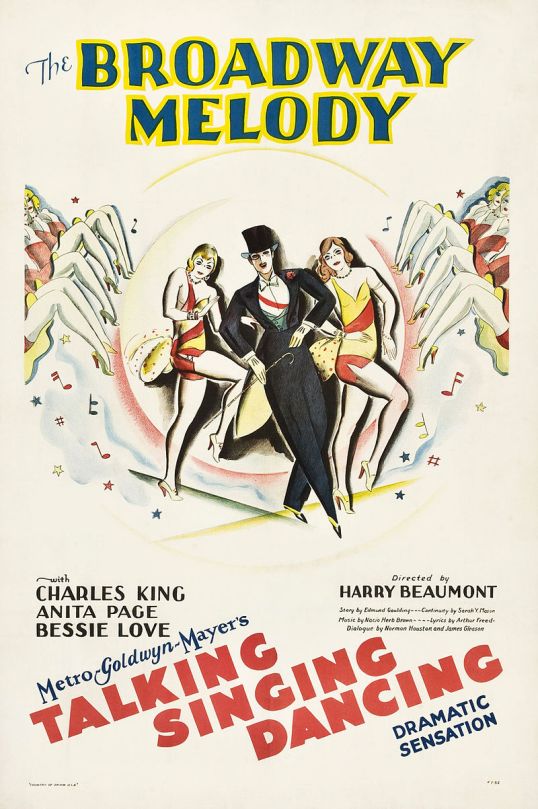
Lisa Reviews An Oscar Winner: The Broadway Melody (dir by Harry Beaumont)


broadway_melody_poster

Oh, The Broadway Melody.

Where to begin?

First released way back in 1929, The Broadway Melody is a historically significant film.  You really can’t talk about the development of film — especially sound film — without taking at least a few minutes to acknowledge The Broadway Melody.  It was the 2nd film to ever win the Oscar for Best Picture (or Best Production, as it was called back then) and it was the first sound film to win the Oscar.  (In fact, it would be 83 years before another silent film won Best Picture and it’s debatable whether or not The Artist can really be considered a silent film in the same way that Wings was silent film.)  It was also the first musical to win best picture and some people consider it to be the first true musical to have ever been produced.  It was such a huge box office success that it could be argued that The Broadway Melody is responsible for nearly every musical that followed it.

To say that The Broadway Melody tells a familiar story would be an understatement.  I’ve read a few reviews that have suggested that the clichés in this film really weren’t clichés until after The Broadway Melody was released but I’ve seen enough silent films to know that this is not the case.  It tells the story of two sisters who want to be stars.  After spending years working in vaudeville, they’ve been invited to perform in a revue that’s being produced by Francis Zanfield (Eddie Kane).

(I assume that Zanfield was meant to be a stand-in for Florence Ziegfeld, himself the subject of a later Best Picture winner, The Great Ziegfeld.)

The sisters are Hank (Bessie Love) and Queenie (Anita Page).  Hank is the driven one.  Hank is the one with the raw talent and she’s also the one who best understands how the business of entertainment works.  Her younger sister, Queenie (Anita Page), may not have Hank’s drive or quite the same level of talent but she does have beauty.  Guess who finds the most success?

Songwriter Eddie Kearns (Charles King) is engaged to marry Hank but soon, both he and Queenie find themselves falling in love.  Not wanting to hurt her sister, Queenie instead runs off with a notorious playboy named Jock Warner (Kenneth Thomson).

As I stated previously, The Broadway Melody has not aged well.  The fact that it’s one of the first sound films just allows contemporary viewers to hear the creakiness of the plot.  As impressive as sound film was to audiences in 1929, it’s obvious today that the cast and crew of The Broadway Melody were still struggling to figure out how to work with the new technology.  As a result the performances are still a bit too broad, which only serves to make the film seem even more melodramatic than it actually is.  As for the songs, they’re not particularly memorable.  I always enjoy backstage musicals but Broadway Melody is no 42nd Street.

I did appreciate the relationship between Bessie Love and Anita Page.  That was one of the few things about the film that felt real to me, perhaps because I have three older sisters.  Interestingly enough, when Anita Page died in 2008, she was the last surviving attendee of the first Academy Awards ceremony.

The Broadway Melody was named the Best Picture of 1929.  This was the year that the winners were selected by a committee and there were no official nominations.  Though the notes from the meeting indicate that there was some consideration given to awarding the Best Actress Oscar to Bessie Love, Best Picture was the only Oscar that The Broadway Melody received.