That’s the plot of this 1957 film from director Bert I. Gordon. Chicago-haters will love this film, especially the scene where General Morris Ankrum announces that he has no choice but to nuke the entire city. If you don’t hate Chicago, you can still enjoy watching Peter Graves somehow retaining his dignity while dealing with the threat of giant locusts.
For the record, I’m enough of a country girl that I fully understand just destructive locusts can be. That said, when it comes to their appearance, they’re not the most intimidating creatures out there. The worst that can be said about them is that they look like really ugly grasshoppers. A giant grasshopper still looks like a giant grasshopper. And, needless to say, locusts do not attack humans.
(I’m also enough of a Southern girl that I can remember collecting the locust exo-skeletons that would always show up in the fall and winter.)
Here is the ludicrous and entertaining BeginningoftheEnd!
4 Or More Shots From 4 Or More Films is just what it says it is, 4 shots from 4 of our favorite films. As opposed to the reviews and recaps that we usually post, 4 Shots From 4 Films lets the visuals do the talking!
Today, the Shattered Lens celebrates would have been the 103 birthday of director Bert I. Gordon! Known as Mr. BIG, both because of his initials and the fact that his films often dealt with things becoming bigger than they should, Gordon made his directorial debut in 1954 and continued to work all the way through 2014. And that means that it’s time for….
4 Shots From 4 Bert I. Gordon Films
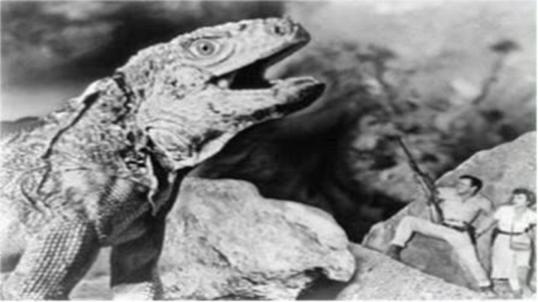
King Dinosaur (1955, dir by Bert I. Gordon, DP: Gordon Avil)
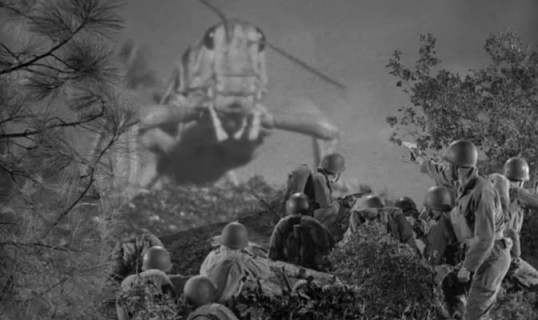
Beginning of the End (1957, dir by Bert I. Gordon, DP: Jack A. Marta)
Village of the Giants (1965, dir by Bert I. Gordon, DP: Paul Vogel)
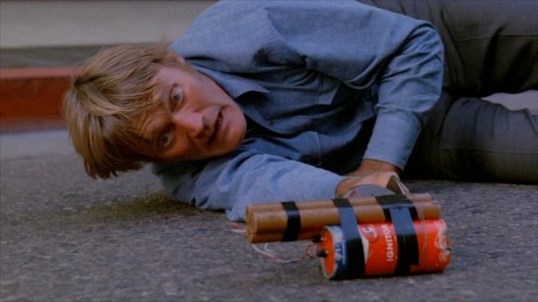
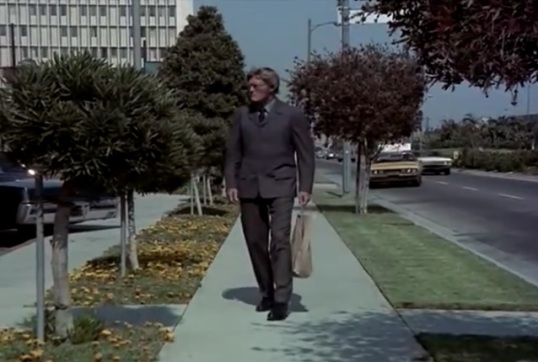
The Mad Bomber (1973, dir by Bert I. Gordon, DP: Bert I. Gordon)
“Tom Stewart killed me!” shouts the spirit of Vi Mason (Juli Reding).
Technically, it’s debatable whether or not Tom Stewart (Richard Carlson) actually killed Vi. As is seen during the opening moments of 1960’s Tormented, Vi actually slipped and was clinging onto the lighthouse’s balcony for dear life before she fell to her death on the rocks below. Tom didn’t push her and he didn’t force her to fall. However, Tom did refuse to pull her up. After she fell, he ran into the ocean and thought he had dragged back to safety. But then it turned out that he was just dragging around a bunch of seaweed.
To a certain extent, Tom is glad to be done with Vi. Vi was his ex-girlfriend and she was determined to keep Tom from marrying the rich and innocent, Meg (Lugene Sanders). Meg’s father (Harry Fleer) already hates Tom because he’s not only a pianist but he’s also a jazz pianist! Still, Meg loves Tom and, in a somewhat disturbing way, Meg’s little sister, Sandy (Susan Gordon), seems to be kind of obsessed with Tom as well. “Why can’t I get married!?” Sandy demands. BECAUSE YOU’RE LIKE TEN, YOU LITTLE BRAT!
Still, it’s not helping Tom that he keeps hearing Vi’s voice and seeing her ghost. Everyone in the village think that Tom is acting strangely but they dismiss it as pre-wedding jitters. (And, of course, his future father-in-law just assumes that Tom is being weird because he’s one of those jazz pianists.) If it wasn’t bad enough that Tom is having to deal with Vi’s ghost, he’s also got a hepcat blackmailer named Nick (Joe Turkel). Nick was hired to take Vi out to the island where Tom lives. When Vi doesn’t return to pay him, Nick goes to Tom for the money. When Nick overhears that Tom is about to marry a rich woman, Nick decides that he needs even more money.
Joe Turkel was one of the great character actors. A favorite of Stanley Kubrick’s, he appeared in Paths of Glory and later played Lloyd the Bartender in The Shining, Turkel also played Eldon Tyrrell in Blade Runner, in which he made the mistake of talking down to Rutger Hauer’s Roy. In the role of Nick, Tukel is the best thing to be found in Tormented. Turkel delivers all of his dialogue with a wonderfully insolent attitude. He’s the type of character who, in the style of Robert Mitchum in Cape Fear, refers to everyone he meets as “Dad.” He’s a lowlife and criminal but he’s got the spirit of Kerouac and Cassady in him and it doesn’t take him long to see straight through Tom.
Tormented was directed by Bert I. Gordon, who was best-known for his movies about giant monsters. There aren’t any monsters in Tormented but there is a really shrill ghost and a truly unlikable protagonist. There’s a lot flaws to be found in this film but Joe Turkel makes up for a lot of them. And the scene where Vi’s ghost objects to Tom’s wedding is a lot creepier than it really has any right to be. This is probably the best film that Bert I. Gordon ever directed, which does not necessarily mean its a good film. Bert I. Gordon was still Bert I. Gordon. But Tormented is definitely entertaining.
Ants are interesting creatures. On the one hand, they work hard and they can design and build a complex home in just a matter of hours. They’re loyal to the other members of their tribe and they all happily do whatever needs to be done to keep their community healthy and moving forward. They’re family-orientated. They take care of their children. They eat earth worms. They fight other ants. They can carry several pounds over their own weight. They like to move in a single-file line. These are all things that people, in general, admire. If you had to hire someone to do some yardwork, you would want someone who had the attitude of an ant.
At the same time, ants also have no respect for privacy, they tend to get everywhere, and they bite you and leave behind those ugly red marks that take forever to go away and that can itch like heck. I was once outside barefoot, helping someone wash his car, when I suddenly felt a really intense pain in my foot. I looked down and saw that I had stepped straight into an ant hill. It was not only an ant hill but it was a FIRE ANT HILL! I grabbed a hose and I washed all of the ants off my foot but it was still one of the most painful experiences of my life. Ants are hard-working and industrious but they’re also kind of mean and they really don’t like humans. (Maybe they would like us more if people stopped kicking ant hills and using magnifying glasses to set them on fire.) Ants will break into your house and then bite you when you tell them to go away. My point is that you might like ants but ants do not like you and you better remember that!
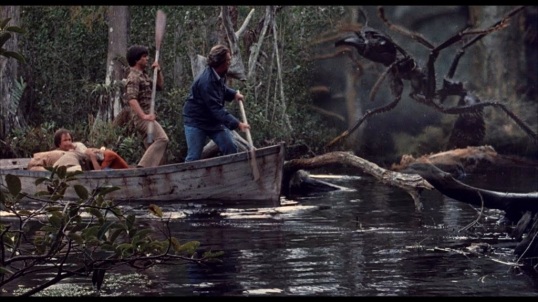
The 1977 film, Empire of the Ants, is all about humanity’s mixed feelings towards ants. Joan Collins plays a shady real estate agent who leads a group of potential home buyers into the bayou because she wants to trick them into buying some worthless property on a nearby island. What Collins and her clients don’t know is that a barrel of radioactive waste was recently dumped off of a nearby boat and when the waste washed on shore, a bunch of ants got into it and it caused them to become giant ants! The giant ants are industriously creating their own sugar-based society but they’re also attacking and brainwashing humans!
Needless to say, this is a Bert I. Gordon film. Gordon took his “Mr. Big” nickname quite literally and, as a result, he spent almost his entire career making movies about animals and occasionally humans who were turned into giants by radiation. Apparently, radiation can do anything! Empire of the Ants is a typical Gordon film, in that the special effects are just bad enough to be kind of charming. The ants are either awkwardly super-imposed into the scene or they are clearly made out of plastic. There’s a scene where an ant grabs a man by his neck and it would be really terrifying if not for the fact that the ant’s head appears to have been made from Styrofoam. Unfortunately, even though the special effects are bad in an amusing way, Empire of the Ants is still a pretty boring film. Gordon devotes way too much time to the people heading out to look at Joan Collins’s beachfront property. No one is watching a film like this for human drama.
This movie is based on a short story by H.G. Wells. Wells, reportedly, considered it to be the worst thing he had ever written.
The 1957 film, Beginning of the End, is perhaps the ultimate horror film for people who dislike Illinois.
Because it’s a Bert I. Gordon film and Gordon took his “Mr. Big” nickname seriously, it deals with giant monsters. In this case, the monsters are a bunch of locust who ate all of this radioactive grain that was being stored in a silo. The locusts grew to giant size and then they went on a rampage.
Fortunately, the rampage appears to be localized to Illinois. Apparently, the locusts have enough respect for state boundaries that they know better than to hop into Indiana, Missouri, or Wisconsin. Instead, the locusts take out the farming community of Ludlow and then start making their way to Chicago, perhaps hoping to battle the Chicago Outfit for control of the city’s politics. Do they seriously think Mayor Daley is just going to sit back while a bunch of locusts overrun his city?
The government wants to cover up the locust rampage because they don’t want to risk a mass panic in the 47 states that they actually care about. (This film came out before Alaska and Hawaii joined the Union.) However, when enterprising reporter Audrey Aimes (Peggie Castle) comes across the remains of Ludlow and discovers that the U.S. military has taken over the area, she is determined to discover what happened. She hooks up with Dr. Ed Wainwright (Peter Graves), whose work in making food bigger led to the giant locust attacks in the first place. In most movies, Ed would shoulder most of the blame for the locust attack but Beginning of the End seems to understand that these things happen when you’re dousing food with radiation and then keeping the food in a poorly secured silo.
Of course, the main reason why it’s not Ed’s fault is that Ed is played by Peter Graves and seriously, who could blame anything on Peter Graves? Graves was one of those actors who could deliver even the silliest of dialogue with a straight face and he certainly gets to do that in Beginning of the End. He seems to be taking the situation seriously, even if no one else is.
One reason why it is a little bit difficult to take the situation seriously is because it’s about giant locusts. Now, make no mistake about it. I’m enough a country girl that I know how destructive locusts can be. The problem is that locusts may be destructive but they don’t look all that menacing. Even giant locusts just look like really ugly grasshoppers. This film uses a lot of rear projection and still photography to create the idea of giant locusts crawling over buildings and threatening the soldiers who have been sent to fight them. As is so often the case with Bert I. Gordon’s film, there’s a definite charm to the cheap special effects. But still, locusts are locusts.
Chicago haters will love the scene where General Hanson (Morris Ankrum) announces that the locusts have only left him with one option, the drop an atomic bomb and wipe the city off the face of the Earth. Fortunately, Ed is there to suggest another solution. Good old Peter Graves. I don’t know what we would have done without him.
As a final note, I’ll just mention that the poster for this film is actually more exciting than the film itself:
Haunted by the death of his teenage daughter and the subsequent collapse of his marriage, William Dorn (Chuck Conners) feels that society is changing too quickly. He misses the days when people were polite and followed the law. Now, he’s upset that he can’t even walk around Los Angeles without seeing people littering. The waitress at the local diner has forgotten the importance of smiling while taking her customer’s order. Hospitals are full of doctors who don’t care about their patients. The colleges are full of long-haired drug pushers. His ex-wife is attending a consciousness raising seminar. William has had it with the 1970s so he decides to start blowing stuff up.
William starts to wander around Los Angeles. Usually, he’s carrying a brown paper sack and, inside the sack, he’s got a ticking time bomb. He always wears the same suit and thick glasses and yet, somehow, no one ever seems to notice or remember him. Even though all of his bombs are timebombs, they still go off within seconds of him planting them, which means that he’s usually only standing a few feet away with they explode. William also sends the police tape-recorded manifestos without making any effort to disguise his voice. William may not be the smartest criminal around but that still doesn’t stop him from terrorizing the city.
Detective Geronimo Minelli (Vince Edwards) is determined to track down the mad bomber, even if it means yelling at everyone that he meets. Minelli is one of those intense detectives who doesn’t care about what the Supreme Court has to say about the rights of suspects and the accused. Unfortunately, the only witness who can identify the bomb is George Fromley (Neville Brand), a sex offender who doesn’t want to admit that he saw the bomber blow up a hospital because he was busy assaulting one of the patients at the time. Can Minelli convince Fromley to provide a physical description of the bomber? And will William Dorn ever realize that it’s probably not a good idea to store a bunch of ticking time bombs in his basement?
First released in 1972 and also known as The Police Connection, Bert I. Gordon’s The Mad Bomber is unique amongst Gordon’s films in that it doesn’t feature any giant animals or killer bugs. In this film, the monsters are all human and don’t have any convenient excuses for their behavior. Though Neville Brand does a good job with the role, George Fromley is still probably one of the most unlikable and despicable characters to ever appear in the movie. Meanwhile. Vince Edwards plays Minelli as being the type of cop who is one bad day away from massively violating someone’s civil rights during a traffic stop. The film does build up some sympathy for William Dorn, with still shots of his daughter used to show us what’s going through Dorn’s mind as he plants his bombs. But then it tosses all that sympathy away by having him target a meeting of feminists, apparently because he blames them for his wife leaving him.
The main problem with the film is that we’re expected to believe that someone who looks like this would be able to walk around Los Angeles and plant bombs without anyone noticing.
That’s nothing against Chuck Conners, who does a good job of portraying William’s frustration with the world. But still, it’s hard to believe that no one is going to notice a dude who is nearly seven feet tall and who is carrying a ticking shopping bag.
Flaws and all, The Mad Bomber is a watchable and occasionally even an engrossing film. It’s certainly one Gordon’s better efforts and Gordon does a good job of creating and maintaining a properly ominous atmosphere, even if it sometimes hard to take seriously the sight of Chuck Conners, lumbering around in his suit and trying to discreetly drop off bombs. In many ways, it’s a film that still feels relevant today. William, like so many. is trying to forcefully stop the world from changing around him. He’s a man who has lost anything and has decided that it’s the fault of everyone else. (In many ways, he’s like Rainn Wilson in Super, ragefully reacting to a world is not as simple as he believes it should be.) The Mad Bomber may not be as much fun as Gordon’s giant monster films but it’s still a film that has something to say.
4 Shots From 4 Films is just what it says it is, 4 shots from 4 of our favorite films. As opposed to the reviews and recaps that we usually post, 4 Shots From 4 Films lets the visuals do the talking!
Director Bert I. Gordon, the original Mr. Big, has passed away at 100 years old. In honor of his life and legacy, here are….
4 Shots From 4 Bert I. Gordon Films
The Amazing Colossal Man (1957, dir by Bert I. Gordon, DP: Joseph Biroc)
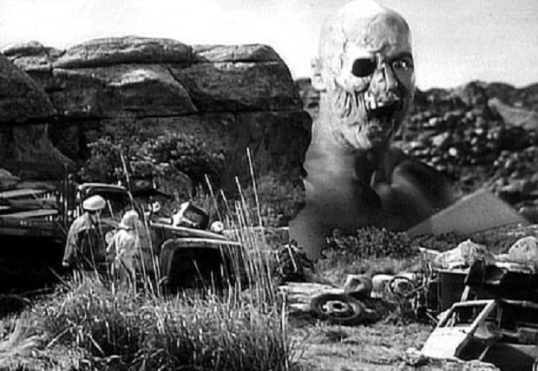
War of the Colossal Beast (1958, dir by Bert I. Gordon, DP: Jack A. Marta)
Village of the Giants (1965, dir by Bert I. Gordon, DP: Paul Vogel)
Empire of the Ants (1977, dir by Bert I. Gordon, DP: Reginald H. Morris)
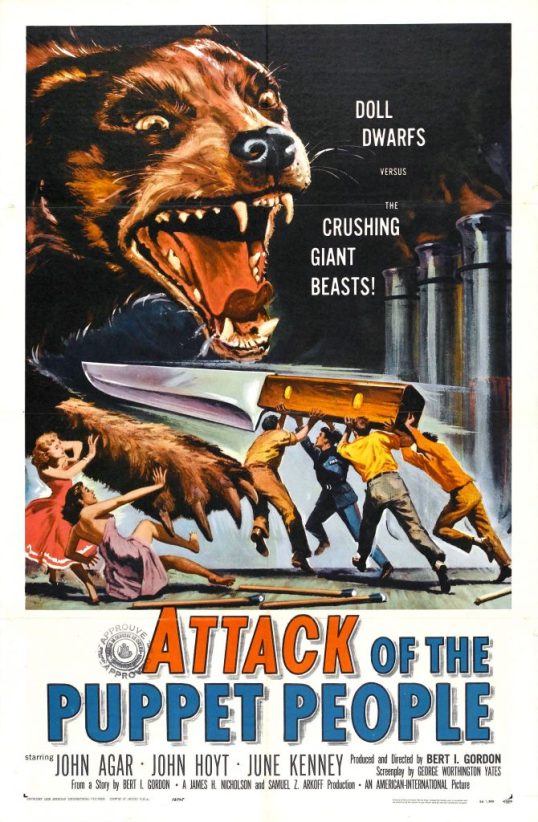
At the start of the 1958 film, Attack of the Puppet People, Sally Reynolds (June Kenney) is looking for a job. Fortunately, Dolls, Inc. is hiring! Dolls, Inc. is owned by Prof. Franz (John Hoyt), who is the world’s greatest dollmaker. In fact, he’s got an entire display case full of very lifelike dolls. Why, the dolls are so authentic that it almost seems as if they could be alive. Is it possible that Franz had been shrinking people and then sticking them in his display case?
It’s not only possible but it’s also exactly what Franz has been doing.
Soon, Sally and her boyfriend, Bob (John Agar), have been shrunk down to dollsize and are living with the other dolls in the display case. It turns out that Prof. Franz’s motives aren’t really malicious. He just tends to get lonely and he’s decided that they best way to keep people around is to shrink them and then imprison them. Fortunately, getting shrunk doesn’t seem to lead to any health complications or anything like that. It just means that you’re now very small and vulnerable to dogs and cats.
Franz even allows the dolls to come out of the display case at night. Much like the toys from Toy Story, the Doll People throw a party every night and pretend to just be inanimate objects whenever anyone steps into the store. That said, the puppet people don’t necessarily want to spend the rest of their lives on display. Can they figure out how to escape from the store and how to reverse the shrinking process?
It’s a pretty silly film but then again, what else would you expect from something called Attack of the Puppet People? There are a few amusing scenes where the puppet people have to deal with maneuvering around and dealing with giant furniture and, at one point, a really big door knob. And, of course, there’s the inevitable scene in which a curious dog spots two of the puppet people trying to make their escape. It’s a 50 B-movie, dumb but undeniably fun. John Hoyt appears to be having a lot of fun as the doll-loving mad scientist and John Agar is his usual stolid but oddly likable self.
Attack of the Puppet People was directed by Bert I. Gordon, who also did The Amazing Colossal Man and War of the Colossal Beast. (At one point, Bob and Sally got to a drive-in that’s show The Amazing Colossal Man and Gordon shares a few minutes of his previous film.) Gordon specialized in films about giant lizards, giant insects, giant ants and sometimes even giant people. In fact, his nickname was “Mr. Big,” both because of his initials and the subject matter of his films. Attack of the Puppet People is a unique Gordon film in that it deals with shrinking instead of growing. It’s also one of his more entertaining films. Bert I. Gordon, incidentally, is still with us. He turned 100 years old on September 24th.
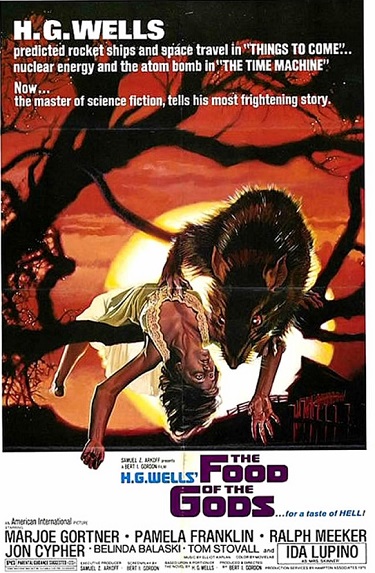
Uh-oh! Something weird has bubbled up to the ground on an island near British Columbia and a farmer and his wife (played by John McLaim and Ida Lupino) foolishly decided to feed it to their farm animals! Soon, they’ve got giant chickens! And listen, that might sound like a good thing to some but I’ve spent enough time around farms to know that giant chickens are not a good thing! Seriously, normal-sized chickens are messy enough. Giant ones? I don’t even want to thinking about it.
Unfortunately, it’s not just the chickens that are eating the food. Rats are eating the food. Wasps are eating the food. All of the animals are turning into giants and now, they’re hunting humans! After his best friend is attacked and killed by giant wasp, a football player named Morgan (Marjoe Gortner) decides to investigate on his own. You would think that a football player would be busy preparing for his next game or something like that but no, not Morgan! Morgan’s determined to find out why there are giant animals off the coast of Canada.
Of course, Morgan isn’t the only one interested in the so-called Food of the Gods. There’s also Jack Bensington (Ralph Meeker), who owns a dog food company. Jack wants to sell the food. Why would Jack want to do that? Does he actually think that causing dogs to transform into giants who would undoubtedly try to kill their masters is somehow going to be good for his company’s reputation? Jack’s main motivation seems to be that he’s a businessman and, in this film’s moral universe, that automatically makes him one of the bad guys. But it seems like even an evil businessman would know better than to kill off all of his customers.
This 1976 film, which is loosely (very loosely) based on a novel by H.G. Wells, was directed by Bert I. Gordon and, if you think the plot sounds a little ludicrous …. well, it is. Nothing about the film really makes much sense but that’s kind of to expected from a Bert I. Gordon film. Gordon specialized in making films about giants destroying stuff. The films were never particularly good but Gordon obviously understood that American filmgoers love big things. Food of the Gods, as silly as it may be, apparently made a lot of money when it was first released.
Today, of course, it’s impossible to watch the film without noticing just how terrible the special effects are. Between the unconvincing use of super-imposed images and the obviously fake rats that are tossed at some of the actors, there’s not a single shot that doesn’t somehow look totally ridiculous. In fact, it’s all so silly and obviously done on the cheap that it becomes rather charming, or at least as charming as the superimposed image of giant wasp ever could possibly be. You have to admire the film’s determination to tell its story despite not having the resources to do so. As for the rest of the film, it’s dumb but it doesn’t take itself too seriously. If you’re specifically searching for a bad giant animal movie, The Food of the Gods is fun in its own goofy, nonsensical, low-budget way.
4 Or More Shots From 4 Or More Films is just what it says it is, 4 shots from 4 of our favorite films. As opposed to the reviews and recaps that we usually post, 4 Shots From 4 Films lets the visuals do the talking!
This October, I’m going to be doing something a little bit different with my contribution to 4 (or more) Shots From 4 (or more) Films. I’m going to be taking a little chronological tour of the history of horror cinema, moving from decade to decade.
Today, we take a look at the late 50s!
8 Shots From 8 Horror Films: The Late 50s
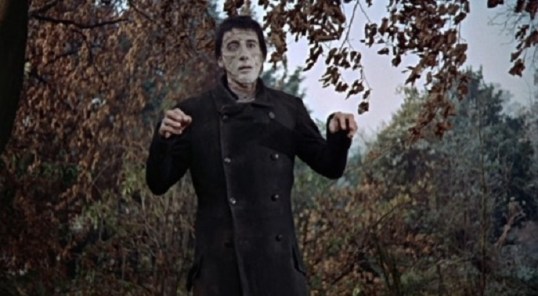
The Curse of Frankenstein (1957, dir by Terence Fisher, DP: Jack Asher)
Plan 9 From Outer Space (1957, dir by Edward D. Wood, Jr., DP: William C. Thompson)
Not Of This Earth (1957, dir by Roger Corman DP: John J. Mescall)
Horror of Dracula (1958, starring Christopher Lee as the Count, Dir by Terence Fisher, DP: Jack Asher)
Night of the Ghouls (1959, dir by Edward D Wood, Jr. DP: William C. Thompson)
War of the Colossal Beast (1958, dir by Bert I. Gordon, DP: Jack A. Marta)
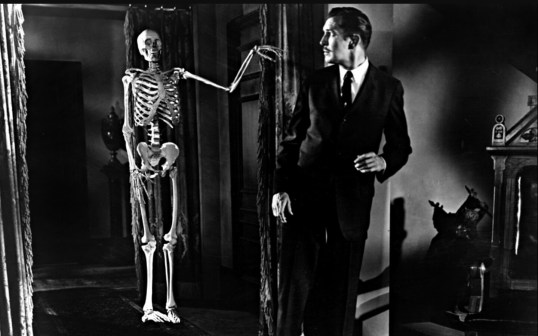
House on Haunted Hill (1959, dir by William Castle, DP: Carl E. Guthrie)
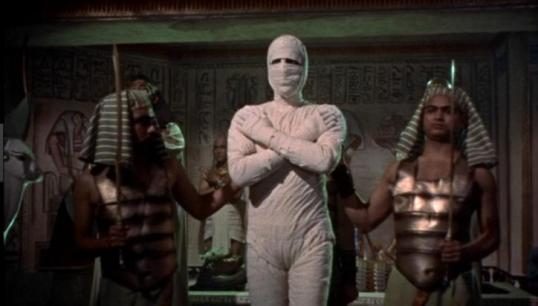
The Mummy (1959, dir by Terence Fisher, DP: Jack Asher)








 Through the Shattered Lens