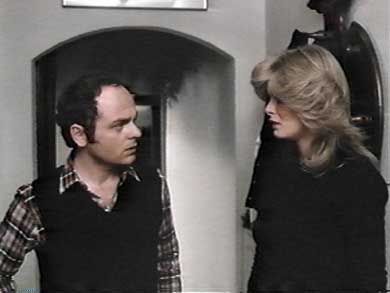
TV Review: Night Gallery 1.6 “They’re Tearing Down Tim Riley’s Bar/The Last Laurel)


The first season of Night Gallery came to a conclusion on January 20th, 1971.  Though the first season was undoubtedly uneven, it did end on a high point.  The first segment in the 6th episode, They’re Tearing Down Tim Riley’s Bar, is widely considered to be the best episode of Night Gallery and one of Rod Serling’s best teleplays.  It also brought Night Gallery one of it’s few Emmy nominations when it was nominated for Outstanding Single Program of the year.  (It lost to The Andersonville Trial, a theatrical adaptation that was produced for PBS.)
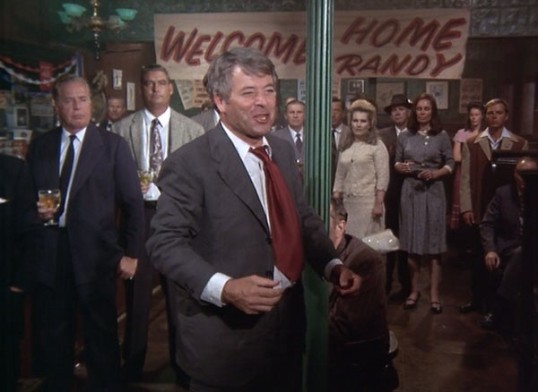
They’re Tearing Down Tim Riley’s Bar (dir by Don Taylor, written by Rod Serling)

They’re Tearing Down Tim Riley’s Bar tells the story of Randy Lane (William Windom).  In 1945, Sgt. Randy Lane returned home from serving in World War II, a war hero who had a wonderful future ahead of him.  He had just gotten married.  He had just gotten a good job at an up-and-coming company called Pritzker Plastics.  When he came home, the first place he went was Tim Riley’s Bar, where his father and the other bar patrons toasted him and told him to look forward to the future.

Twenty-five years later, the middle-aged Randy Lane is looking at his life and asking, “Is this as good as it gets?”  He’s now a sales director at Pritzker Plastics but his boss (John Randolph) doesn’t appreciate him, his assistant (Bert Convy) is plotting to steal his job, and the only person who seems to care about him is his sympathetic secretary (Diane Baker).  Randy’s wife died in 1952, while Randy was out of a sales call.  Randy now lives alone.  Even his neighborhood bar — Tim Riley’s Bar — has closed and been abandoned.  With the bar schedule to be torn down, Randy wonder what happened to all of the promise and happiness of the past.

When Randy goes by the deserted bar and looks through the front window, he’s shocked to see all of his old friends and his father waving at him.  But when Randy rushes into the bar to join them, he discovers the bar is deserted.  Later, Randy is at work when suddenly, he sees Pritzker Plastics the way it was back in 1948.  Even later, when he enters his house, he finds himself standing in a hospital hallway in 1952, once again getting the news that his wife has died.

In many ways, They’re Tearing Down Tim Riley’s Bar is an atypical Night Gallery segment.  Though there are hints of the supernatural throughout the story, it’s hardly a work of horror.  Instead, it’s a rather melancholy meditation on aging, disappointment, and regret.  Is the past forever lost?  Can things ever be as good as they once were?  These are the questions that are raised in this well-directed and well-acted segment.

The Last Laurel (dir by Daryl Duke, written by Rod Serling)

Clocking in at 8 minutes, The Last Laurel is yet another segment about a bitter man (in this case, Jack Cassidy) who suspects that his wife (in the case, Martine Beswick) is cheating on him with his doctor (in this case, Martin E. Brooks) so he teaches himself a supernatural skill in order to get revenge.  In this case, it involves astral projection.  Not surprisingly, it ends with a twist that’s pretty much dependent on one of the characters doing something extremely stupid.

The Last Laurel is well-acted but predictable.  It’s not bad but, especially when compared to something like They’re Tearing Down Tim Riley’s Bar, it feels rather insubstantial.  It feels like filler.

The first season of Night Gallery came to an end with an excellent episode.  Starting tomorrow — season 2!

Previous Night Gallery Reviews:
  1. The Pilot
  2. The Dead Man/The Housekeeper
  3. Room With A View/The Little Black Bag/The Nature of the Enemy
  4. The House/Certain Shadows on the Wall
  5. Make Me Laugh/Clean Kills And Other Trophies
  6. Pamela’s Voice/Lone Survivor/The Doll

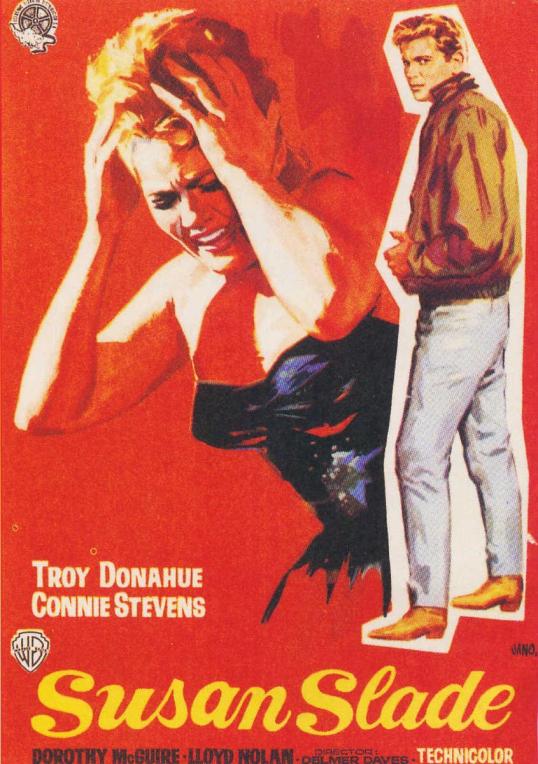
Film Review: Susan Slade (dir by Delmer Daves)


Shortly after this 1961 film begins, 17 year-old Susan Slade (Connie Stevens) announces, “We’ve been sinful!”

She’s talking to her first lover, Conn White (Grant Williams).  You would think that anyone — even someone as unbelievably naive and innocent as Susan Slade — would know better than to ever trust someone named Conn White but no.  From the minute that Conn and Susan met on an ocean liner heading from South America to California, it was love at first sight.  In fact, Susan was so sure of her love that she spent the night in Conn’s cabin, fully knowing that it would mean surrendering her status as an Eisenhower era good girl.

Conn laughs off her concerns about sin.  He also tells her that it makes perfect sense for her not to tell her parents (played by Dorothy McGuire and Lloyd Nolan).  “When we’re married,” he asks, “are you going to tell your mother every time that we make love?”

Wow, Conn still wants to get married even though he’s already had sex with her!?  And he’s also extremely wealthy and stands to inherit control of a multinational corporation!  He sounds like the perfect guy!  Way to go, Susan!

Unfortunately, it turns out that Conn does have one flaw.  He really, really likes to go mountain climbing.  In fact, he’s planning on scaling fearsome old Mt. McKinley.  While Susan and her family settle into life in Monterey, California, Conn heads up to Alaska.  He promises Susan that he’ll keep in touch but, when she doesn’t hear from him, she fears the worse.  Has he abandoned her?  Was he lying when he said he wanted to get married?  Then one day, she gets a call from Conn’s father, informing her that Conn fell off the mountain and died.  Susan’s almost father-in-law tells her that Conn’s body cannot be retrieved from the mountain.  Though it’s neither confirmed nor denied by the film, I decided that this was because Conn faked his own death to get out of having to spend any more time listening to Susan talk about sin.

Anyway, Susan’s single again but, fortunately, she does not lack for suitors.  For instance, there’s the spoiled Wells Corbett (Bert Convy), who is kind of shallow and arrogant but who has a lot of money.  And then there’s Hoyt Brecker (played, in reliably vacuous style, by Troy Donahue), who is poor but honest and who is also an aspiring writer.  “Someday,” Susan declares,”they’ll say that Robert Louis Stevenson, Jack London, and Hoyt Brecker wrote here!”  Who will Susan chose?  The sensitive artist who loves her unconditionally or the arrogant rich boy who smirks his way through the whole film?

Complicating matters is the fact that Susan is …. pregnant!  That’s right, this is another one of those movies from the early 60s where having sex outside of marriage always leads to an unplanned pregnancy.  And, because this movie is from 1961, the only solution is for the Slades to move down to Guatemala for two years, just so they can fool the people on Monterey into believing that the baby is actually McGuire’s and that Susan Slade is not an unwed mother but is instead an overprotective older sister.  Will either of Susan’s two suitors be waiting for her when she and her family return to California?

Now, please don’t get me wrong.  I do understand that there’s a big difference between 1961 and 2019 and that there used to be a lot more scandal attached to sex outside of marriage and unwed pregnancy.  In fact, I guess that difference is really the only thing that makes Susan Slade interesting to a modern viewer.  As soon as we see that this film was directed by Delmer Daves (the poor man’s Douglas Sirk) and that it stars Troy Donahue, we know who poor Susan is going to end up with so it’s not like there’s any real surprises lurking in the film’s plot.  And none of the actors, though Connie Stevens sometimes to be trying, seems to be that invested in the film’s story.  Instead, Susan Slade is mostly useful of a time capsule of the time in which it was made, a time when sex outside of marriage was unironically “sinful” and the only possible punishment was either pregnancy, death, or both.  Indeed, Susan Slade is less concerned about the hypocrisy of a society that would force Susan to lie about her new “brother” and more about whether bland lunkhead Troy Donaue will still be willing to marry Susan even if she’s no longer eligible to wear white at their wedding.  The film seems to be asking, “After being sinful, can Susan Slade become a good girl again?”  As a movie, it’s fairly turgid but as a cultural artifact of a time in which everyone was obsessed with sex but no one was willing to talk about it, Susan Slade is occasionally fascinating.

Poor Susan Slade!  If only she had gotten pregnant in a 1971 film instead of one made in 1961, her story could have been so different.  But no, she was sinful in the early 60s and that means she’ll be have to settle for Troy Donahue.


Holiday Sweets: Fred Astaire in THE MAN IN THE SANTA CLAUS SUIT (NBC-TV 1979)


gary loggins's avatarcracked rear viewer

Eighty year old Fred Astaire takes on nine different roles in THE MAN WITH THE SANTA CLAUS SUIT, his next to last film. Fred is as charming and debonair as ever, and his presence is what carries the saccharine script, with three varied tales of romance, comedy, and drama interwoven and played by a cast of Familiar TV and Movie Faces, kind of like a “very special Christmas episode” of THE LOVE BOAT.

Gary Burghoff (M*A*S*H’s Radar) is a nerdy math teacher in love with his neighbor, a beautiful (are there any other kind?) fashion model (Tara Buckman, THE CANNONBALL RUN). The model secretly digs him too, but the nerd’s too shy to express his feelings, until a chance encounter with a jeweler (Fred) leads him to rent a Santa suit and propose before she makes the mistake of marrying a rich, handsome playboy (again, are there any other kind?)…

View original post 449 more words

A Movie A Day #6: The Cannonball Run (1981, directed by Hal Needham)


cannonball_runA legendary Hollywood stuntman, Hal Needham moved into directing in the 1970s and proved that all he required to make a successful film were willing stuntmen, fast cars, Coors beer, and Burt Reynolds.  Following that logic, The Cannonball Run may very well be the ultimate Hal Needham movie.

The Cannonball Run follows several teams of racers as they compete to see who can be the first to reach California from Connecticut.  Trying to stop them is Arthur J.  Foyt (George Furth), who represents the Safety Enforcement Unit and who believes that cars are a menace.  However, Foyt is no match for these racers, who include:

  • J.J. (Burt Reynolds), who is racing in memory of his father, and his mechanic Victor (Dom DeLuise), who turns into Captain Choas whenever he is feeling threatened.  J.J. and Victor are driving an ambulance and are accompanied by crazy Dr. Van Helsing (Jack Elam) and a fake “patient” (Farrah Fawcett),
  • Bradford Compton (Bert Convy) who is riding a motorcycle and who, because of the weight of his mechanic, has to pop a wheelie for the entire race,
  • An Arab oil sheik (Jamie Farr) who is racing for “the glory of Islam” and who would probably not be in the movie if it were made today,
  • Sidney Goldfarb (Roger Moore), the heir to a mattress fortune who has had extensive plastic surgery to make himself look like Roger Moore,
  • Jackie Chan and Michael Hui, called “The Japanese team” even though they both speak Cantonese throughout the entire movie,
  • Terry Bradsahw and Mel Tillis because why the Hell not?,
  • Marcie (Adrienne Barbeau) and Jill (Tara Buckman), using their cleavage to get out of speeding tickets, or at least they do until they’re pulled over by Valerie Perrine,
  • And Dean Martin and Sammy Davis, Jr., pretending to be priests and apparently drunk throughout filming.

Based on a real life (and very illegal) cross-country race that was held four times in the 1970s, The Cannonball Run is profoundly stupid movie that, if you’re in the right mood for it, is also profoundly fun.  It’s a movie that really has no plot but it does have a lot of cars, a lot of stunts, a lot of cleavage, and a lot of politically incorrect humor, some of which has not aged well.  Despite being hated by the critics, The Cannonball Run was a huge box office hit and it still remains a nostalgic guilty pleasure for a lot of people, myself included.  One person who did not like The Cannonball Run was Burt Reynolds who, in an interview with the New York Times, once said, “”I did that film for all the wrong reasons.  I never liked it. I did it to help out a friend of mine, Hal Needham. And I also felt it was immoral to turn down that kind of money. I suppose I sold out so I couldn’t really object to what people wrote about me.”

Burt has a point but, in defense of The Cannonball Run, what other movie actually features Jackie Chan beating up Peter Fonda?

chan-fonda-cannoball-run

Or Roger Moore playing someone who thinks that he’s Roger Moore?

roger-moore

Or Jack Elam playing a mad scientist?

jack-elam

Or Sammy and Dino, phoning it in one last time?

sammy-and-dean

Or Captain Chaos?

captain-chaos

Like most of Hal Needham’s films, The Cannonball Run ends with outtakes of Burt Reynolds blowing his lines and hitting people.

Tomorrow’s movie a day will be a film that Burt Reynolds is presumably much more proud of, Sharky’s Machine.

Halloween Havoc!: A BUCKET OF BLOOD (AIP 1959)


gary loggins's avatarcracked rear viewer

buckb11

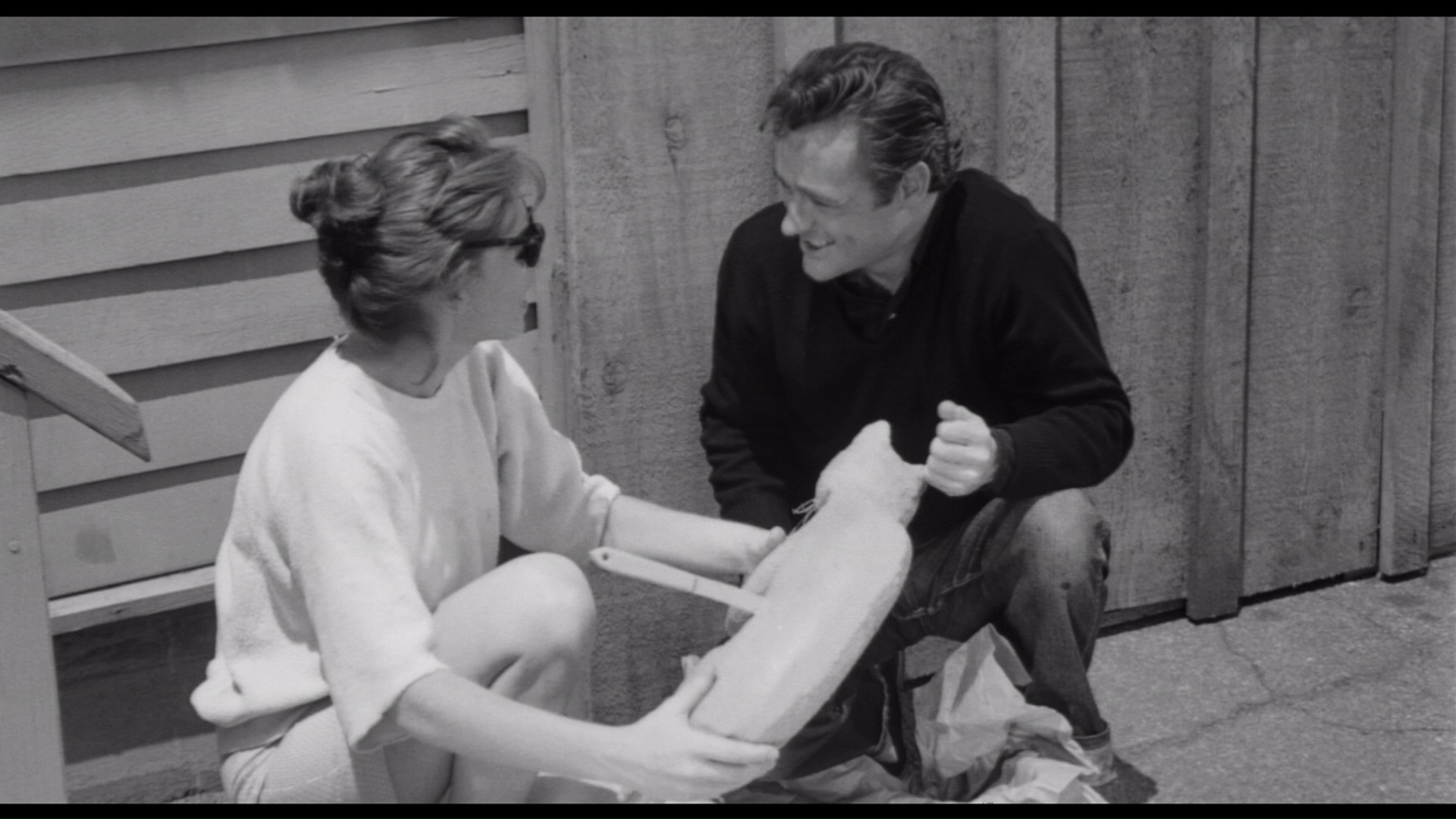
We can’t have Halloween without a good Roger Corman movie, and A BUCKET OF BLOOD is one of my favorites. This 1959 black comedy is a precursor to Corman’s THE LITTLE SHOP OF HORRORS, and I actually prefer it over that little gem. A BUCKET OF BLOOD skewers the pretentiousness of the art world, the 50’s beatnik scene, and the horror genre itself with its story of nerdy Walter Paisley, a busboy at a hipster coffee house learns making it as a famous artist can be murder!

buckb2

Walter’s a no-talent nebbish longing to be accepted by the pompous clientele at The Yellow Door, especially beautiful hostess Carla. When he accidentally kills the landlady’s cat, Walter covers it in clay (with the knife still protruding in poor little Frankie!), and brings it in to work. The grotesque sculpture causes a stir among the patrons, and Walter is congratulated for his brilliant work ‘Dead Cat’. Beatnik…

View original post 558 more words