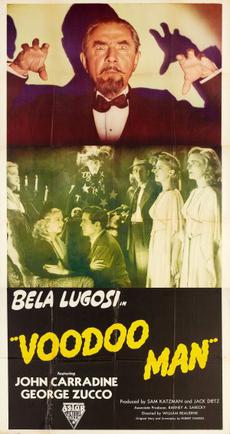
Horror Film Review: Voodoo Man (dir by William Beaudine)


In 1944’s Voodoo Man, Michael Ames stars as Ralph, a screenwriter who has been asked to write a treatment based on the real case of several “girl motorists” who have disappeared in the surrounding area.  Ralph turns down the assignment because he’s busy planning his wedding to Betty (Wanda McKay).  However, when Betty’s maid of honor, Stella (Louise Currie), vanishes, Ralph and Betty set out to investigate.  As Ralph puts it, he’s become a part of the story that he earlier rejected.

What has happened to Stella and all of the other women?  They’ve been abducted by Toby (John Carradine) and Grego (Pat McKee), two lunkheads who work for Dr. Marlowe (Bela Lugosi).  Dr. Marlowe lives in an isolated mansion where he is cared for by his loyal housekeeper (Mici Goty).  Twenty-two years ago, Dr. Marlowe’s wife, Evelyn (Ellen Hall), died but Marlowe has been able to keep her body in a sort of suspended animation ever since.  Marlowe is kidnapping women because, through the use of voodoo and mad science, he hopes to take their “will to live” and transfers it into Evelyn.  Helping Marlowe out is a voodoo priest named Nicholas (George Zucco).

Lugosi, Carradine, and Zucco!  Obviously, the main appeal of Voodoo Man is that it brings together three great names in horror. Even if the story doesn’t really make much sense (and it doesn’t), the film gets a lot of mileage out of the combination of Lugosi, Carradine, and Zucco.  While Lugosi does seem to be a bit bored with his role, Carradine and Zucco really throw themselves into their characters.  John Carradine, in particular, seems to be having the time of his life as he shuffles around the mansion and replies, “Yes, master,” to every command from Dr. Marlowe.  It’s the type of entertaining performance that could only be delivered by a trained Shakespearean slumming in a low-budget, B-grade horror film.  As for Zucco, he plays Nicholas with a certain amount of ruthless erudition.  Zucco is playing the Boris Karloff role here and he definitely seems to understand what that means.

As for the film itself, it has its moments.  Legend has it that director William Beaudine’s nickname was “One Shot” because he was usually only willing to do one take of each scene.  As a result, he filmed quickly and he didn’t spend a lot of money and that was probably a good thing for a production like Voodoo Man.  It also meant that if someone flubbed a line or bumped into a piece of furniture, that take would still be the one that showed up in the film.  My favorite moment of Voodoo Man was when the local sheriff (Henry Hall) referred to Dr. Marlowe as being “Dr. Martin,” and Bela Lugosi, who appeared to be struggling not to laugh, quickly said, “It’s Marlowe.”  The sheriff corrected himself.  That’s the type of fun you don’t get in movies made by people who do more than one take.

Voodoo Man has a quick 61-minute running time.  To enjoy it, it probably helps to already be a fan of low-budget, B-horror films from the 40s.  Lugosi, Carradine, and Zucco are combination that deserves to be seen.

Late Night Retro Television Review: Friday the 13th: The Series 2.16 “Scarlet Cinema”


Welcome to Late Night Retro Television Reviews, a new feature where we review some of our favorite and least favorite shows of the past! On Fridays, I will be reviewing Friday the 13th: The Series, a show which ran in syndication from 1987 to 1990. The show can be found on YouTube!

This week, a nerdy film students takes his love of a 1940s horror film too far!

Episode 2.16 “Scarlet Cinema”

(Dir by David Winning, originally aired on February 20th, 1989)

Darius Pogue (Jonathan Wise) is a nerdy film student who is obsessed with The Wolf Man.  When Darius steals an old antique movie camera, he discovers that, by looking through the camera’s view finder, he can bring The Wolf Man to life and send him to kill anyone who annoys him.  Darius kills a snooty antique store manager.  He kills a bully.  He kills his professor.  He even sends the wolf after Ryan and a girl that Darius likes.

However, as much as Darius enjoys sending the Wolf Man after people, he wants to be the Wolf Man himself.  After allowing the Wolf Man to scratch him, Darius shoots him with silver bullets.  Transforming into a werewolf himself, Darius goes after Ryan, Micki, and Jack.  Unfortunately, Darius didn’t consider that film stock is full of silver nitrate.  Live by the film, die by the film….

This episode was a case where the premise was pretty interesting but the execution didn’t quite work.  The episode mixes in archival footage from The Wolf Man with scenes of Darius’s victims meeting their fate.  So, for example, one sees Lon Chaney Jr. turning into the Wolf Man and then the viewer sees The Wolf Man killing one of Darius’s classmates.  The problem is that the Friday the 13th werewolf makeup doesn’t really look much like the Wolf Man makeup.  Regardless of how darkly lit each scene is, it’s pretty obvious that the Wolf Man from the film is not the same Wolf Man that is doing Darius’s bidding.  It not only negates the whole idea behind the cursed antique but it’s also pretty distracting for those of us just trying to watch the show.  And, again, it’s a shame because the idea behind this episode was actually pretty clever.

Myself, I’ve always liked the original Wolf Man.  Eventually, Larry Talbot got a bit too whiny for his own good and it’s pretty much impossible to buy the idea of the hulking, very American Lon Chaney, Jr. as the son of the sophisticated and very British Claude Rains.  But, even with all that in mind, The Wolf Man holds up as a classic American horror film, full of atmosphere and featuring a pretty impressive monster.  Friday the 13th deserves some credit for making Darius a Wolf Man fan because The Wolf Man, with its portrait of a man being driven mad by a curse that he cannot control, fits in perfectly with the main idea behind Friday the 13th.  Darius, like most of the villains on this show, isn’t really evil until he starts using the camera.  Each times he picks up the camera, his actions become progressively worse.  Just as Larry Talbott was cursed by the werewolf, Darius is cursed by the camera.  Much like a drug addict, Darius falls in love with the camera and he just can’t stop using it.  His addiction changes his personality as it becomes all-consuming,.  Eventually, it drives him to become the Wolf Man himself.

The episode ends with another cursed antique safely hidden away and Darius joining Larry Talbot in the cold embrace of death.  There was a lot of potential to this episode so it’s a shame that it didn’t quite work.

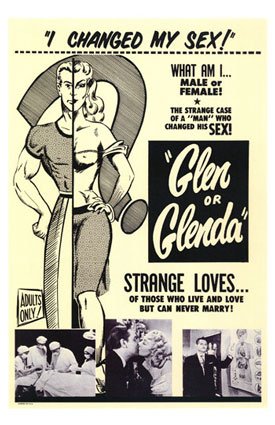
Icarus File No. 15: Glen or Glenda (dir by Edward D. Wood, Jr.)


Today is the 100th birthday of Edward D. Wood, Jr., the director who is often referred to as being “the worst director of all time.”  Personally, I’ve never really agreed with that title.  Ed Wood had a long career in Hollywood and yes, he may have worked exclusively in B-movies and yes, he eventually turned to softcore and then hardcore porn to pay the bills and yes, his life ended under rather tragic circumstances.  But, unlike most truly bad directors, his films are still being watched today and, again unlike most bad directors, his style is immediately recognizable.  You don’t need to see his name in the credits to know when a film was directed by Ed Wood.  You just have to keep an eye out for stock footage, a few familiar actors, and a lot of angora.

If anything, Ed Wood was a director whose ambitions far outweighed the money that he could usually raise for his films.  On the one hand, Plan 9 From Outer Space was a film where the strings holding the flying saucers were clearly visible and where a shower curtain was used to represent the door into an airplane’s cockpit.  On the other hand, it was also a very sincere plea for world peace and a lament that humans would rather blow themselves up with Solarnite than work out their differences.

Or you take a film like 1953‘s Glen or Glenda.  Ed Wood, who identified as a heterosexual and who was considered, by his friends, to be quite a womanizer (and it should be noted that young Ed Wood was strikingly handsome, though he was subsequently very badly aged by alcoholism and homelessness), also preferred to wear clothing designed for women and was open about it at a time when American culture was even more conformist-minded than usual.  In Glen or Glenda, Wood plays the autobiographical role of Glen, who struggles to tell his fiancée (played by Wood’s real-life girlfriend, Delores Fuller) that he dreams of being able to wear her angora sweater.  Glen’s story is told by a psychiatrist (Timothy Farrell) who is talking to a cop (veteran Hollywood character actor Lyle Talbot) who is investigating the death of a transvestite.  Among other things, Glen or Glenda is known for its bad acting, stiffly delivered dialogue, and its occasional digressions about why men go bald while women do not.  (It’s the tight-fitting hats, which cut-off blood flow to the head and not only cause men to lose their hair but also develop the Solarnite bomb.)  But, at the same time, it’s a film in which Wood attempts to handle, with sensitivity and empathy, a subject that most films in the 50s would have either ridiculed or portrayed as being a threat to the American way of life.  All of Wood’s films are sympathetic to those who are considered to be outsiders by conventional society.  This is especially true of Glen or Glenda.

Of course, Glen or Glenda is also known for Bela Lugosi randomly appearing in a laboratory and shouting things like, “Pull ze string!  Pull ze string!”  As far as I can tell, Lugosi is supposed to be playing the creator, who is not portrayed as being a stereotypical God but instead as being a mad scientist who rants and raves in his library and his laboratory.  And while it’s obvious that Bela was probably added to the film at the last minute and, more or less, allowed to do whatever the Hell he wanted, his presence adds a wonderfully bizarre touch to film’s dry style.  (I would compare him to the mysterious burned man who appears at the start of David Lynch’s Eraserhead.)  Whenever the film starts to get a bit too much like an educational film, Lugosi pops up and starts to literally shout at the audiences, frantically issuing a bunch of commands and nursery school rhymes that don’t really made any sense.  It reminds one of H.P. Lovecraft’s insistence that the universe was created by a blind idiot God who had no idea that he was actually creating anything.  The presence of Lugosi and a lengthy and increasingly surreal dream sequence in which Glen imagines himself being tormented by both his fiancée and the devil all suggest that, under different circumstances, Ed Wood could have been the American Buñuel.

Sadly, it was not to be.  Ed Wood died in alcoholic poverty and was reportedly pretty miserable during the final years of his life.  There was nothing pleasant about the end of Wood’s life.  But, on his birthday, I think the least we can do is remove the title of “worst director” from his legacy.  He was nothing of the sort.

Previous Icarus Files:

  1. Cloud Atlas
  2. Maximum Overdrive
  3. Glass
  4. Captive State
  5. Mother!
  6. The Man Who Killed Don Quixote
  7. Last Days
  8. Plan 9 From Outer Space
  9. The Last Movie
  10. 88
  11. The Bonfire of the Vanities
  12. Birdemic
  13. Birdemic 2: The Resurrection 
  14. Last Exit To Brooklyn

Horror on the Lens: Bride of the Monster (dir by Edward D. Wood, Jr.)


Bride of The Monster (1955, dir by Ed Wood)

Since tomorrow will be the great man’s birthday, it seems appropriate that today’s horror film on the lens is Edward D. Wood’s 1955 epic, Bride of the Monster.

(Much like Plan 9 From Outer Space, around here, it is a tradition to watch Bride of the Monster in October.)

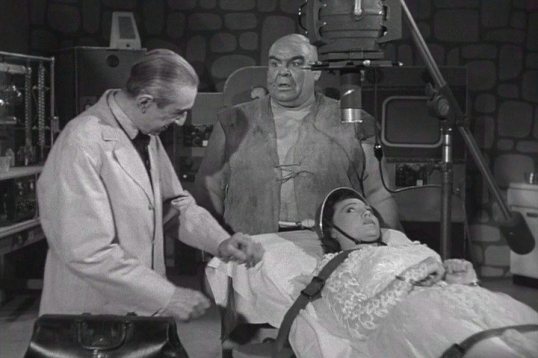
The film itself doesn’t feature a bride but it does feature a monster, a giant octopus who guards the mansion of the mysterious Dr. Vornoff (Bela Lugosi).  Vornoff and his hulking henchman Lobo (Tor Johnson) have been kidnapping men and using nuclear power to try to create a race of super soldiers.  Or something like that.  The plot has a make-it-up-as-you-go-along feel to it.  That’s actually a huge part of the film’s appeal.

Bride of the Monster is regularly described as being one of the worst films ever made but I think that’s rather unfair.   Appearing in his last speaking role, Lugosi actually gives a pretty good performance, bringing a wounded dignity to the role of Vornoff.  If judged solely against other movies directed by Ed Wood, this is actually one of the best films ever made.

(For a longer review, click here!)

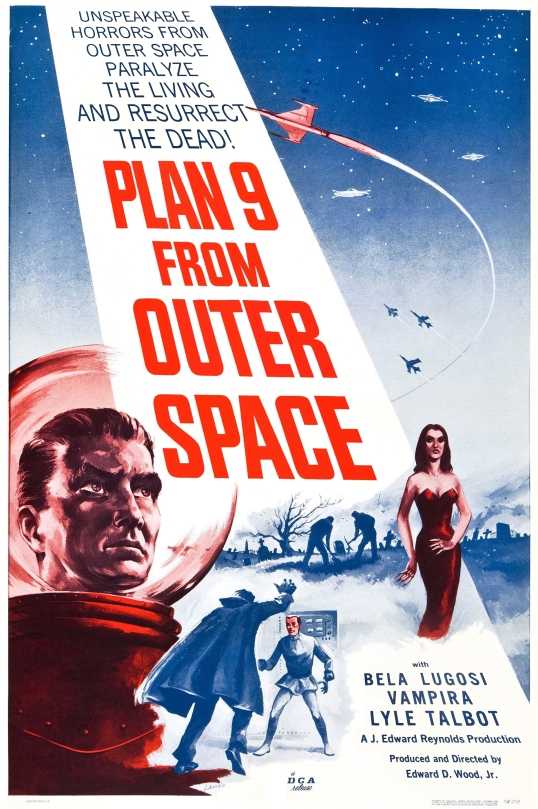
Horror on the Lens: Plan 9 From Outer Space (dir by Edward D. Wood, Jr.)


Viewing Plan 9 From Outer Space during October is a bit of a tradition around these parts and here at the Shattered Lens, we’re all about tradition.  And since the 100th anniversary of the birth of Ed Wood, Jr. is just a five days away, it just seems appropriate to watch his best-known film.

Speaking of tradition, this 1959 sci-fi/horror flick is traditionally cited as the worst film ever made but I don’t quite agree.  For one thing, the film is way too low-budget to be fairly judged against other big budget fiascoes.  If I have to watch a bad movie, I’ll always go for the low budget, independent feature as opposed to the big studio production.  To attack Ed Wood for making a bad film is to let every other bad filmmaker off the hook.  Ed Wood had his problems but he also had a lot of ambition and a lot of determination and, eventually, a lot of addictions.  One thing that is often forgotten by those who mock Ed Wood is that he drank himself to death and died living in squalor.  The least we can do is cut the tragic figure some slack.

Plan 9 From Outer Space is a ludicrous film but it’s also a surprisingly ambitious one and it’s got an anti-war, anti-military message so all of you folks who have hopped down the progressive rabbit hole over the past few years should have a new appreciation for this film.  I mean, do you want the government to blow up a Solarnite bomb?  DO YOU!?

Also, Gregory Walcott actually did a pretty good job in the lead role.  He was one of the few members of the cast to have a mainstream film career after Plan 9.

Finally, Plan 9 is a tribute to one man’s determination to bring his vision to life.  Ed Wood tried and refused to surrender and made a film with a message that he believed in and, for that, he deserves to be remembered.

Now, sit back, and enjoy a little Halloween tradition.  Take it away, Criswell!

Can you prove it didn’t happen?

WELL, CAN YOU!?

Horror Film Review: White Zombie (dir by Victor Halperin)


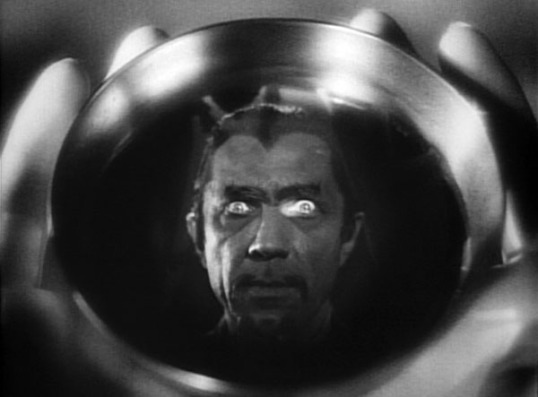
In the 1932 film, White Zombie, Bela Lugosi plays one of his most evil characters.

Lugosi is “Murder” Legendre, a voodoo master who lives on the island of Haiti.  He owns a sugar cane mill, one that has an ever-growing amount of workers.  All of Legendre’s workers do their work without complaint.  Actually, they work without talking at all.  Even when one of them falls to his apparent death, the rest continue to work as if they didn’t even notice.  Legendre has made himself into a wealthy and feared figure because everyone knows that he has an army of zombies who serve him.  He’s not only evil but he’s also someone who enjoys being evil and causing as much trouble as possible.  And yet, because his magic is powerful, the island’s rich plantation owners often pay him for favors.

Among those who are willing to pay Murder for his services is Charles Beaumont (Robert W. Frazer), a plantation owner who is in love with Madeleine Short (Madge Bellamy) and jealous of her fiancé, Neil Parker (John Harron).  Charles wants Madeleine to love him so Murder gives Charles a potion to slip into Madeleine’s drink.  When Madeleine drinks the potion, she appears to die.  After her funeral, Charlies and Murder break into her crypt and retrieve Madeleine.  Madeleine is now in a state of limbo, not quite alive but also not quite dead.  She can still play the piano but she cannot speak and she stares straight ahead with a blank look in her eyes.  She is now one of Murder’s zombies.  Needless to say, Charles isn’t happy about this and neither is Neil.

Now, one thing I should make clear is that the zombies in White Zombie are more like the zombies of Haitian mythology than the zombies that one would expect to find in a George Romero film.  The zombies in White Zombie do not eat human flesh.  They’re not in a process of decay.  They are not immortal.  These zombies are not the walking dead.  Instead, they’re brainwashed victims who have been turned into slaves by Murder and his magic potions.  Murder uses them to punish his enemies and to work in his mill.  As I said at the start of this review, Murder Legendre is one of Bela Lugosi’s most evil characters.

White Zombie is usually considered to be the first feature length zombie film.  Though it was released 91 years ago and watching it requires a bit of adjustment on the part of modern viewers, White Zombie still creates and maintains a memorable atmosphere of ominous magic and growing menace.  The scenes in Murder’s sugar cane mill are especially strong, with Murder’s zombies silently marching from one task to another.  The acting is a bit inconsistent.  Watching the film, it’s easy to see that it was made at a time when Hollywood was still making the transition to sound.  But the important thing is that Bela Lugosi is absolutely fantastic as the menacing Murder Legendre, smirking as he casts his spell and, in one of the film’s most famous scenes, walking straight towards the camera with an evil gleam in his eyes as if he’s coming straight for the audience.  Flaws aside, White Zombie features one of Bela Lugosi’s best performances and is more than worth watching for that reason alone.

Live Tweet Alert: Join #ScarySocial For A Halloween Double Feature


As some of our regular readers undoubtedly know, I am involved in a few weekly live tweets on twitter.  I host #FridayNightFlix every Friday, I co-host #ScarySocial on Saturday, and I am one of the five hosts of #MondayActionMovie!  Every week, we get together.  We watch a movie.  We tweet our way through it.

Tonight, we’ve got a special Halloween double feature!  First up, we’ve got 1932’s White Zombie, starring Bela Lugosi!

After White Zombie, we will watch 1940’s The Wolf Man, starring Claude Rains, Lon Chaney Jr, and …. Belua Lugosi!

Halloween is always fun at #ScarySocial!

If you want to join us on Saturday night, just hop onto twitter, start White Zombie at 9 pm et, and use the #ScarySocial hashtag!  The films are available on Prime!  I’ll be there co-hosting and I imagine some other members of the TSL Crew will be there as well.  It’s a friendly group and welcoming of newcomers so don’t be shy.

Horror Scenes That I Love: Bela Lugosi in Dracula


Dracula (1931, starring Bela Lugosi as the Count, Dir by Tod Browning, DP: Karl Freund)

Bela Lugosi was born in what is now Romania.  Lugosi began his career in his native country, appearing on stage.  After serving as an infantryman in World War I, Lugosi moved into the movie industry and appeared in silent Hungarian films.  The young Lugosi was an activist, involved in labor issues and trying to unionize the Hungarian film industry.  When a new government came to power in Hungary in 1920, the politically-active Lugosi moved first to Germany and then eventually ended up in the United States.  After a period of working as a merchant seaman, Lugosi returned to acting.

He first played Dracula on stage in New York City.  In 1928, while touring in the role of Dracula, he moved out to California and quickly became a part of the Hollywood community.  When Universal produced a film adaptation of Dracula in 1931, Lugosi was the obvious choice for the lead role.  The film made Lugosi a star and it also typecast him.  Lugosi never stopped acting, though the films varied widely in quality.  By the end of his career, Lugosi was a member of the Ed Wood stock company.  Even appearing in something like Bride of the Monster, Lugosi still made an impression.

In the scene below, from 1931’s Dracula, Lugosi suggests that Edward van Sloan’s Van Helsing should perhaps leave the country.

Horror on the Lens: Plan 9 From Outer Space (dir by Edward D. Wood, Jr.)


Viewing Plan 9 From Outer Space during October is a bit of a tradition around these parts and here at the Shattered Lens, we’re all about tradition.  And since today is the 97th anniversary of the birth of Ed Wood, Jr., it just seems appropriate to watch his best-known film.

Speaking of tradition, this 1959 sci-fi/horror flick is traditionally cited as the worst film ever made but I don’t quite agree.  For one thing, the film is way too low-budget to be fairly judged against other big budget fiascoes.  If I have to watch a bad movie, I’ll always go for the low budget, independent feature as opposed to the big studio production.  To attack Ed Wood for making a bad film is to let every other bad filmmaker off the hook.  Ed Wood had his problems but he also had a lot of ambition and a lot of determination and, eventually, a lot of addictions.  One thing that is often forgotten by those who mock Ed Wood is that he drank himself to death and died living in squalor.  The least we can do is cut the tragic figure some slack.

Plan 9 From Outer Space is a ludicrous film but it’s also a surprisingly ambitious one and it’s got an anti-war, anti-military message so all of you folks who have hopped down the progressive rabbit hole over the past few years should have a new appreciation for this film.  I mean, do you want the government to blow up a Solarnite bomb?  DO YOU!?

Also, Gregory Walcott actually did a pretty good job in the lead role.  He was one of the few members of the cast to have a mainstream film career after Plan 9.

Finally, Plan 9 is a tribute to one man’s determination to bring his vision to life.  Ed Wood tried and refused to surrender and made a film with a message that he believed in and, for that, he deserves to be remembered.

Now, sit back, and enjoy a little Halloween tradition.  Take it away, Criswell!

Can you prove it didn’t happen?

WELL, CAN YOU!?

Horror on the Lens: Bride of the Monster (dir by Edward D. Wood, Jr.)


Bride of The Monster (1955, dir by Ed Wood)

Today’s horror film on the lens is Edward D. Wood’s 1955 epic, Bride of the Monster.

(Much like Plan 9 From Outer Space, around here, it is a tradition to watch Bride of the Monster in October.)

The film itself doesn’t feature a bride but it does feature a monster, a giant octopus who guards the mansion of the mysterious Dr. Vornoff (Bela Lugosi).  Vornoff and his hulking henchman Lobo (Tor Johnson) have been kidnapping men and using nuclear power to try to create a race of super soldiers.  Or something like that.  The plot has a make-it-up-as-you-go-along feel to it.  That’s actually a huge part of the film’s appeal.

Bride of the Monster is regularly described as being one of the worst films ever made but I think that’s rather unfair.   Appearing in his last speaking role, Lugosi actually gives a pretty good performance, bringing a wounded dignity to the role of Vornoff.  If judged solely against other movies directed by Ed Wood, this is actually one of the best films ever made.

(For a longer review, click here!)