Late Night Retro Television Review: CHiPs 4.20 “Dead Man’s Riddle”


Welcome to Late Night Retro Television Reviews, a feature where we review some of our favorite and least favorite shows of the past!  On Mondays, I will be reviewing CHiPs, which ran on NBC from 1977 to 1983.  The entire show is currently streaming on Prime!
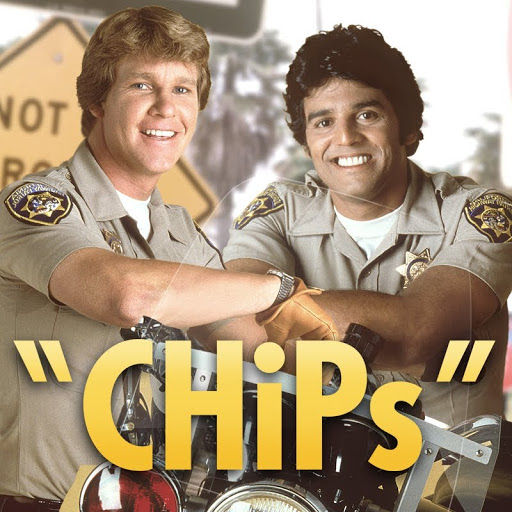
This week, the CHiPs team investigates an accident and a guest star gives a really terrible performance.

Episode 4.20 “Dead Man’s Riddle”

(Dir by Michael Caffey, originally aired on May 10th, 1981)

An accident in the mountains causes three cars to explode and one driver to die.  Since the dead driver was a captain with the Los Angeles fire department, the MAIT Team is sent out to recreate the accident and to try to figure out what happened.  They know that at least three cars were involved in the accident.  One driver died.  One driver is in the hospital.  And the other driver appears to be missing.  Getraer suspects that the accident could be due to people racing each other in the mountains.

What makes this episode odd is the casting of Joanna Kerns as psychiatrist Colleen Jacobs.  She’s assigned to the MAIT Team.  She actually drives through the mountains frequently and she even gets involved in racing sometimes.  In fact, she saw one of the cars right before the accident!  At first, she doesn’t bother to share this with anyone.  Instead, she just sits in the background with a guilty look on her face.  Finally, Jon Baker — in an unmarked car — tricks her into trying to race him.  That’s when she finally confesses….

….and faces absolutely no consequences!  Oh sure, Getraer gets a little annoyed and says that it would have been helpful if Dr. Jacobs had been honest from the start.  But Dr. Jacobs is allowed to continue to work with the MAIT Team.  Even though she intentionally withheld evidence from investigators, she’s not charged with obstruction.  Ponch tells her that she’s getting a chance to redeem herself which I don’t think is police policy.  No one comments on the fact that, even though she was worried that she may have previously caused a fatal accident, she still tried to race Baker.  Does no one care that, at the very least, she appears to have no impulse control?

Making things even stranger is that Joanna Kerns gives one of the worst performances that I have ever seen as Dr. Jacobs, delivering half of her lines as if she’s struggling not to laugh.  Even when she’s admitting her fear that she may have been responsible for the accident, she still seems like she’s on the verge of breaking out into laughter.  It’s very odd.

Speaking of odd,  an eccentric old man named Max (Owen Brooks) claims that he saw a UFO before the crash.  (Dr. Jacobs laughs when she repeats this.)  It turns out that he just saw a hubcap flying through the air.

In the end, it’s proven that the captain was not at fault in the accident.  That’s all that anyone really seems to care about.  I assume that Dr. Jacbos and Baker then proceeded to race each back to Los Angeles.

Bonus Horror On The Lens: I Was A Teenage Werewolf (dir by Gene Fowler, Jr.)


1957’s I Was A Teenage Werewolf combines two genres that were very popular in the late 50s.

On the one hand, it’s a film about a teenage rebel.  Tony Rivers (Michael Landon) is a teenager that means well but he keeps losing his temper.  If he can’t learn to control his anger, he could very well be looking at a life behind bars.

On the other hand, it’s also a horror film.  When Tony visits a hypnotist (Whit Bissell), the end result is Tony turning into a werewolf and going on a rampage, all while still wearing his letterman jacket.

All in all, this is a pretty fun little movie.  You can check out my review of it by clicking here.

And you can watch the movie below!

GANG WAR (1958) – a young Charles Bronson testifies against the mob!


Charles Bronson starred in four movies and one TV show in 1958. Two of those movies were produced by Harold Knox, written by Louis Vittes, and directed by Gene Fowler, Jr. The first of the two films was SHOWDOWN AT BOOT HILL, an excellent low budget western that featured Bronson as a bounty hunter with a chip on his shoulder and love in his heart. The second film was GANG WAR. 

In GANG WAR, Charles Bronson plays Alan Avery, a high school teacher in Los Angeles who’s walking home one night and happens to witness a gangland killing. He calls the police to report the murder, but he doesn’t want to get any further involved so he doesn’t give them his name. Avery was on his way home from a trip to the pharmacy where he had picked up a prescription for his pregnant wife (Gloria Henry) who is suffering from migraines. In the stress of the moment, he left the pharmacy sack in the phone booth and the police are able to track him down to his home. After being pressed by the police, Avery reluctantly agrees to testify. He’s a great witness as he’s able to give the police a description of the car and its license plate number. His information leads to the arrest of Joe Reno, the second in command to mobster Maxie Meadows (John Doucette). Maxie sends his attorney Bryce Barker (Kent Taylor) over to the police station to see Captain Finch. Finch happens to be on Maxie’s payroll, and he immediately tells Barker about the witness. He even leaks it to the press so they can run a story revealing Avery’s name and address. Maxie would prefer to buy Avery’s silence, but he also wants a little insurance, so he sends his punch drunk henchman Chester over to slap around Avery’s wife. This order is akin to asking Lennie Small from OF MICE AND MEN to go play with some puppies. Simple-minded Chester proceeds to kill Mrs. Avery. When Avery comes home and finds his wife dead, he heads directly to Maxie’s house to kill him. The cab driver who took Avery to Maxie’s place just happened to see his gun, so he called the cops. Just before Avery can squeeze off a kill shot, the police show up and arrest him. Pissed that Avery was able to get so close to killing him, Meadows puts an actual hit out on him this time. Will the high school teacher be able to survive his battle against the mob?!!

(Note: The analysis below ventures into spoiler territory for both GANG WAR and SHOWDOWN AT BOOT HILL. You may want to watch these films prior to reading the rest of the review.)

As a lifelong fan of Charles Bronson, I really appreciate his work with director Gene Fowler, Jr. in 1958. Fowler recognized Bronson’s charismatic screen presence, but he also recognized something deeper in the legendary icon… his heart. SHOWDOWN AT BOOT HILL seemed to be giving us Bronson as a typical western hero, only to reverse course and turn Bronson into a romantic lead who would choose to throw down his guns so he could establish roots in a community and spend his life with the woman he loves. In a similar way, GANG WAR seems to be setting Bronson up to be a vigilante, not much different than the type of character he would be portraying throughout the 70’s and 80’s. But when 70’s and 80’s Bronson would be pulling his trigger, Fowler presents a more thoughtful Bronson who recognizes that the best revenge can sometimes be in letting someone live with the consequences of their own decisions. This allows him to lower his gun, walk away and continue his life free of the guilt and the legal consequences that would undoubtedly come with taking another person’s life. This decision honors his wife’s legacy much more than murder and a lifetime in jail ever would. 

There are many good performances in this little gem. Bronson may not have been a “star” when this film was made, but there is no doubt that he was ready. He simply commands every frame that he appears in from the beginning to the end. John Doucette and Kent Taylor are also memorable as the gangster and his paid off lawyer, respectively. Doucette’s Maxie Meadows is certainly a stereotype of the gangsters in TV’s and movies at the time, but he plays the part well, saving his very best for his last moments of the film. Kent Taylor has the movie’s best story arc. When we meet him, he’s an alcoholic who can’t stand what he’s allowed himself to become, yet he continues to run every time Maxie calls. It’s a strong moment when he decides he won’t do it anymore. And Jennifer Holden is simply gorgeous as Marie, Maxie’s woman. Speaking of nice scenery, it was also fun seeing a Los Angeles that included landmarks like the Capitol Records Building and the old Nickodell Restaurant. So much of the action in GANG WAR takes place against these iconic backdrops, and for a guy who’s never been to LA, seeing these places again almost makes me feel like a resident.

Overall, while GANG WAR does feel like an old fashioned 50’s movie, it has plenty of things to recommend it, not the least of which is an excellent performance from a young Charles Bronson. At a 75 minute run time, it’s definitely worth a viewing.

The trailer for GANG WAR is presented below:

Horror On The Lens: I Was A Teenage Werewolf (dir by Gene Fowler, Jr.)


1957’s I Was A Teenage Werewolf combines two genres that were very popular in the late 50s.

On the one hand, it’s a film about a teenage rebel.  Tony Rivers (Michael Landon) is a teenager that means well but he keeps losing his temper.  If he can’t learn to control his anger, he could very well be looking at a life behind bars.

On the other hand, it’s also a horror film.  When Tony visits a hypnotist (Whit Bissell), the end result is Tony turning into a werewolf and going on a rampage, all while still wearing his letterman jacket.

All in all, this is a pretty fun little movie.  You can check out my review of it by clicking here.

And you can watch the movie below!

Retro Television Reviews: Fantasy Island 3.13 “The Inventor/On The Other Side”


Welcome to Retro Television Reviews, a feature where we review some of our favorite and least favorite shows of the past!  On Tuesdays, I will be reviewing the original Fantasy Island, which ran on ABC from 1977 to 1986.  Almost entire show is currently streaming is on Youtube!

This week’s trip to Fantasy Island is sadly forgettable.  Let’s find out why.

Episode 3.13 “The Inventor/On The Other Side”

(Dir by Earl Bellamy, originally aired on December 15th, 1979)

This week, there is no banter between Tattoo and Mr. Roarke before they head off to meet their guests.  In fact, Ricardo Montalban and Herve Villechaize barely look at each other.  It’s a shame because this is actually a pretty dire episode.  It could have used some passive-aggressive Tattoo/Roarke interaction.

The first fantasy features Arte Johnson as Professor Dwayne Clebe and Marcia Wallace as his assistant, Martha Meeks.  Professor Clebe is tying to develop a solution that, when sprayed on metal, will make it impervious to damage.  When he first arrives at Fantasy Island, the solution is called 2X76409, with the 9 signifying the 9 labs that have been blow up by Clebe’s experiments.  By the time he and Martha perfect the solution, it has become the 2X76411.  Fear not, no one is injured when the labs blow up.  Even though Clebe and Martha are both standing in the middle of these explosions, they always just end up with soot on their face.

Anyway, once the formula is perfected, leaders of both industry and the world’s trade unions travel to Fantasy Island to try to destroy it.  The industrialists think that it will drive down prices.  The unionists think that it will put people out of work.  Eventually, the Russians show up because they want the formula for themselves.  It all leads to a big chase and Prof. Clebe realizing that he loves Martha.

The whole fantasy was way too cartoonish and overwritten for its own good and it featured some of the worst acting that I’ve ever seen on Fantasy Island.  Let’s move on!

Unfortunately, the other fantasy really isn’t that great either.  Irma Gideon (Jeanette Nolan) was the wife of a medium.  When he died, he promised that he would contact her from the other side.  He hasn’t done so and Irma’s fantasy is to go to the other side, see her husband, and then return.  Mr. Roarke arranges for a séance but, when he suspects that Irma is planning on just going to the other side and staying there, he cancels the fantasy.  After Irma swears that she won’t stay in “the other side,” Mr. Roarke allows her to enter a death-like trance in a Fantasy Island laboratory.  When Irma goes to the Other Side and is tempted to cross a bridge and stay permanently, her grandson (Keith Gordon) enters into a trance of his own so that he can beg her to come back.

It all sounds like it should be interesting but the execution is lacking, with one scene featuring a painting of Irma’s husband speaking to her being so badly done that it makes it impossible to take the rest of the fantasy seriously.  Jeanette Nolan and Keith Gordon both give marginally better performances that Arte Johnson and Marcia Wallace did in the other fantasy but, in the end, the whole thing just falls flat.

Well, not every trip to Fantasy Island can be a winner.

Horror On The Lens: I Was A Teenage Werewolf (dir by Gene Fowler, Jr.)


1957’s I Was A Teenage Werewolf combines two genres that were very popular in the late 50s.

On the one hand, it’s a film about a teenage rebel.  Tony Rivers (Michael Landon) is a teenager that means well but he keeps losing his temper.  If he can’t learn to control his anger, he could very well be looking at a life behind bars.

On the other hand, it’s also a horror film.  When Tony visits a hypnotist (Whit Bissell), the end result is Tony turning into a werewolf and going on a rampage, all while still wearing his letterman jacket.

All in all, this is a pretty fun little movie.  You can check out my review of it by clicking here.

And you can watch the movie below!


Horror On The Lens: I Was A Teenage Werewolf (dir by Gene Fowler, Jr.)


1957’s I Was A Teenage Werewolf combines two genres that were very popular in the late 50s.

On the one hand, it’s a film about a teenage rebel.  Tony Rivers (Michael Landon) is a teenager that means well but he keeps losing his temper.  If he can’t learn to control his anger, he could very well be looking at a life behind bars.

On the other hand, it’s also a horror film.  When Tony visits a hypnotist (Whit Bissell), the end result is Tony turning into a werewolf and going on a rampage, all while still wearing his letterman jacket.

All in all, this is a pretty fun little movie.  You can check out my review of it by clicking here.

And you can watch the movie below!


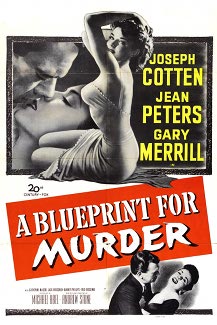
Lisa Cleans Out Her DVR: A Blueprint for Murder (dir by Andrew L. Stone)


(I am currently in the process of cleaning out my DVR!  I recorded the 1953 film noir, A Blueprint for Murder, off of FXM on February 21st.)

Much like Alfred Hitchcock’s Shadow of a Doubt, A Blueprint for Murder stars Joseph Cotten in a story about a seemingly wonderful person who might actually be a murderer.  Actually, now that I think about it, it seems like Joseph Cotten appeared in quite a few films that centered around that idea.  What distinguished A Blueprint For Murder is that, for once, Joseph Cotten is not the murderer.  Instead, he’s the one who is forced to deal with the overwhelming evidence that someone in his life might be a sociopath.

Cotten plays Cam Cameron, who is shocked when his niece, Polly, suddenly takes ill and dies.  Cam’s immediate response is to comfort his sister-in-law, Lynne (Jean Peters).  And yet, Lynne doesn’t seem to be too upset over Polly’s death.  Could it be because Polly was only her stepdaughter? Or maybe Lynne is no longer surprised by sudden death, seeing as how her husband also died after a sudden and mysterious illness.

Or could it be that Lynne murdered both Polly and her husband?  That’s the theory put forward by Maggie (Catherine McLeod), the wife of Cam’s friend, Fred (Gary Merrill).  Maggie thinks that it sounds like both Polly and her father were poisoned with strychnine!  As the initially skeptical Fred points out, when Lynne’s husband died, he put all of his money in a trust for his children.  If his children die, Lynne stands to inherit the fortune.  Polly’s already dead.  The only remaining obstacle would be Cam’s nephew, Doug.

Much like Don’t Bother To Knock, A Blueprint for Murder barely clocks in at a little over 70 minutes.  It’s a briskly told melodrama and, seen today, it’s easier to imagine it as an episode of a television series than as an actual movie.  As I watched it, I kept thinking that it felt like an old episode of CSI Miami, with Joseph Cotten in the role that would have been played by David Caruso.  (“Two deaths in one family?  It sounds like something’s in the water and it’s not fluoride.”  YEEEEEEEEEEAHHHHHH!  DON’T GET FOOLED AGAIN!!  NO NO!)  For that matter, it was also easy for me to imagine A Blueprint For Murder being remade for Lifetime, with Josie Davis in the Joseph Cotten role and maybe AnnaLynne McCord replacing Jean Peters.

A Blueprint For Murder is actually pretty predictable up until the final 15 minutes.  It’s during the final 15 minutes that Cam, Lynne, and Doug all end up on a cruise ship together and, in an effort to prove his suspicions, Cam does something that has so much potential for backfiring that it kind of makes you reconsider everything that you previously assumed about him.  To be honest, it doesn’t make much sense.  It’s hard to believe, despite what Cam insists, that what he did was his only possible option.  Then again, it is the 1950s.  In an era before DNA testing, maybe the only way to solve a crime was by doing something crazy.

That said, I enjoyed A Blueprint for Murder.  It’s a real time capsule film and you know how much I love those.  I may never be able to find a time machine but I can always experience the past by watching something like A Blueprint for Murder.  Joseph Cotten is, as always, a sturdy lead.  In real life, Jean Peters’s acting career was somewhat derailed when she married legendary weird guy Howard Hughes.  In this film, she gives a great performance as the potentially murderous sister-in-law.

If you’re a fan of 50s noir or either of the two leads, keep an eye out for A Blueprint For Murder.

Lisa Watches An Oscar Nominee: The Sand Pebbles (dir by Robert Wise)


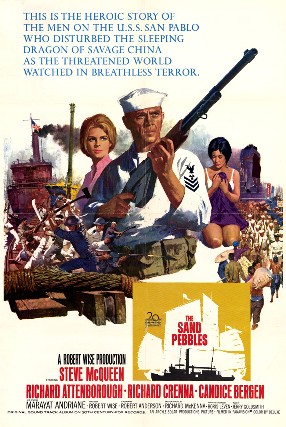
The_Sand_Pebbles_film_posterAfter watching Witness For The Prosecution, I continued TCM’s 31 Days of Oscar by watching the 1966 Best Picture nominee, The Sand Pebbles.

Considering that The Sand Pebbles is close to four hours long, it’s interesting how little there is to really say about it.  Taking place in 1926, The Sand Pebbles follows the crew of the USS San Pablo, a gunboat that patrols the Yangtze River in China.  The San Pablo is there to protect American business interests, which are in particular danger because China is caught up in a communist revolution.  For the most part, the crew of the San Pablo are portrayed as being lazy and racist.  They have little interest in understanding the culture of the people around them and they use Chinese laborer to do the work on the boat.

When Jake Holman (Steve McQueen) is transferred to the San Pablo, he upsets his fellow crewmen by insisting on working in the ship’s engine room himself, the fear being that if Holman is willing to work then the rest of them will be expected to work as well.  The ship’s commander, Lt. Collins (Richard Crenna), views Holman as being a threat to morale and starts to make plans to get Holman off of his boat.  But, first, the boat is going to have to get out of China…

The Sand Pebbles is an episodic film and some of those episodes are more interesting than others.  Typically, an episode will start out positively and then end with some sudden tragedy.  For instance, Holman trains one laborer (Mako) to be a boxer and then watches as he beats the most racist crewman on the ship.  However, just a few minutes later, the laborer is captured and savagely tortured by the communists and Holman is forced to perform a mercy killing.

In another subplot, Holman’s only friend, Frenchy (Richard Attenborough), marries a local prostitute (Emmanuelle Arsan, who would later write an autobiography that would serve as the basis for a very different type of film).  However, in order to see his wife, Frenchy has to continually swim to shore in the middle of the night.  Frenchy soon develops pneumonia and dies while his wife is dragged off and apparently executed.

And finally, Holman strikes up a romance with Shirley Eckert (Candice Bergen), an innocent missionary.  However, when her arrogant and naive boss, Jameson (Larry Gates), refuses to leave the country despite the revolution, the San Pablo is ordered to rescue them.  This, of course, leads to a final battle with the communists which leaves a good deal of the cast dead.

As I watched The Sand Pebbles, my main impression was that it was an extremely long movie.  The film’s climatic battle was exciting and Steve McQueen (not to be confused with the director of 12 Years A Slave and Shame) gave a good performance but otherwise, the film often seemed to drag.  While the movie’s theme of Americans struggling (and failing) to understand another country’s culture had a definite resonance, The Sand Pebbles did not seem to be quite sure what it truly wanted to say about it.

Let’s face it — over 500 films have been nominated for best picture.  And, while a good deal of them hold up surprisingly well and are still entertaining to watch, there’s also a handful like The Sand Pebbles, ambitious films that never quite reached their potential but were probably nominated because they seemed like the type of epic film that should be nominated.  Many of these films were nominated and a few even won.

However, in the case of The Sand Pebbles, a nomination would have to be enough.  That year, the Oscar for Best Picture was won by A Man For All Seasons.

Horror on TV: Twilight Zone 2.28 “Will The Real Martin Please Stand Up?”


TheTwilightZoneLogo

Tonight’s episode of The Twilight Zone examines what happens when a freak snow storm breaks out, a bus makes a stop at a late night diner, and reports come in of a UFO landing somewhere in the area. The fun starts once the bus driver realizes that he has an extra passenger. Who is the alien? Or, any other words: Will the real Martian please stand up? This episode is a classic example of how a group of strangers trapped in one location can be used to generate a lot of suspense. It has a great ending as well!

This episode was originally broadcast on May 26th, 1961. It was written by Rod Serling and directed by Montgomery Pittman.