That Richard Burton is today best-remembered for his tumultuous marriages to Elizabeth Taylor and for his performances in several less-than-worthy films is unfortunate as Burton was also one of the most highly regarded staged actors of his generation. In fact, late in his life, Burton often expressed regret that he had ever left the stage for films to begin with.
In 1964, Burton played Hamlet on Broadway, in a production that was directed by John Gielgud. (Gielgud also provided the voice of the Ghost.) This is a video-recording of both that production and Burton’s acclaimed performance. Burton brings an intense and almost divine madness to the role. Watching, one can see why Burton would have preferred to have been remembered for this instead of for playing Mark Antony.
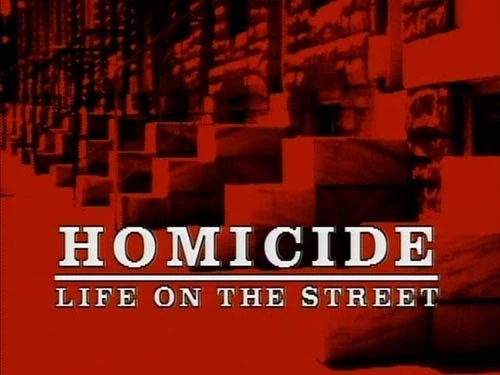
Welcome to Retro Television Reviews, a feature where we review some of our favorite and least favorite shows of the past! On Sundays, I will be reviewing Homicide: Life On The Street, which aired from 1993 to 1999, on NBC! It can be viewed on Peacock.
This week, Giardello sets a dangerous precedent.
Episode 3.18 “In Search of Crimes Past”
(Dir by Kenneth Fink, originally aired on April 14th, 1995)
A woman (Felicia Shakman) takes Colonel Barnfather hostage, pointing a gun at his head and demanding that Bolander reopen the investigation into a murder that occurred sixteen years ago. Bolander was the primary on the murder and the man that he arrested is scheduled to be executed in just a matter of hours. The woman with the gun is the man’s daughter. Russert wants to bring in the hostage negotiators but Giardello instead orders Bolander to take a look at the files and the evidence and to try to see if he arrested the wrong man.
I’m not really sure I buy Giardello’s response. Giardello claims he has no choice but actually, it seems to me that Giardello is setting a dangerous precedent. In Baltimore, if you think a relative has been wrongly convicted, you can apparently just take someone hostage and demand the case be reopened. I’m not sure those are the rules that anyone wants to set.
Now, of course, it turns out that Bolander did arrest the wrong guy. It perhaps would have been more interesting if Bolander had look at the files and said, “Yeah, I got the right guy,” but then this episode wouldn’t be able to make a statement against the death penalty. Bolander realizes that he made a mistake and also that the actual murderer is a man who committed suicide that very evening.
While that’s going on, Pembleton and Bayliss investigate the death of an elderly woman who appears to have slipped and drowned in her bathtub. Her husband (Barnard Hughes) seems to be heartbroken. Of course, the husband actually killed her. He has fallen in love with another woman and he killed his wife so that he could be with her. I preferred this storyline to the Bolander one, just because it featured a lot of Pembleton/Bayliss scenes and a good performance from Barnard Hughes.
Finally, Munch hired a new bartender. He didn’t bother to tell his partners beforehand but how could Lewis and Bayliss possibly complain about Munch hiring Jerry Stiller to tend bar? (Technically, Stiller was playing an Irishman named McGonical.) This was a minor but likeable storyline, mostly because of Jerry Stiller’s likably bizarre performance.
So, this was yet another good but not great episode. The Bolander storyline was a bit too melodramatic for its own good. It’s not the sort of thing that would have happened during the show’s first two seasons, back when the whole point was to be realistic. But that Bayliss/Pembleton storyline featured the show’s two most compelling characters doing what they did did best. This episode was not perfect but it held my attention nonetheless.
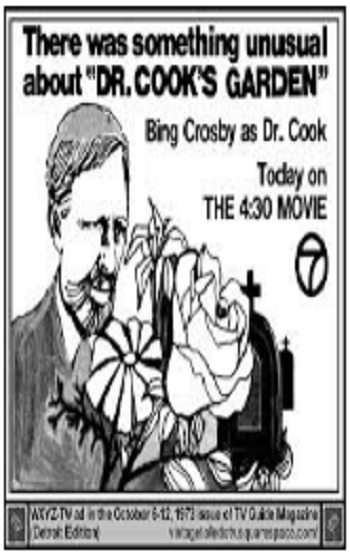
Welcome to Retro Television Reviews, a feature where we review some of our favorite and least favorite shows of the past! On Sundays, I will be reviewing the made-for-television movies that used to be a primetime mainstay. Today’s film is 1971’s Dr. Cook’s Garden! It can be viewed on YouTube!
Everyone loves Dr. Leonard Cook.
Played by Bing Crosby, Dr. Cook has been the doctor in the small town of Greenfield for as long as anyone can remember. He has delivered almost the entire town. He’s the friendly face that everyone sees whenever they have an ache or a pain. He’s the somber source of comfort whenever the time comes from someone to pass. Dr. Cook has lost some patients but he’s saved even more and no one doubts that Dr. Cook always does his best. As admired as Dr. Cook is as a doctor, he’s almost equally admired for the beautiful garden outside of his office. Cook maintains the garden by always pulling out any plants that he feels would not serve the best interest of the garden. That’s Dr. Cook. He’s always doing whatever needs to be done to make the world a nicer place.
Unfortunately, Dr. Cook is getting old and he’s slowed down a bit. He has a heart condition and he can no longer be as physically active as he once was. Dr. Cook’s former student, Jimmy Tennyson (Frank Converse), returns to Greenfield so that he can help out his former mentor. Dr. Tennyson is going to help ease Dr. Cook into retirement and then eventually take Cook’s place as the town doctor. Dr. Cook may say that he’s not planning on retiring anytime soon but it’s obvious that he has faith in Dr. Tennyson’s ability to eventually replace him.
Or, at least, Cook feels that way until Dr. Tennyson starts asking about some of Cook’s patients who have died over the years. Tennyson discovers that many of Cook’s patients died despite not being seriously ill and that Dr. Cook also has a surprisingly large supply of poisons. When it’s mentioned that no one in town has ever wondered why Dr. Cook has lost so many patients because only the “mean” patients tend to die, Dr. Tennyson realizes that Dr. Cook has been doing his bit to make sure the town of Greenfield stays a nice place. Dr. Cook calls it “community service.” Dr. Tennyson calls it murder but can he turn on his former mentor and the most beloved man in town? And when Tennyson starts to pressure Cook to stop practicing medicine and playing God, Dr. Cook starts to make his own plans to put his former student in his place.
An adaptation of a stage play by Ira Levin, Dr. Cook’s Garden is a suspenseful and short made-for-TV movie. Director Ted Post does a good job of opening up the action and preventing the film from becoming overly stagey. The main reason the film succeeds is due to the performance of Bing Crosby in the role of Dr. Cook. Crosby’s kindly and cheerful demeanor keeps the viewer off-balance but, once Dr. Cook decides to target his former student, the friendly surface evaporates and Dr. Cook is revealed to be just as ruthless and cruel as those who he targets. This is the type of film that will inspire you to wonder just what exactly your neighbors may be hiding in their gardens.
Wyoming sheep rancher Dan Logan (George C. Scott) and his teenage son, Chris (Nicolas Beauvy), spend a night camping out on their land. While Dan stays in the tent, Chris decides to sleep outside, underneath the stars. The next morning, Dan leaves the tent to discover that all of his sheep are dead and that Chris is having violent convulsions. Dan rushes his son to the local hospital, where he hopes that the family’s longtime physician, Dr. Caldwell (Richard Basehart), can save his son’s life.
However, at the hospital, Dan is separated from his son. Two doctors that he’s never met before — Dr. Spencer (Barnard Hughes) and Major Holliford (Martin Sheen) — take over his case. They tell him that Chris was probably just exposed to an insecticide and that both Dan and his son are going to have to stay at the hospital for a few days. Dan is confined to his room and not allowed to see his son.
What Dan doesn’t know is that both he and his son have been unwittingly exposed to a secret army nerve gas. Though the experiment was only meant to be performed on the animals that were grazing on Dan’s land, Dan and Chris were accidentally sprayed. When Dan discovers the truth about what’s been done to him and his son, he sets out to try to get revenge with what little time he has left.
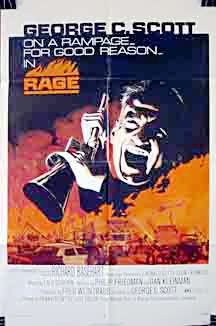
Fresh from refusing an Oscar for Patton, George C. Scott made his feature film directorial debut with Rage. (He had previously directed The Andersonville Trial for television.) As a director, Scott sometimes struggles. Rage is so relentlessly grim and serious that even the most experienced director would have had a difficult time making it compelling. The scenes in the hospital are effective claustrophobic but they’re also often dramatically inert. The only humor in the film comes from Scott’s overuse of slow motion. When even simple scenes, like throwing coffee on a campfire, are shown in slow motion, it goes from being ominous to unintentionally humorous.
As a director, Scott did make a very wise decision by casting himself in the lead role. No one was better at portraying pure, incandescent anger than George C. Scott and the film picks up once Dan discovers what’s been done to himself and his son. Once Dan sets off to get revenge, Rage becomes an entirely different film, one that is about both a father’s anger and the cold calculation of a government that views him as just as a subject to be tested upon. The final scene is especially effective and suggests that Scott could have become an interesting director if he had stuck with it.
Scott would direct one more film, The Savage Is Loose, before devoting the rest of his distinguished career to performing.
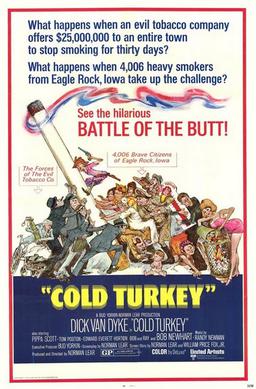
The 1971 satire, Cold Turkey, is the film that boldly explores just how much into the ground one joke can driven.
It’s a film that imagines what would happen if a big tobacco company decided to try to improve its image by giving people an incentive to quit smoking. In the real world, of course, they ended up funding Truth.org and coming up with anti-smoking commercials that were so lame that they would make viewers want to go out and buy a pack of cigarettes just to spite the self-righteous people lecturing them during the commercial breaks. In the film, however, Marwen Wren (Bob Newhart) comes up with the idea of offering to pay 25 million dollars to any community that can completely stop smoking for 30 days.
Wren figures that no large group of people will be able to just give up smoking for a month. Not in 1971! However, Wren didn’t count on the single-minded determination of the Rev. Clayton Hughes (Dick Van Dyke). Hughes is the stern and self-righteous minister of Eagle Rock Community Church in Eagle Rock, Iowa. He knows that Eagle Rock could really use that money so he sets off on a crusade to convince all 4,006 of the citizens of Eagle Rock to take the pledge to quit smoking.
As I said at the start of this review, Cold Turkey is pretty much a one-joke film. The joke is that everyone in the movie — from the tobacco company execs to the citizens of Eagle Rock to Rev. Hughes — is an asshole. They start the film as a bunch of assholes and, once they try to quit smoking, they become even bigger assholes. Soon, everyone in town is irritable and angry. The only people happy are the people who never smoked in the first place, largely because they’ve been set up as a sort of paramilitary border patrol. Even though his anti-smoking crusade lands him on the cover of Time, Rev. Hughes is also upset because he started smoking right before it was time to quit smoking. He deals with his withdraw pains through sex and frequent glowering.
Wren is concerned that the town of Eagle Rock might actually go for a full 30 days without smoking so he attempts to smuggle a bunch of cigarettes into the town and then runs around with a gigantic lighter that looks like a gun. It’s a storyline that doesn’t really go anywhere but then again, you could say that about almost all of the subplots in Cold Turkey. There’s a lot of characters and there’s a lot of frantic overacting but it doesn’t really add up too much. Storylines begin and are then quickly abandoned. Characters are introduced but then never do anything. For a while, It seems like the film is at least going to examine the Rev. Hughes’s totalitarian impulses but no. Those impulses are clearly there but they’re not really explored.
If I seem somewhat annoyed by this film, it’s because it really did have a lot of potential. This could have been a very sharp and timeless satire but instead, it gets bogged down in its own frantic storytelling and the film’s comedy becomes progressively more and more cartoonish. By the end of the movie, the President shows up in town and so does the military and it all tries to achieve some Dr. Strangelove-style lunacy but the film doesn’t seem to know what it really wants to say. It seems to be setting itself up for some sort of grandly cynical conclusion but instead, it just sort of ends. One gets the feeling that, at the last minute, the filmmakers decided that they couldn’t risk alienating their audience by taking the story to its natural conclusion.
Admittedly, while watching the film, I did find myself comparing Hughes and his bullying mob to the same people who are currently snapping at anyone who suggests that maybe the Coronavirus lockdowns were a bit excessive. It’s easy to think of some modern politicians and media figures who probably would have had a great time in Eagle Rock, ordering people around and shaming anyone who wants a cigarette. But otherwise, Cold Turkey was just too cartoonish and one-note to really work.
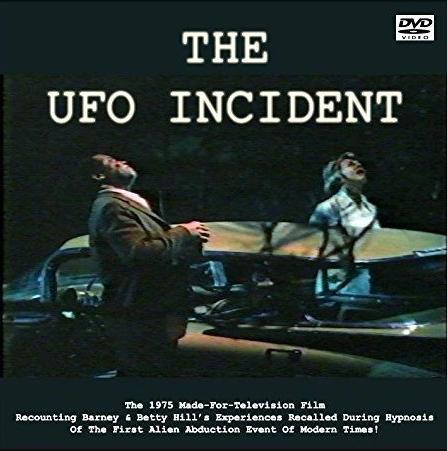
Betty and Barney Hill (played by Estelle Parsons and James Earl Jones) are a happily married couple living in New Hampshire in the mid-60s. They are both haunted by something that happened two years previously, while they were on vacation. They both remember something appearing in the sky over their car but they can’t remember anything that happened afterwards. They are both haunted by nightmares and a strong feeling that something terrible most have happened to them. Finally, they meet with Dr. Benjamin Simon (Barnard Hughes), who places them both under hypnosis. Only then does a clear picture start to emerge of what Betty and Barney believe happened as they both describe being abducted and experimented upon by aliens.
The UFO Incident is a very sober and serious account of the Hills’s abduction. It never takes a clear side as to whether Betty and Barney are remembering something that actually happened or if they’re just remembering elaborate dreams. That works to the film’s advantage, though it might disappoint those looking for a more dramatic take on the subject. This is a made-for-TV movie so don’t expect much from the special effects and the alien costumes look disappointingly cheap. The important thing, though, is that the film treat the Hills and their story with respect and James Earl Jones gives one of his best and most relatable performances as Barney. The film is as much about how even a good marriage can be threatened by stressful times as it is about the UFOs.
The UFO Incident is based on the non-fiction book, The Interrupted Journey by John G. Fuller, which purported to tell the story of the Hills and their abduction. The Hills were two of the first people to come forward with a story about being abducted by aliens. Much of the common elements that can be found in stories about alien abductions, like the little grey men, the medical experimentation, and the amnesia afterwards, began with the Hills’s account of what they believed happened to them in 1961. The Hills, who were active and highly respected in their community, were considered to be unusually credible witnesses, though Dr. Simon ultimately decided that Barney’s recollections of being on the UFO were probably influenced by Betty’s descriptions of her nightmares. Barney, himself, died in 1969, three years after the book was published. Betty remained active in the UFO community until her death in 2004.
Tonight, I watched the 1969 winner of the Oscar for Best Picture, Midnight Cowboy.
Midnight Cowboy is a movie about Joe Buck. Joe Buck is played by an impossibly young and handsome Jon Voight. Joe Buck — and, to be honest, just calling him Joe seems wrong, he is definitely a Joe Buck — is a well-meaning but somewhat dumb young man. He lives in Midland, Texas. He was raised by his grandmother. He used to go out with Annie (Jennifer Salt) but she eventually ended up being sent to a mental asylum after being raped by all of Joe Buck’s friend. Joe Buck doesn’t have many prospects. He washes dishes for a living and styles himself as being a cowboy. Being a Texan, I’ve known plenty of Joe Bucks.
Joe Buck, however, has a plan. He knows that he’s handsome. He’s convinced that all women love cowboys. So, why shouldn’t he hop on a bus, travel to New York City, and make a living having sex with rich women?
Of course, once he arrives in the city, Joe Buck discovers that New York City is not quite as inviting as he thought it would be. He lives in a tiny and dirty apartment. He can barely afford to eat. Walking around the city dressed like a cowboy (and remember, this was long before the Naked Cowboy became one of the most annoying celebrities of all time) and randomly asking every rich woman that he sees whether or not she can tell him where he can find the Statue of Liberty, Joe Buck is a joke. Even when he does get a customer (played, quite well, by Sylvia Miles), she claims not to have any money and Joe Buck feels so sorry for her that he ends up giving her his money.
As I watched the first part of the movie, it stuck me that the main theme of Midnight Cowboy appeared to be that, in 1969, New York City was literally Hell on Earth. But then Joe Buck has flashbacks to his childhood and his relationship with Annie and it quickly became apparent that Midland, Texas was Hell on Earth as well. Towards the end of the film, it’s suggested that Miami might be paradise but not enough to keep someone from dying on a bus.
Seriously, this is a dark movie.
Joe Buck eventually meets Ratso Rizzo (Dustin Hoffman). Ratso’s real name is Enrico but, after taking one look at him, you can’t help but feel that he’s a perfect Ratso. Ratso is a con man. Ratso is a petty thief. Ratso knows how to survive on the streets but New York City is still killing him. As a child, Ratso had polio and now he walks with a permanent limp. He coughs constantly, perhaps because he has TB. Ratso becomes Joe Buck’s manager and roommate (and, depending on how you to interpret certain scenes and lines, perhaps more) but only after attempting to steal all of his money.
Unfortunately, Ratso is not much of a manager. Then again, Joe Buck is not much of a hustler. Most of his customers are men (including a student played by a young but recongizable Bob Balaban), but Joe Buck’s own sexual preference remaining ambiguous. Joe Buck is so quick to loudly say that he’s not, as Ratso calls him, a “fag” and that cowboys can’t be gay because John Wayne was a cowboy, that you can’t help but suspect that he’s in denial. When he’s picked up by a socialite played by Brenda Vaccaro, Joe Buck is impotent until she teases him about being gay. In the end, though, Joe Buck seems to view sex as mostly being a way to make money. As for Ratso, he appears to almost be asexual. His only concern, from day to day, is survival.
Did I mention this is a dark movie?
And yet, as dark as it is, there are moments of humor. Joe Buck is incredibly dense, especially in the first part of the movie. (During the second half of the film, Joe Buck is no longer as naive and no longer as funny. It’s possible that he even kills a man, though the film is, I think, deliberately unclear on this point.) Ratso has a way with words and it’s impossible not to smile when he shouts out his famous “I’m walking here!” at a taxi. And, as desperate as Joe Buck and Ratso eventually become, you’re happy that they’ve found each other. They may be doomed but at least they’re doomed together.
There’s a lengthy party scene, one that features several members of Andy Warhol’s entourage. I was a bit disappointed that my favorite 60s icon, Edie Sedgwick, was nowhere to be seen. (But be sure to check out Ciao Manhattan, if you want to see what Edie was doing while Joe Buck and Ratso Rizzo were trying not to starve.) But, as I watched the party scene, I was reminded that Midnight Cowboy is definitely a film of the 60s. That’s both a good and a bad thing. On the positive side, the late 60s and 70s were a time when filmmakers were willing to take risks. Midnight Cowboy could only have been made in 1969. At the same time, there’s a few moments when director John Schlesinger, in the style of many 60s filmmakers, was obviously trying a bit too hard to be profound. Some of the flashbacks and fantasy sequences veer towards the pretentious.
Fortunately, the performances of Voight and Hoffman have aged better than Schlesinger’s direction. Hoffman has the more flamboyant role (and totally throws himself into it) but it really is Voight who carries the film. Considering that he’s playing a borderline ludicrous character, the poignancy of Voight’s performance is nothing short of miraculous.
Midnight Cowboy was the first and only X-rated film to win best picture. By today’s standards, it’s a PG-13.


 Through the Shattered Lens