4 Shots From 4 Films is just what it says it is, 4 shots from 4 of our favorite films. As opposed to the reviews and recaps that we usually post, 4 Shots From 4 Films is all about letting the visuals do the talking.
Happy birthday to the wonderful and iconic actress, Barbara Steele!
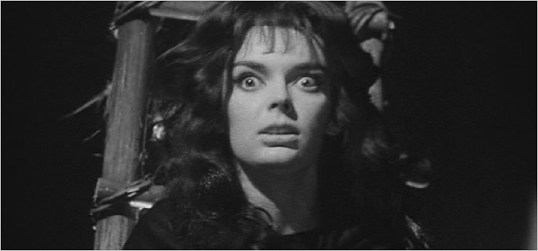
The British-born actress, Barbara Steele, became a star in Italy in the 60s, working with directors from Riccardo Freda to Mario Bava to Federico Fellini. One of Steele’s defining roles was in Bava’s 1960 film, Black Sunday.
In this scene, Steele’s witch is sentenced to be executed and, since this is a Bava film, it won’t be a quick execution. What makes this scene stand-out is Steele’s defiance. It’s hard not to admire her refusal to give those judging her what they want. You watch this scene and you have no doubt that if you get cursed by Barbara Steele, it’s going to be a curse for life.
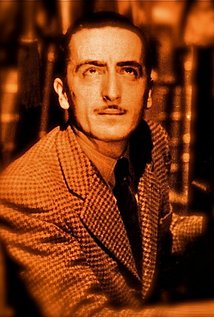
After starting his career as a cinematographer and a visual effects engineer, Mario Bava made his directorial debut with 1960’s Black Sunday, starring Barbara Steele!
2. Black Sabbath (1963)
In 1963, Bava directed one of his most popular films, the horror anthology Black Sabbath. The trailer put the spotlight on the great Boris Karloff.
3. Planet of the Vampires (1965)
One of Bava’s best films, Planet of the Vampires, was later cited by many as an influence on the Alien films.
4. Bay of Blood (1971)
One of the first slasher films, Bay of Blood was also a social satire that featured Bava’s dark sense of humor.
5. The House of Exorcism (1974)
When it was released in the United States, Bava’s Lisa and the Devil was re-titled House of Exorcism and, after new scenes were filmed, sold as a rip-off to The Exorcist.
6. Shock (1977)
Bava’s final film as a director was Shock, which starred Daria Nicolodi as a woman who is being haunted by the ghost of her first husband.
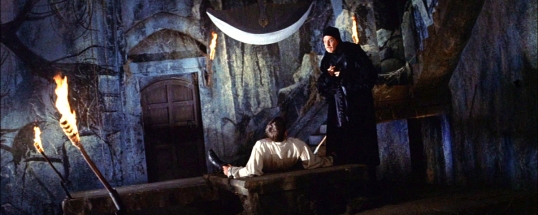
The second of Roger Corman’s Edgar Allan Poe adaptations, 1961’s The Pit and The Pendulum opens in much the same way as The Fall of the House of Usher. A young Englishman (played by John Kerr) rides a horse across a colorful but desolate landscape. A castle sits in the distance.
Of course, as opposed to the 19th Century British setting of The Fall of the House of Usher, The Pit and the Pendulum takes place in 16th Century Spain, at a time when the country was still scarred by the horrors of the Inquisition. And Francis Barnard is not traveling to the castle to see his fiancée but instead, he’s searching for information about the disappearance of his sister, Elizabeth (played by the one and only, Barbara Steele). At the castle, Francis meets Elizabeth’s husband, Nicholas (Vincent Price) and Nicholas’s sister, Catherine (Luana Anders). Nicholas explains that Elizabeth died under mysterious circumstances, while suffering from a rare blood disorder that seemed to quickly sap away her will to live. Nicholas’s best friend, Dr. Leon (Anthony Carbone), explains that Elizabeth died of fright after she locked herself in one of the iron maidens in the castle’s torture chamber….
Oh yes, the castle has a torture chamber. Nicholas’s father was a leader of the Inquisition and he used the castle as a place to conduct his business. Nicholas’s father was a madman who suspected that his wife was cheating on him. One day, while young Nicholas was exploring the torture chamber, he witnessed his father murder both his wife and his brother. Nicholas watched as his mother was entombed alive and ever since, he’s been terrified of the idea of premature burial. In fact, his fear that he may have buried alive Elizabeth while she was still alive is driving him mad. The sudden arrival of the suspicious Francis doesn’t help matters….
The Pit and the Pendulum opens with splashes of color spreading across the screen, a sign that Corman was once again in a pop art state of mind when he directed this film. The Pit and The Pendulum takes everything that worked (and didn’t work) about The Fall of the House of Usher and it turns it all up by a notch or two. The castle is even more gothic. Vincent Price’s Nicholas is even more mentally fragile than his Roderick Usher, though Nicholas is also a quite a bit more sympathetic. If Roderick was a control freak who used his family’s curse as an excuse to embrace his own authoritarian tendencies, Nicholas is just a frail man suffering from PTSD. He’s definitely more of a victim than a victimizer … or, at least, he is at first. Much like Mark Damon is The Fall of the House of the Usher, John Kerr is a bit of a stiff in the role of Francis but it doesn’t matter. Vincent Price is the main attraction here and Corman’s direction shows that he understood that.
And then there’s the Pendulum. It takes a while for the Pendulum and its swinging blade to make an appearance but when it does, it lives up to the hype. The Pendulum swings and Corman goes all out, zooming into Price’s crazed eyes while the Pendulum comes closer and closer to its latest victim. The images are tinted red and green and the Pendulum itself seems to swing in a slow motion, the cinematic equivalent of a nightmare come to life.
The Pit and the Pendulum is a wonderful work of gothic pop art. Featuring Vincent Price at his most wonderfully unhinged, this is a film we should all watch this Halloween.
Pit and the Pendulum (1961, dir by Roger Corman, DP: Floyd Crosby)
The British-born actress, Barbara Steele, became a star in Italy in the 60s, working with directors from Riccardo Freda to Mario Bava to Federico Fellini. One of Steele’s defining roles was in Bava’s 1960 film, Black Sunday.
In this scene, Steele’s witch is sentenced to be executed and, since this is a Bava film, it won’t be a quick execution. What makes this scene stand-out is Steele’s defiance. It’s hard not to admire her refusal to give those judging her what they want. You watch this scene and you have no doubt that if you get cursed by Barbara Steele, it’s going to be a curse for life.
For today’s edition of Lisa Marie’s Favorite Grindhouse And Exploitation Film Trailers, we share some trailers from the maestro of Italian horror, Mario Bava!
Black Sunday (1960)
After starting his career as a cinematographer and a visual effects engineer, Mario Bava made his directorial debut with 1960’s Black Sunday, starring Barbara Steele!
2. Black Sabbath (1963)
In 1963, Bava directed one of his most popular films, the horror anthology Black Sabbath. The trailer put the spotlight on the great Boris Karloff.
3. Planet of the Vampires (1965)
One of Bava’s best films, Planet of the Vampires, was later cited by many as an influence on the Alien films.
4. Bay of Blood (1971)
One of the first slasher films, Bay of Blood was also a social satire that featured Bava’s dark sense of humor.
5. The House of Exorcism (1974)
When it was released in the United States, Bava’s Lisa and the Devil was re-titled House of Exorcism and, after new scenes were filmed, sold as a rip-off to The Exorcist.
6. Shock (1977)
Bava’s final film as a director was Shock, which starred Daria Nicolodi as a woman who is being haunted by the ghost of her first husband.
At the height of the Vietnam War, the U.S. Government came up with a plan that could have changed the course of the war.
What if the government developed gigantic, super-fast, occasionally jumpy piranha? And what if they set those killer fish loose in the rivers of Vietnam? Would those fish swim through North Vietnam and take out the VC? Sadly, the war ended before the government got a chance to test out Operation Razorteeth. With the war over, the government was stuck with a bunch of killer fish. Scientist Robert Hoak (Kevin McCarthy) ignored all orders to destroy his mutant fish because they were his life’s work. (Awwwwwwwww!) He kept an eye on them and did everything he could to prevent them from getting into the nearby river.
Unfortunately, Dr. Hoak’s best wasn’t good enough. Because the piranha have gotten loose and now they’re making their way down to the river! They start out eating skinny dipping teenagers, fisherman, and Keenan Wynn. (They’re good enough not to eat Wynn’s adorable dog, which I appreciated.) Further down the river, there’s a summer camp and a water park! It’s definitely not safe to get back in the water but sadly, that’s what several people insist on doing throughout this film. Even when the water is full of blood, people will jump in. (It’s easy to be judgmental but it is a pretty river. I don’t swim but I honestly wouldn’t mind living near a river that looked that nice. Instead, I have to make due with a creek.)
Floating down the river on a raft and trying to warn everyone is the unlikely team of Maggie (Heather Menzies) and Paul (Bradford Dillman). Maggie is a detective who has come to town to track down the two teenage skinny dippers who were eaten at the start of the film. Paul is a drunk. Well, technically, Paul is a wilderness guide and he does spend the entire movie wearing the type of plaid shirt that would only be worn by someone who goes camping every weekend but really, Paul’s main personality trait seems to be that he enjoys his booze. Paul’s daughter is away at the summer camp. Yes, that’s the same summer camp that’s about to be visited by a school of piranha. AGCK!
Produced by Roger Corman and obviously designed to capitalize on the monster success of Jaws, Piranha was an early directorial credit for Joe Dante. Dante would later go on to direct films like The Howling and Gremlins. Piranha was also an early screenwriting credit for the novelist John Sayles, who would use his paycheck to launch his own directing career. As a director, Sayles specializes in politically-themed ensemble pieces, which is something you might not guess while watching Piranha. (Piranha does have an anti-military subplot but then again, it’s a film from the 70s so of course it does.) Like the best of Corman’s film, Piranha works because it sticks to the basics and it delivers exactly what it promises. Piranha promises killer fish biting away at anyone dumb enough to get in the water and that’s what it gives us. As an added bonus, we also get some occasionally witty dialogue and Joe Dante’s energetic, self-aware direction.
As is typical with the films of both Corman and Dante, the cast is full of familiar faces. Along with Kevin McCarthy as the mad scientist and Keenan Wynn as the eccentric fisherman, Dick Miller shows up as the waterpark owner. Richard Deacon, who made a career of playing bosses and neighbors on various sitcoms in the 50s and 60s, plays the father of a missing teenager. Director Paul Bartel plays the head of the summer camp, who may be a jerk but who still heroically jumps in the water to save several campers. (Bartel’s moment of heroism is one of Piranha’s best scenes and, significantly, it’s played without irony. You’ll want to cheer for the guy.) Finally, the great Barbara Steele plays the government scientist who shows up to clean up Operation Razorteeth.
Piranha is simple but entertaining. Dante’s direction is energetic and, despite the film’s self-referential tone, the killer fish are just savage enough to be scary. It’s a film that tell us not to get back in the water but which understands that the temptation might just be too strong.
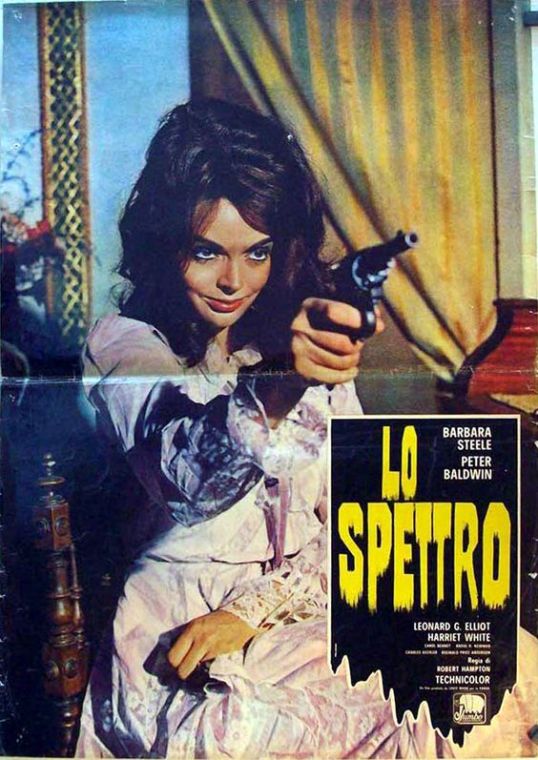
The 1963 Italian film The Ghost takes place in 1910 at an isolated Scottish estate. It’s the type of estate where the mornings are always foggy, the nights are always full of lightning, and shadows always seem to be creeping around every corner. The film opens with a darkened seance, one in which the estate’s housekeeper, Catherine (Harriet Medin), serves as a medium. It’s an appropriate opening because, as we soon discover, everyone at this estate is obsessed with death.
The estate’s owner, the appropriately-named Dr. Hichcock (Elio Jotta), is sickly and obviously doesn’t have much time left. He speaks constantly of the end while his wife, Margaret (Barbara Steele) and his doctor, Charles Livingstone (Peter Baldwin), continually try to keep him for committing suicide.
Of course, just because Margaret and Charles seem to be committed to keeping Dr. Hichcock from killing himself that doesn’t mean that they aren’t willing to do the job themselves. Margaret and Charles are lovers and are eagerly looking forward to getting their hands on Hichock’s fortune once he actually does die. When Margaret suggests that maybe Charles could help the process out while still making Hichcock’s death look natural, Charles is, at first, a bit hesitant. But, he finally goes through with it.
So, now, Dr. Hichcock’s dead! They have a moodily-photographed funeral and everything! However, Margaret and Charles are shocked when the doctor’s assets are revealed to amount to very little money. Figuring out that he must have hidden his fortune somewhere in the estate, Margaret and Charles start to search but find themselves wondering how much they can trust each other.
Making things even more complicated is that it appears that Dr. Hichcock might not be done with either one of them. Soon, both Margaret and Charles are hearing the dead doctor’s voice echoing throughout the house and other strange things start to happen. Even the housekeeper gets possessed and starts telling Margaret not to trust Charles. Is Dr. Hichcock haunting them from the grave or is Margaret being driven mad by her own greed and guilt? Or is there another solution?
The Ghost is a moody and enjoyable gothic mystery story, one that is dripping with atmosphere and which features a typically fierce and compelling performance from the greatest femme fatale of Euroshock cinema, Barbara Steele. Take the murder at the center of the plot and then add in the creepy housekeeper and you have a film that feels almost like a cross between Rebecca and Double Indemnity. It’s not a perfect film, of course. Especially when compared to other Italian horror-thrillers of the era, the pace is a bit slow and you’ll probably figure out the story’s big twist before anyone in the film does. But no matter. Once you get used to it, the slow pace actually adds to the film’s creepy atmosphere and, if the plot is familiar, it’s familiar in the way that the best fairy tales and other cautionary legends are familiar. It’s an enjoyably creepy film and a perfect example of why Barbara Steele remains one of the most revered icons of Italian horror.
This 1964 Italian horror film takes place in a feudal village in the 15th century. It’s a time of fear, corruption, and ignorance, which is a dangerous combination. The village is ruled over by the corrupt Count Humboldt (Giulliano Raffaelli). With his villagers panicking about every day problems like poor crops, banditry, and disease, the Count understand that the best thing to do is just blame it all on a witch. Of course, it doesn’t do much good to blame a witch unless you also burn her and that’s exactly what the count decides to do Adele Karnstein. When Adele’s daughter, Helen (Barbara Steele), goes to the castle to make an appeal for her mother’s life, the Count responds by raping her and then tossing her over the edge of a cliff.
Adele’s other daughter, Lisabeth (Halina Zalewska), is adopted by the Count and grows up in his castle. Eventually she is married off to the count’s evil and greedy nephew, Kurt (George Ardisson). Knowing fully well what Kurt’s family did to her mother and her sister, Lisabeth is not all happy about the arrangement but what can she do? She has absolutely no one to help her.
And then, one night, lightning strikes Helen’s grave. Not only does the grave fly open but Helen is now suddenly walking around the village and heading for the castle. Except, of course, she is now calling herself Mary. When Mary arrives at the castle, Kurt is immediately taken with her, so much so that he starts to plot the murder of Lisabeth. However, is it possible that this is all a part of Mary’s plan?
Meanwhile, the black plague has once again struck the village and again, the villagers are starting to demand a sacrifice….
Obviously, the main reason to see The Long Hair of Death is for Barbara Steele’s performance in the dual roles of Helen and Mary. In the early 60, Steele appeared in several Italian gothics and she almost inevitably always seemed to play a character who, after being unjustly killed by a member of the upper class, returned from the dead to get revenge. (This was a template that was set down by her best-known Italian film, Mario Bava’s Black Sunday.) While I’ve read that it’s a role that Steele got tired of playing, that doesn’t change the fact that she was very good at it. Steele’s characters always returned to punish the men who had previously used and abused her, which is one reason why her performances remain popular to this day.
That’s certainly the case with The Long Hair of Death, in which the entire film is basically leading up to Kurt being punished for both his sins and the sins of his uncle. George Ardisson gives a wonderful performance as Kurt, effortlessly going from arrogant and lecherous to terrified and helpless without missing a beat. Director Antonio Margheriti plays up the story’s gothic atmosphere, giving the film an occasionally dream-like feel. He emphasizes not just the villainy of the Humboldts but also the superstition of the villagers, making clear that evil cannot prosper without ignorance.
The Long Hair of Death is hardly perfect. The middle part of the film drags and the low-budget is occasionally a hindrance. (The village often looks like it’s made out of cardboard.) But the film comes alive whenever Barbara Steele is on-screen and the ending is a brilliantly macabre. Lovers of Italian gothic horror will find much to appreciate about The Long Hair of Death.
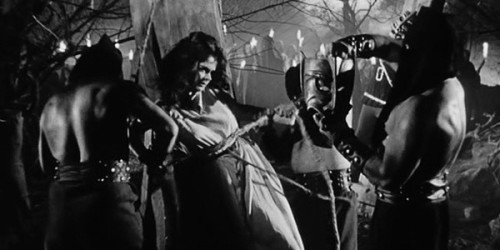
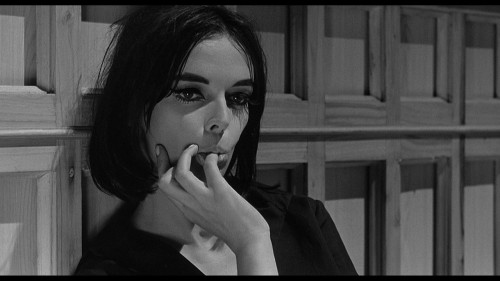
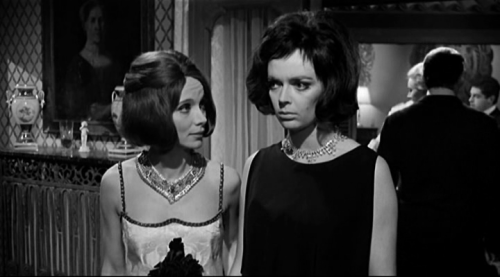
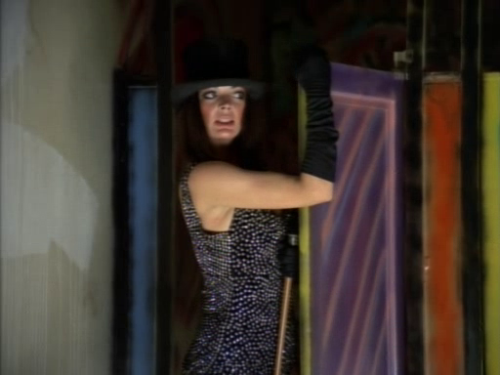
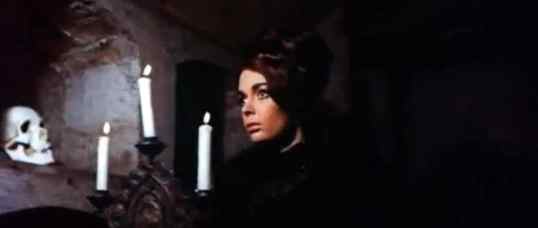
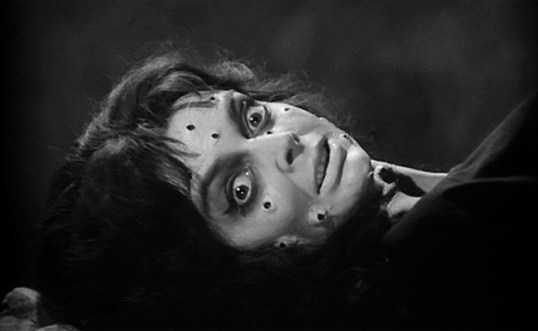
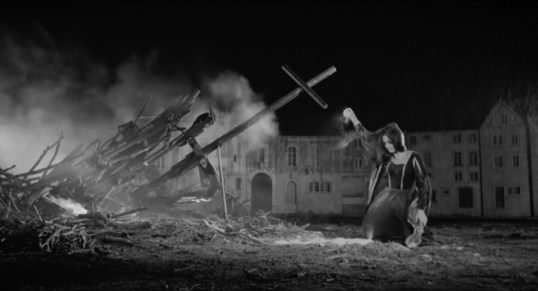
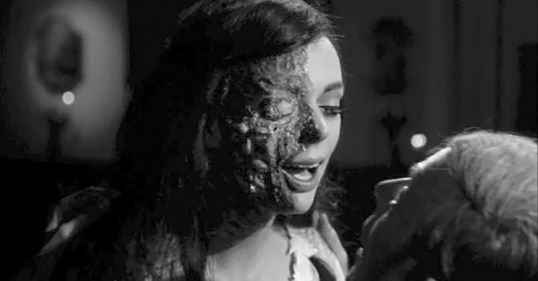
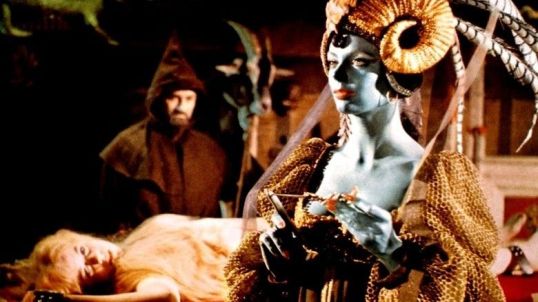
4 Shots From 4 Films is just what it says it is, 4 shots from 4 of our favorite films. As opposed to the reviews and recaps that we usually post, 4 Shots From 4 Films lets the visuals do the talking. British-born Barbara Steele, who shot to fame in a series of Italian lensed horror films during the 1960’s, celebrates her 80th birthday today. She’s the last of the iconic classic horror film stars, and in her honor here’s 4 shots from the career of Scream Queen Barbara Steele:
Black Sunday (1960, directed by Mario Bava)
The Long Hair of Death (1964, directed by Antonio Margheriti)
Nightmare Castle (1965, directed by Mario Caiano)
The Crimson Cult (1968, directed by Vernon Sewell)


 Through the Shattered Lens