Film Review: Cyrus (dir. by Mark and Jay Duplass)


Last Tuesday night, as we watched the end credits of Cyrus rolling across the screen at the Plano Angelika, a very dear and close friend of mine leaned over and whispered in my ear, “That was a really odd fucking movie.” 

(Actually, it was two weeks ago.  Sorry, I started this review a while ago and only recently returned to finish it.)

And he’s right.  Though the film is worth seeing (though I’d honestly suggest waiting until it comes out on DVD unless you’re just the world’s biggest John C. Reilly or Jonah Hill fan), Cyrus really is an odd fucking movie.

Cyrus is the latest film from Jay and Mark Duplass, the two brothers responsible for 2008’s Baghead, one of the unacknowledged great films of the last decade.  In Cyrus , John C. Reilly plays a character named — appropriately enough — John.  John is a likable loser, a less musical version of the character Reilly played in Chicago.  When the movie opens, John is depressed over the fact that his ex-wife, Jamie (Catherine Keener), is getting married again.  At Jamie’s suggestion, he goes to a party where he proceeds to have too much to drink, flirts awkwardly with every woman he sees, and somehow manages to charm Molly (Marisa Tomei).  Molly is soon sleeping over at John’s house but every morning, John wakes up to discover that she’s either already left or is in the process of sneaking out.  John asks her if she’s married.  Molly replies that she’s not but is still vague about why she never stays the entire night.  Finally, one morning, John follows Molly after she leaves.  He sits out in front of her house and, after she’s left for work, John proceeds to creep around outside the house. 

And, of course, its while he’s doing all of this creepy stalker stuff that he first meets Cyrus (played, of course, by Jonah Hill).  Cyrus is Molly’s 22 year-old son and from the minute he first appears, its obvious that there’s something off about him.  He’s far too friendly and speaks in the oddly stilted cadence of someone who is obviously making an effort to act “normal.”  He  spends all of his time composing New Agey synthesizer music in an elaborate home recording studio.   Of course, the main sign that there’s something odd about Cyrus is that he’s played by Jonah Hill.

However, the main thing that distinguishes Cyrus is just how close he is to his mother.  From the first moment that we see him and Molly interact (he’s playing his music and Molly enters the house and immediately starts dancing to it), its obvious that Cyrus is Oedipus, Norman Bates, and Yanni all wrapped up into one package.  And, obviously, he views John as being competition…

Cyrus is an uneven film, one that starts out strong but — once the title character is actually introduced — suddenly seems to get hit by an identity crisis.  Is it a realistic portrait of sad, lonely people trying to find love in uncertain times or is it an Apatowish mix of stoner sentiment and over-the-top comedy?  Is Cyrus meant to be the emotionally wounded, painfully insecure outsider that he appears to be the movie’s more contemplative moments or is he just a sociopathic comedic device that Reilly has to overcome in order to pursue his relationship with Tomei?  That’s the question that is at the heart of Cyrus and discovering the answer is the film’s entire excuse for existing.  Unfortunately, the Duplass Brothers don’t seem to know the answer themselves and as a result, the entire film feels directionless and we’re left with too many unanswered questions.

For instance, where is Cyrus’s father?  It’s mentioned by both Cyrus and Molly that the father is no longer in their lives but why?  Though its never explicitly stated, its obvious that both Cyrus and Molly have suffered abuse in the past, probably at his hands.  However, the issue itself is never directly confronted and its hard to believe that John wouldn’t have asked about it at some point.  For that matter, beyond her role as Cyrus’s mother and John’s girlfriend, Molly isn’t given any back story whatsoever.  Considering the fact that the entire movie is about how Cyrus and John feel towards her, it’s interesting that she’s never given a scene where she really gets to explain how she truly feels towards either of them.  A good deal of the film’s attitude towards Molly can be seen in the fact that, while a major plot point hinges on her being at her job as opposed to at home, we never find out just what exactly it is that she does for a living.

That’s unfortunate because, in many ways, Cyrus shows a good deal of promise and psychological insight.  One of the subtle pleasures of the film is seeing how all of the various relationships (John and Molly, John and Cyrus, Molly and John, John and his ex-wife, Cyrus and Molly) actually run parallel with each other.  When Molly first flirts with John, John replies, “Are you hitting on me?  I’m Shrek.”  And it seems like he’s got a point until you see Cyrus and Molly together.  It’s at that point that you realize that John probably once looked just like Cyrus and that Cyrus is eventually going to grow up to be John.  It’s hard not to wonder if Cyrus’s father looked like John or if Molly is attracted to John because he reminds her of her son.  On the other hand, much as Cyrus is totally dependent on Molly, John is similarly dependent on his ex-wife (who, as played by Catherine Keener, looks strikingly similar to Marisa Tomei).  In a nice touch, his ex-wife’s new husband seems to have the same opinion of John that John has of Cyrus.

The Duplass Brothers also get a quartet of excellent performances from the film’s leads.  This is all the more exceptional considering that three of them are playing characters that are either underwritten (Tomei and Keener) or else totally inconsistent (Hill).  The film really belongs to John C. Reilly who is such a sympathetic, likable presence as John that he convinces the audience to forgive a lot of the film’s unevenness.  His best moments are to be found in the film’s opening party scene where he essentially acts like a total drunk jackass yet you still feel oddly sorry for him.  He’s just such a nice guy.

As previously stated, Cyrus is an odd film, an uneasy mix of independent and mainstream sensibilities.  Watching it, I found myself wondering if the Duplass Brothers were really sure what type of movie they wanted to make, if they wanted to emulate the cold, detached dry wit of the Coen Brothers or if they were indulging in a little Judd Apatow-style schmaltz.  Both styles attempt to co-exist in Cyrus and the end result is a movie that seems to be struggling to establish its own identity.  Still, Cyrus is worth seeing if just for the performances.  As flawed as the film is, it confirms what Baghead indicated, that the Duplass Brothers as intriguing filmmakers to watch out for in the future.

Review: The Black Waters Of Echo’s Pond (dir. by Gabriel Bolongna)


I’m going to start this review with a disclaimer.  Yesterday, I nearly died trying to see this movie.  As I was driving to the theater, I nearly collided with another car.  One of us (okay, it me) wasn’t paying attention and ran a stop sign.  We handled the near accident with the usual mix of car horns and profanity and, my heart still racing, I drove on to the theater and saw The Black Waters of Echo’s Pond.

As a result of my near death experience, I sat through this movie with one thought in my head: was seeing it worth losing my life?  While there are some movies (Suspiria, Beyond the Darkness, Zombi 2, and the Living Dead Girl, for example) that I would happily sacrifice a few years in order to see on the big screen, Black Waters is not one of them.

The film actually starts out well with a 9-minute prologue.  An archeological expedition in Turkey discovers an ancient tomb.  Inside the tomb, they find a map that is somehow linked to the Greek God Pan.  For nine minutes, we’re treated to clunky exposition (“Why, it’s what we’ve been here looking for!”  “Professor, do you mean that it’s the ancient map of Pan’s Arcadia?”  “Yes, the same Pan who was the Greek God of fertility and…”) and it seems like this movie might actually turn out to be a fun, cheerfully stupid take on the old Mummy movies that Hammer Studios released in the late 60s.

No such luck.  All the members of the expedition are promptly killed off-screen.  We jump forward to the “present day” and the entire movie quickly goes downhill.

In the present day, nine college friends get together to spend a weekend in an isolated mansion on an even more isolated island.  Why they would want to do this is never really addressed nor do you ever believe that any of the characters have a shared history or would actually be friends if not for the fact that the film demands it.  While there are some talented actors in the cast, they have absolutely no chemistry when they’re on screen together.  Since the rest of the film is pretty much dependent upon us believing that these people are all old friends, this lack of chemistry pretty much dooms the entire movie. 

(Add to that, the men in this group all appear to be having the worst bad hair day in recorded history.)

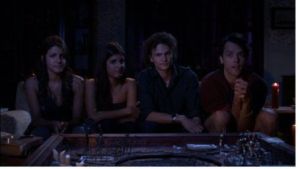
Once they’re in the mansion, the power promptly dies.  While attempting to find a fuse box, one of the friends instead discovers a board game.  Our group proceeds to play the game and soon, they’re seeing visions of murder, illicit sexual activity, and a big-horned demon.  However, none of them find this to be all that curious because they are 1) stoned and 2) incredibly stupid.

As I watched them play this cursed Jumanji death game, I found myself wondering if nobody in this film had ever seen a horror movie before.  Surely, if they had, they would realize that getting together in an isolated location, joking about sex, smoking weed, and then playing with the mysterious game that was previously walled up in the cellar is a good way to guarantee that you’re not going to be alive in the morning. 

To a certain extent, you have to be willing accept a lot of stupidity on the part of the characters in a horror film.  After all, we all know that our poor victims are always going to end up running up a flight of stairs in order to escape the killer (as opposed to going out the front door) and we forgive them for that because we know that if their actions were logical, then there would not be a movie.  However, the victims of the Black Waters of Echo’s Pond simply require us to forgive too much. 

Anyway, the game quickly starts to get weird as everyone draws cards that require them to answer increasingly personal questions.  Old resentments boil up to the surface.  One guy admits to wanting to have sex with both his girlfriend and her sister while the token responsible girl finds herself compelled to flirt with the token slut.  All of this goes on until finally, one member of the group snaps and, while everyone else is busy getting it on, proceeds to cut his best friend in half with a chainsaw.  (And no, nobody in the house hears the screams or the chainsaw because, as I mentioned earlier, they’re all incredibly stupid.)

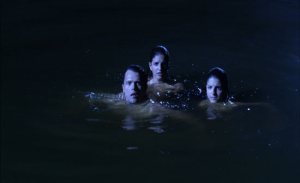
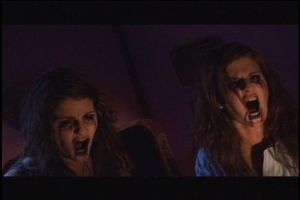
Once that first murder is committed, everyone is soon trying to kill everyone else.  In this regard the film is remarkably similar to Mario Bava’s classic Bay of Blood (a.k.a. Twitch of the Death Nerve).  However, the constant carnage in the Bava film worked because Bava made it clear that his many murderers were all working independently from each other with just their own greed to motivate them.  Whereas in Black Waters, it is made clear from the start that everyone has been possessed by Pan.  In short, the murders have nothing to do with the people being killed or those who do the killing.  And while the murders are nicely brutal and bloody (I hate bloodless horror films), they don’t have any meaning beyond the mechanics of the film.

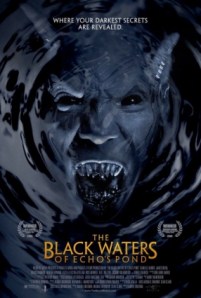
Pan (or at least I assume that its meant to Pan because it looks more like a Minotaur than anything else) shows up fairly early in the movie and he is an impressive creature with a goat’s head that features glowing eyes and long, dirty talons at the end of his fingers.  Still, I think it was a mistake on the part of the filmmaker’s to reveal him as early (and as often) as the film does.  Once Pan shows up, the movie loses all of its mystery.  We now know, for sure, that all the ensuing mayhem is the result of Pan’s supernatural malevolence.  By revealing Pan as early as it does, the film sacrifices whatever chance it may have had to be truly scary.  Instead Pan, just becomes another faceless killer and the movie, which has been advertised as a “psychological thriller,” loses its edge.

Outside of Pan, the cast is largely forgettable and they’re certainly not helped by how unlikable the majority of the characters are.  A few members of the cast do occasionally manage to offer up a few good (or, at least, memorable) moments but their efforts are sabotaged by some of the most leaden dialogue I’ve ever heard.  (It’s not a good sign that the film feels like it was dubbed into English even though it’s not.) 

The Babysitter twins from the Planet Terror segment of Grindhouse show up for instance and, even though their characters are wildly inconsistent, they both bring a lot of energy to their roles.  Incidentally, one of them gets the worst the line of the dialogue in the entire film when she says, “Shakespeare is Shakespeare!  B-movies are porn!”

Robert Patrick plays Pete, the grizzled old-timer who gets to do the whole “Some people say the killer is still out there…” thing.  It’s not much of a role but Patrick has fun with it.

Speaking of horror film tropes, Mircea Monroe plays Veronique, the token slut.  From the minute she shows up on-screen, you know she’s doomed because she’s flirtatious, openly bisexual, and likes to show off her boobs.  (Come to think of it, if I ever find myself in a slasher film, I am fucked!)  It’s a thankless role but Monroe does her best with it and actually give Veronique a personality that goes beyond the puritan stereotype of the slasher film slut.  Her best scene is her last.  The look of mournful resignation on her face make her final fate rather sad and suggests the type of film that Black Waters could have been.

The two nominal leads are played Danielle Harris and James Duval and they both occasionally manage to transcend the shallowness of their roles.  Harris, of course, is a horror film veteran who could play her role in her sleep.  To her credit, she doesn’t.  James Duval is best known for playing Frank the Bunny in Donnie Darko.  Here, he plays ne’er-do-well Rick.  If for no other reason, the movie is worth seeing just for the way Duval delivers the line “Shit!  We’re fucked!”  It’s a line that he repeats several times and he says it with just the right combination of genuine frustration and stoner pathos.

In many ways, Black Waters On Echo’s Pond feels a lot like one Lucio Fulci’s post-Manhattan Baby efforts.  You have no doubt that the movie was made by talented people and you keep wanting it to be better than it actually is.  You find yourself clinging onto the few isolated moments that are actually effective and hoping that maybe they’ll carry you to the light at the end of the tunnel.  Unfortunately, by the end of the movie, you realize that the light was actually the train that’s just bisected you because you were too stupid to jump off the tracks.

Ultimately, the main problem with The Black Waters of Echo’s Pond is that it just is not a scary movie.  I can usually forgive a lot from a horror movie as long as there’s a handful of shocking “jump” moments.  Unfortunately, Black Waters doesn’t feature a single one.  While the gore effects are occasionally impressive, it takes more than blood to make a horror movie.  All the material was there for this to be a fun little B-movie (and not a porno, regardless of what that Babysitter Twin claims) but it just doesn’t happen.

I recently posted some of my feelings about this film over on a message board.  I quickly received a reply from a gentleman who disagreed with me.  He informed me that not only did I not have the slightest idea how difficult it is to make a movie but by criticizing this film, I was failing to support “independent film.”  “Why don’t you just go spend more of your money on Avatar again?” he asked.  Well, for the record, I hated Avatar and I do support independent film.  Just because this movie was made outside of the studios, that doesn’t make it a good film.  If you want to see a good, independent horror and/or fantasy film, go track down Baghead or Primer.  Leave the Black Waters of Echo’s Pond undisturbed.