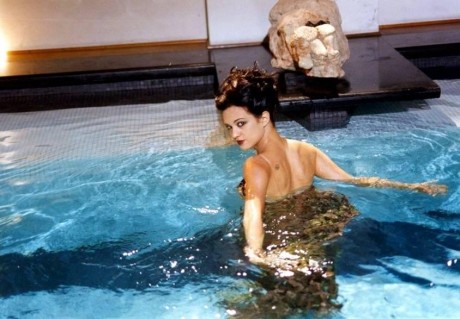
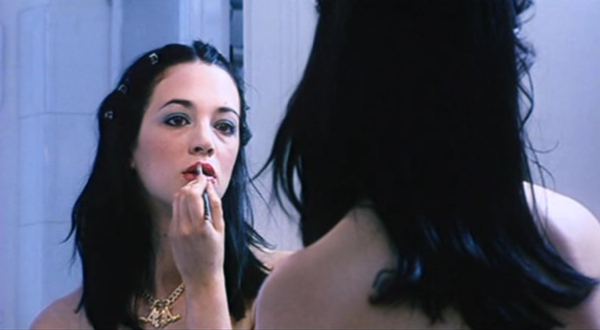
4 Shots From 4 Films: Special Daria Nicolodi Edition!


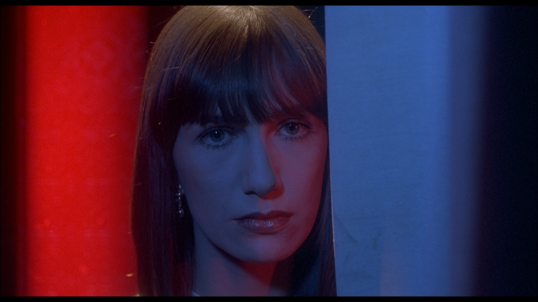
Daria Nicolodi in Tenebra (1982, dir by Dario Argento)

Daria Nicolodi in Tenebrae (1982, dir by Dario Argento)

4 Shots From 4 Films is just what it says it is, 4 shots from 4 of our favorite films.  As opposed to the reviews and recaps that we usually post, 4 Shots From 4 Films is all about letting the visuals do the talking.

I have to admit that I’m breaking the rules here.  When Arleigh first suggested 4 Shots From 4 Films as a feature here on Through the Shattered Lens, I promised myself that I would pace myself and, at most, only contribute once on a weekly basis.

But then, after Arleigh posted the first entry in 4 Shots From 4 Films, I realized that it was Lucio Fulci’s birthday and, being the lover of Italian horror that I am, there was no way that I could pass up the chance to post a Fulci-themed 4 Shots From 4 Films.  And now, less than 24 hours later, I find myself posting yet another 4 Shots From 4 Films.

But can you blame me?  It’s Daria Nicolodi’s birthday and, if you love Italian horror, then you know just how important an actress Nicolodi is.  Not only did Daria Nicolodi serve as the inspiration for what is arguably Dario Argento’s best film, Suspiria, but she also appeared in Mario Bava’s classic Shock.  The combination of her undeniable talent and her outspoken and eccentric style — there is no such thing as a boring Daria Nicolodi interview — has made Daria Nicolodi into an icon of horror cinema.

And, on top of all that, she’s Asia Argento’s mother!

So, indulge me because, as a lover of Italian horror, there is no way that I could pass up a chance to present our readers with 4 Shots From 4 Films: The Special Daria Nicolodi Edition!

Deep Red (1975, dir by Dario Argento)

Deep Red (1975, dir by Dario Argento)

Shock (1977, dir by Mario Bava)

Shock (1977, dir by Mario Bava)

Inferno (1980, dir by Dario Argento)

Inferno (1980, dir by Dario Argento)

Delirium (1987, directed by Lamberto Bava)

Delirium (1987, directed by Lamberto Bava)


Embracing the Melodrama #52: The Heart is Deceitful Above All Things (dir by Asia Argento)


600full-the-heart-is-deceitful-above-all-things-poster

Based on a controversial collection of short stories by JT LeRoy (which was a pen name used by the writer Laura Albert), The Heart is Deceitful About All Things covers three years in the life of Jeremiah and his dug addict mother Sarah.  Over the course of the film, Jeremiah is played by thee different actors — Jimmy Bennett at age 7 and, at age 10, Cole and Dylan Sprouse.  Sarah is fearlessly played by the film’s director, Asia Argento.

Partially in response to her extremely religious upbringing, Sarah spends most of her time drinking, smoking meth, and moving from man to man, the majority of whom treat both her and her son badly.  It looks like things are going to get better when Sarah marries the seemingly stable Emerson (Jeremy Renner) but, when Sarah suddenly abandons both her husband and her son so that she can go to Atlantic City, Emerson rapes Jeremiah.

Jeremiah is sent to live with his grandfather (Peter Fonda) and grandmother (Ornella Muti) who, it turns out, are members of an ultra-religious cult.  Thought Jeremiah initially manages to bond with his cousin Buddy (Michael Pitt), life in the cult proves to be no safer than life with his mother.  After three years with the cult, Jeremiah is standing on a street corner and yelling that everyone is going to go to Hell unless they repent when he is suddenly approached by Sarah.  Sarah grabs him and carries him over to a nearby truck that is being driven by her current boyfriend.

Sarah now supports herself as a dancer and as a prostitute.  When she realizes that the presence of her son is making men reluctant to pay for her, Sarah grows out Jeremiah’s hair and starts to dress him in her old clothes so that she can pass him off as being her younger sister.

Eventually, Sarah and Jeremiah find themselves living with amiable but slow-witted meth addict Jackson (Marilyn Manson) and that’s when things really start to head down hill…

In some ways, The Heart Is Deceitful About All Things is a difficult film to recommend because it is so extremely dark and depressing.  Much as in her debut film, Scarlet Diva, Asia Argento refuses to compromise on the bleakness of her vision.  She set out to make a realistic portrait of what it’s like to live on the fringes of American society and that’s exactly what she did.  If the end result is depressing…well, the fringes aren’t exactly a happy place.  In the end, you’re actually happy that the film is full of familiar actors like Argento, Michael Pitt, Peter Fonda, and Winona Ryder because you need that reminder that, ultimately, you’re watching a movie and that everyone was able to go home after they finished filming.

The Heart Is Deceitful Above All Things may not be easy to enjoy but it is a film that, as a result of its uncompromising vision,  ultimately wins your respect.

heart-is-deceitful-above-all-things-0

Embracing the Melodrama #49: Scarlet Diva (dir by Asia Argento)


Scarlet Diva

I’ve always loved Asia Argento because, as both an actress and a public personality, she is tough, hard, and sexy all at the same time.  She’s not one of those actresses who feels the need to hide who she really is.  Watching her on-screen, you realize that she doesn’t give a fuck whether you like her or not.  Instead, she’s going to do whatever it is that she wants to do and, if you’re lucky, you might get to watch.  Some hold her responsible for the erratic output of Dario Argento’s post-Opera career but those people far too often fail to take into account that Asia, with her naturally off-center presence, has often been the most interesting thing about Dario’s later films. (Say what you will about Trauma, The Stendhal Syndrome, and Mother of Tears, they’re all better with Asia than without her.)  Asia Argento is one of those talented actresses who could never have played Ophelia because no one would ever believe that she would so easily drown.  Instead, she’d simply pull herself out of the water and then go kick Hamlet’s ass for being so indecisive.

In the year 2000, Asia Argento made her directorial debut with the underrated Scarlet Diva.  In Scarlet Diva, Asia plays Anna Batista, a 24 year-old Italian actress who, having won both acclaim and awards in Italy, is now being tempted with offers to come out to Hollywood.  Over the course of this frequently (and intentionally) disjointed film, Anna is forced to deal with the dark reality of being young, rich, and famous.  (Yeah, yeah, I know you’re rolling your eyes but just calm down…)  After being told that she’ll costar with De Niro, she finds herself playing Cleopatra in a hilariously bad movie that does not co-star Robert De Niro.  She meets a sleazy producer (Joe Coleman) who invites her to his hotel room and then promptly undresses and demands that she “earn” a part in his next film.  Anna runs from him and the naked producer chases after her with the camera focused (in close-up) on his hairy ass all the way.  While dealing with all of that, Anna also find time to visit her best friend in Paris, just to discover that she has spent the last two days bound and gagged in bed.  She also buys drugs underneath a highway overpass and suffers from frequent dream sequences and flashbacks to growing up with her mentally unstable mother (played by Asia’s real-life mother, Daria Nicolodi).

And yet, during all of this, Anna can still find happiness because she thinks that she’s in love with rock star Kirk Vaines (Jean Sheperd, playing a role that was written for Vincent Gallo).  When Anna discovers that she’s pregnant, she decides not to have her usual abortion and instead to keep the baby.  However, when Kirk reacts to Anna’s news with indifference, it leads to one of the longest (and most emotionally raw) running sequences that I have ever seen, as the pregnant Anna flees down the streets of Rome…

asia_argento_-_scarlet

Just to judge from the movies that various actor have made about the trials of being a star, fame is a special sort of Hell, the type that is dominated with surreal dream sequences and frequent claustrophobia.  That’s certainly true of Scarlet Diva, which is perhaps one of the most self-indulgent films ever made.  And yet, it’s that very self-indulgence that makes Scarlet Diva so much more watchable and, in its own way, likable than most debut films from actors-turned-directors.  For all the drama and pain that Anna goes through, Asia Argento seems to understand just how narcissistic this film truly is and, in a few scenes, it’s evident that she’s gently mocking her own “poor me” self-indulgence.

Ultimately, Asia seems to be saying that Anna (and probably, at the time she made this film, Asia herself, since she has said that this film is partially autobiographical) is her own worse enemy.  Hence, this film — which was made with an admirable lack of concern about going too far or for being TMI — is a massively cathartic work for all of the rest of us who are also occasionally our own worst enemy.

Yes, Scarlet Diva may be a self-indulgent, narcissistic film.  It’s also a very brave and honest film that deserves a lot more praise and attention than it has received.

Scarlet Diva

Quickie Review: The Church aka La Chiesa (dir. by Michele Soavi)


The Italian horror cinema scene has always been dominated by such names as Mario Bava, Dario Argento and Lucio Fulci. Their films became Italy’s contribution to horror cinema and one cannot find a fan of the genre who don’t hold these three gentlemen in high regard. Other names of the Italian horror scene were not as well-known beyond the most hardcore horror fans and some just don’t deserve to be in the same company as the previously mentioned trio. One filmmaker who should be part of their company is one Michele Soavi. He rose through the ranks as an actor at first before moving on to becoming assistant directors for mentors such as Joe D’Amato and Dario Argento. The latter would become a major influence in Soavi’s work and would help produce some of his films. One of those Argento would end up producing for Soavi is the 1989 supernatural horror film, The Church (known in Italy as La Chiesa).

The Church wasn’t one of Soavi’s best films, but it was still one of the better horror films to come out of Italy during the waning years of the 80’s when Italian horror began a slow decline. Starring a very young Asia Argento (hard to believe that a career which began with reports of nepotism would turn out to be a successful one in and out of Italy) and an Italian-American actor named Tomas Arana (people would know him best as the ambitious Quintus in Ridley Scott’s Gladiator), the film starts off with a cohort of Teutonic Knights who destroy and kill a town suspected of witchcraft. The bodies of all killed soon get dumped into a mass grave and sealed with a huge metal cross and prayers to keep the evil that was done from ever coming out.

The beginning does have a somewhat ambiguous tone to it as we the audience don’t know if the villagers were indeed evil. Soavi definitely leaves that up in the air until the final third of the film kicks in and most of the horror scenes appear to satisfy gore fans. The knights destroying the village was well-staged and executed with some cool kill-scenes and effects.

It’s the middle reel where the film slowed down to the point that could lose the more casual horror fan. We get the usual non-believer researcer (Arana) who stumbles upon the ancient cross sealing the mass grave beneath the church that had been built over it down the centuries. Even this researcher and another knows that they should leave it alone, but being the scientists one of them proceeds to unseal the find with the reasoning that pursuit of knowledge should triumph over supersitition. Thus, the church becomes the scene of demonic possessions of various individuals. First, the initial researcher who opens unseals the cross then the parents of Asia Argento’s character before moving on to churchgoers who become trapped in the church after some demonic force seals all exits.

The rest of the film once that church seals itself is one person either getting killed by those possessed by the demons escaping from the sealed grave or someone getting possessed. This third act actually has a touch of Fulci’s nightmarish-style and less of Argento’s more dream-like quality. There’s a beautiful scene of Tomas Aranas’ character made-up to be some verdigrised-bronze angel statue, wings and all, embracing a very naked young woman that looked straight out of a Luis Royo painting. Another scene where regular Soavi actor Barbara Cupisti was shown in sexual congress with a demonic being that should give more than a few people nightmares despite being framed and shot in a beautiful manner.

The final nightmare scene of beauty which pushes The Church over into Fulci territory is when a mass of naked, muddied bodies of all those possessed entwine and writhe to form the likeness of a demon’s head. This sequence alone was worth watching through the much slower middle section of this film and Soavi’s eye for staging and lighting the scene made it look like something out of the pages of Dante Alighieri’s Divine Comedy.

One could say that The Church just didn’t live up to the usual quality one expected out of a Michele Soavi film after a he made the excellent giallo-slasher film Stage Fright just two years prior. This second full-lenght feature by Soavi showed him still honing his talent as a filmmaker which would finally culminate five years later in one of the best Italian horror films and one of the best films in the zombie subgenre with his Dellamorte Dellamore. Plus, even when he’s not on top of his craft like with The Church it is still worth a watch and better than the stuff released by his contemporaries like Bruno Mattei.

My Top Ten Books About The Movies


I love movies and I love books so I guess it would stand to reason that I love books about movies the most of all.  (I also love movies about books but there are far fewer of those, unfortunately.)  Below are my personal favorites.  I’m not necessarily saying that these are the ten greatest film books ever written.  I’m just saying that they’re the ones that I’m always happy to know are waiting for me at home.

10) Soon To Be A Major Motion Picture by Theodore Gershuny — This is one of the great finds of mine my life.  I found this in a used bookstore and I bought it mostly because it only cost a dollar. Only later did I discover that I had found one of the greatest nonfiction books about the shooting of a movie ever written!  Gershuny was present during the filming of a movie called Rosebud in the early 70s.   I’ve never seen Rosebud but, as Gershuny admits, it was a critical disaster that managed to lose a ton of money.  The book provides a fascinating wealth of backstage gossip as well as memorable portraits of director Otto Preminger and actors Robert Mitchum (who was originally cast in the lead role), Peter O’Toole (who took over after Mitchum walked off the set), and Isabelle Huppert.   If nothing else, this book should be read for the scene where O’Toole beats up critic Kenneth Tynan.

9) Suspects by David Thomson — A study of American cinema noir   disguised as a novel, Suspects imagines what would happen if George Bailey from It’s a Wonderful Life fell in love with Laura from the movie of the same name.  Well, apparently it would lead to Sunset Boulevard’s Norma Desmond having an affair with Chinatown’s Noah Cross and to one of George’s sons, sensitive little Travis, getting a job in New York City as a Taxi Driver.  And that’s just a small sampling of what happens in this glorious mindfuck of a novel.

8 ) Profondo Argento by Alan Jones — Long-time fan Alan Jones examines each of Dario Argento’s films (even Argento’s obscure historical comedy The Five Days of Milan) and proceeds to celebrate and (in many cases) defend Argento’s career.  Jones also interviews and profiles several of Argento’s most frequent collaborators — Daria Nicolodi, Asia and Fiore Argento, Simon Boswell, Claudio Simonetti, Keith Emerson, George Romero, Lamberto Bava, Michele Soavi, and many others.  Jones’ sympathetic yet humorous profile of Luigi Cozzi is priceless.

7)  Spaghetti Nightmares by Luca Palmerini — Spaghetti Nightmares is a collection of interviews conducted with such Italian filmmakers as Dario Argento, Ruggero Deodato, Umberto Lenzi, Lucio Fulci, and others.  Among the non-Italians interviewed are Tom Savini (who, as always, comes across as appealingly  unhinged) and David Warbeck.  (Sadly, both Warbeck and Fulci would die shortly after being interviewed.)  What makes this interesting is that, for once, Argento, Fulci, et al. are actually being interviewed by a fellow countryman as opposed to an American accompanied by a translator.  As such, the subsequent interviews turn out to be some of the most revealing on record.

6) Sleazoid Express by Bill Landis and Michelle Clifford — Landis and Clifford’s book is both a history and a defense of the old grindhouse theaters of New York City.  Along with describing, in loving and memorable detail, some of New York’s most infamous grindhouses, they also write about some of the more popular movies to play at each theater.  Along the way, they also offer up revealing profiles of such legendary figures as David Hess and Mike and Roberta Findley.  Reading this book truly made me mourn the fact that if I ever did find myself in New York City, I won’t be able to hit the old grindhouse circuit.

5) Beyond Terror: The Films of Lucio Fulci by Stephen Thrower — Fulci has always been a terribly underrated director and, indeed, it’s easy to understand because, in many ways, he made movies with the specific aim of alienating and outraging his audience.  It requires a brave soul to take Fulci on his own terms and fortunately, Stephen Thrower appears to be one.  Along with the expected chapters on Fulci’s Beyond Trilogy and on Zombi 2, Thrower also devotes a lot of space to Fulci’s lesser known works.  Did you know, for instance, that before he became the godfather of gore, Fulci specialized in making comedies?  Or that he also directed two very popular adaptations of White Fang?  Thrower also examines Fulci’s often forgotten westerns as well as his postapocalyptic sci-fi films.  And, best of all, Thrower offers up a defense of the infamous New York Ripper that, when I read it, actually forced me to consider that oft-maligned film in a new light.  That said, Thrower does admit to being as confused by Manhattan Baby as everyone else.

4) Immoral Tales by Cathal Tohill and Pete Toombs — Tohill and Toombs offer an overview of European “shock” cinema and some of the genre’s better known masters.  The book contains perhaps the best critical examination of the work of Jean Rollin ever written.  The authors also examine the work of Jesus Franco and several others.  This is a great book that reminds us that the Italians aren’t the only ones who can make a great exploitation film.
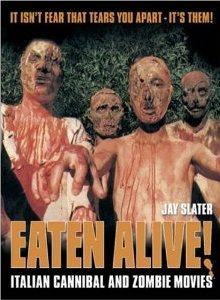
3) Eaten Alive by Jay Slater — This book offers an overview of the Italian film industry’s legendary cannibal and zombie boom.  Along with reviewing every Italian movie to feature even the slightest hint of cannibalism or the living dead (this is one of the few books on Italian cinema that discusses both Pasolini and Lucio Fulci as equals), Eaten Alive also features some very revealing interviews with such iconic figures as Catriona MacColl, Ian McCullough, and especially Giovanni Lombardo Radice.  Radice, in fact, also contributes a memorable “guest” review of one of the movies featured in the book.  (“What a piece of shit!” the review begins.)  Memorable reviews are also contributed by Troma film founder Lloyd Kaufman who brilliantly (and correctly) argues that Cannibal Holocaust is one of the greatest films ever made and Ramsey Campbell who hilariously destroys Umberto Lenzi’s infamous Nightmare City.

2) The Book of the Dead by Jamie Russell — If, like all good people, you love zombies then you simply must do whatever it takes to own a copy of this book.  Starting with such early masterpieces as White Zombie and I Walked With A Zombie, Russell proceeds to cover every subsequent zombie film up through George Romero’s Land of the Dead.  Russell offers up some of the best commentaries ever written on Romero’s Dead films, Fuci’s Beyond Trilogy, Rollin’s Living Dead Girl, and Spain’s Blind Dead films.   The pièce de résistance, however, is an appendix where Russell describes and reviews literally ever zombie film ever made.

1)  All The Colors Of the Dark by Tim Lucas  — This is it.  This is the Holy Grail of All Film Books.  If you’ve ever asked yourself if any book is worth paying close to 300 dollars, now you have your answer.  This one is.  Tim Lucas offers up the most complete biography of director Mario Bava ever written.  In fact, this may be the most complete biography of any director ever written!  Lucas examines not only Bava’s life but also every single movie that Bava was ever in any way connected to, whether as a director or as a cameraman or as the guy in charge of the special effects.  This is 1,128 pages all devoted to nothing but the movies.  This is the type of book that makes me thankful to be alive and I owe a huge debt of gratitude to Tim Lucas for writing it.