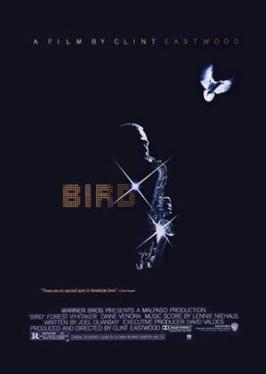
Bird (1988, directed by Clint Eastwood)


Forest Whitaker stars as the legendary saxophonist Charlie “Bird” Parker.  The film, which is structured around flashbacks and time jumps and features some of the most beautifully-done transitions that I’ve ever seen, follows Parker as he plays his saxophone, challenges the jazz purists who his own individual style, and looks for work in both America and France.  Along the way, we watch as he befriends and learns from Dizzy Gillespie (Samuel Wright), mentors a young trumpet player named Red Rodney (Michael Zelniker), and has a complex relationship with a white jazz lover named Chan Parker (Diane Venora).  Throughout his life, Charlie Parker struggles with his addiction to heroin and alcohol, occasionally getting clean to just then fall back into his habit.  To its credit, the film avoids most of the biopic cliches when it comes to portraying Parker’s addiction.  Parker accepts that he’s an addict, just as he accepts that he has a talent that is destined to revolutionize American music.

Director Clint Eastwood has always been a fan of jazz and he actually saw Charlie Parker perform when he was a young man.  His love of jazz had been present in almost every modern-era film that he has directed, staring with Play Misty For Me’s lengthy trip to the Monterey Jazz Festival.  Bird was a passion project for Eastwood, the first film that Eastwood directed without also appearing in.  (Eastwood doesn’t star in his second directorial effort, Breezy, but he does have a brief and silent cameo as a man standing on pier.)  Eastwood takes a nonlinear approach to telling the story, eschewing the traditional bopic format and instead putting the focus on Parker’s music.  Eastwood was able to get several never bef0re-released recordings of Parker performing and, when Whitaker is blowing into his saxophone in the film, we’re actually hearing Parker.  Eastwood’s direction captures the smoky atmosphere of the jazz clubs where Parker and Gillespie made their name while the nonlinear style reflects the feeling of just letting a song take you to wherever it’s going.  This is a movie about jazz that plays out like a jazz improvisation.

Forest Whitaker gives an amiable and charismatic performance as Charlie Parker, playing him as someone who has found both an escape and peace in his music, even as he physically struggles with the ravages of his drug addiction.  Whitaker won the Best Actor at Cannes for his performance in Bird.  Eastwood received the Golden Globe for Best Director.  Bird feels like it was labor of love for both of them.  Bird may not have set the box office on fire when it was originally released but it remains one of the best jazz films.
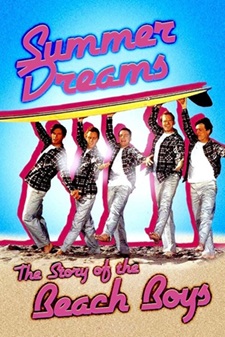
Summer Dreams: The Story of the Beach Boys (1990, directed by Michael Switzer)


Bruce Greenwood stars as Dennis Wilson and Greg Kean plays his brother Brian in this made-for-TV movie about the history of the Beach Boys.  The movie focuses on Dennis and his struggle with his abusive father (Arlen Dean Snyder) and his ultimately fatal addictions.  Bo Foxworth plays Carl Wilson, who doesn’t get a line until half an hour into the movie.  Andrew Myler plays Al Jardine and Casey Sanders plays Mike Love, both of whom are portrayed as being bystanders while Brian and Dennis create the Beach Boys sound.  (Jardine doesn’t get a single line in the movie.)  An actor named Michael Reid MacKay shows up briefly as Charles Manson, wearing a fake beard and crashing at Dennis’s pad in the 60s.  The movie portrays the Beach Boys transformation from being a clean-cut group of California teenagers to psychedelic pioneers by putting everyone in a wig once the late 60s arrive.

Summer Dreams claims to be The Story of the Beach Boys but next to no time is spent on the recording of Pet Sounds and Smile isn’t mentioned at all.  (Don’t go looking for Van Dyke Parks.)  Admittedly, this film was made before Brian Wilson made his touring comeback so I guess it would make sense that the story would focus on Dennis, who had died seven years previously.  (Brian is portrayed as being neurotic and sensitive but not mentally ill.)  Bruce Greenwood doesn’t do a bad job as Dennis and there definitely is a place for a movie that takes a real look at Dennis Wilson and his contributions to the group.  Dennis was, in many ways, as serious an artist as Brian but, due to his early death, he’s often overlooked.  But this film, mired as it is in biopic cliches and bland recreations of the 60s and 70s, doesn’t do justice to either Brian or Dennis or the group as a whole.

Watch Love & Mercy instead.

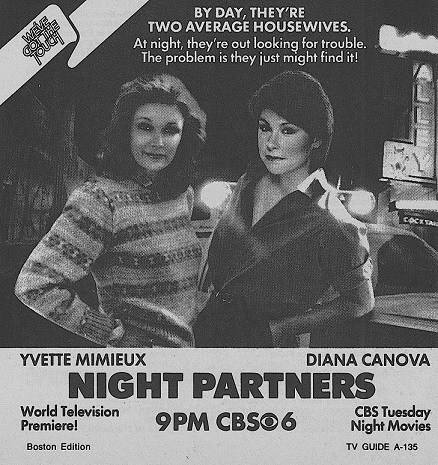
Retro Television Review: Night Partners (dir by Noel Nosseck)


Welcome to Retro Television Reviews, a feature where we review some of our favorite and least favorite shows of the past!  On Sundays, I will be reviewing the made-for-television movies that used to be a primetime mainstay.  Today’s film is 1983’s Night Partners!  It  can be viewed on Tubi.

Lauren Hensley (Diana Canova) is a divorced mother who has a nice house in Bakersfield, California.  Her best friends and neighbors are housewife Elizabeth McGuire (Yvette Mimieux) and Elizabeth’s husband, a cop named Glenn (Arlen Dean Snyder).  One night, after spending the day with the McGuires, Lauren returns to her home and is attacked by three burglars.

For Lauren, the crime is not even the worst part of the night.  The worst part is when the police don’t even seem to care that much about her suffering and instead take a “just-the-facts” approach to getting the details to what she’s been through.  Glenn attempts to explain to both Lauren and Elizabeth that cops see terrible things every day and, if they seem desensitized to it all, that’s just their way to handling the stress of the job.  Lauren, however, feels that the cops need a unit that provides the same support for victims that the criminals receive from their lawyers and social workers.

At a community meeting, Lauren proposes her idea to the police chief, John Wilson (Larry Linville).  When Wilson replies that there is no money in the budget, Lauren suggests that maybe the program could be staffed by volunteers.  She then proceeds to volunteer herself and Elizabeth.  Wilson agrees, but on the requirement that Lauren and Elizabeth first attend the police academy and train with the officers.  Under the watchful eye of the gruff but kindly Joe Kirby (M. Emmet Walsh), the two middle-aged housewives run obstacle courses and learn about conflict resolution.  And while the conflict resolution lessons make sense, I’m not sure what the point of having them do the obstacle course was.

Eventually, Lauren and Elizabeth become quite good at their jobs, providing comfort to the victims and getting information that helps the police put away criminals, like the serial rapist (a young M.C. Gainey) who has been stalking the streets of Bakersfield.  Of course, it takes them a while to get good at the job.  When Elizabeth and Lauren are first sent out on the streets, they can’t even keep the police codes straight and they accidentally call in a robbery code when they’re instead just letting the dispatcher know that they’re on break.  Bizarrely, when Lauren and Elizabeth are not at a crime scene talking to a victim, they’re just supposed to drive around in a beat-up patrol car.  Neither one of them has the power to arrest anyone because they’re just volunteers.  In fact, they’re supposed to stay out of the way until the police specifically call for them to come to a crime scene.  So, why are they patrolling the city like real cops?  It seems like that would basically be a lawsuit waiting to happen.

Night Partners was obviously designed to serve as a pilot for a series where Laruen and Elizabeth would comfort victims and help to solve crimes.  The two lead actresses are likable and M. Emmet Walsh is particularly effective as their supervisor.  That said, the film itself can’t decide if it wants to be a hard-hitting crime drama or a comedy about two housewives trying to make it as cops.  Of course, there’s no reason why it couldn’t be both.  Some of the best cops shows have had elements of dark, gallows humor.  But this film’s tone is so inconsistent that the comedic scenes seem to be taking place in an entirely different universe from the dramatic scenes.

As someone who strongly believes that the right of the victims need to be given as much weight as the rights of the criminals, I appreciated the film’s message.  I just wish it had been delivered a bit more effectively.

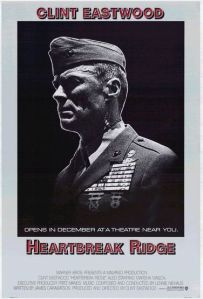
A Movie A Day #203: Heartbreak Ridge (1986, directed by Clint Eastwood)


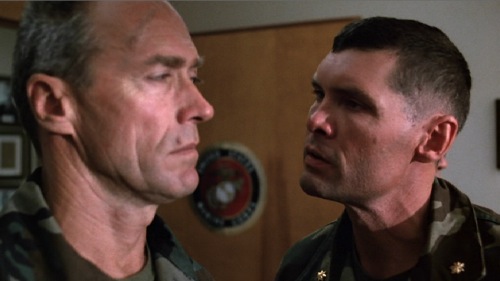
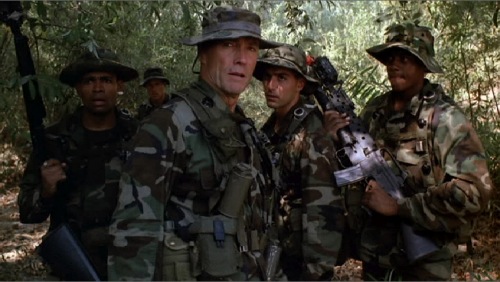
The year is 1983 and things are looking bad for the Second Marine Division of the U.S. Marine Corps.  The officers are almost all college graduates like Major Powers (Everett McGill) and Lt. Ring (Boyd Gaines), men who have never served in combat but who are convinced that they know what it means to be a Marine in the 80s.  Convinced that they will never have to actually fight in a war, the latest batch of recruits is growing soft and weak.  All of the slackers have been put in the Recon Platoon, where they are so undisciplined that they think that wannabe rock star Cpl. Jones (Mario Van Peebles) is a good Marine.  MARIO VAN PEEBLES!
They haven’t met Sgt. Highway yet.

Gunnery Sgt. Thomas Highway (Clint Eastwood) has seen combat, in both Korea and Vietnam.  He drinks too much.  He fights too much.  He has chased away his wife (Marsha Mason), despite his attempts to understand her by reading Cosmo and Ladies Home Journal.  Major Powers may think that Highway is a relic but Highway knows better than to worry about what a college boy thinks.  The Recon Platoon may think that they can defy him but that haven’t seen Highway throw a punch yet.  Everyone may think it’s a waste of time to learn how to fight but little do they know that America is about to invade Grenada.

Heartbreak Ridge is all about Clint Eastwood.  Without Clint Eastwood, it would just be another basic training film.  With Clint Eastwood, it is a minor masterpiece and a tribute to America’s fighting spirit.  In 1986, no one was better at glaring at a young punk or glowering at a clueless superior officer than Clint Eastwood.  Even the running joke of Highway reading women’s magazines works because it is impossible not to laugh at Clint Eastwood intently studying an issue of Cosmo.   Clint may have been 56 when he directed and starred in Heartbreak Ridge but he was still believable beating up men who were less than half his age.  (Mario Van Peebles thinks he’s going to be able to stand up to Clint Eastwood?  Get outta here!)  There is never any question that Highway is going to able to whip everyone into shape.  The only question is how many terse one-liners are going to be delivered in the process.   By the time Highway and his platoon reach Grenada, everyone is ready to watch Clint put the communists in their place and Clint does not disappoint.

Reportedly, the U.S. Marine Corps. initially supported Heartbreak Ridge but, in case of life imitating art, disowned the finished picture, feeling that the film’s portrayal of The Corps was inaccurate and the sergeant’s “training” methods were too old-fashioned to actually be effective.

Thomas Highway would disagree.

One final note: Bo Svenson has a small role as the man trying to steal Marsha Mason away from Clint.  If you have ever wanted to see Dirty Harry and Buford Pusser fight over the Goodbye Girl, here’s your chance.