October True Crime: Murder in Coweta County (dir by Gary Nelson)


In 1948, one of the richest men in Georgia committed a murder.

John Wallace was a landowner, back when that title actually meant something.  He was known as the boss of Meriweather County.  Everyone in the county seemed to work for Wallace in one way or another.  He controlled the county officials.  The sheriff enforced the law only as far as John Wallace would allow him.  The bootleggers had to pay Wallace for protection.  When one bootlegger, a sharecropper named Wilson Turner, failed to do so, he was fired and kicked off of Wallace’s land.

Turner retaliated by stealing two of Wallace’s cows.

Wallace responded by murdering Turner.

Because Turner attempted to flee and Wallace chased after him, Wallace committed the murder not in Meriweather County but in neighboring Coweta County.  What Wallace didn’t realize was that this meant the investigation didn’t fall under the jurisdiction of his hand-picked sheriff.  Instead, Sheriff Lamar Potts of Coweta County headed up the investigation.  John Wallace was eventually arrested by Sheriff Potts and he was eventually convicted of murdering Wilson Turner.  At the time, the case drew a lot of attention both because of Wallace’s wealth but also because two of the main witnesses for the prosecution were the two black men who Wallace forced to help him dispose of Wallace’s body.

It’s an interesting story, largely because the history of America is full of men like John Wallace, people who set up their own little dictatorships.  It’s often portrayed as being a Southern phenomena but John Wallace really wasn’t that much different from the crude political bosses who, for decades, dominated politics in city like New York and Chicago, the type who held onto power through a combination of intimidation and patronage.  In my home state of Texas, George Berham Parr inherited the political machine that controlled Duval and Jim Wells County.  Parr committed numerous crimes during his time as the “Duke of Duval” but he had important friends.  He was the one who “found” the votes necessary for Lyndon Johnson to win a senate seat in 1948.  (In return, Johnson got Harry Truman to pardon Parr for failing to pay his taxes.)  Parr is also suspected of having been involved in at least one murder but it wasn’t until LBJ himself retired from politics that anyone truly investigated Parr’s activities.  In 1974, he was again convicted of failing to pay his taxes and Parr was later found dead at his ranch.  Suicide was the official police ruling.

As for the story of John Wallace, it was turned into a made-for-TV movie in 1983.  Murder in Coweta County stars Andy Griffith as John Wallace and Johnny Cash as Sheriff Potts.  Griffith, playing a soulless villain, is chilling as John Wallace.  Wallace is all-smiles and good ol’ boy charisma whenever there’s a crowd around but, once it’s just him and his cronies, a different side comes out.  Wallace thinks that he can get away with murder because he’s been able to get away with everything else.  Sheriff Potts is determined to see that justice is done.  Murder in Coweta County is an atmospheric Southern crime story, one that is so full of atmosphere that you can feel the humidity.  While Johnny Cash was definitely a better singer than an actor, Andy Griffith’s villainous turn makes the film worth watching.

Andy Griffith tells a story about football in 1953! 


Andy Griffith’s “What It Was, Was Football” is a classic, comic monologue about a naive country preacher who stumbles upon a football game and tries to make sense of something he’s never seen before. Needless to say, it’s hilarious, and it highlights just what a great comedian Griffith is. In honor of what would have been Andy Griffith’s 99th birthday, I gave it a listen, and now I share it with you. Enjoy! 

Brad’s “Scene of the Day” – Happy Birthday to Andy Griffith (1926-2012)!


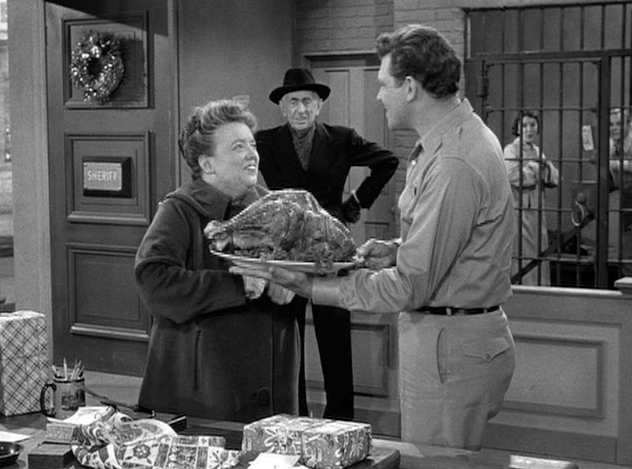
Andy Griffith would have been 99 years old today. This man has brought so much joy into my life over the years, and that joy has primarily come from his performance as Sheriff Andy Taylor on THE ANDY GRIFFITH SHOW (1960-1968). There are 249 episodes of the classic TV series, and I have watched every single one of them many times. I love Andy’s relationship with his deputy Barney Fife (Don Knotts), and their adventures lead to so many laughs, but the shows that touch me the most emotionally involve his relationship with his son, Opie (Ron Howard). There are several episodes throughout the series where Andy will put his trust in Opie even when he’s unsure if it’s the right thing to do. One of those episodes is the first episode of season 3, entitled “Mr. McBeevee.” It’s one of my favorite episodes of the entire series, and it illustrates the special relationship between a dad and his son.

Enjoy, my friends.

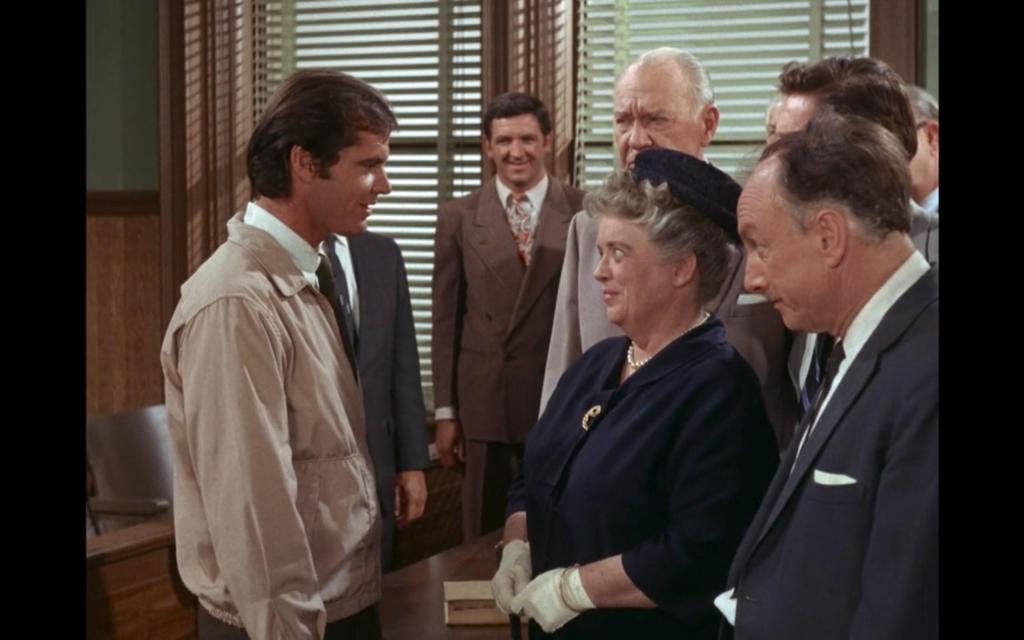
Jack Nicholson guest stars on THE ANDY GRIFFITH SHOW: Season 8, episode 7 – “Aunt Bee, the Juror” – originally aired on October 23rd, 1967!


Aunt Bee (Frances Bavier) serves on a jury where the case involves a man named Marvin Jenkins (Jack Nicholson) who’s been accused of stealing appliances from a department store in Mount Pilot, North Carolina. While the evidence against Mr. Jenkins appears to be overwhelming, Aunt Bee isn’t ready to convict him because he “seems like such a sweet man.” The rest of the jury is getting sick of her so they press her to explain why she doesn’t think he’s guilty. Her answer, “have you noticed his eyes, pure hazel! I just don’t feel like he did it.” The jury decides to take a break for the evening. The next day she brings brownies and wants to continue discussing the case. Needless to say, the remaining jury members aren’t happy as they are ready to be done. They’re quite rude to Aunt Bee and the case finally ends with a hung jury because Aunt Bee refuses to give in to their pressure. Marvin Jenkins, happy to be free, thanks Aunt Bee for believing in him. Meanwhile there’s a guy hanging around the court that seems way too interested in the outcome of the case, especially when Jenkins gets set free. Based on a couple of things he says, Andy (Andy Griffith) figures out that he’s the one who actually stole the items at the store, and it turns out that Aunt Bee was right the whole time. Even better, the episode ends with the judge writing a letter to Aunt Bee requesting her recipe for brownies! 

“Aunt Bee, the Juror” is the second of two episodes where Jack Nicholson appeared on The Andy Griffith Show. He first appeared in season 7, episode 10, “Opie Finds a Baby.” It’s a very short appearance where he shows up at the very end as the father of the found baby. In this episode, Nicholson again has a pretty small role as the man on trial. He answers some questions from the lawyers and Aunt Bee believes him even though no one else does. At the end he happily thanks Aunt Bee for thinking the best of him and not finding him guilty. Most of the episode focuses on Aunt Bee holding out for what she believes in. Based on his short appearance in this episode, it’s hard to believe that Nicholson was on the verge of superstardom. He had already filmed THE SHOOTING (1966), RIDE THE WHIRLWIND (1966), and HELL’S ANGELS ON WHEELS (1967), with EASY RIDER (1969) and FIVE EASY PIECES (1970) just a couple of years away. For me, it’s just fun to see an actor of his caliber on one of my favorite shows of all time.

Happy 88th Birthday, Mr. Nicholson. Thanks for a lifetime of wonderful performances! 

Retro Television Review: Fantasy Island 6.3 “The Perfect Gentleman/Legend”


Welcome to Retro Television Reviews, a feature where we review some of our favorite and least favorite shows of the past!  On Tuesdays, I will be reviewing the original Fantasy Island, which ran on ABC from 1977 to 1984.  Unfortunately, the show has been removed from most streaming sites.  Fortunately, I’ve got nearly every episode on my DVR.

Smiles, everyone!

Episode 6.3 “The Perfect Gentleman/Legend”

(Dir by Philip Leacock, originally aired on October 30th, 1982)

Jimmy Jordan (Paul Williams, who appeared on a lot of these type of shows) is a rock star who witnessed a mob hit at one of his concerts.  Jimmy did what anyone would do.  He called the police.  They offered to protect him if he testified but then they told him that they probably wouldn’t be able to continue to protect him afterwards.  (Uhmm …. hello?  Witness Protection Program?)  Jimmy decided to fake his own death and then go to Fantasy Island.  His fantasy?  To not get caught by the two mobsters who have been sent to make sure that he’s actually dead.

Uhmmm …. that’s weird.  Like all of that was going on Jimmy just decided to go to Fantasy Island?  And then he shows up on Fantasy Island wearing a trenchcoat over his rock star jump suit?  Weird.

Fortunately, Michelle (Leslie Easterbrook) is on the island and her fantasy is apparently to have a new butler!  Soon, Jimmy is calling himself Godfrey and helping Michelle and her family save their business while Tracer (John Davis Chandler) and Killer (Joseph Ruskin) search for him.  Needless to say, Jimmy and Michelle fall in love and leave the island together and, unless I missed something, it appears that Jimmy is planning on just being Godfrey for the rest of his life.  He even drives Michelle and her daughter to the docks so that they can all fly off to the mainland.  I guess the world is going to go on believing that Jimmy’s dead and….

This fantasy raised way too many unanswered questions and Paul Williams was convincing neither as a rock star or a butler.  This is a fantasy that called out for someone like …. oh, I don’t know.  Sonny Bono, maybe.

The other fantasy was a bit of an improvement, just because it featured the unlikely but surprisingly likable pairing of Michelle Phillips and Andy Griffith.  Phillips plays Andrea Barclay, who has a beautiful singing voice but who suffers from crippling stage fright.  Her fantasy is to successfully perform in front of the toughest crowd ever.

Really?  Roarke says, The toughest crowd?

By now, guests should realize that whenever Roarke says something like that, it means your fantasy is going to be interpreted in a bizarre way that you never expected.  Considering that, the last time that Michelle Phillips was on the show, her fantasy to be the most famous woman in the world somehow led to her becoming Lady Godiva, Andrea really should have known better.  Instead, Andrea is shocked when she finds herself in the Old West, where Judge Roy Bean (Andy Griffith) has promised the citizens of Langtry, Texas that his favorite actress and singer, Lillie Langtry (Madlyn Rhue), will be performing for them.  When Lillie leaves without singing, it’s time for Andrea to put on a mask and pretend to be Lillie as she performs in Judge Bean’s saloon.  Yeah, it’s a silly fantasy but Andy Griffith and Michelle Phillips both put their heart into their performances.  Andy Griffith does his folksy-but-intelligent routine while Michelle Phillips especially deserves a lot of credit for taking things seriously.

This episode had the same problem as last week’s.  Everything felt very familiar.  Last week, we had what seemed like the show’s hundredth boxing and dancing fantasy.  This week, we have what feels like the hundredth singing fantasy.  After five seasons, it’s obvious that the show’s writers had started to run out of ideas.

Next week …. Roddy McDowall returns to Fantasy Island!  Yay!


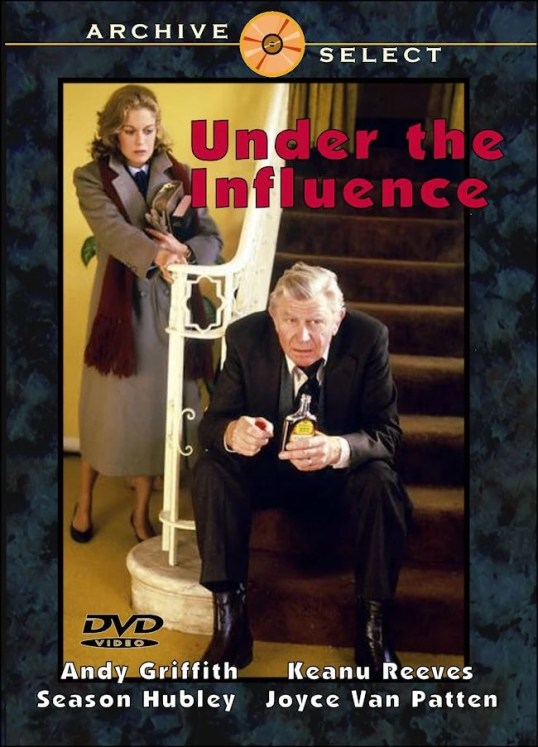
Retro Television Reviews: Under the Influence (Dir by Thomas Carter)


Welcome to Retro Television Reviews, a feature where we review some of our favorite and least favorite shows of the past!  On Sundays, I will be reviewing the made-for-television movies that used to be a primetime mainstay.  Today’s film is 1986’s Under the Influence!  It  can be viewed on YouTube!

Noah Talbot (Andy Griffith) is an upstanding member of the community.  He owns a hardware store.  He has a large family.  He’s known as a gruff but folky storyteller.  He’s a deacon in his church and helps to collect the offering every Sunday.

He’s also a drunk and a bit of a bully.  His family walks on eggshells around him, fearful of setting him off on one of his benders.  He occasionally spends the night in jail, arrested for trying to drive drunk.  Even when he gets bailed out, his first instinct is to go back to the bar.  The folks at the bar love him, don’t you know.  The people at the bar are always happy to see him and never bother him about whether he’s had too much.  The people at the bar never let him down the way that he feels his family has left him down.

The members of his family each cope in their own individual way.  Noah’s wife (Joyce Van Patten) is in denial and spends a lot of her time popping pills.  His oldest daughter, Ann (Season Hubley), is driven to succeed at work and spends all of her time both hating her father and desperately hoping for his approval.  (When she tells him that she got a raise at work, he berates her for only getting a 6% increase in her salary.  “That’s just a cost of living increase!” he snaps at her.)  His eldest son, Stephen (Paul Provenza), fled to Los Angeles and is trying to make a career as stand-up comedian.  (“You’re no David Letterman,” Noah tells him.)  His youngest daughter, Terri (Dana Anderson), secretly replaces Noah’s liquor with water and food-coloring.  And his youngest son, Eddie (Keanu Reeves), is becoming an alcoholic himself.

Having read all that, you may be wondering just how exactly Keanu Reeves could be the son of Andy Griffith and it’s a fair question.  This was one Keanu Reeves’s first acting roles and he does a pretty good job in the role of Eddie.  That said, he looks so totally different from both Andy Griffith and Joyce Van Patten and the actors playing his siblings that I was half-expecting someone to mention that Eddie had been adopted.  Then again, Paul Provenza doesn’t really bear much of a resemblance to the actors playing his parents either.  Dana Anderson and Season Hubley do, at least, look like sisters.

Lack of family-resemblance aside, all of the actors in Under the Influence do a good job of inhabiting their characters.  For those who are used to seeing Andy Griffith playing friendly Southerners in reruns of The Andy Griffith Show and Matlock, it’s shocking and a little disturbing to see him playing an abusive, alcoholic jerk in Under the Influence.  Noah is someone who would not only destroy his own family to get a drink but who would then blame them for it happening in the first place.  Noah may be under the influence of alcohol but the entire family is suffering because they’re under the influence of Noah.  By the time Noah is spitting up blood and demanding that his youngest son sneak liquor into his hospital room, the viewer knows there is no hope for Noah but hopefully, his family will escape.

It doesn’t make for a particularly happy movie but, speaking as someone who grew up in an alcoholic household, I can attest that it does make for an honest portrayal of what addiction does not just to the addict but also to the people around the addict.  I cringed in sympathy through nearly the entire film, especially as I watched three of the four children react in the same ways that I did.  (Unlike Eddie, I never became much of a drinker and instead developed an aversion to alcohol in general.)  It’s a film that feels real and one’s heart aches for the entire family.  If it could happen to Andy Griffith, it could happen to anyone.

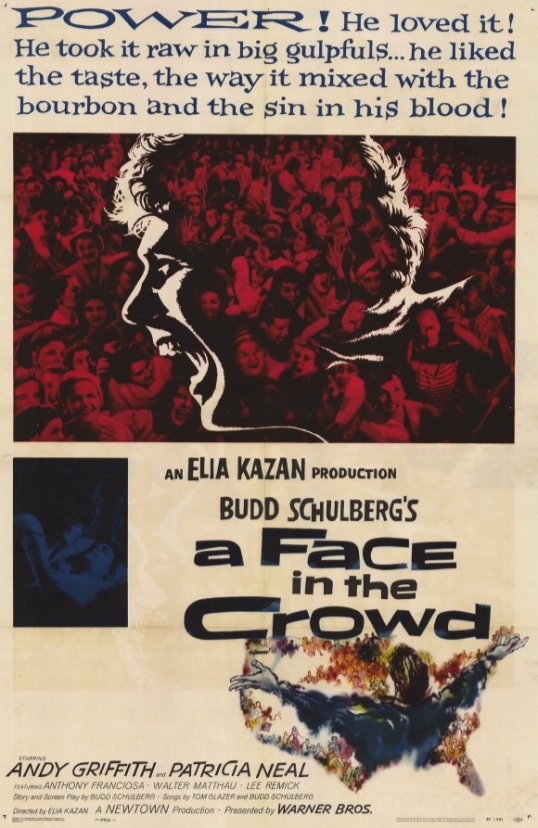
Scenes I Love: Lonesome Rhodes Reveals His True Self In A Face In The Crowd


The director Elia Kazan was born 113 years ago, in what was then the Ottoman Empire and what is today Turkey.  Though he died in 2003, Kazan has remained a controversial figure and there’s still a lot of debate over what his artistic legacy should be.  As a director, he revolutionized both Broadway and Hollywood.  He made films about topics that other directors wouldn’t touch and he played a huge role in making Marlon Brando a star and popularizing the method.  (I’ll allow you to decide whether that’s a good or a bad thing.)  He won two Oscars and he’s been cited as an influence by some of the most important directors of the past century.

Kazan was also a former communist who, at the height of the 50s red scare, testified in front of the HUAC and who “named names.”  Kazan often claimed that he only identified people who had already been named.  Many of his former colleagues, however, felt that Kazan had betrayed them and never forgave him.  Though Kazan always denied it, many felt that his decision to name names had more to do with settling personal scores than with any actual concern about national security.  Not helping matters was that Kazan’s 1954 film, On The Waterfront, was widely viewed as being Kazan’s attempt to justify being an informer.  Indeed, Kazan’s post-HUAC films seemed to alternate between thinly veiled attempts to paint himself as a hero and attempts to remind people that he was still a liberal.

That adds an interesting subtext to his best film, 1957’s A Face In The Crowd.  In this film, Andy Griffith plays Lonesome Rhodes, the type of down-home entertainer who would probably have been quite popular with the supporters of HUAC.  A reporter played by Patricia Neal falls in love with Lonesome and helps him become a celebrity with a national following but, too late, she discovers that Rhodes is hardly the folksy and naïve country boy that she originally believed him to be.  Instead, he’s a master manipulator who, drunk on his own power and fame, makes plans to transform himself into a political power.  Lonesome is portrayed as being a down-home fascist, a countryfied version of the infamous Father Charles Coughlin.  At the same time, one could also argue that Rhodes, with his seething contempt for the people who follow him, was also meant as a commentary on the people who claimed to represent the workers but who only saw them and their struggle as a means to an end. 

A Face In The Crowd may have been Kazan’s attempt to remind his detractors that he was still a man of the Left but it’s far more interesting as a work of prophecy.  There’s really not much difference between Lonesome Rhodes and the modern day celebrities and influencers who are currently famous simply for being famous and who, for the right amount of money and ego-stroking, are more than willing to propagandize for one side or the other.

In this wonderfully acted and directed scene, Lonesome Rhodes gets drunk on his own power and reveals just how corrupt his outlook has become.  Making this scene all the more powerful is that it’s easy to imagine our current leaders springing something like Secretary of National Morale on us today.

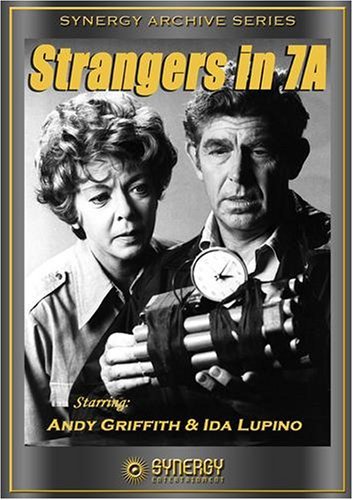
The Strangers in 7A (1972, directed by Paul Wendkos)


Artie Sawyer (Andy Griffith) is a man who no one respects.  Having recently been fired from his long-time job, he’s forced to take a job as a superintendent for an apartment building in New York.  The tenants don’t think much of him.  His wife, Iris (Ida Lupino), is getting tired of his self-pity.  The only person who seems to like Artie is Claudine (Susanne Benton).  The young and beautiful Claudine approaches Artie in a bar and, after flirting with him, reveals that she needs a place to stay.  Artie agrees to let Claudine check out Apartment 7A.  At the apartment, Claudine rolls around in the bed, dances seductively, and then reveals that she has three male friends who are going to be staying in the apartment with her.  Billy (Michael Brandon), Virgil (Tim McIntire), and Riff (James A. Watson, Jr.) all served in Vietnam together and now they need to crash at the apartment for a while.  Artie can either let them stay or they can reveal to his wife that he was at a bar, trying to pick up young women.

Led by the psychotic Billy, the three men are planning on robbing the bank next door.  When Artie, who is having doubts about whether or not it was a good idea to let four obviously unstable people live rent-free in his building, discovers their plans, he and Ida are taken hostage.  When the bank robbery goes wrong, Billy tries to use the hostages and a bomb as leverage for his escape from the police.

As far as films about bank robberies goes, The Strangers in 7A is no Dog Day Afternoon.  While it’s interesting to see the usually confident Andy Griffith play a loser, he never seems like enough of a loser that he would actually risk a job that he clearly needs just because Claudine flashed a little leg at him.  Even when he’s playing a character who is down on his luck, he’s still Andy Griffith.  Along with the lead role being miscast, the bank robbers are too generic to really be credible or threatening.  Susanne Benton is sexy as the femme fatale and Ida Lupino is sympathetic as Artie’s wife but otherwise, The Strangers in 7A is forgettable.

The Strangers in 7A was made for television.  At the time, Andy Griffith was still trying to escape being typecast as Mayberry’s amiable Sheriff Taylor.  Griffith was a convincing villain in movies like Pray For The Wildcats and Savages but he’s just not believable as a loser in this film.

Griffith Gets Serious: Winter Kill (1974, directed by Jud Taylor)


Eagle Lake, a mountain resort town in California, has a problem.  It’s almost tourist season and there is a sniper stalking through the night, using his rifle to pick off citizens and painting messages like “The First” and “The Second” in the snow.  It’s up to police chief Sam McNeill (Andy Griffith) to figure out the killer’s motives and capture him before the vacation season begins!  To catch the killer, McNeill is going to have to investigate his friends and neighbors, all of whom have secrets that they don’t want to have revealed.

1974 was a busy year for Andy Griffith.  Best-known for playing the folksy and reassuring Sheriff Taylor for over ten years on The Andy Griffith Show, Griffith tried to change his image by appearing in three unexpectedly dark made-to-TV movies.  In Pray For The Wildcats and Savages, Griffith played the villain.  In Winter Kill, he’s back in a more familiar role.  He is once again playing a lawman, though this one carries a gun and doesn’t have time to sit on his porch and play the guitar while Aunt Bea makes dinner.  Instead, he’s getting pressure from all sides to capture a psycho sniper who, at the start of the movie, shoots an old woman after throwing pebbles at her bedroom window.  Eventually, the sniper even ends up kidnapping Chief McNeill’s girlfriend!  This never happened in Mayberry!

Winter Kill is a pretty good mystery.  It’s not strictly a horror film but the sight of the masked sniper, making his way through the night and coldy gunning down unsuspecting victims is scary enough that it might as well be.  Andy Griffith was surprisingly tough and gritty as Chief McNeill.  He might be a good guy in this movie but you still know better than to mess with him.  The rest of the cast is made up of television regulars but keep an eye out for a youngish Nick Notle playing a cocky ski instructor.

Winter Kill was actually meant to be a backdoor pilot for a show where Chief McNeill would battle crime on a weekly basis.  Though that didn’t happen, the concept was later retooled and became a short-lived series called Adams of Eagle Lake.

Captain Kirk vs. Sheriff Taylor: Pray For The Wildcats (1974, directed by Robert Michael Lewis)


The year is 1974 and there’s nothing more dangerous than being a hippie in Baja California.  That’s because psychotic business Sam Farragutt (played by Andy Griffith!) is on the loose.  Sam likes to describe himself as being a hippie himself.  “A hippie with money,” Sam puts it as he waves a hundred dollar bill in the face of a hippie without money,

Actually, there is one thing more dangerous than being a hippie in Baja California and that’s being an ad executive.  Once again, Sam Farragutt is to blame.  He’s willing to give his business to three ad execs but first they have to agree to go down to Baja and ride around with him on their motorcycles.  The three ad execs are Terry Maxon (former child evangelist Marjoe Gortner!), Paul McIllvain (former Brady Bunch star Robert Reed!), and suicidal burn-out Warren Summerfield (William Shatner!).  Warren is having an affair with Paul’s wife (Angie Dickinson!) but he’s still planning on committing suicide in Mexico.

However, going to Mexico gives Warren a new lease on life.  After Warren discovers that Farragutt is responsible for the death of two hippies, he becomes determined to make sure that justice is served.  Soon, Andy Griffith (!) is chasing William Shatner (!) across the Mexican desert.  Someone’s going to die.  Is it going to be Sheriff Taylor or Captain Kirk?

Pray For The Wildcats was a made-for-TV movie that aired the same year as Savages.  Both movies were a part of Andy Griffith’s attempt to change his image after playing the folksy Sheriff Taylor on The Andy Griffith Show.  Griffith is a good villain but the main appeal of Pray for the Wildcats is the chance to see William Shatner doing his thing.  Shatner has a juicy role here, playing a man who is at first suicidal and then righteously indignant.  He overemotes with the self-serious intensity that was Shatner’s trademark in the years before he finally developed a sense of humor about himself.  The movie itself gets bogged down with unnecessary flashbacks and dated dialogue but the spectacle of Griffith vs. Shatner makes it all worth it.