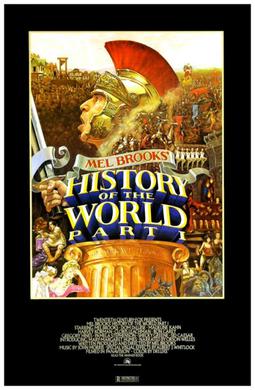
The History of the World, Part I (1981, directed by Mel Brooks)


Overlong, wildly uneven, gimmicky too a fault, and often laugh out loud funny with a mix of jokes that range from the crude to the sublimely clever to the surprisingly sentimental, The History of the World, Part I is the ultimate Mel Brooks films.

Narrated by Orson Welles and featuring five historical stories and a collection of coming attractions, The History of the World Part I follows man from his caveman origins to the French Revolution and the thread that ties it all together is that humanity always screws up but still finds a way to survive.  Moses (Mel Brooks) might drop and break one of the three tablets listing the 15 Commandments but he’s still able to present the other ten.  Stand-up philosopher Comicus (Mel Brooks) might make the mistake of poking fun at the weight of Emperor Nero (Dom DeLuise) but he still makes his escape with Josephus (Gregory Hines), Swiftus (Ron Carey), and Miriam the Vestal Virgin (Mary-Margaret Humes) and ends up serving as the waiter at the Last Supper.  (“Jesus!”)  The Spanish Inquisition may have been a catastrophe but it also gave Torquemada (Mel Brooks) a chance to show off his performance skills.  The French Revolution may have been a bloodbath but the future still held promise.  Ask for a miracle and he’ll show up as a white horse named Miracle, no matter what era of history you’re living in.

The humor is very Mel Brooks.  During the Roman Empire sequence, Madeline Kahn plays Empress Nympho.  Jackie Mason, Harvey Korman, Cloris Leachman, Spike Milligan, Jan Murray, Sammy Shores, Shecky Greene, Sid Caesar, Henny Youngman, and Hugh Hefner all make cameo appearances.  Carl Reiner is the voice of God.  John Hurt plays Jesus.  The film ends with the promise of a sequel that will feature “Jews in Space.”  Not every joke lands.  The entire caveman sequence feels forced.  But when the film works — like during The Inquisition production number — it’s hard not get caught up in its anything-goes style.  The entire Roman Empire sequence is probably more historically accurate than the typical Hollywood Roman epic.  That’s especially true of Dom DeLuise’s naughty performance as Emperor Nero.

Mel Brooks is 99 years old today and he says that he has at least one more film to give us, a sequel to Spaceballs.  I’m looking forward to it!  I’m also looking forward to rewatching and enjoying all of the films that he’s already given us.  The History of the World, Part I may not have initially enjoyed the critical acclaim of his earlier films but, in all of its anarchistic glory, it’s still pure Mel Brooks.
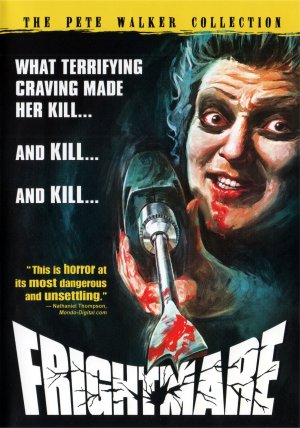
The TSL’s Daily Horror Grindhouse: Frightmare (dir by Pete Walker)


Frightmare_FilmPoster

Since I already reviewed one British film about cannibalism earlier today, I figured why not review another one?  Pete Walker’s film Frightmare was released in 1974, two years after the release of Death Line.  You have to wonder what was going on in British society in the early 70s that led to so many cannibal films.  When watched together, Frightmare and Death Line present a vision of a society that was devouring itself, both literally and figuratively.

Frightmare tells the story of Dorothy (Shelia Keith) and Edmund Yates (Rupert Davies).  Dorothy is a fortune teller who has something of a violent temper.  Edmund is her loving but abused husband.  However, Dorothy has more than just a temper.  She also has a taste for human flesh.  She’s just spent 15 years in prison, convicted of killing and eating a man.  However, she has now been “found sane,” (and that’s a term that is repeated, with increasing irony, throughout the entire film) and she has been released.  She’s even reading fortunes again!

Jackie (Deborah Fairfax) is Edmund’s daughter by his first marriage.  She’s devoted to her father and, at the same time, scared of her mother.  She doesn’t believe that her mother is truly sane, despite the fact that her psychiatrist boyfriend, the well-meaning but arrogant Graham (Paul Greenwood), continues to remind her that Dorothy has been “found sane.”  Jackie knows that Dorothy still wants to eat human flesh so, every weekend, she takes the train to Dorothy’s home and delivers meat.  Jackie tells Dorothy that it’s human flesh but, in reality, it’s just a placebo.  When Graham finds out what Jackie’s doing, he is outraged.  After all, Dorothy has been found sane!

Jackie, however, has other things to worry about.  Her younger half-sister, the rebellious Debbie (Kim Butcher), is living with her.  Along with dating an obnoxious biker, Debbie also resents the fact that Jackie is obviously Edmund’s favorite.  And, as quickly becomes clear, Debbie is as much of a sociopath as her mother…

Speaking of which, Dorothy may have been found sane but it’s obvious that she’s not.  (Throughout the film, no matter how erratic Dorothy’s behavior becomes, Graham continually assures us that she has been found sane.)  It also become obvious that Jackie’s placebos are not doing the trick.  Dorothy is once again murdering the random people who come to get their fortunes told.  And Edmund is helping her cover up the crimes, all the while pathetically telling anyone who will listen, “They said she was sane….they said she was sane…”

Frightmare is one of those films that you really do have to see in order to understand just how effective it is.  It’s an undoubtedly pulpy story and there’s not a subtle moment to be found in the entire film but it doesn’t matter.  Frightmare is properly named because it is pure nightmare fuel.  This is a film that work both as a family melodrama and a satire on the trust that people put into authority (the authorities said that Dorothy was sane so, everyone assumes, she must be) but ultimately, this is an intense and frightening little film.  That’s largely due to Sheila Keith’s ferocious performance.  She turns Dorothy into a force of cannibalistic nature.

Feel free to have a Death Line/Frightmare double feature.  Just don’t expect to have much of an appetite afterward…