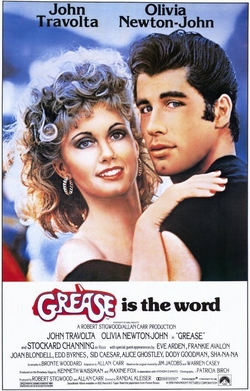
When it comes to reviewing Grease on this site, the film and I have a long and twisted history. There have been several times when I was tempted to review Grease but one thing has always stopped me:
I absolutely hate this film.
Grease is one of my least favorite films and, to be honest, just thinking about it causes me pain. Just about everyone that I know loves Grease. They love the songs. They love the music. They love the performances. They want to see it on stage. They want to see it on the big screen. They watch every time it pops up on AMC.
Growing up as a theater nerd means being surrounded by people who love Grease. I cannot begin to count the number of times that I forced to watch this movie in school. So many theater teachers seemed to feel that showing Grease in class was some sort of reward but, for me, it was pure torture. And the fact that I was usually the only one who disliked the film made the experience all the more unbearable.
Back in 2014, when I was doing the first set of Back To School reviews, I was planning on reviewing Grease. But I just could not bring myself to voluntarily relive the film. Instead of putting myself through that misery, I decided to watch and review Rock ‘n’ Roll High School instead. It was the right decision and I stand by it.
Jump forward two years and here I am doing Back to School again. And again, for some reason, I had put Grease down as a film to review. It’s just a movie, right? And yet, after I finished writing my excellent review of Animal House, I again found myself dreading the idea of having to even think about Grease.
So, I said, “Fuck this,” and I promptly erased Grease from the list and I replaced it with Skatetown USA. Then I watched Skatetown and I’m glad that I did because that was an experience that I can’t wait to write about! And yet, I still had this nagging voice in the back of my mind.
“You’re going to have to review Grease at some point,” it said, “If not now, when?”
The voice had a point. However, I was soon reminded that there was an even more important reason to review Grease. A little further down on my list of Back to School films to review was a little film called Grease 2. How could I possibly review Grease 2 if I hadn’t already reviewed Grease? My OCD would not allow it!
And so, here I am, reviewing Grease.
Grease, of course, is a musical about teenagers in 1958. Danny (John Travolta) is in love with Sandy (Olivia Newton-John) and Sandy is in love with Danny. But Danny’s a greaser and Sandy’s Australian! Will they be able to work it out, despite coming from different worlds? Of course they will! Danny’s willing to dress up like a jock in order to impress Sandy while Sandy’s willing to wear black leather to impress Danny! Yay! They go together! And they’ve got a flying car, too! YAY!
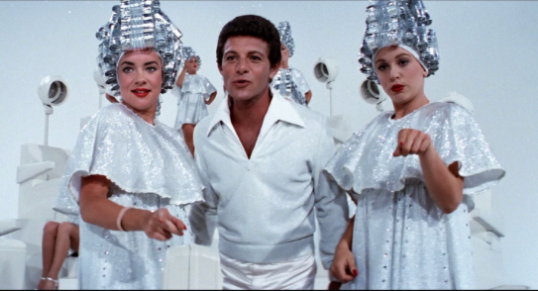
And then Satan arrived…
Of course, there’s other subplots as well. For instance, Frenchy (Didi Conn) nearly drops out of school but she’s visited by Satan (Frankie Avalon) and he manages to change her mind. And Rizzo (Stockard Channing) might be pregnant because Kenickie (Jeff Conaway) hasn’t bought any new condoms since the 8th grade. Comparing the sensitive way that teen pregnancy was handled on a show like Degrassi: The Next Generation with the way it’s handled in Grease is enough to make you want to sing “O Canada” every day for the rest of your life.
Here’s what I do like about Grease: Stockard Channing is great as Rizzo, though it’s hard not to feel that she deserves better than a doofus boyfriend like Kenickie and a boring bestie like Sandy. I also like You’re The One That I Want. That’s a fun song.
But as for the rest of the movie … BLEH! I mean, it is so BORING! It takes them forever to get to You’re The One That I Want. Olivia Newton-John is so wholesome that she literally makes you want to tear your hair out while John Travolta pretty much acts on auto pilot. As for the supporting cast, most of them appeared in the stage production of Grease and they still seem to be giving stage performances as opposed to film performances. They’re still projecting their lines to the back of the house. Worst of all, it’s obvious that director Randal Kleiser had no idea how to film a musical because the dance numbers are so ineptly staged and framed that, half the time, you can’t even see what anyone’s doing with their feet. If you can’t see the feet, it defeats the whole purpose of having an elaborate dance number in the first place!
So, no, I don’t like Grease.
Sorry, everyone.
However, I’m sure I’ll enjoy Grease 2….

Love you, Canada!


 Through the Shattered Lens