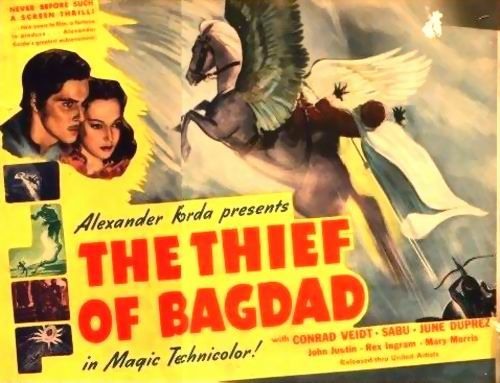
Alexander Korda’s Arabian Nights fantasy THE THIEF OF BAGDAD has stood the test of time as one of filmdom’s most beloved classics. A remake of Douglas Fairbanks Sr.’s 1924 silent classic, Korda and company added some elements of their own, including Indian teen star Sabu as the title character, and some innovative Special Effects. In […]
The 9th film in Mill Creek’s Fabulous Forties DVD box set was 1942’s Jungle Book. Based on the novel by Rudyard Kipling (which was later made into an animated Disney film and of which a remake is scheduled to be released next week), Jungle Book was directed by Zoltan Korda and produced by Zoltan’s brother, Alexander. Today, the Hungarian-born Korda Brothers are best remembered as being pioneers of the British film industry. However, during World War II, they relocated their film making to the United States. Jungle Book was one of the most critically and commercially successful of their American films.
Jungle Book opens in colonial India. An elderly Indian storyteller is visited by a British woman (Faith Brook) who wants to hear a story from his youth. The rest of the film plays out in flashback, a structure that allows Jungle Book to walk a thin line between reality and fantasy. Is the storyteller telling the exact truth or is he exaggerating his tale? That’s left up to the viewer to decide. Personally, I chose to believe that he’s telling the exact truth. It’s more magical that way.
The storyteller starts by telling the woman about the Indian jungle and the animals that live within it. Some of the animals are kind and some of them are cruel but they all serve a purpose. The most feared of the animals is a tiger named Shere Kahn. When a baby disappears from a nearby village, the villagers assume that he, like his father, was killed by Shere Kahn. What they do not know is that the baby actually wandered into the jungle and was raised by wolves.
The baby grows up to be Mowgli (Sabu), a feral young man who can talk to the animals. When Mowgli is captured by the villagers, he is unknowing adopted by his real mother, Mesusa (Rosemary DeCamp). At first, the wild Mowgli struggles to adapt to human ways and one of the villagers, Buldeo (Joseph Calleia), insists that Mowgli has “the evil eye.”
As Mowgli becomes a little more civilized (though he’s never exactly tamed), he starts to fall in love with a Mahala (Patricia O’Rourke). Unfortunately, Mahala is the daughter of Buldeo and Buldeo is none to happy when Mowgli and Mahala start to spend all of their time exploring the jungle together. However, that’s before Mowgli and Mahala come across a lost palace that is full of treasure. When the greedy Buldeo finds out about the treasure, he demands that Mowgli tell him where the palace is. Driven mad by Mowgli’s refusal to tell him, Buldeo goes to more and more extreme measures to find the treasure…
Jungle Book is a big epic film, one that proudly announces that it was shot in Technicolor. The sets are big, the live animal footage (as opposed to the stock footage usually used in films like this) is impressive, and it’s just a fun movie to watch. (Even though I was watching a typically cheap Mill Creek transfer, I was still impressed with the films visuals.) Indian actor Sabu makes for a charismatic Sabu but the film’s best performance comes from Joseph Calleia, who brings unexpected depth to his villainous character.
(Movie lovers, like you and me, probably best know Joseph Calleia as Orson Welles’s tragic partner in Touch of Evil.)
You can watch the original Jungle Book below!
(Jungle Book is in the public domain so, if the video above gets taken down — as often seems to happen with embedded YouTube videos — I would suggest just going to YouTube and doing a search for Jungle Book 1942. You’ll find hundreds of other uploads. I picked the one above because it did not appear to have any commercials.)
This afternoon, as part of my mission to see every single film ever nominated for best picture, I watched Alexander Korda’s 1933 biopic The Private Life of Henry VIII.
Now, I have to admit that I’ve never been a big fan of the historical King Henry VIII as I have a hard time finding much sympathy for a man who beheads one wife, not to mention two of them. I like to imagine that he met his end in much the same way that Joe Spinell meets his end at the end of Maniac, with all of his dead wives suddenly showing up and ripping off his head. But, Henry is one of those larger-than-life historical figures that always seems to end up as the subject of movies, speculative fiction, and, of course, Showtime television series.
The Private Life of Henry VIII is one of the better known recreation of Henry’s life on-screen. For the most part, the film ignores Henry’s policies as king and instead is a darkly humorous recreation of his relationships with five of his six wives. (His first marriage, to Catherine of Aragon, is ignored.) The episodic film opens with the execution of Anne Boyelen (Merle Oberon). This sequence establishes the film’s tone early and it’s actually a lot more cynical than we usually expect a film from 1933 to be. In between shots of Boyelen waiting to meet her fate, we get extended scenes of two executioners — one French and one English — arguing about which nationality is better when it comes to chopping off heads. Meanwhile, the members of Henry’s court spend their time whispering innuendo about Henry’s new wife, Jane Seymour (Wendy Barrie). When Henry (played by Charles Laughton) finally shows up on the scene, he turns out to be a buffoon, a childish man who happens to control the destiny of England. After Jane dies in childbirth, Henry marries Anne of Cleves (played by Laughton’s wife, Elsa Lanchester). Anne, however, finds Henry to be repulsive and, in the film’s most obviously comedic segment, she goes out of her way to make herself as sexually unappealing as possible in order to convince Henry to give her a divorce. (This, of course, led to the split between England and the Catholic Church but the film doesn’t dwell on that. This is a comedy, not Man For All Seasons.) After the divorce, Henry finally marries Catherine Howard (Binnie Barnes) who has spent the whole movie pursuing Henry. For the first time in the movie, Henry is portrayed as being truly in love, unaware (at first) that Catherine only married him for his crown and is actually having an affair with Thomas Culpepper (Robert Donat).
The Private Life of Henry VIII was not the first movie to be made about Henry VIII but it’s probably the most influential because of Charles Laughton’s Oscar-winning performance in the title role. Laughton’s performance pretty much set the standard as far as future Henry’s were concerned. His Henry is buffoonish womanizer who does everything to excess. (This is the film that pretty much created the whole image of monarchs as men who don’t use forks, knives, or spoons.) However, as over-the-top as Laughton’s performance may seem, it’s actually full of very subtle moments that suggest the actual human being lurking underneath all of the bluster. It’s hard not to sympathize with Laughton’s Henry as he struggles to explain what sex is to Anne of Cleves or with his obvious pain when he discovers that he’s been betrayed by the only one of his wives that he actually loved.
(Of course, any similarity between Laughton’s Henry and the real-life Henry is probably a coincidence.)
The Private Life of Henry VIII was the first British film ever nominated for best picture and, perhaps because it wasn’t made by the Hollywood establishment, it hasn’t aged as terribly as most films from the 30s. While the film does have its slow spots, the performances of Laughton, Oberon, and Lanchester still hold up well and some of the film’s dark comedy almost feel contemporary. Oddly enough, this British film about English history lost to an American film about English history, Cavalcade.
(I should mention that I haven’t seen Cavalcade so I can’t say whether it was a better film. I’m going to have to see Cavalcade eventually but it’ll be later than sooner as the movie is only available as part of a DVD boxed set that costs close to 300 dollars. Agck!)


 Through the Shattered Lens