Van Damme Directs: The Quest (1996, directed by Jean-Claude Van Damme)


In the 1920s, New York pickpocket Christoper DuBois (Jean-Claude Van Damme) flees both the police and the mob by stowing away on a boat.  Before he leaves, he promises a group of orphans that he will return to them.  Thay promise is easier made than kept because DuBois is captured by pirates, rescued by Lord Dobbs (Roger Moore), and then sold into slavery on an island off the coast of Siam.

Apparently, Siamese slavery means being taught in the ways of Muay Thai boxing because, when Dobbs eventually returns, DuBois is a champion fighter.  Not holding a grudge about the whole slavery thing, DuBois requests that Dobbs and his partner, Harri (Jack McGee), accompany him to the Lost City of Tibet so that DuBois can represent the United States in a martial arts tournament.  The winner receives a statue made entirely out of the gold, the legendary Golden Dragon.  Wanting the dragon for themselves, Dobbs and Harri go with DuBois to Tibet.  Also accompanying them is a reporter (Janet Gunn) and Max Devine (James Remar), the boxer was supposed to represent the United States but who dropped out when he realized that DuBois was the better fighter.

In the Lost City, DuBois survives several elimination rounds against the best fighters from across the world.  While DuBois always shows mercy to his opponents, his main rival, Khan (Abdel Quissi), indiscriminately kills anyone who gets in the ring with him.  Meanwhile, Dobbs and Harri make plans to steal the golden dragon for themselves.

When it comes to the second-tier action heroes of 1990s, Jean-Claude Van Damme was never as good an actor as Dolph Lundgren but he was still more likable than Steven Seagal.  Van Damme’s appeal was that, in real life, he could actually do all of the things that he did in the movies.  For action audiences, there was never any doubt about who would win if Van Damme and Steven Seagal ever went at in real life.   Movies like The Quest never impressed the critics but they did give Van Damme’s fans exactly what they wanted out of a Van Damme film.

The Quest was unique because it was Van Damme’s debut as a director.  Unlike a lot of actors-turned-director, Van Damme mostly resists the temptation to get too self-indulgent.  There is one scene where Van Damme wears old age makeup and another where he wanders through the slums of New York while dressed as a clown but Van Damme is smart enough to leave most of the heavy acting to capable professionals like Roger Moore and James Remar.  While Moore and Remar ham it up and keep things entertaining, Van Damme concentrates on fighting and trying to return to the orphans.  The fight scenes are sometimes too short but at least Van Damme makes a point of showcasing each competitor’s different style.  There aren’t many films that include both sumo wrestling and capoeira.

The Quest is basically Bloodsport in the 1920s but, as they used to say in the 90s, it’s still damme entertaining.

Film Review: Fit To Kill (dir by Andy Sidaris)


1993’s Fit To Kill opens with the most incompetent secret agents in the world on a training exercise in the desert.  All of the Andy Sidaris regulars are present.  There’s Donna (Dona Speir).  There’s Nicole (Roberta Vasquez).  Bruce (Bruce Penhall) and Shane (Michael Shane) are still with the organization, despite the fact that, over the course of four films, neither one of them has really added much to the mix.  For some reason, these agents still don’t know better than to hide whenever they see a remote control helicopter.  Seeing as how every Andy Sidaris film features someone being blown up by either a remote control helicopter or remote control boat, you would think that these experienced government agents would no longer be shocked when it happened.

Anyway, we quickly go through all of the usual Sidaris stuff.  There’s a meeting in a hot tub.  The team’s boss, Lucas (Tony Peck), shows up and acts like a prick.  Coded messages are still being sent out via the Hawaiian radio station.  Shane Abilene still can’t shoot a gun to save his life.  Eventually, the film gets around to revealing the latest mission.

Chang (Aki Aleong) is the owner of a valuable Russian diamond.  As he explains in a flashback that’s full of stock footage, the diamond was originally stolen by a Nazi general.  On his deathbed, the general gave the diamond to Chang.  And really, in defense of Sidaris, it must be said that the flashbacks are actually handled fairly well.  Maybe the flashbacks were Sidaris’s attempt to show that he actually could be a good director when he felt like it.  Anyway, Chang is planning on returning the diamond to the Russian ambassador (Rodrigo Oberon) during an official ceremony.  The problem is that the diamond is extremely valuable and, as a result, certain international criminals want to steal it.

Criminals like Martin Kane!

That’s right.  Martin Kane is back and he’s again played by RJ Moore.  Just as in Hard Hunted, RJ Moore is handsome, stylish, and charismatic.  RJ was the son of Roger Moore and, when he shows up wearing a tuxedo, it’s hard not to regret that RJ never got a chance to play James Bond.  Kane is determined to steal the diamond but it turns out that he’s motivated by more than just pure greed.  What’s this!?  A complex character in an Andy Sidaris film?  Believe it or not, it’s true.  And Moore gives a good performance in the film, perhaps the best performance to ever show up in a Sidaris film.

If Moore gives the best performance in the film, he’s closely followed by Julie Strain, who plays Blu Steele.  Blu Steele is the mercenary/assassin who is hired by Kane to steal the diamond.  However, Blu Steele has schemes of her own.  Strain, to her credit, appears to understand the exact type of movie that she’s been cast in and she responds with a totally over-the-top performance.  Both she and Moore are so memorably berserk that Donna, Roberta, Bruce, and Shane are even more forgettable than usual.

Fit To Kill is stupid but entertaining.  The plot makes no sense and the dialogue is full of the usual bad puns and regrettable jokes.  Still, it’s entertainingly stupid, thanks to Moore and Strain.  Plus, there’s a scene in which two hitmen get into a passionate debate about whether Homer Simpson’s a better actor than Fred Flintstone.

Of course, it all ends with a hot tub party.  The Fast and the Furious franchise has Vin Diesel saying grace before everyone eats.  Andy Sidaris films have hot tub parties.

Embracing the Melodrama Part III #1: No Down Payment (dir by Martin Ritt)


Back in 2014 and 2015, I did a series of reviews that I called Embracing the Melodrama, in which I reviewed some of the best (and worst) melodramas ever made.  All together, I reviewed 186 films as a part of Embracing the Melodrama, everything from Sunrise to Reefer Madness to The Towering Inferno to Cocaine: One Man’s Seduction.  I had so much fun doing it that I’ve decided to do it again.

No, don’t worry.  I’m not going to attempt to review 186 films this time.  Instead, for Embracing The Melodrama Part III, I am going to limit myself to reviewing 8 films.  I’ll be posting one Embracing the Melodrama review a day, from now until next Sunday.

Let’s kick things off with 1957’s No Down Payment, a film about life in … THE SUBURBS!

(cue dramatic music)

The suburbs!

Is there any place in America that’s more dramatic?  Is it any wonder that, since the early 50s, films have regularly been using the suburbs as an example of everything that’s apparently wrong with America?  Every year sees at least one major film about how terrible life is in the suburbs.  Last year, for instance, George Clooney directed a film called Suburbicon, which was regularly cited as a possible Oscar contender before it was released and everyone was reminded of the fact that George Clooney is a terrible director.  That said, I can understand why filmmakers continue to be drawn to the suburbs.  Secret affairs.  Dangerous drugs.  Duplicitous children.  Fractured families.  Barbecuing alcoholics.  Undercover occultists.  You can find them all in the suburbs!

No Down Payment opens with David (Jeffrey Hunter) and Jean Martin (Patricia Owens) driving down a California highway and looking at the billboards that dot the landscape.  Every billboard advertises a new community, inviting people to make a new and better life away from the crowded city.  David and Jean smile, amused by how blatant all of the ads are.  That’s when they see the billboard that’s advertising their new home:

Sunrise Hill Estates

A Better Place For Better Living

Soon, David and Jean are moving into their new home and meeting their new neighbors.  It turns out that most of the houses in Sunrise Hill Estates are available for “no down payment” and the majority of the residents are struggling financially.  Though David may look at all of his neighbors and say, “Looks like everybody here is living a wonderful life,” the truth is something far different.

(If David’s line sound a bit too on the nose and obvious, that’s because almost all of the dialogue in No Down Payment was too on the nose and obvious.  As a side note, “on the nose” is an extremely strange expression.)

David’s neighbors include:

Herm Kreitzer (Pat Hingle) and his wife, Betty (Barbara Rush).  Herm owns an appliance store and sits on the town council.  Herm is gruff but likable.  He’s the leader of his neighborhood and he welcomes the Martins with a backyard party.  Herm’s employee, Iko (Aki Aleong), wants to move to Sunrise Hill but no one is willing to give him a reference because he’s not white.

Troy Boone (Cameron Mitchell) and his wife, Leola (Joanne Woodward).  We know that Troy is going to be trouble because he’s played by Cameron Mitchell.  We know that we’re going to like Leola because she’s played by Joanne Woodward.  Troy’s an auto mechanic and a veteran.  He wants to be appointed the chief of police but the town is reluctant to hire him because he doesn’t have a college education.  Leola wants to have a child but Troy says that they can’t even think about that until he has a good job.

And then there’s Jerry Flagg (Tony Randall) and his wife, Isabelle (Sheree North).  Jerry is a used car salesman and he’s also a drunk.  Jerry spends most of the movie hitting on other women and embarrassing Isabelle.  Jerry has no impulse control and, as a result, he’s heavily in debt.  His only hope is that he can convince a family to buy an expensive car that they really don’t need.  When last I checked, that’s what a used car salesman is supposed to do.

The film deals with a lot of issues — prejudice, sexism, economic insecurity — that are still relevant today.  Unfortunately, the film itself is a bit slow and what was shocking in the 50s seems rather jejune today.  Watching the film, you get the feeling that, as with many films of the 50s, all of the interesting stuff is happening off-screen.  That said, the film has an interesting cast.  Jeffrey Hunter and Patricia Owens are a bit dull as the Martins but then you’ve got their neighbors!  Any film that features Cameron Mitchell glowering can’t be all bad but the best performance comes from Tony Randall, who is memorably sleazy and desperate as Jerry Flagg.  For a fun experiment, watch this film right before watching Will Success Spoil Rock Hunter?

Tomorrow, we’ll continue to embrace the melodrama with 1961’s Common Law Wife!

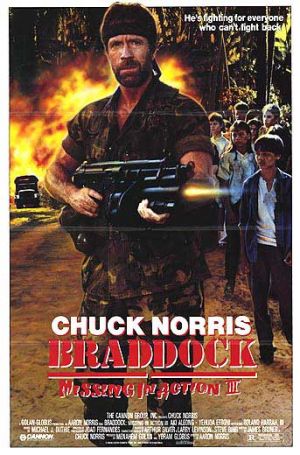
A Movie A Day #137: Braddock: Missing in Action III (1988, directed by Aaron Norris)


Chuck Fucking Norris, dude.  Chuck Norris is so cool that continuity bends to his will and thanks him for the opportunity.

Need proof?

Just watch Braddock: Missing in Action III.

The third Missing in Action film starts in 1975, with the fall of Saigon.  The communists are taking over.  The Americans are fleeing Vietnam.  Colonel James Braddock (Chuck FUCKING Norris) is determined to bring his Vietnamese wife to America with him but, when she loses her papers and is not allowed to make her way to the American embassy, Braddock believes that she had been killed. (Keep an eye out for Keith David as the Embassy guard.  Only Chuck Norris could overshadow Keith David in a movie.)  Heartbroken, Braddock returns to the United States.

Every fan of the Missing in Action franchise knows better.  We all know that Chuck was in a POW camp when Saigon fell.  In Missing in Action 2, he and his fellow prisoners did not even know if the war had ended.  Also, Chuck mentioned having a wife waiting for him back in the United States.  What gives?

I can think of only two possible explanations.

Either Chuck Norris and Cannon Films did not care about continuity

or

Chuck Norris is so cool that, in order to prevent his collected coolness from knocking the Earth off of its axis, the U.S. Army split Chuck’s coolness in half by creating a clone.  One clone spent ten years in a POW camp.  The other clone escaped during the Fall of Saigon but had to leave behind his wife.

Thirteen years later and back in the U.S., Chuck is contacted by Reverend Polanski (Yehuda Efroni), who tells him that his wife is still alive in Vietnam and that he has a 12 year-old son.  Chuck’s boss at the CIA tells him that, under no circumstances, is Chuck to go to Vietnam.

Anyone who thinks they can tell Chuck Norris what do is a fool.

Chuck goes to Vietnam and is reunited with his wife and son.  Unfortunately, when Chuck tries to get his new family out of the country, they are captured by sadistic General Quoc (Aki Aleong).  Again, Braddock must escape from a Vietnamese prison camp.

Braddock: Missing in Action III was co-written by Chuck Norris and it was directed by his brother, Aaron.  It’s a Norris production all the way, which means a lot of heroic shots of Chuck and a lot of bad guys wondering why Chuck is so much better than them.

Braddock was released four years after the first Missing in Action but, more importantly, it was released two years after Oliver Stone’s Platoon changed the way that movies dealt with the war in Vietnam.  By the time that Braddock came out, films in which lone American refought and single-handedly won the war were no longer in fashion.  Braddock was a flop at the box office and it ended the franchise.  However, continuity errors aside, Braddock is actually the best of the Missing in Action films.  It features Chuck’s best performance in the series and Chuck searching for his wife and child gives Braddock more emotional weight than the first two Missing in Action films. Maybe Chuck should have co-written and selected the director for all of the films he made for Cannon.

Chuck Norris, dude.

Chuck Fucking Norris.