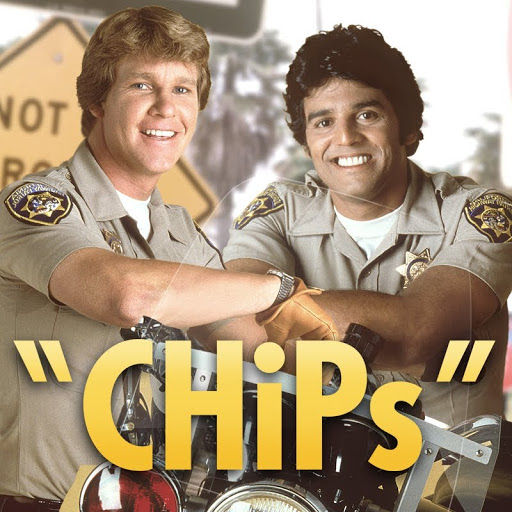
Late Night Retro Television Review: CHiPs 4.21 “A Special Operation”


Welcome to Late Night Retro Television Reviews, a feature where we review some of our favorite and least favorite shows of the past!  On Mondays, I will be reviewing CHiPs, which ran on NBC from 1977 to 1983.  The entire show is currently streaming on Prime!
This week, the fourth season comes to an end.

Episode 4.21 “A Special Operation”

(Dir by Leslie H. Martinson., originally aired on May 17th, 1981)

Season 4 comes to an odd end with A Special Operation.

Getraer is injured when he crashes his motorcycle.  He takes a piece of metal to the face and he nearly loses his eyesight.  Luckily, the abrasive but brilliant Dr. Patterson (James Sloyan) is able to save both Getraer’s eye and his ability to see with it.  However, the idealistic young Dr. Rhodes (A Martinez) worries that Patterson may have missed something.  Can Patterson set aside his ego long enough to listen to his younger colleague?

Hey, wait a minute, isn’t this CHiPs?

I don’t have any way to prove this but there’s a part of me that strongly suspects the season finale of CHiPs was also a backdoor pilot for a medical show.  So much time is spent with Patterson, Rhodes, and the nurses at the local hospital that it just feels like there was some hope that viewers would call in and demand to see more of Dr. Rhodes.  A Martinez even gives a very Erik Estrada-style performance in the role of Rhodes.

Speaking of Estrada, he’s barely in this episode.  (Ponch, we’re told, is preparing for to testify in a big court case.)  It largely falls to Jon Baker to stop the assassin (Eugene Butler) who has been hired to try to take Getraer out of commission.  This, of course, leads to the assassin stealing an ambulance and Baker chasing him.  The ambulance flips over in slow motion but somehow, the assassin survives to that Baker can arrest him.

It was a strange end for a season that’s largely been dominated by Erik Estrada and his performance as Ponch.  (Larry Wilcox, I will say, looked happy to have the finale to himself.)  For the most part, Season 4 was an uneven season.  The writing so favored Estrada over Wilcox that the show sometimes felt like it was turning into a parody of itself.  The show that started out about two partners on motorcycles became a show about how Ponch could literally walk on water and do no wrong.

Next week, we start season 5!

October True Crime: Manhunt: The Search For The Night Stalker (dir by Bruce Seth Green)


Richard Ramirez was a loser.

That may seem like an obvious statement but I think it’s important to sometimes reiterate these things.  That’s especially true with someone like Richard Ramirez.  Ramirez murdered at least 15 people in California in 1984 and 1985 and, to this day, no one is sure why.  The press gave Ramirez a cool nickname, christening him “The Night Stalker.”  When he was captured, the press covered his claims of being a Satanist.  Because he was a dark-haired bad boy with intense eyes, a large number of true crime groupies attended his trial and later claimed to be in love with him.  (That will always be strange to me as Ramirez was also described as having rotten teeth and rancid breath.  That would be a definite turn-off for me.  Well, that and all of the raping and murdering.)  Even when he was sent to Death Row, Ramirez’s admirers continued to send him money and gifts in the mail.  For a select group of people, he was an icon.

That’s why I think it’s important to make a few things clear about Richard Ramirez.

He was a drug addict who reportedly struggled with impotence.

He was barely literate.

He specifically targeted women and the elderly because he knew he could overpower them.

He was captured because he was too much of a dumbass to realize that his picture was in every newspaper.  He ended up getting his ass kicked by several angry citizens and he probably would have been killed by them if the police hadn’t shown up.

He was a Satanist, which is one of most boring things that you can be.

He said “See you in Disneyland,” after he was sentenced to death.  He could have just gone to Disneyland on his own without killing people beforehand.

He had terrible personal hygiene.  The long dark hair?  There’s no way it wasn’t full of lice.

When he died, no one claimed his body so the prison just set him on fire and today, they probably use his ashes to help soak up spills.

In short, the dude was a loser and certainly not worthy of being played by Lou Diamond Phillips.

1989’s Manhunt: The Search For The Night Stalker deals with the search for the Night Stalker while not making the mistake of glamorizing him.  We see Ramirez’s crimes but the film doesn’t waste much time trying to figure out what makes Ramirez tick.  Instead, Ramirez remains a shadow of evil, descending on Los Angeles and reminding us all the lock our doors.  The emphasis is instead on the two detectives (Richard Jordan and A Martinez) who are investigating the crimes and the journalists who often sensationalized the murders but who also played an important role in getting the uncaptured Ramirez’s face in front of everyone in California.  The film itself delves into all of the true crime made-for-TV movie cliches but Jordan and Martinez both give good performances, the film does a good job of capturing the paranoia of a city under siege, and, most importantly, the film reminds us that Richard Ramirez was, above all else, a total and complete loser.

A Blast From The Past: Testing Dirty (dir by Lynn Hamrick)


Our regularly scheduled review of Degrassi High will not be posted tonight so that we can bring you this special presentation.

My Retro Television Reviews will return on Monday but for now, check out this 1990 program called Testing Dirty!  In this short film, Christopher Daniel Barnes (best known for playing Greg Brady in The Brady Bunch Movie) is a high school athlete who tests positive for drugs despite not using them.  As he tries to clear his name, the adults in his community debate whether or not random drug tests are actually fighting or helping the problem.  That’s an important topic but, for the most part, this film is best-known for a cameo appearance by Adam Sandler as a drug dealer.

And now, without further ado …. it’s time for Testing Dirty!

Retro Television Review: Fantasy Island 4.24 “Paquito’s Birthday/Technical Advisor”


Welcome to Retro Television Reviews, a feature where we review some of our favorite and least favorite shows of the past!  On Tuesdays, I will be reviewing the original Fantasy Island, which ran on ABC from 1977 to 1984.  Almost the entire show is currently streaming on Daily Motion.

This week, season 4 comes to an end.

Episode 4.24 “Paquito’s Birthday/Technical Advisor”

(Dir by Don Weis, originally aired on May 23rd, 1981)

This week, Tattoo is stunned to see Manuel (A Martinez) and Consuelo Lopez (Linda Cristal) get off the plane with their young son, Paquito (Anthony Trujillo).  Tattoo immediately guesses that Mr. Roarke must have given them a special deal so they could come to the Island and he snaps that Roarke is too nice.

Roarke, never one to worry about being nice when it come to Tattoo, replies that young Paquito nearly died earlier in the year and now, Manuel and Consuelo are on the verge of losing their frame.  Manual and Consuelo wanted to give Paquito a wonderful birthday party before they end up homeless.  Take that, Tattoo!

Manuel’s wealthy relative, Dona Delores (Victoria Racimo), is also on the Island and Paqutio soon starts hanging out with her, despite Manuel resenting her for having money.  Delores, who cannot have children of her own, has an idea.  Maybe she could adopt Paquito and give him the life that Manuel and Consuelo never could.  In return, she could help Manuel’s out with his money problems.

Don’t worry!  Manuel and Conseulo don’t lose Paquito and they even get to stay on Fantasy Island.  And it also turns out that Delores isn’t so bad after all.  This is Fantasy Island and nothing bad has happened on Fantasy Island since that hunter died at the end of his fantasy.  The ending is happy and the fantasy is ultimately pleasant and kind of forgettable.  In the end, what I’ll always remember is that the voice of young Paquito was obviously dubbed by an adult woman trying to sound like a child.  That was kind of weird.

Of course, it wasn’t as weird as the other fantasy.

Nancy Harvester (Randi Oakes) has spent the past few years of your life taking care of her terminally ill uncle.  After her uncle passed, he left her a fantasy in his will.  He wants Nancy to enjoy life and finally get a boyfriend.  When Roarke informs Nancy why her uncle wanted his will to be read on Fantasy Island, Nancy replies that she’s never even been with a man and there’s no way she can make her uncle’s last fantasy come true.  (Her uncle’s last fantasy was for his niece to lose her virginity?  That is definitely kind of creepy….)  Fortunately, Nancy’s childhood crush, Gene (Jim Stafford), is on the Island and Roarke summons a special friend to give Nancy advise.

Meet Helen of Troy (played by Jill St. John)!

Yes, the same Helen of Troy who inspired one of the bloodiest and most tragic wars in ancient history is the person that Mr. Roarke recruits to give advise to Nancy.  I mean, was the mermaid busy?  What about Aphrodite?  Remember how Aphrodite lives on Fantasy Island?  Couldn’t Mr. Roarke have asked them to help out?

Interestingly enough, the dialogue between Helen and Roarke indicate that they are lifelong friends, which would indicate that Mr. Roarke is several thousand years old.  Helen also makes a few comments that suggest that she and Roarke were once quite close.  Was Mr. Roarke involved in the war with Sparta?  I wonder which side he was on.

But what about Nancy?  Does Helen help out Nancy?  Yes, of course she does.  This is Fantasy Island so, of course, Nancy and Gene depart on the same plane.

All fantasies come true on Fantasy Island, which is one reason why the original show continues to be so loved. I would argue that the reason why the recent Fantasy Island reboot failed was because it complicated things by attempting to explore the lives of the people who lived and worked on the Island, as opposed to just focusing on fantasies with happy endings.  For all the time that I’ve spent speculating about what the Island actually is and how it works, it ultimately doesn’t matter.  No one cares how Fantasy Island works.  All that matters is that it does.

So ends season 4 of Fantasy Island.  It was a bit of an uneven season.  The obvious hostility between Ricardo Montalban and Herve Villechaize made more than a few scenes a bit awkward to watch.  I miss the playfulness that defined their interactions during the earlier seasons.  But still, the Island is lovely and it’s fun to imagine what it would be like to really go there.

Next week, Roarke and Tattoo are joined by a new helper as the fifth season begins!

The Take (1974, directed by Robert Hartford-Davis)


Lt. Terrence Sneed (Billy Dee Williams), a tough and suave cop from San Francisco, is sent to New Mexico to help Police Chief Berrigan (Eddie Albert) take down the local crime syndicate.  No sooner has Sneed arrived in town than he’s helping to prevent a prison break and killing gangsters.  Berrigan is impressed and explains to Sneed that the local crime boss is Victor Manso (Vic Morrow).  Even though everyone knows that Manso is crooked, the police haven’t ever been able to put together a case that will stand up in court.  Maybe Sneed is the man who can do it.

What Berrigan doesn’t know is that Sneed is a crooked cop, himself.  As soon as Sneed leaves his meeting with Berrigan, he goes over to Manso’s office and collects his money.  Manso assigns Sneed to work with another crooked cop, Captain Dollek (Albert Salmi).  However, it turns out that Sneed has plans of his own.  While still on Manso’s payroll, Sneed starts to put together a case that might finally take Manso down.

The Take is full of good actors in small roles.  If you have ever wanted to see Billy Dee Williams share a scene with Frankie Avalon, The Take is the film for you.  Avalon plays Danny James, a small-time hood who is arrested and interrogated by Sneed.  At first, Danny is cocky and arrogant but, as soon as Sneed removes his jacket and his watch and makes a fist, Danny starts crying and begging Sneed not to beat him.  Danny is soon turned into an informant and then disappears from the movie.  The beautiful model Kathirine Baumann plays Danny’s girlfriend.  While only wearing a towel, she gives Capt. Dollek the finger and looks amazing doing it.  Sorrell Brooke, who later found fame as Boss Hogg on The Dukes of Hazzard, also has a few good scenes as Sneed’s deceptively respectable money launderer.

The Take can be a confusing film to watch because it’s never firmly established just how corrupt Sneed actually is.  Sometimes, Sneed just seems like he’s trying to make a little extra money and then, other times, he comes across as being a full-blown gangster.  Despite being on Manso’s payroll, Sneed seems to be determined to take him down and the film never makes clear why.  Billy Dee Williams is his usual supremely cool self but he seems almost too cool to play a morally ambivalent cop.  More impressive are Vic Morrow and Eddie Albert, who both shamelessly chew the scenery as two leaders on opposite sides of the law.

The Take is often mistakenly referred to as being a blaxploitation film but it’s really just a cop film with a lead actor who happens to be black.  Unlike the best blaxploitation films, there’s no political subtext to be found in the movie.  Sneed could just as easily be a corrupt white detective and, with the exception of one throwaway line, race is never mentioned.  While this is a minor cop film, it features a few good action scenes and, again, it’s your only chance to see two very different pop cultural icons, Billy Dee Williams and Frankie Avalon, acting opposite of each other.  That’s not a bad pay-off for 91 minutes of your life.

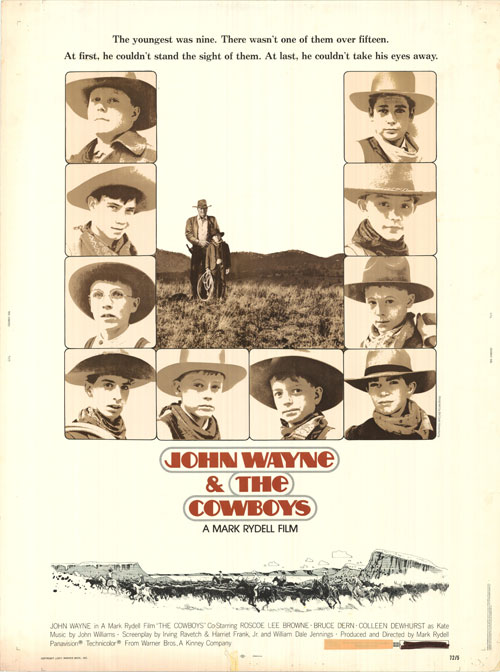
Young Frontier: John Wayne in THE COWBOYS (Warner Brothers 1972)


gary loggins's avatarcracked rear viewer

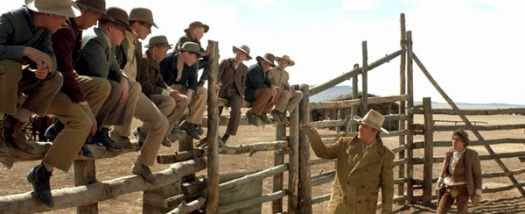
THE COWBOYS is not just another ‘John Wayne Movie’ from the latter part of his career. Not by a long shot. Duke had read the script and coveted the part of Wil Andersen, who’s forced to hire a bunch of wet behind the ears adolescents for a 400 mile cattle drive across the rugged Montana territory. Director Mark Rydell wanted George C. Scott for the role, but when John Wayne set his sights on something, he usually got what he wanted. The two men were at polar opposites of the political spectrum, and the Sanford Meisner-trained Rydell and Old Hollywood Wayne were expected to clash. They didn’t; putting their differences aside, they collaborated and cooperated  to make one of the best Westerns of the 70’s.

Andersen’s regular hands have all deserted him when gold is discovered nearby, leaving the aging rancher in the lurch. He heads for Boseman to look…

View original post 797 more words

Lisa Cleans Out Her DVR: Change of Habit (dir by William A. Graham)


(Lisa is currently in the process of cleaning out her DVR!  How long is it going to take?  Some would say forever but, here at the Shattered Lens, we’re hoping that she might have it all done by August.  Anyway, she recorded the 1969 film Change of Habit off of Starz on March 20th!)

It’s Elvis vs. God for the heart of Mary Tyler Moore!

(Okay, so that may be a little bit glib on my part but, seriously, that pretty much sums up Change of Habit.)

Change of Habit opens with three nuns walking through New York City.  There’s the forgettable nun, Sister Barbara (Jane Elliott).  There’s the black, streetwise nun, Sister Irene (Barbara McNair).  And then there’s the idealistic and wholesome nun, Sister Michelle (Mary Tyler Moore).  Because they’re nuns, even notoriously rude New Yorkers are nice to them.  They walk across a busy intersection and all of the cars stop for them.  A cop sees them jaywalking and just smiles and nods at them.  In case you were ever wondering why someone would become a nun, it’s because nuns always have the right-of-way and they don’t have to obey arbitrary laws.  It’s a good life.

The sisters are shopping and, as the opening credits roll, the three of them duck into a dressing room and change into contemporary civilian clothing.  Obsessively, the camera keeps zooming in on everyone’s bare legs.  You can literally hear the film’s producers telling all the boys in the audience, “This may be a G-rated Elvis film but that’s not going to stop us from implying nun nudity!”

It’s Sister Michelle’s idea that the nuns should wear contemporary clothing, the better to relate to the Godless youth of the 1960s.  Unfortunately, now that they’re dressed like everyone else, they have to actually obey traffic laws.  When they attempt to cross the street for a second time, cars honk at them and the cop yells at them for jaywalking.

Michelle, Irene, and Barbara get jobs working at a free clinic.  The clinic is run by John Carpenter (Elvis Presley).  Carpenter is looking for aspiring actresses to appear in a movie about a babysitter being stalked by a masked murderer on Halloween and … oh sorry.  Wrong John Carpenter.  This John Carpenter is a no-nonsense doctor who will stop at nothing to bring peace and good health to the most poverty-stricken neighborhoods in New York!

That’s right.  It’s an Elvis film with a social conscience!

And that probably sounds like a joke but Change of Habit‘s heart is in the right place.  It’s intentions are good.  At least a few of the people involved in the film were probably trying to make the world a better place.  There’s a subplot involving an autistic child that, when you consider this film was made in 1969, is handled with unusual sensitivity.  Of course, that doesn’t mean that the rest of Change of Habit doesn’t feel totally and completely out-of-touch.  The entire film feels so dated that I imagine it probably even felt dated when it was initially released.  This is one of those films where the local black militants give Sister Irene a hard time about being a sell-out, just to eventually admit, during a block party, that maybe white folks aren’t so bad after all.  By the end of the movie, they’re even joking with the cops.  All that was needed was for Elvis to sing a song or two.  To be honest, there are times when Change of Habit feels like the 1969 version of Kendall Jenner’s Pepsi commercial.

Of course, the majority of the film deals with Elvis falling in love with Mary Tyler Moore.  He doesn’t know that she’s a nun and, as she falls in love with him, she’s forced to make a difficult choice.  Does she follow God or does she follow Elvis?  Actually, the film ends before she officially makes that choice but there’s little doubt as to what she’s going to eventually do.  In his final non-concert film appearance, Elvis is totally miscast as a serious-minded doctor and, it must be said, he looked miserable throughout the entire film.  You get the feeling he’d rather be doing anything than starring in Change of Habit.  (Maybe he was already thinking about how much he wanted a special FBI badge.)  Mary Tyler Moore is a bit more believable as a nun.  Fortunately, both Moore and Elvis were likable performers and their likability makes Change of Habit, as ludicrous as it often is, far more watchable than it has any right to be.

In the end, Elvis may not have saved society but he did get to sing a gospel song or two.