4 Or More Shots From 4 Or More Films is just what it says it is, 4 shots from 4 of our favorite films. As opposed to the reviews and recaps that we usually post, 4 Shots From 4 Films lets the visuals do the talking!
116 years ago, on this date, Elia Kazan was born Istanbul. Kazan would go on to become a groundbreaking director, both for the stage and in movies. He would play a key role in turning both Marlon Brando and James Dean into stars and he made films, like Gentleman’s Agreement and A Face In The Crowd, that challenged the political pieties of the day. Of course, he also named names in front of HUAC, a decision that continues to be controversial to this day. Two of Kazan’s films — Gentleman’sAgreement and On The Waterfront — won the Oscar for Best Picture. A Streetcar Named Desire was widely expected to win before it was upset by An American In Paris. A Face In The Crowd is often cited as being one of the most prophetic films ever made. When Kazan was given an honorary Oscar in 1999, many in the auditorium refused to applaud but his influence as a filmmaker cannot be denied.
It’s time for….
4 Shots From 4 Elia Kazan Films
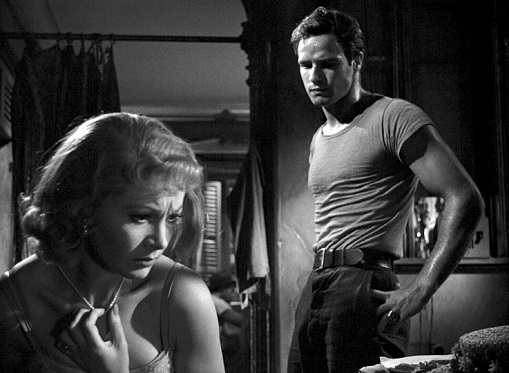
A Streetcar Named Desire (1951, dir by Elia Kazan, DP: Harry Stradling)
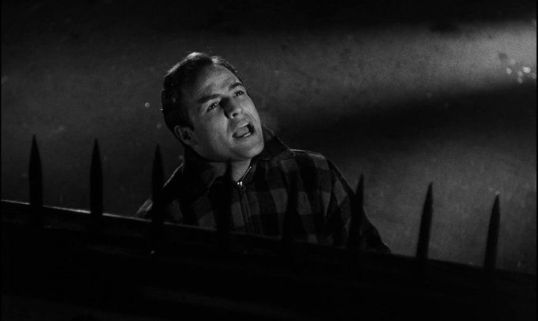
On The Waterfront (1954, dir by Elia Kazan, DP: Boris Kaufman)
East of Eden (1955, dir by Elia Kazan, DP: Ted D. McCord)
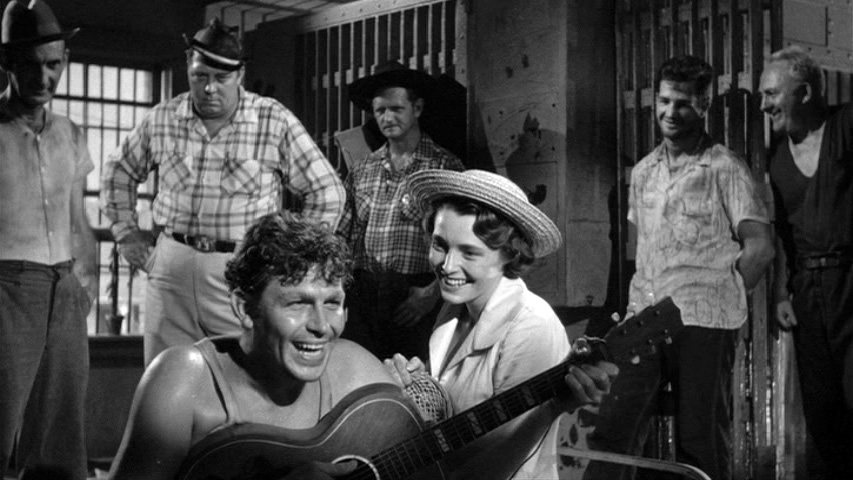
A Face In The Crowd (1957, dir by Elia Kazan, DP: Gayne Rescher and Harry Stradling)
4 Or More Shots From 4 Or More Films is just what it says it is, 4 shots from 4 of our favorite films. As opposed to the reviews and recaps that we usually post, 4 Shots From 4 Films lets the visuals do the talking!
114 years ago, on this date, Elia Kazan was born Istanbul. Kazan would go on to become a groundbreaking director, both for the stage and in movies. He would play a key role in turning both Marlon Brando and James Dean into stars and he made films, like Gentleman’s Agreement and A Face In The Crowd, that challenged the political pieties of the day. Of course, he also named names in front of HUAC, a decision that continues to be controversial to this day. Two of Kazan’s films — Gentleman’sAgreement and On The Waterfront — won the Oscar for Best Picture. A Streetcar Named Desire was widely expected to win before it was upset by An American In Paris. A Face In The Crowd is often cited as being one of the most prophetic films ever made. When Kazan was given an honorary Oscar in 1999, many in the auditorium refused to applaud but his influence as a filmmaker cannot be denied.
It’s time for….
4 Shots From 4 Elia Kazan Films
A Streetcar Named Desire (1951, dir by Elia Kazan, DP: Harry Stradling)
On The Waterfront (1954, dir by Elia Kazan, DP: Boris Kaufman)
East of Eden (1955, dir by Elia Kazan, DP: Ted D. McCord)
A Face In The Crowd (1957, dir by Elia Kazan, DP: Gayne Rescher and Harry Stradling)
The director Elia Kazan was born 113 years ago, in what was then the Ottoman Empire and what is today Turkey. Though he died in 2003, Kazan has remained a controversial figure and there’s still a lot of debate over what his artistic legacy should be. As a director, he revolutionized both Broadway and Hollywood. He made films about topics that other directors wouldn’t touch and he played a huge role in making Marlon Brando a star and popularizing the method. (I’ll allow you to decide whether that’s a good or a bad thing.) He won two Oscars and he’s been cited as an influence by some of the most important directors of the past century.
Kazan was also a former communist who, at the height of the 50s red scare, testified in front of the HUAC and who “named names.” Kazan often claimed that he only identified people who had already been named. Many of his former colleagues, however, felt that Kazan had betrayed them and never forgave him. Though Kazan always denied it, many felt that his decision to name names had more to do with settling personal scores than with any actual concern about national security. Not helping matters was that Kazan’s 1954 film, On The Waterfront, was widely viewed as being Kazan’s attempt to justify being an informer. Indeed, Kazan’s post-HUAC films seemed to alternate between thinly veiled attempts to paint himself as a hero and attempts to remind people that he was still a liberal.
That adds an interesting subtext to his best film, 1957’s A Face In The Crowd. In this film, Andy Griffith plays Lonesome Rhodes, the type of down-home entertainer who would probably have been quite popular with the supporters of HUAC. A reporter played by Patricia Neal falls in love with Lonesome and helps him become a celebrity with a national following but, too late, she discovers that Rhodes is hardly the folksy and naïve country boy that she originally believed him to be. Instead, he’s a master manipulator who, drunk on his own power and fame, makes plans to transform himself into a political power. Lonesome is portrayed as being a down-home fascist, a countryfied version of the infamous Father Charles Coughlin. At the same time, one could also argue that Rhodes, with his seething contempt for the people who follow him, was also meant as a commentary on the people who claimed to represent the workers but who only saw them and their struggle as a means to an end.
A Face In The Crowd may have been Kazan’s attempt to remind his detractors that he was still a man of the Left but it’s far more interesting as a work of prophecy. There’s really not much difference between Lonesome Rhodes and the modern day celebrities and influencers who are currently famous simply for being famous and who, for the right amount of money and ego-stroking, are more than willing to propagandize for one side or the other.
In this wonderfully acted and directed scene, Lonesome Rhodes gets drunk on his own power and reveals just how corrupt his outlook has become. Making this scene all the more powerful is that it’s easy to imagine our current leaders springing something like Secretary of National Morale on us today.
If you only know Andy Griffith from his genial TV Southerners in THE ANDY GRIFFITH SHOW and MATLOCK, brace yourself for A FACE IN THE CROWD. Griffith’s folksy monologues had landed him a starring role in the hit Broadway comedy NO TIME FOR SERGEANTS. The vicious, wild-eyed Lonesome Rhodes was thousands of miles away from anything he had done before, and the actor, guided by the sure hand of director Elia Kazan, gives us a searing performance in this satire of the power of the media, and the menace of the demagogue.
When we first meet Larry Rhodes, he’s in the drunk tank in rural Pickett, Arkansas, a small town not unlike Mayberry. Local radio host Marcia Jeffries is doing a remote broadcast there, hoping to catch some ratings. The no-account drifter is hostile at first, but when the sheriff promises him an early release, you can practically see the wheels spinning…
For our latest entry in the 44 Days of Paranoia, we take a look at Elia Kazan’s 1957 political satire, A Face In The Crowd.
The film opens with radio producer Marcia Jeffries (Patricia Neal) visiting a local jail in Arkansas. She’s looking for human interest stories that she can feature on her show and she discovers one when she meets an imprisoned drifter named Larry Rhodes (Andy Griffith). When Marcia interviews him, Rhodes proves himself to be a natural performer, telling folksy jokes and launching into a song about being a “free man in the morning.” Rhodes proves to be so popular that, after he’s released from jail, he pursues a career in show business with Marcia as both his manager and, eventually, his lover.
Moving to Memphis, a renamed Lonesome Rhodes eventually lands his own television variety show and he soon starts doing irreverent commercials for local companies. Along the way, Rhodes also finds a new manager, the glib and manic Joey DePalma (Anthony Franciosa). With the help of Joey, Rhodes becomes the spokesman for a fake energy supplement, Vitajex.
As Rhodes’ fame grows, so does his ego. After dumping Jeffries, Rhodes impulsively marries a 17 year-old majorette (Lee Remick). His show also goes national and Rhodes soon starts to use his influence to try to both promote an incompetent, business-backed Presidential candidate and to destroy anyone who he considers to be an enemy. As his show’s disillusioned head writer (Walter Matthau) puts it, Rhodes has become a “demagogue in denim.”
A Face In The Crowd is a personal favorite of mine. Director Kazan deftly mixes satire with melodrama and, with the exception of the weak ending, the film’s vision of media manipulation and demagogic celebrities probably feels more plausible today than when it was first released. The film is full of great performances, from the avuncular Walter Matthau to vulnerable Patricia Neal to the innocent-and-then-not-so-innocent Lee Remick. Anthony Franciosa is wonderfully glib and sleazy and it’s a lot of fun to watch his joy at discovering how easy it is to manipulate the world.
Ultimately, however, the film’s success is mostly due to Andy Griffith’s amazing performance as Lonesome Rhodes. Griffith, displaying all of the folksiness but none of the empathy that would be displayed in his later television show, turns Rhodes into a force of nature, a smiling charlatan and a charismatic sociopath who manipulates for the pure enjoyment of manipulation.
To make the obvious comparison, it’s very easy to imagine Lonesome Rhodes getting his own show on MSNBC, where on a nightly basis he could bark orders at his followers and ridicule anyone who dares to question him. But even beyond that, the character of Lonesome Rhodes resonates. I’m from the South. I grew up down here and I live down here. I can tell you, from my own personal observations and experiences, that we still have our share of demagogues. Some of them run in elections and some of them preach on Sunday but all of them have got a bit of Lonesome Rhodes inside of them.
For that reason, A Face In The Crowd is probably more relevent today than it’s ever been.
Located below is the famous Vitajex advertising montage from Elia Kazan’s 1957 film, A Face In The Crowd. Everytime I see this, I wonder if maybe American audiences in the 50s were smarter than we give them credit for.
Then again, A Face in The Crowd was a notorious financial and critical failure when it was first released. It’s actually one of the best and most influential movies ever made. Certainly, it’s one of the few Kazan films that still seems artistically relevent today. It should also be noted that A Face in the Crowd features Anthony Franciosa years before his starring turn in Dario Argento’s Tenebrae, Andy Griffith playing a villain, the film debut of Lee Remick, Walter Matthau as a tv writer, and Patricia Neal having a nervous breakdown. Supposedly, a very young Rip Torn is somewhere in this film as well but I’ve never been able to spot him.


 Through the Shattered Lens