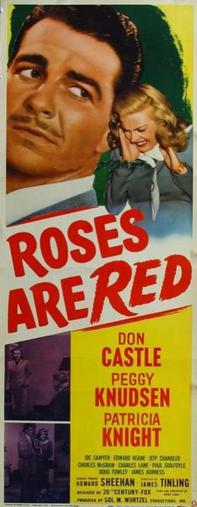
30 Days of Noir #10: Roses are Red (dir by James Tinling)


As the 1947 film, Roses Are Red, begins, Robert A. Thorne (Don Castle) has just been elected to the office of district attorney.

Now, being the horror fan that I am, the thing that I immediately noticed was that the new district attorney had the exact same name as the character played by Gregory Peck in The Omen.  However, Roses Are Red has nothing to do with the son of Satan or the end of the world.  Instead, it’s just a briskly paced tale of swapped identity.

Robert A. Thorne is not just a brilliant lawyer.  He’s also an example of that rare breed, an honest politician.  He ran on a platform of reform and that’s what he’s intending to pursue now that he’s been elected.  As he tells his girlfriend, journalist Martha McCormick (Peggy Knudsen), cleaning up this country isn’t going to be easy but he’s determined to do it.  And the first step is going to be taking down the local mob boss, Jim Locke (Edward Keane).

The wheelchair-bound Jim Locke is a man who prefers to stay in the safety of his penthouse, where he can feed his fish and give orders to his subordinates, all of whom have names like Duke (Charles McGraw), Knuckle (Jeff Chandler), Buster (Paul Guilfoyle), and Ace (Douglas Fowley).  However, his man on the police force, Lt. Rocky Wall (Joe Sawyer), has warned him that this new district attorney might not respond to usual combination of bribes and intimidation.  That’s not good news because there are men who might be willing to testify against Locke in return for a shorter prison sentence.

However, things start to look up when none other than Robert A. Thorne shows up at Locke’s penthouse and says that the honesty bit was all a sham and that he wants to be on Locke’s payroll.  However, Locke soon figures out that he’s not talking to Thorne.  Instead, he’s talking to Don Carney (also played by Don Castle), a career criminal who has recently been released from prison and who just happens to look exactly like Robert Thorne!

Locke and Don come up with a plan that seems foolproof.  What if Knuckle kidnaps Thorne and holds him hostage for a few days?  During that time, Don can study Thorne and learn how to perfectly imitate all of his movements and expressions.  Once the two men are absolutely indistinguishable, Knuckle will murder Thorne and then Don will take his place.

Knuckle manages to kidnap Thorne with absolutely no trouble.  The police, under the prodding of Lt. Wall, announce that Thorne has obviously run off to avoid dealing with the local gangsters.  Don starts the process of studying Thorne but it turns out that the district attorney has a few tricks of his own….

With a running time of only 67 minutes, Roses are Red doesn’t waste any time jumping into its somewhat implausible plot.  Fortunately, the film is so short and quickly paced that most viewers won’t really have time to worry about whether or not the film’s plot actually makes any sense.  This is an entertaining, low-budget film noir, featuring a host of memorable performances and all of the hard-boiled dialogue that you could hope for.  Don Castle does a good job playing both the sleazy Don Carney and the upright Robert A. Thorne.  History nerds like me will immediately notice that, with his mustache and his slicked back hair, Castle bears a distinct resemblance to former Manhattan D.A. and two-time presidential candidate, Thomas E. Dewey.

All in all, Roses are Red is an enjoyable film for fans of old school gangster noir.  Check it out below:


30 Days of Noir #9: Pickup (dir by Hugo Haas)


Once upon a time, there was a man who lived by the railroad tracks.  He was a station agent and his name was Jan Horak (Hugo Haas) but everyone just called him “Hunky.”  He was a middle-aged man, originally from Eastern Europe.  He lived in a little house and basically kept to himself.  His only friends were a slang-spouting hobo known as The Professor (Howland Chamberlain) and his assistant, the young and handsome Steve (Allan Nixon).  With no family in the United States, Hunky was frequently lonely so he decided to go to the town carnival and buy a puppy.  Instead, he ended up meeting the woman who will not only become his wife but who would also eventually plot his murder.

And so begins the low-budget 1951 film, Pickup.

The woman who Hunky meets is Betty (Beverly Michaels).  When we first see Betty, she’s riding on a miracle-go-round with a rather bored look on her face.  (The camera lingers on her legs, which was the traditional way that films introduced “dangerous” women in the late 40s and 50s.)  We know that Betty is probably bad news because she chews gum with her mouth open and she smirks as soon as she sees Hunky stumbling around the carnival.  She approaches him and starts to flirt with him.  Hunky is so smitten that he forgets about buying a puppy.

Instead, he returns home and prepares for a wedding.  However, what Hunky doesn’t know is that Betty is in desperate need of money and the only reason that she’s showing any interest in him is because she’s under the impression that he’s rich.  As soon as they get married, Betty starts planning for a way to lose a husband while still getting to keep his money.  Not surprisingly, it involves Steve….

It also involves a sudden case of deafness.  Even before Hunky marries Betty, he suffers from a persistent ringing in his ears.  It only gets worse as it becomes more and more obvious just how unhappy Betty is in their marriage.  One day, while standing on the railroad tracks, Hunky loses his hearing all together.

He screams at the sky and hears nothing.

He grabs a sledgehammer and starts pounding it against the tracks and, again, he hears nothing.

He tells Betty and Steve that he can’t hear and, when they reply, he can see their lips move but he can’t hear a word that they say.

Hunky’s gone deaf!  Steve moves in to help Betty take care of her husband.  He also moves in because he’s been having an affair with Betty for quite some time.  They openly discuss murdering Hunky in front of him, confident that he can’t hear a word that they’re saying.  What they don’t realize, though, is that Hunky’s deafness was only temporary and he knows exactly what they’re planning to do….

I really liked Pickup.  Plotwise, it’s not the most original film ever made.  In fact, the film is often described as being an unofficial remake of The Postman Always Rings Twice (this despite the fact that Pickup is based on a novel that was published before James Cain’s famous story).  But that said, the film has enough odd and quirky moments to make it stand out.

For instance, there’s the character of the Professor, who comes across like some sort of early beatnik who has somehow found himself in a hard-boiled crime film.  There’s the scenes of Hunky not only losing his hearing but also slowly recovering it, with dialogue fading in and out as if it was recorded underwater.  And then there’s Beverly Michaels, giving an absolutely wonderful performance as Betty.  As played by Michaels, Betty is someone who is very much aware that she’s playing a role.  She delivers every sarcastic put-down with confidence and style but, throughout the film, there are hints that Betty is not quite as sure-of-herself as she seems to be.  (Just watch the scene where she nervously tries to light a cigarette.)

There’s a profound sense of melancholy running through Pickup, one that only really becomes clear after the film ends. For that, we must credit director and star Hugo Haas.  Originally hailing from what is now the Czech Republic, Hugo Haas came to Hollywood to escape the Nazis and he plays Hunky with the sad weariness of a man who understands that the world can be a dark place.  As written, Hunky seems incredibly naive but, as played by Haas, he’s just a man so desperate to believe in love and kindness that he allows himself to tricked.  However, as the film makes clear, he’s never as much of a fool as the people around him believe him to be.  Before eventually returning to Europe, Haas made a handful of successful (if not quite critically acclaimed) films in America.  Almost all of them seemed to return to the same theme of outsiders searching for love.

Personally, I recommend picking up Pickup.  It’s a classic B-noir, worth seeing for both Beverly Michaels and Hugo Haas.

http://www.youtube.com/watch?v=LbZxQ0NuyCU

30 Days of Noir #8: The Red Menace (dir by R.G. Springsteen)


The 1949 film, The Red Menace, starts in the same manner as many film noirs.

It’s night.  It’s dark.  A car speeds through the desert.  Inside the car are Bill Jones (Robert Rockwell) and Nina Petrovka (Hannelore Axman).  When they stop at a gas station, the owner asks too many questions and gets a phone call.  Bill and Nina get paranoid and speed off.  What are they running from? we wonder.

We’re not the only ones wondering.  Soon a narrator starts to speak.  “What are they running from?” the narrator asks.  The narration is supplied by Lloyd G. Davies, who was apparently a members of the Los Angeles city council at the time this film was made.

It’s flashback time!  We discover that Bill is an ex-GI, recently returned from World War II.  Haunted by the death and destruction that he saw in Europe, Bill is now questioning everything that he once believed about America.  One day, a man overhears Bill yelling at a bureaucrat at the VA.  The man approaches Bill and tells him that he can help.  The man leads Bill to a hidden bar and introduces Bill to the sultry Mollie O’Flaherty (Barbara Fuller).  Mollie invites Bill back to her apartment.

Are we in Double Indemnity territory?  Is she going to convince him to murder her husband?

Are we heading down the same path that doomed Lawrence Tierney in The Hoodlum?  Is Mollie going to trick Bill into serving as the fall guy for a bank robbery?

Or …. is she going to show him a book?  In fact, not just one book but …. SEVERAL BOOKS!

Bill is actually quite shocked to discover that Mollie not only has a large collection of books but that she’s actually read some of them.  He’s even more shocked when he discovers that most of them are books about communism!  Mollie admits that yes, she is a communist.  She goes on to explain that communism isn’t what Bill has been led to believe it to be.  She argues that the communists just want the best for the workers and that the communists were the first group to fight for civil rights.  Bill says that he doesn’t care about causes anymore but he soon starts to hang out with Mollie and the members of the local communist cell.

While Mollie may have been the one assigned to bring Bill into the cell, it’s Nina who is instructed to teach Bill about Marx.  (Of course, she can’t just educate him at a school.  Instead, she has to do stuff like speak to him while they’re going in circles on a ferris wheel.)  At first, Bill is a happy communist, helping to organize labor protests and attending all of the right meetings.  However it doesn’t take long before both Bill and Nina start to realize that not everything is perfect in the aspiring worker’s paradise.  For one thing, the heads of the cell look, act, and speak more like gangsters than revolutionaries.  Disagreeing with the party line can lead to everything from a beating to a murder to a denouncement in the local communist newspaper, The Toiler.  Even the party’s commitment to civil rights turns out to be a lie as the party leaders curse the only black member of the cell behind his back.

When Mollie’s lover, the poet Henry Solomon (Shepard Menken), makes the mistake of writing a poem that suggests that Marx was inspired by Hegel, he’s told that the official party position is that no one inspired Marx but Marx.  Henry is told to either denounce his poem or be cast out of the movement.  After Henry tells off the leaders of the cell, he is denounced in The Toiler.  Henry finds himself cast out by all of his friends, sentenced to wander the dark streets of Los Angeles alone.  Even though Henry made a point of tearing up his communist membership card, it turns out that the party has several copies of every card.  Whenever Henry gets a new job, his employer is mailed a copy of Henry’s card and Henry finds himself unemployed again.  As for Mollie, she’s visited by not only her mother but also by her priest, all of whom tell her that the communists are no good.  Can a trip back to church save Mollie’s soul?

Meanwhile, Bill and Nina find themselves being targeted by one of the leaders of the cell, Yvonne Kraus (Betty Lou Gerson). Yvonne is so evil that, when she’s confronted by U.S. immigration officers, she immediately launches into a bizarre and rather incoherent monologue.  Drums start to play in the background as she speaks, letting us know that she’s totally sold her soul to the communists.  It’s suggested that Yvonne wants Bill to herself but Bill has fallen in love with Nina and Nina with him.  This is despite the fact that no one in the cell is allowed to all in love without prior permission.

Definitely a film of its time, The Red Menace takes all of the usual gangster film clichés and uses them to tell a story not about the Mafia but instead about the Marxists.  Instead of greed, the film’s femme fatales are motivated by Das Kapital.  Speaking of which, the film features a bit more ideology than you might expect.  Mollie, Nina, and Solomon are all given scenes where they explain the philosophy behind communism and in which they explain why an otherwise decent American might turn against their own government.  The film suggests that Yvonne and her cohorts are evil not so much because they believe in communism but because they’re hypocrites who don’t practice what they preach.

Which is not to say that The Red Menace is a particularly nuanced film.  Especially when Gerson’s delivering her dialogue, The Red Menace is a frequently over-the-top melodrama.  This is a movie in which Bill and Nina are fortunate enough to meet a folksy and patriotic sheriff named Sam.  “We just call him Uncle Sam!” a nearby child cheerfully exclaims.

The Red Menace is a film that’s occasionally silly and occasionally effective.  It can make for a disjointed viewing experience, as harrowing scenes of Henry being shunned by former comrades are followed up by scenes of folksy old Uncle Sam talkin’ about how everyone gets a second chance in ‘Merica.  It’s a film that begins with a picture of an octopus with the face of Karl Marx and ends with a shot of the Statue of Liberty.  The Left will hold the film up as being a campy document of American paranoia while the Right will just enjoy watching a bunch of commies get what they deserve.

And then there’s the unapologetic history nerds, like me.  I enjoyed the movie.  It’s a document of its time.

30 Days of Noir #7: The Sniper (dir by Edward Dmytryk)


Halfway through the chilling 1952 film, The Sniper, there’s a scene in which a woman is seen standing on the rooftop of a San Francisco apartment building.  She’s nonchalantly hanging laundry.  When she steps to the side, we suddenly see that there’s a man standing on the next rooftop over.  And he’s holding a rifle.

Fortunately, in this case, the man is a policeman.  He’s one of several cops who have been ordered to stand on rooftops with their weapons drawn and to keep an eye on the city below.  There’s a killer on the loose and the city is demanding that the police capture him.  And yet, even with a city that’s caught in the grip of fear and even with heavily armed men watching everything going on in the streets, life goes on.  People go to bars.  People go to work. Couples stroll in the park.  And one woman hangs her laundry to dry on the rooftop of an apartment building.

Suddenly, the policeman spots someone on another rooftop, a man who isn’t supposed to be there.  He’s a young guy, carrying what looks like a rifle.  The police quickly rush to the rooftop where they arrest the young man.  Have they caught the sniper who has been terrorizing San Francisco?

The police think that they have their man but we know that they don’t.  We know that the sniper is a guy named Eddie Miller (Arthur Franz).  Eddie is a delivery man.  He’s handsome but, from the minute we first see him, we can tell that there’s something off about him.  He stumbles through life, keeping his head down and rarely speaking to anyone.  The few times he does attempt to smile, it’s painfully awkward.  He’s someone who is struggling to convince the people of San Francisco that he’s one of them but the more he tries, the more of an outsider he seems to be.  In fact, the only time that we see Eddie truly happy is when he goes to a carnival and comes across a dunk tank.  Over and over again, he throws a baseball and cause the woman inside to be submerged in cold water.

At first, Eddie tries to deal with his bad thoughts by deliberately burning his hand on an electric stove.  When he goes to the emergency room, he asks the attending doctor why he would do something like that but the doctor is soon distracted by another patient.  With his hand bandaged, Eddie goes on a shooting spree, targeting brunette women.

This dark film is fairly evenly divided, between Eddie, the cops that are trying to catch him, and the psychiatrist who tries to explain him.  Not surprisingly, the cops, led by the appropriately named Lt. Kafka (Adolphe Menjou), aren’t particularly interested in what makes the sniper tick.  They just want to get him off the street.  However, Dr. James Kent (Richard Kiley) is convinced that the only way to stop not only this killer but others is to understand what’s going on inside of his mind.  The differences between Kafka and Kent’s approaches are most obvious in a scene in which every registered sex offender in San Francisco is paraded into a squad room full of jeering cops.  While the detectives taunt the offenders that they know, the offender that they don’t know prepares to kill yet again.

The Sniper was directed by Edward Dmytryk, who previously directed the Oscar-nominated (and superficially similar) Crossfire.  This was Dmytryk’s first film after his career was temporarily derailed by his refusal to testify before the House Unamerican Activities Committee.  (He later changed his mind and named names while testifying about his time as a member of the Community Party.)  Interestingly enough, top-billed Adolphe Menjou was one of the leaders of the anti-communist Motion Picture Alliance for the Preservation of American Ideals, a prominent supporter of the blacklist that Dmytryk had narrowly escaped.

Filmed in a black-and-white, documentary style, The Sniper is a chilling and disturbing film.  When Eddie stalks through the city at night, the dark shadows that he casts against the walls of empty alleyways and closed storefronts serve to remind us that men like Eddie could be lurking anywhere, unseen and unknown.  During the day scenes, the harshly bright lighting reminds us of just how vulnerable we are.  If the night provides too many places to hide, the day provides too few.  Arthur Franz gives a disturbingly credible performance as Eddie.  While he plays Eddie as being obviously troubled, he also suggests how someone like Eddie has managed to survive without getting exposed.  Menjou is properly cynical as the world weary Kafka while Richard Kiley brings some needed passion and anger to the film’s most talky scenes.  The film ends on a note of melancholy ambiguity, leaving it to us to make up our own mind about how to deal with the Eddie Millers of the world.

30 Days of Noir #6: Walk The Dark Street (dir by Wyott Ordung)


The 1956 film noir, Walk The Dark Street, opens with a platoon of soldiers fighting in the Korean War.

Dan Lawton (Don Ross) has been promoted to lieutenant and Sgt. Tommy Garrick (Eddie Kafafian) isn’t happy about it.  Despite the fact that he and Dan were once good friends, Tommy now is openly insubordinate.  Dan claims that Tommy is just jealous that Dan got promoted while Tommy didn’t.  Tommy, however, claims that Dan is too incompetent to lead the men.  He writes a letter to his older brother, Frank (Chuck Conners).  In the letter, Tommy says that, if he dies, Dan is to blame.  Shortly after sending the letter, Tommy is killed in battle.

After the war, Dan returns to the United States.  When he enlisted in the army, he left behind a small hardware store and now he’s returned to discover that the store’s insurance has lapsed and that he’ll need several thousand dollars to renew it.

While Dan tries to come up with a way to save his store, he also decides to pay a visit to Tommy’s brother.  Why does Dan drop by Frank’s apartment?  It’s difficult to say.  When Dan first shows up in Frank’s doorway, you assume that he’s going to praise Tommy or maybe seek some sort of forgiveness for Tommy’s death.  Instead, Dan just tells Frank that Tommy wouldn’t have gotten killed if he had followed orders (!) and then mentions that he and Tommy didn’t always get along (!!).  Like, seriously, what’s the point of telling Frank any of this?  What does Dan think that he’s accomplishing?

Frank doesn’t seem to be too upset over Tommy’s death.  In fact, Frank is actually a lot more interested in talking about his love of hunting.  Frank even shows Dan some film that he shot during his last safari, which means that those of us in the audience get to spend four minutes watching nature documentary stock footage that has little to do with the rest of the movie.  Frank explains that he has a heart condition so he can’t go abroad to hunt anymore.  Poor Frank!  But, hey, Dan’s going to be in Los Angeles for the next two days and Frank does still own a gun so maybe Frank could just hunt him!

At first, Dan’s not too enthusiastic about the idea of being hunted by Frank.  Frank, however, assures him that they won’t be using real bullets.  Instead, they’ll hunt each other with “camera guns.”  Apparently, you pull the trigger and, instead of firing a bullet, the gun fires a cartridge that takes a picture.  Dan’s still reluctant but then Frank offers to pay him $10,000.  You can renew a lot of insurance for $10,000!

Quicker than you can say “Most Dangerous Game!,” Frank is stalking Dan through Los Angeles.  What Dan doesn’t realize is that Frank was lying about using a camera gun.  He wants revenge for his brother’s death so he’s hunting Dan with live ammunition!

This is one of those films that probably sounds more interesting than it actually is.  After setting up an intriguing premise, Walk The Dark Street doesn’t really do much with it.  It turns out that neither Dan nor Frank is particularly clever so nearly the entire movie is just footage of them walking down various streets in Los Angeles.  If you’re a history nerd like me, you might get a kick out of seeing what the streets of Los Angeles looked like in the mid-50s but otherwise, there’s not much excitement to be found in this movie.

The film stretched its credibility to the breaking point when Dan, while trying to hide from Frank, just happens to randomly run into Tommy’s ex-girlfriend, Helen (Regina Gleason).  Whereas Frank is stoic to a fault and Dan is just an incredible dumbass, Helen at least gets to tell everyone off.  She’s not impressed with either Frank or Dan, which makes her the default audience surrogate.  Helen figures out what Frank is planning but Dan refuses to believe her because, again, Dan’s not very smart.  While it may not have been the film’s intention, it’s hard not to feel that Tommy had a point about Dan being incredibly incompetent.

Aside from offering a chance to see what Los Angeles looked like back in the 50s, Walk The Dark Street is largely forgettable.

http://www.youtube.com/watch?v=sBkdbXm07ow

30 Days of Noir #5: The Hoodlum (dir by Max Nosseck)


He’s a bad seed, that Vincent Lubeck!

At the start of the 1951 film, The Hoodlum, Vincent (played by the legendary Lawrence Tierney) is rotting away in prison.  Even though the parole board is considering whether or not to release him, things aren’t looking good for Vincent.  The warden (Gene Roth) has taken it upon himself to attend the parole hearing and remind them of Vincent’s long criminal record.  Vincent’s been in trouble for as long as he’s been alive.  The warden says that allowing Vincent to walk the streets will just make the streets even more unsafe.

However, Vincent’s mother (Lisa Golm) swears that she’ll keep an eye on Vincent.  She will give Vincent a place to live and she’s even arranged for Vincent to get a job at the family gas station, where he’ll be working under his brother, Johnny (played Lawrence’s younger brother, Edward Tienery).  Moved by a mother’s tears, the board grants Vincent parole.

Big mistake.  As soon as Vincent’s out of prison, he starts making plans to return to his old life.  He has no interest in working in a gas station and he resents Johnny’s success.  Vincent is the type of bum that steals his brother’s girlfriend, gets her pregnant, and doesn’t feel the least bit guilty when she jumps off a roof to her death.

Vincent’s also the type who always has a scheme going.  For instance, it turns out that his brother’s gas station is right across the street from both the town mortuary and the bank!  Soon, Vincent is hanging out with his old gang and plotting to rob an armored car.  Vincent’s not going to let anyone stand in his way.  Not the police.  Not his lover.  Not even his own brother.  The only person that Vincent seems to care about is his sickly mother and, even then, Vincent doesn’t actually care enough to stay out of trouble.

The Hoodlum is a low-budget gangster noir.  It’s only an hour long so it doesn’t waste any time.  Instead, it jumps straight into its often sordid story.  From the minute that Vincent gets out of prison, he’s greedily watching that bank and telling off anyone who looks at him funny.  What makes Vincent an especially despicable character is that he’s not even good at what he does.  If Vincent was some sort of criminal mastermind, you could at least get some sort of guilty pleasure out of watching him rob that armored car.  Instead, Vincent’s an idiot who not only messes up everything that he does but who isn’t even smart enough to understand that he’s screwed up.

Fortunately, Vincent is played by Lawrence Tierney.  Tierney was a veteran tough guy, an actor who played killers onscreen and who spent a good deal of his offscreen time sitting in jail.  (Tierney had a bad habit of getting into bar brawls.)  In the role of Vincent, Tierney is a force of pure, uninhibited destructive energy.  When he glares at his brother, you feel the resentment.  When he rushes at a security guard while holding a gun, you never doubt that he’s capable of using it.  Tierney gives such a raw and angry performance that you can’t stop watching him.  Vincent quickly overstays his welcome but Tierney remains a fascinating actor.

The Hoodlum is a short and brutal little movie, one that works best as a showcase for the intimidating talent of Lawrence Tierney.

30 Days of Noir #4: Lady in the Death House (dir by Steve Sekely)


The 1944 film, Lady in the Death House, tells the tragic and faintly ridiculous story of Mary Kirk Logan (Jean Parker).

The daughter of a small-time criminal, Mary has spent most of her life trying to escape from her family’s legacy of crime.  She’s even got a job, working at the same bank that her father once tried to rip off.  Of course, at work, everyone knows her as Mary Kirk and they have no idea that her father was the infamous Tom Logan.  If that information got out, Mary would lose her job and no longer be able to take care of herself or her younger sister, Suzy (Marcia Mae Jones).

One night, Mary is out on a date with a clumsy man who takes her out to a nightclub and manages to accidentally set Mary’s dress on fire.  Luckily, Dr. Brad Braford (Douglas Fowley) is there, having a drink with his friend, the famous criminologist, Charles Finch (Lionel Atwill).  Brad jumps into action, extinguishing the fire and saving Mary’s dress.  It’s love at first sight.

There’s just one problem.  Dr. Bradford is studying ways to bring the dead back to life and, in order to raise money for his research, he’s been working as the state’s executioner.  When someone goes to the electric chair, Brad is the one who pulls the lever.  Mary says that she can only marry Brad if he gives up his electrifying night job.

However, before Brad can turn in his letter of resignation, Mary is arrested for the murder of Willis Millen (Dick Curtis), a crook who once knew her father.  Mary swears that she’s innocent but there are two eye witnesses who testify that they not only heard Mary and Willis fighting but that they also saw the shadow of someone hitting Willis over the head with a lamp.  It doesn’t take long for the jury to reach a verdict:

I have to admit that, when this newspaper appeared on-screen, I was actually more curious about the “youth” who was arrested for stealing glitter off of campaign signs.  However, for whatever reason, the film declines to follow up on that story.  Instead, we watch as Mary goes to death row, with the knowledge that she is to die “at the hand of the man I love.”

However, there may still be hope!  Charles thinks that Mary is innocent.  Though there’s only 24 hours left before Brad is scheduled to execute Mary, Charles launches an investigation of his own.  But even if Charles is able to find the evidence that exonerates Mary, will he be able to contact the governor in time?  Or will Mary go to the chair?

Well, regardless of what happens, rest assured that this World War II-era film will end with an appeal for all movie goers to do the right thing and buy war bonds.

Lady in the Death House is an entertaining but fairly ludicrous little movie.  I mean, realistically, having the executioner execute his own fiancée is a huge conflict of interest.  It seems like they could have gotten a substitute executioner, if just for one night.  But, if they did that, we wouldn’t get the melodramatic highlight of Mary announcing that she’s scheduled to be killed “by the hand of the man I love.”

Lady in the Death House provides a rare chance to see Lionel Atwill in a heroic role.  The British actor played a countless number of mad scientists, killers, and Nazis before his premature death in 1946.  (Atwill’s promising career was derailed in 1943, when he accused of hosting orgies at home and was subsequently convicted of perjury.  That’s one reason why Atwill turned up in a “poverty row” feature like this one.)  Atwill is convincing as Charles Finch.  The same superior attitude that made him a good villain also makes him believable as the only person capable of figuring out who murdered Willis Millen.

Taking on its own terms, Lady in the Death House is a fun movie.  If nothing else, it provides a lesson on how to get a message to the governor, even if no one’s quite sure where he is for the evening.  That’s an important lesson to learn!

30 Days of Noir #3: Footsteps in the Night (dir by Jean Yarbough)


The 1957 film Footsteps in the Night opens in a small motel apartment in Los Angeles.

Jazz blares from a record player.  Playing cards are spread across a table.  A cigarette burns in an ashtray while a stack of poker chips sits undisturbed nearby.  When the apartment’s resident, Henry Johnson (Douglas Dick) steps into the room, he nearly stumbles over the dead body that’s lying in the middle of the floor.

Henry looks down at the body.  Is he shocked?  Is he scared?  Is he regretful?  Is he guilty?  It’s impossible to tell from his somewhat perturbed but mostly blank facial expression.  He takes in the scene and then promptly turns out the lights.

The dead man is Henry’s neighbor, Fred Horner (Robert Shaye).  When the police arrive, Detectives Andy Doyle (Bill Elliott) and Mike Duncan (Don Haggerty) immediately deduce that someone murdered Fred in the middle of a poker game.  Since everyone says that Henry was not only a degenerate gambler but that he also frequently got into arguments with Fred, Henry becomes the number one suspect.  Not helping Henry’s case is the fact that he’s disappeared and his girlfriend, Mary Raiken (Eleanore Train), won’t reveal where he’s hiding.

It seems like an open-and-shut case but Doyle has his doubts.  The case against Henry is almost too perfect and Doyle wonders if maybe they’re overlooking something.  As Doyle and Duncan continue to investigate, they discover that Fred Horner was an angry and misanthropic man.  They also discover that there’s a salesman named Bradbury (James Flavin) who is staying at an adjacent hotel and who bears a strong resemblance to the dead man….

Clocking in at just 62 minutes, Footsteps in the Night is a fast-paced police procedural with elements of film noir tossed in for good measure.  While I was doing some research for this review, I discovered that Footsteps in the Night was actually the fifth and final film in which Bill Elliott played Detective Andy Doyle.  Before taking on the role of Doyle, Elliott appeared in several westerns and he plays Doyle much like an ideal frontier sheriff.  He’s a no-nonsense lawman who solves cases with common sense and doesn’t have much time for wild speculation.  Dan Haggerty backs him up as the equally no-nonsense Mike Duncan.  As opposed to the modern tendency to celebrate cops who “break the rules,” Footsteps in the Night emphasizes the professional, by-the-book attitude of Doyle and Duncan.  If you were ever murdered, Duncan and Doyle are the type of cops that you would want assigned to the case.

As for their number one suspect, Henry may claim to have just been an innocent bystander but his gambling addiction makes him less than trustworthy in the eyes of many cops.  It’s only when Doyle and Duncan start to dig into the case that they discover just how cruelly Fred manipulated Henry’s addiction.  In the best tradition of many murder mysteries, Footsteps in the Night not only leaves you wondering who the murderer may have been but also whether or not the victim may have gotten what he deserved.

Footsteps in the Night is a good police procedural.  I look forward to watching and reviewing the other four films in which Bill Elliott played Detective Doyle as well.

http://www.youtube.com/watch?v=sTwVORuKuJ0

30 Days of Noir #2: Whispering Footsteps (dir by Howard Bretherton)


The 1943 film Whispering Footsteps opens with Mark Borne (John Hubbard) getting ready for his day.  In his bedroom, at the boarding house where he lives, Mark turns on his radio and hears a news report of a double murder in a nearby town.  Two girls have been strangled.

As the news report says that the killer has brown hair, Mark brushes his brown hair.

As the news report says that the killer has brown eyes, Mark looks at his brown eyes in the mirror.

As the news report says that the killer has a “lean, intelligent” face, the camera focuses on Mark’s lean, intelligent face.

Finally, as the news report says that the killer was wearing a gray, double-breasted suit, Mark puts on gray, double-breasted suit.

Yes, Mark looks just like the murderer and that quickly becomes a problem for him as he attempts to go about his day.  When he walks to his job at the local bank, he notices that he’s being followed by a detective (Cy Kendall).  When Mark later tries to take his lunch break, he again finds himself being followed.  Desperate to escape from the detective, Mark steps into a bookstore and buys a random book.  It’s only once he steps outside that Mark discovers that the title of the book is Psychology of the Homicidal.

Mark is a respectable member of the community but, because he looks like a serial killer, everyone in town soon starts to gossip about him.  Why does he go for so many walks?  Why does he sometimes seem to be in a bad mood?  Could he be a murderer?  Even the other residents of the boarding house start to view him with suspicion.  Every time that she sees him, Rose Murphy (Juanita Quigley) screams.

Of course, Rose screams whenever anything happens.  For instance, when she is shown a newspaper story about a local murder, Rose screams.  Whenever anyone walks up behind her, Rose screams.  Whenever anyone says hi to her, Rose screams.  When a woman is found strangled in the basement, Rose screams again.  Admittedly, it’s easy to get annoyed with Rose’s constant screaming but, in that last case, she’s probably justified.

Anyway, Mark only has one person on his side and that’s Brook (Rita Quigley), the daughter of his boss.  And yet, at one point, Brook finds herself being chased through the night by a man in a double-breasted suit.  Is Mark guilty or does he just have the worst luck in the world?

If nothing else, Whispering Footsteps will keep you guessing.  Up until the last minute of the film, you’re never sure whether Mark is innocent or guilty.  Who is the monster, the film asks.  Is it Mark or is it the gossips who have decided to judge him?  As convincingly played by John Hubbard, Mark starts out as upbeat and just a little bit shallow but, by the end of the movie, he’s become a haunted and paranoid man, embittered by the town’s refusal to believe in him.  Charles Halton, as Mark’s self-righteous boss, and Rita Quigley provide good support.  Less successful are some awkward attempts at humor.  It won’t take you long to get tired of Rose screaming.

Clocking in at 52 minutes, Whispering Footsteps was obviously meant to be the second part of a double feature.  It’s a well-done examination of guilt, innocence, and gossip.  See it on a double bill with In A Lonely Place.

30 Days of Noir #1: Lady Gangster (dir by Robert Florey)


Welcome to Noirvember!

Yeah, yeah, I know.  That sounds kinda silly, doesn’t it?  However, November is traditionally the month that classic film bloggers tend to concentrate on writing about film noir.  It provides a bit of grit and cynicism in between the horror fun of October and the holiday schmaltz of December.

I have to admit that I’m a little bit torn when it comes to taking part in Noirvember.  On the one hand, I love a good film noir and there’s quite a few obscure and underrated ones available on YouTube right now.  On the other hand, as a natural-born contrarian, I don’t like the idea of hopping on any bandwagons.

In the end, my love of film noir won out.  So, welcome to my first entry in 30 Days of Noir.


The 1942 film, Lady Gangster, opens with Dot Burton (Faye Emerson) walking up to a bank.  She’s carrying a small white dog with her.  Though the bank isn’t due to open for another 30 minutes, she explains to the bank guard that she’s got a train to catch and she simply has to deposit a check.  The guard unlocks the door and lets both her and her dog inside.

While filling out her deposit slip, Dot puts the dog down on the floor.  The dogs runs off, distracting the guard just long enough for three men with guns to slip into the bank and rob the place.  Though the police quickly arrive, the men manage to escape, taking $400,000 with them.

The police are immediately suspicious of Dot, especially when she struggles to keep her story straight as to why she’s at the bank.  The lead detective thinks that Dot was in on it.  Dot says that she was merely out for a stroll with her dog.  Dot says that her dog is named Tiny.  The dog, which looks exactly like one that was recently reported missing, is wearing a collar that reads “Boots.”

The district attorney announces that Dot will be prosecuted to the full extent of the law.  However, a crusading radio broadcaster named Ken Phillips (Frank Wilcox) is convinced that Dot is being railroaded.  Once he realizes that he went to high school with her, Ken is even more determined to help Dot.  Using the power of the airwaves, he forces the district attorney to release Dot into his custody.  Once free, Dot promptly confesses to Ken that she was a part of the robbery and that she’s hidden the money.  An indignant Ken turns her into the police.

So now, Dot’s in prison and no one’s sure where the money is.  One of the bank robbers even dresses up like a woman so that he can see Dot on visiting day but she refuses to tell him anything.  Dot isn’t going to reveal where the money is unless it means she can also get parole.  She needs to get released soon because she’s already got two psychotic snitches targeting her.

Fortunately, Ken has had a change of heart and is lobbying for her release.  Unfortunately, Dot has been tricked into believing that Ken has once again betrayed her so, naturally enough, she sets him up to be murdered.  When Dot discovers that she’s been fooled, can she find a way to warn Ken before it’s too late?

Believe it or not, all of this happens over the course of 62 minutes.  With that many betrayals, twists, and crimes packed into that short of a running time, there’s never a dull moment in Lady Gangster.  Though the film itself is full of huge plot holes and Frank Wilcox is a bit of a stiff as Ken, the film is totally worth seeing for Faye Emerson’s ferocious performance as Dot Burton.  Dot is a force of nature.  When the robbers try to steal her money, Dot instead steals from them.  When Dot believes that Ken has betrayed her, she sets him up to be murdered with a moment of hesitation.  When Dot discovers that Ken didn’t betray her, she immediately starts scheming to prevent the murder that she arranged.  Even when Dot confesses to being a part of the robbery, she does it on her own terms.  Nobody tells Dot what to do and, in that way, she represents the best of America.  As Dot herself explains it, “I’ll play ball with anyone but Hitler.”

The film has a rather odd ending, one that makes you wonder just how forgiving people generally were back in 1942.  But no matter!  Lady Gangster is a quickly paced movie that’s just melodramatic enough to be enjoyable.  It’s in the public domain and on YouTube.  Watch it for Faye Emerson’s performance.