It appears that there were at least two pulp magazines called Headquarters Detective. This was a version that ran for 8 issues in 1936. And then there’s the better-known version that ran from 1940 t0 1955. As you can tell from the covers, both versions told the same type of true crime stories. The covers definitely emphasized the sordid aspects of the stories within.
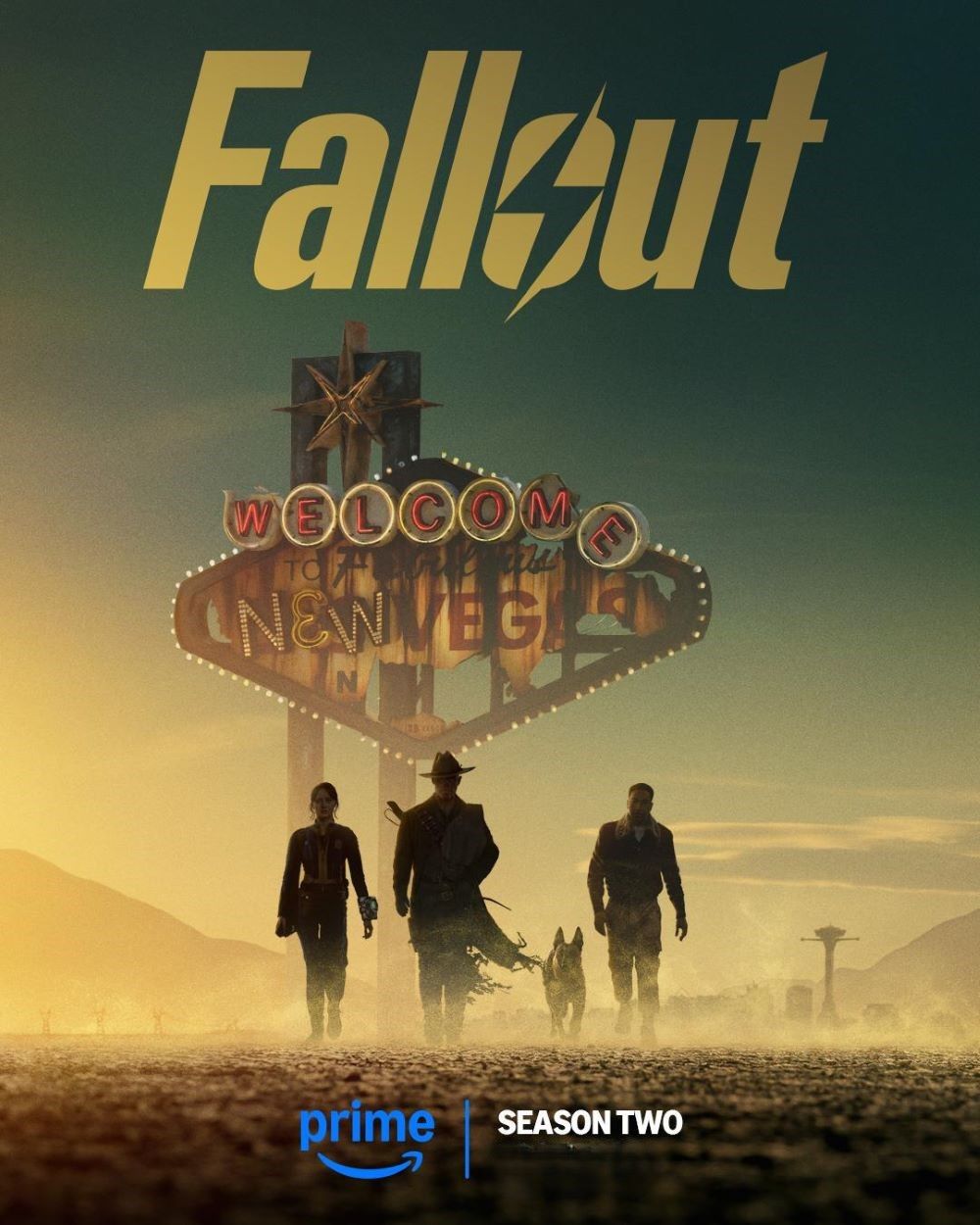
Review: Fallout (Season 2, Episode 4 “The Demon in the Snow”)

“If doing the right thing makes me a traitor, then maybe I’m not the one who’s broken.” — Maximus
Episode 4 of Fallout Season 2, “The Demon in the Snow,” feels like the moment the season properly hits its stride: nasty, funny, and chaotic, but with just enough focus that it never collapses into pure noise. The hour leans into monster-movie horror and drug-fueled mayhem while still pushing the major storylines forward in ways that feel purposeful rather than like random side quests. It is very much a mid-season “everything is escalating at once” chapter, and for the most part, that energy works in its favor.
The episode is built around escalation on multiple fronts. On the surface level, that means finally unleashing a full-on deathclaw, escalating Brotherhood tension into outright war, and sending Lucy stumbling into New Vegas with a chemically assisted death wish. Underneath the spectacle, though, the script keeps circling one idea: the ways addiction, ideology, and systems twist people into thinking their worst decisions are actually noble. That combination of pulpy set pieces wrapped around a fairly sharp thematic throughline is where the episode finds its groove, even if not every beat lands cleanly.
The Cooper flashbacks give the title “The Demon in the Snow” its most literal read. He’s stuck in a remote war zone long before the bombs fall, only to come face to face with a deathclaw framed as this almost mythic horror cutting through soldiers like they barely exist. The sequence works both as a tense creature-feature moment and as a reminder that the apocalypse wasn’t born just from nukes; it was also born from the weapons and bioweapons people created and then failed to control. There’s something quietly grim in the way Cooper realizes that whatever “victory” his side claims out here has less to do with human heroism and more to do with the nightmare they’ve unleashed.
That past horror reverberates nicely against Lucy’s present-day story. She wakes up in an NCR camp wired to Buffout after being dosed for days, which means she’s basically sidelined into instant addiction. The show has a dark sense of humor about it: Lucy’s twitchy, hyper-focused, and suddenly way too ready to bulldoze through anything that isn’t directly tied to rescuing her father. She frames staying on the drug as a moral choice—if it helps her get to Hank faster, then it must be “right”—and that rationalization is exactly the sort of self-delusion the episode keeps poking at. The Ghoul plays the exasperated straight man here, watching her slide further into this chemically boosted version of herself that’s both capable and deeply compromised.
Their approach to New Vegas walks a satisfying line between fresh ground and game nostalgia. The city’s automated defenses are already wrecked by the time they roll up, which kills any chance of a slow-burn infiltration and immediately tells you something very bad has been here recently. The reimagined Kings—now a feral ghoul faction that riffs on the Elvis-obsessed gang from Fallout: New Vegas—become cannon fodder once Lucy lets the Buffout and her revenge drive take the wheel. The fight that follows is gory, brisk, and noticeably sharper in choreography than some of the earlier action this season. At the same time, the show never totally lets the audience forget how disturbing Lucy’s enthusiasm for the violence actually is; even The Ghoul looks a bit rattled by just how far she’s willing to go now.
The Vegas section eventually funnels into the Lucky 38, where the horror angle fully takes over. The once-bustling casino sits eerily vacant, patrolled only by the corpses of destroyed securitrons and an ominous egg that Lucy discovers a little too late. When the deathclaw finally emerges, it’s staged as a true “oh, we’re in over our heads” moment rather than just a giant CGI flex. The earlier wartime flashback helps here; by the time the creature steps into the light in the present, it already has weight in the story as something more than just a boss fight. Pairing Lucy’s adrenaline and bravado with a threat that genuinely terrifies her is a smart way to cap the episode’s Vegas thread.
Over with the Brotherhood, the show continues leaning into its mix of satire and tragedy. Maximus, scrambling to cover up the fact that he killed his superior, shoves Thaddeus into the dead man’s armor, which leads to some very deliberate physical comedy as Thaddeus fumbles around in a suit he barely understands. Around that goofiness, though, the tension over the cold fusion relic boils over. Leadership squabbles turn ugly, and different Brotherhood factions reveal how thin the veneer of honor and order really is once power is on the line. Dane quietly emerges as one of the more competent and grounded figures, slipping recruits out of harm’s way and securing the relic while the so-called authorities are busy imploding.
The strongest Brotherhood moment belongs to Max’s confrontation with High Cleric Quintus. Max comes clean about killing the Paladin and gets a surprisingly measured response—until he explains that he did it to protect ghouls. The conversation flips on a dime into pure zealotry, with Quintus dropping any pretense of nuance and revealing just how deep the organization’s dehumanizing worldview runs. It’s a blunt scene, but it makes the point: the Brotherhood can talk about discipline and order all it wants, yet underneath that rhetoric sits a fanatical hatred that ultimately guides its choices. When the ships start falling and the Brotherhood’s fortress turns into a battlefield, the chaos feels like the natural endpoint of that ideology colliding with reality.
While all of this plays out topside, the Vault storyline quietly remains the show’s creepiest thread. Vault 33 is dealing with a growing water crisis, yet somehow there are still little pockets of privilege and favoritism intact, which underlines how these supposedly “ordered” societies still manage to ration compassion as much as supplies. Overseer Betty’s attempt to negotiate for help with Vault 32 turns anything resembling cooperation into a transaction; every promise of aid seems to come with a hidden clause involving Hank or Vault 31. At the same time, the group from Vault 31 stumbling into the outside world and discovering things like old food trucks brings a streak of bleak comedy. They’re technically in charge, but their naïveté makes them feel just as fragile as anyone else.
Hints of a looming “phase two” for the Vault experiments keep that story humming in the background, suggesting that the worst outcomes for Vault 32 and 33 haven’t even surfaced yet. The vault sections may be quieter compared to the deathclaw and Brotherhood fireworks, but they deepen the sense that the real villain of the series is still the architecture of Vault-Tec’s grand experiment, not just any one person caught inside it.
If there’s a major knock against the episode, it’s that it occasionally feels like it’s doing too much at once. Between Cooper’s war memories, Lucy’s spiral in Vegas, Brotherhood infighting, and the various vault machinations, the hour sometimes jumps away from a scene right as it’s hitting an emotional high point. Lucy’s addiction arc, in particular, moves so quickly that it risks feeling like a setup beat rather than something fully explored in the moment. On the other hand, that density also gives the world a lived-in, interconnected feel—plotlines bump into each other, collide, and ricochet, instead of sitting on separate tracks waiting for their turn.
Taken as a whole, “The Demon in the Snow” stands out as one of the more compelling entries in Season 2 so far. It delivers on fan expectations with the live-action deathclaw and New Vegas callbacks, but it doesn’t stop at simple spectacle. Lucy’s compromised heroism, Max’s struggle to reconcile his conscience with his faction, Cooper’s haunted past, and the vault dwellers’ slow realization that their home is a gilded cage all circle the same idea: people will justify almost anything—violence, bigotry, self-destruction—if it feels like it serves a higher cause or keeps them from admitting they’re afraid. The episode is rough-edged and occasionally overloaded, but that messiness fits the world it’s dealing with, and it sets the board for the back half of the season in a way that feels genuinely promising.
Here Are The 2025 Actor Nominations!
The SAG Awards are now known as the Actor Awards for some reason. I think that’s kind of dumb but whatever. The important thing that the 2025 Actor nominations were announced this morning. My main take away? The Best Picture hopes of both Jay Kelly and Wicked: For Good are dead. If they couldn’t score an ensemble nod with this crowd, they’re not going to make it to the top ten. (Wicked: For Good, at least, seems destined to get a nomination for Ariana Grande and some technical nods. Jay Kelly seems destined to go for zero.)
Here are the Actor Nominations:
OUTSTANDING PERFORMANCE BY A CAST IN A MOTION PICTURE
Frankenstein
Hamnet
Marty Supreme
One Battle After Another
Sinners
OUTSTANDING PERFORMANCE BY A FEMALE ACTOR IN A LEADING ROLE
Jessie Buckley – Hamnet
Rose Byrne – If I Had Legs I’d Kick You
Kate Hudson – Song Sung Blue
Chase Infiniti – One Battle After Another
Emma Stone – Bugonia
OUTSTANDING PERFORMANCE BY A MALE ACTOR IN A LEADING ROLE
Timothée Chalamet – Marty Supreme
Leonardo DiCaprio – One Battle After Another
Ethan Hawke – Blue Moon
Michael B. Jordan – Sinners
Jesse Plemons – Bugonia
OUTSTANDING PERFORMANCE BY A MALE ACTOR IN A SUPPORTING ROLE
Miles Caton – Sinners
Benicio del Toro – One Battle After Another
Jacob Elordi – Frankenstein
Paul Mescal – Hamnet
Sean Penn – One Battle After Another
OUTSTANDING PERFORMANCE BY A FEMALE ACTOR IN A SUPPORTING ROLE
Odessa A’zion – Marty Supreme
Ariana Grande – Wicked: For Good
Amy Madigan – Weapons
Wunmi Mosaku – Sinners
Teyana Taylor – One Battle After Another
OUTSTANDING STUNT ENSEMBLE IN A MOTION PICTURE
F1
Frankenstein
Mission: Impossible — The Final Reckoning
One Battle After Another
Sinners
Artwork of the Day: Strange Sinner (Artist Unknown)
Music Video of the Day: I’m In The Mood For Dancing by The Nolans (1979, dir by ????)
Who isn’t?
Enjoy!
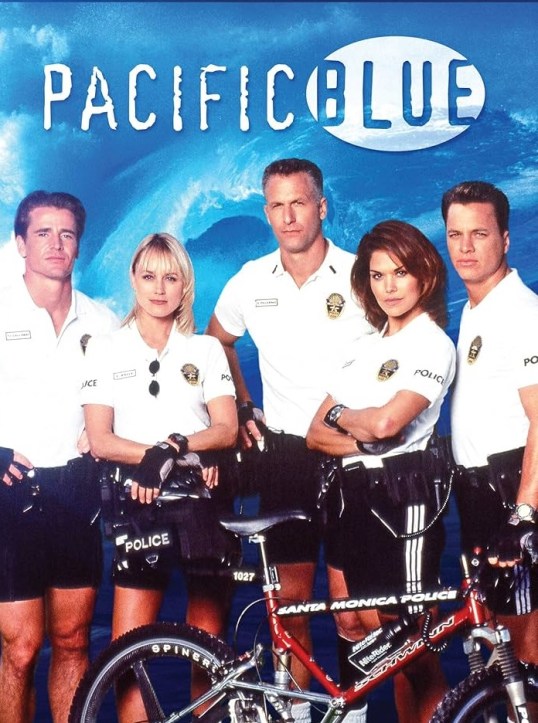
Late Night Retro Television Review: Pacific Blue 3.9 “Cop In A Box”
Welcome to Late Night Retro Television Reviews, a feature where we review some of our favorite and least favorite shows of the past! On Tuesdays, I will be reviewing Pacific Blue, a cop show that aired from 1996 to 2000 on the USA Network! It’s currently streaming everywhere, though I’m watching it on Tubi.
Okay, we’re doing this again.
Episode 3.9 “Cop In A Box”
(Dir by Scott Lautanen, originally aired on November 2nd, 1997)
Oh, Pacific Blue. How I have not missed you.
This episode features TC getting abducted by Harland Groves (Jeremy Roberts), a criminal who TC previously busted. Harland traps TC in an underground beach bunker. How Harland got his hands on an underground beach bunker is never explained. Harland demands that TC’s rich family pay him 4 million dollars. At the same time, he plans to use a chlorine gas bomb to kill TC. Why he didn’t kill TC to begin with and then demand the money is never really explained. It’s almost as if Harland secretly wanted his plan to fail.
I really didn’t have a problem with the idea of TC getting killed off. Pacific Blue is one of the more boring of the shows that I review and killing TC would have livened things up. At the very least, without TC around, I would no longer be forced to try to keep straight which member of Pacific Blue was TC and which member was Victor. Unfortunately, TC manages to disarm the chlorine bomb. When Harland attacks him in the bunker, it leads to a bunch of sand pouring in. Harland is suffocated while TC escapes.
Oh well.
The cool thing about this episode is that Andy Buckley — who later played David Wallace on The Office — returned as TC’s brother. The funny thing about this episode was the sight of grim-faced Palermo barking out orders while wearing his stupid bicycle shorts. And the unfortunate thing is that TC survived so Pacific Blue will not be changing any time soon.
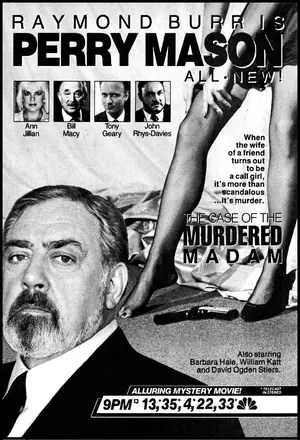
I Watched Perry Mason: The Case Of The Murdered Madam (1987, Dir. by Ron Satlof)
Former madam Suzanne Domenico (Ann Jillian) attempts to blackmail four rich men who are planning on embezzling money from a bank and is found dead by her husband, Tony, shortly afterwards. Tony (Vincent Baggetta) is arrested and charged with murdering his wife. Tony’s older brother used to run around with Della Street (Barbara Hale) and Della is able to get Perry Mason (Raymond Burr) to defend him in court. Paul Drake, Jr. (William Katt) is brought in to do the investigative legwork. Once again, Paul falls for a younger woman (Daphne Ashbrook) who will probably never be mentioned again in any of the other movies.
This movie was a little sad because it was obvious that Raymond Burr was not in good health. He spends most of the movie sitting or moving with crutches. In the movie, they say that Perry is using crutches because of a skiing accident but looking at Raymond Burr, there’s no way to imagine him skiing. Burr is still as sharp as ever when asking questions in the courtroom but it’s still clear that he was in pain when he did this movie. Perry being sidelined does mean that Barbara Hale and William Katt get to do more than usual. After spending the last few movies constantly getting outrun and smacked around, Katt finally gets to beat someone up in the movie.
The mystery isn’t bad, even though I guessed who the murderer was long before the trial started. The entire embezzlement scheme comes down to embezzling a few cents a day so that no one will notice. That’s the same thing they tried to do in Office Space! Luckily, no one got murdered that time.
Overall, this was a good entry in the Parry Mason movies, especially for those of us who like watching Paul Drake, Jr. I’m starting to wonder if all of Perry and Della’s friends are going to end up getting accused of murder at some point. My aunt and I always used to joke about how often Jessica Fletcher’s nephew was accused of murdering someone. It might be just as dangerous to be a friend of Perry Mason’s!
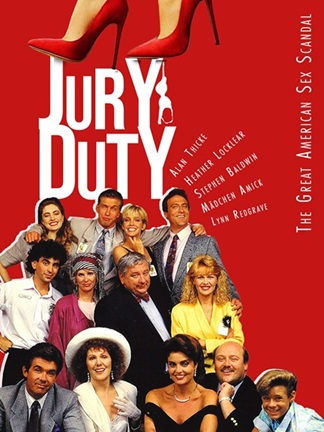
Jury Duty (1990, directed by Michael Schultz)
Meek-looking accountant Sanford Lagelfost (Bronson Pinchot) is on trial for embezzlement. It’s supposed to be a simple, up-and-shut case but when the beautiful star witness (Tracy Scoggins) testifies that Sanford is an amazing lover, it becomes a tabloid sensation and the jurors are sequestered in a hotel, where they have to deal with their own restlessness and several distractions, the majority of whom are also played by Bronson Pinchot. Pinchot plays a total of four characters but it’s not like he’s Peter Sellers or even Eddie Murphy. He looks and sounds like Bronson Pinchot in every role.
The jurors are played by a bunch of a familiar television actors. Alan Thicke plays a yuppie named Phil and Lynn Redgrave plays a hippie named Abby and they end up getting married. Stephen Baldwin is the waiter who falls for Heather Locklear, an actress who is a former call girl who is being threatened by her pimp. Madchen Amick is the spoiled rich girl. Television mainstays Mark Blankfield, Ilene Graf, William G. Schilling, Danny Pintauro, and Bill Kirchenbauer are all present and accounted for. Adding to the overall sitcom feel of the movie is the presence of Reginald VelJohnson as the judge. No one in the cast tries very hard, though I do think a case can be made that Madchen Amick was the most beautiful woman on television in 1990.
With the film failing to achieve either a consistent tone or a single laugh, the best thing that I can say about Jury Duty is that it didn’t feature Pauly Shore. Instead it featured Alan Thicke driving a BMW with a license plate that read, “BMW4Phil.” It’s hard to believe that this film was directed by Michael Schultz, who was responsible for movies like Car Wash, Cooley High, and Greased Lightning in the 70s and Berry Gordy’s The Last Dragon in the 80s.
I wish I had watched The Last Dragon instead.
Gun Lords of Stirrup Basin (1937, directed by Sam Newfield)
On the frontier, crooked lawyer Gabe Bowdre (Karl Hackett) is trying to secure all of the local water rights for himself and that means running off both the homesteaders and the ranchers. Bowdre and his men try to start a range war between the ranching Stocktown family and the homesteading Dawsons. Meanwhile, Dan Stockton (Bob Steele) has fallen in love with Gail Dawson (Louise Stanley) and marries her mere minutes before someone shoots his father in the back.
Gun Lords of Stirrup Basin has all the common elements that usually come with a B-western. I have lost track of how many times I have watched Karl Hackett play a crooked businessman who tries to start a range war to win either the water rights or the property deeds. Bob Steele spent a good deal of his career beating up Karl Hackett on screen.
What sets Gun Lords of Stirrup Basin apart is the Romeo and Juliet angle. While it’s predictable, the love story between Dan and Gail still adds more emotional depth than is usually found in these movies. The scene where all of the ranchers glare daggers at Dan’s new wife is powerful.
Bob Steele’s as good a hero as usual and Karl Hackett is a dastardly villain. Gun Lords of Stirrup Basin runs a little less than an hour, making it a good western for an afternoon break.
Retro Television Review: Fantasy Island 7.21 “Bojangles and the Dancer/Deuces Wild”
Welcome to Retro Television Reviews, a feature where we review some of our favorite and least favorite shows of the past! On Tuesdays, I will be reviewing the original Fantasy Island, which ran on ABC from 1977 to 1984. The show is once again on Tubi!
It’s time for our second-to-last trip to the Island.
Episode 7.21 “Bojangles And The Dancer/Deuces Wild”
(Dir by Bob Sweeney, originally aired on May 12th, 1984)
Sisters Audrey and Judy Jennings (played, of course, by Audrey and Judy Landers) come to the Island because they’re sick of men only appreciating their bodies as opposed to their other talents. They end up meeting a hotelier named Rex Reinhardt (Stuart Whitman) who, after some poorly-defined drama involving his duplicitous chief of security (John Ericson), ends up opening a resort with the two of them. Fans of the James Bond franchise will be happy to see Walter Gotell, who played the head of the KGB opposite Roger Moore in several films, cast as a writer who romances one of the sisters.
It’s kind of a sad fantasy when you consider that this is the second-to-last episode of the original Fantasy Island and the best they could do for this story were the Landers sisters and Stuart Whitman. Not only were the guest stars not particularly inspiring but the fantasy itself didn’t really make much sense.
As for the other fantasy, it does feature a big-name guest star. Sammy Davis, Jr. plays the legendary dancer, Bojangles! Now, admittedly, Sammy doesn’t look particularly healthy in this particular episode. Reportedly, by the time the 80s rolled around, all of the smoking, drinking, and drug-taking had finally started to catch up with him. But, even while obviously ill, Sammy Davis Jr. still had the undeniable charisma of a natural-born star. The fantasy is nothing special. Joe Wilson (Glynn Turman) goes into the past so that he can dance with Bojangles. However, Sammy Davis Jr. lights up the story. He shares a wonderfully-acted scene with Ricardo Montalban, two old showbiz pros sharing what may have been a final moment together.
So, this trip to the Island was a mixed bag. Neither fantasy was particularly compelling and Tattoo’s absence was very much felt. (Lawrence, I’ve noticed, tends to be rather judgmental of the guests which is something Tattoo never was.) But at least Sammy Davis Jr. was there to add some life to the proceedings.
Only one more episode to go.