I review COOGAN’S BLUFF (1968) – starring Clint Eastwood!


Here at The Shattered Lens, we’re looking forward to celebrating the birthday of Clint Eastwood on May 31st. In anticipation, I decided to revisit COOGAN’S BLUFF (1968). 

Clint Eastwood is Coogan, a tough as nails deputy sheriff from Arizona, who’s ordered by his boss, Sheriff McCrea (Tom Tully) to go to New York City and bring back the escaped killer James Ringerman (Don Stroud). When he gets to New York, he’s informed by Lieutenant McElroy (Lee J. Cobb) that Ringerman has overdosed on LSD while in the state’s custody, he’s now in the Bellevue Hospital, and he will not be released to Coogan until the state Supreme Court says so. Stuck in the Big Apple with nothing to do but flirt with probation officer Julie Roth (Susan Clark), Coogan decides to take matters into his own hands and get Ringerman out of the hospital early. He bluffs the attendants at the hospital into turning Ringerman over to him so he can catch the first plane back to Arizona. It seems like a good plan until he’s ambushed by Ringerman’s girlfriend Linny (Tisha Sterling) and his friend Pushie (David Doyle), he gets conked on the head, and he loses both his gun and his prisoner. Now, in trouble with Lieutenant McElroy and Sheriff McCrea, Coogan is ordered back home to Arizona. Determined to get Ringerman at any cost, Coogan stays in the city and leaves a trail of broken hearts and bruised bodies on his way to capturing his man! 

Made in 1968 after Eastwood’s string of excellent spaghetti westerns with Sergio Leone, COOGAN’S BLUFF may be set in contemporary times, but Coogan still seems to be a product of the old west. A big part of the fun is watching him interact with the people of New York City, where everyone is trying to take advantage of him, whether it be the cab driver, the hotel clerk, or the hooker down the hall. When he finally gets to the police station, he sees a building that’s completely overrun with criminals and crazies. He soon finds that Lieutenant McElroy follows the law down to the letter, while he treats the law as more of a set of suggestions on his way to getting the bad guys. This leads to endless frustration and almost gets Coogan arrested multiple times throughout the film as he doesn’t want to deal with all the red tape. One thing that doesn’t change whether Coogan is in Arizona or New York is his success with the ladies. They all swoon and he more than willingly obliges. The only problem for his prospect of true love is the fact that getting his guy always comes first, and he’ll use that sex appeal to get whatever information he needs. One of the main action scenes in this film, the bar fight, is set up ironically when the woman he’s “using” turns the tables and instead sets him up to be pummeled. 

COOGAN’S BLUFF is Eastwood’s first film with director Don Siegel, with whom he’d make DIRTY HARRY a few years later. You can definitely see the genesis of Harry Callahan in Walt Coogan, a man who does whatever it takes to stop criminals, is quick with a whip, and usually pisses off his superiors along the way. In some ways, you could say that Walt Coogan set the mold for the hero of cop films for the next couple of decades! It also has that sense of humor that would be a mark of Eastwood’s cop films. This one includes a funny thread that runs throughout where every person he meets assumes he’s from Texas because he wears a cowboy hat, and he always corrects them that he’s from Arizona. I get this as I always make sure people know that I’m from Arkansas! 

Overall, I really enjoy COOGAN’S BLUFF due mainly to Clint Eastwood’s excellent performance in the lead role. It was a great start to his “post Leone” career and would influence action movie heroes from that point forward. 

Song of the Day: Two Mules For Sister Sara by Ennio Morricone


In preparation for our celebration of Clint Eastwood’s birthday on the 31st, I watched Two Mules From Sister Sara earlier today.

The 1970 film, which was heavily influenced by Eastwood’s Spaghetti westerns, featured a soundtrack from Ennio Morricone.  It only seems appropriate that his excellent work should also provide us with our song of the day.


Here’s What Won At Cannes


Here’s what won at this year’s Cannes Film Festival.  As the Academy’s membership has become more international, Cannes has been transformed into an Oscar precursor over the past few years.  Time will tell if that’s the case this year.  (Of the film’s that did win this year, The Secret Agent sounds like the most Oscar-friendly)

Palme d’Or
Jafar Panahi for It Was Just an Accident

Grand Prix
Joachim Trier for Sentimental Value

Jury Prize
Mascha Schilinski for Sound of Falling and Oliver Laxe for Sirat (tie)

Best Director
Kleber Mendonça Filho for The Secret Agent

Best Screenplay
Jean-Pierre and Luc Dardenne for Young Mothers

Best Actress
Nadia Melliti for The Little Sister

Best Actor
Wagner Moura for The Secret Agent

Special Prize
Resurrection, dir. Bi Gan

Camera d’Or for Best First Film
The President’s Cake, dir: Hassan Hadi

Palme d’Or for Best Short Film
I’m Glad You’re Dead Now, dir: Tawfeek Barhom

Live Tweet Alert: Watch Ninja III: The Domination With #ScarySocial!


As some of our regular readers undoubtedly know, I am involved in a few weekly live tweets on twitter.  I host #FridayNightFlix every Friday, I co-host #ScarySocial on Saturday, and I am one of the five hosts of #MondayActionMovie!  Every week, we get together.  We watch a movie.  We tweet our way through it.

Tonight, for #ScarySocial, I will be hosting 1984’s NINJA III: THE DOMINATION!

If you want to join us on Saturday night, just hop onto twitter, start the film at 9 pm et, and use the #ScarySocial hashtag!  The film is available on Prime and Tubi!  I’ll be there co-hosting and I imagine some other members of the TSL Crew will be there as well.  It’s a friendly group and welcoming of newcomers so don’t be shy!


4 Shots From 4 Films: Special Roger Deakins Edition


4 Shots From 4 Films is just what it says it is, 4 shots from 4 of our favorite films. As opposed to the reviews and recaps that we usually post, 4 Shots From 4 Films lets the visuals do the talking!

Today is the birthday of our greatest living cinematographer, Roger Deakins!  It’s time for….

4 Shots From 4 Roger Deakins Films

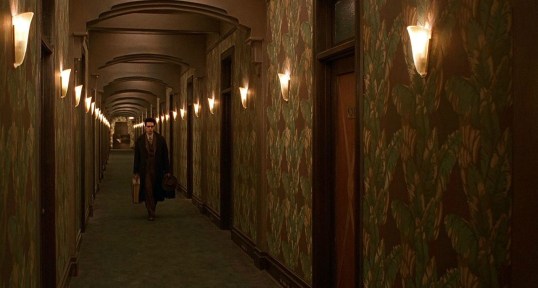
Barton Fink (1991, dir by the Coen Brothers, cinematography by Roger Deakins)

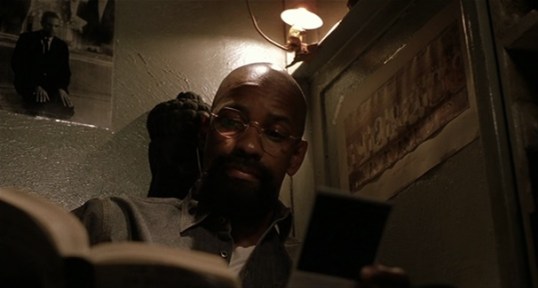
The Hurricane (1999. dir by Norman Jewison, DP: Roger Deakins)

Skyfall (2012, dir by Sam Mendes, cinematography by Roger Deakins)

Sicario (2015, dir by Denis Villeneuve, cinematography by Roger Deakins)

Late Night Retro Television Review: Friday the 13th: The Series 3.14 “Repitition”


Welcome to Late Night Retro Television Reviews, a feature where we review some of our favorite and least favorite shows of the past! On Fridays, I will be reviewing Friday the 13th: The Series, a show which ran in syndication from 1987 to 1990. The entire series can be found on YouTube!

This week …. hey, where is everyone?

Episode 3.14 “Repetition”

(Dir by William Fruet, originally aired on February 5th, 1990)

After newspaper columnist Walter Cromwell (David Ferry) accidentally hits and kills a girl with his car, he finds himself consumed with guilt.  He also start to hear the girl’s voice in his head, demanding that he bring her back to life.  Walter just happens to have a cursed amulet, one that allows the owner to bring someone else back to life as long as he kills someone who is wearing the amulet.  Walter’s first victim is his dying mother.  But after he kills her, he starts to hear her voice demanding to be brought back to life.  So, Walter commits another murder, one after the other, trying to bring back to life every one who he kills.

This was an interesting episode because neither Johnny nor Jack were anywhere to be seen.  Instead, it was just Micki and she only appeared at the start and the end of the episode.  The entire episode focused on Walter and his descent into madness and, it must be said, that worked just fine.  This show’s strength has always been its collection of cursed antiques and this episode allowed us to see how one of them actually works.  We saw how the amulet manipulated Walter and how Walter himself became more and more hooked on using the amulet’s power.  I’ve always viewed the antiques as being a bit like drugs and their users being addicts and this episode certainly played into that theory.

This was an intense episode, featuring moody visuals and a strong script from David Lynch’s daughter, the future director Jennifer Lynch.  After last week’s odd episode, it was nice to see an episode this week that actually got to the heart of what this series was always supposed to be about.

MAN WITH A CAMERA (TV Series) – starring Charles Bronson – S1, E3: Profile of a Killer 


Mike Kovac (Charles Bronson) is working on a pictorial profile of a banker in a small town outside of New York City, when a man named Terry Killeen (Tom Pittman) robs the bank and kills the banker. Killeen sees Kovac’s camera and forces him to come along with them. Killeen wants to be famous so he has Kovac document his one man crime spree as he robs a bank every day for six straight days. Kovac takes pictures at each robbery and sends them to his friend and small town newspaper man, Jenkins (Russell Collins), to publish the stories. Jenkins figures out that Kovac is using the pictures to provide clues to where they are heading, mainly the Lone Pine Lodge. It seems the college girl that Killeen loves, Sara (Mayo Loiseaux) is at the Lodge and Killeen thinks she will reciprocate his feelings now that he’s a famous outlaw. With Killeen planning to kill Kovac once he’s taken a picture with him and Sara, will Jenkins be able to figure out the clues and make it to Lone Pine and save his friend before it’s too late?!

The most unique aspect of “Profile of a Killer” is the performance of Tom Pittman as the bank robber / murderer, Terry Killeen. He’s certainly over the top, but his cackling laugh as he murders, robs, and terrorizes everyone around him is somewhat unsettling. Sadly, Tom Pittman would die on October 31st, 1958, one week after this episode aired, in a car accident. I also liked the performance of Russell Collins as Kovac’s friend and newspaper man, Jenkins. Jenkins’ day job may be as a newspaper editor, but he makes it clear throughout the episode to the local sheriff’s deputy Gilligan (Wayne Heffley) that he’s planning on getting out of the office and saving Kovac by himself if he has to. That’s pretty much exactly what he does. The episode concludes with a rifle wielding Jenkins and Kovac working together to take on Killeen in a night time gunfight. It’s a fun scene, with Kovac’s flashbulbs and Jenkins’ deadeye shooting skills both coming in handy. And of course, there’s the continued excellence of Charles Bronson in the lead as Mike Kovac. In this episode he uses his brain more than his brawn. He didn’t get any real cool lines, and he didn’t get the opportunity to kick any butt. That’s always a missed opportunity with Bronson, but he still dominates the proceedings with his unique charisma and presence. 

“Profile of a Killer” doesn’t give Bronson any true badass moments, but it does create some memorable characters for his Mike Kovac to interact with, and I enjoyed that very much!

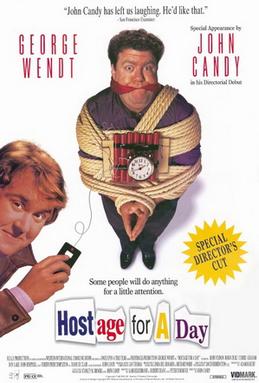
Hostage For A Day (1994, directed by John Candy)


Hostage For A Day is the only film that the much-missed John Candy ever directed.  (It premiered on Canadian television, a few months after his death.)  It’s also one of the only films to feature George Wendt in a leading role, as opposed to being a supporting player.  The film is full of funny people like Don Lake and Robin Duke.  John Vernon plays Candy’s father-in-law.  A lot of talent went into this movie.  It’s too bad that it’s not very good.

Wendt does give a good performance in the lead role.  He plays Warren Kooey, who is depressed on his 41st birthday.  His wife (Robin Duke) has drained their bank account to remodel their house and apparently shag their interior decorator, Hondo (Currie Graham).  No one respects him at work.  Warren’s reflection in the mirror tells Warren that he needs to do something with his life.  Warren decides to fake a hostage situation so that he can collect the ransom.  The problem is that the SWAT team has recently had their budget cut and can’t afford to pay the amount that Warren comes up with.  Then some real kidnappers (led by John Candy, making a very brief appearance) hold him hostage for real.  While this goes on, Wendt continues to talk to his reflection in the mirror and there are a few sweet but out-of-place scenes featuring him reuniting with his childhood sweetheart, Diane St. Clair (Christopher Templeton).

As a director, Candy never seems to be sure what type of film he’s trying to make.  The comedy is broad but Candy also tries to sneak in some sentimental moments and the end results just doesn’t mix well.  He gets some good performances for his cast but the film itself never really comes together.  This was George Wendt’s only starring role and he does a good enough job that I regret he didn’t get bigger roles once Cheers went off the air because, judging by this film, he could have handled them  I just wish this movie was better.