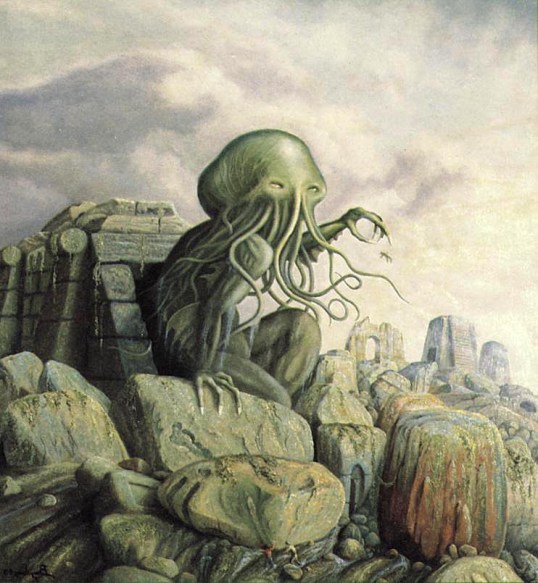
by Raymond Bayless
It’s about time he woke up.
by Raymond Bayless
It’s about time he woke up.

“Welcome to the Woodchuck Music Festival, three days of peace, love, and death.”
Your emcee is a bearded John Belushi and, in between warning the audience about spiked drugs and encouraging the people climbing the sound tower to jump off from the high spot possible, he introduces several musical acts. Christopher Guest appears as Bob Dylan, repeatedly walking to and then retreating from the stage until Belushi produces enough money to convince him to perform a song called Positively Wall Street. Introduced as the ultimate “bummer” by Belushi, Joan Baez (Rhonda Coullet) comes out on stage with a baby and rambles about her imprisoned husband David (whose hunger strike was so successful that he and the inmates of Cell Block 11 have all starved to death) before singing a protest song with a title that I can’t repeat. Joe Cocker (Belushi) sings while shaking on stage. James Taylor (Christopher Guest) attempts to perform but his band (including Belushi and Chevy Chase) are too zoned out on heroin to play their instruments. The owner of Yasser’s Farm (played by Christopher Guest) comes out to praise everyone in the audience who has already died. Finally, a heavy metal group called Megadeath (no, not that Megadeth!) come out on stage and turn up their amplifiers so loud that the entire audience dies at the end of their song.
An Off-Broadway production that premiered in 1973 and ran for over 300 performance, National Lampoon’s Lemmings has achieved legendary status amongst comedy nerds. It’s rare that you read any history of Saturday Night Live, Second City, or This Is Spinal Tap without coming across a reference to Lemmings. Along with satirizing Woodstock and the 60s counterculture in a way that probably few would have the guts to do today, the production features Belushi, Chase, and Guest before any of them became (however briefly) stars. Fortunately, HBO — which started broadcasting a year before the premiere of Lemmings — filmed one of the stage shows.
Viewed today, Lemmings still carries a strong satiric bite. Though Lemmings was clearly a 70s production, much of its humor still feels relevant today. The vapid political posturing, the greed disguised as altruism, the audience blindly following their idols, there was little in Lemmings that one can’t see today just by spending a few minutes on social media. Beyond the humor, though, Lemmings is a chance to see Belushi, Chase, and Guest as youngish men who had their entire lives ahead of them. Chase is surprisingly likable, playing up his goofy physical comedy. Guest disappears into each role that he plays, with his impersonation of Dylan being the clear highlight. That said, Belushi is the clear star of the show, delivering the most absurd of lines with an engaging sincerity. As I watched Lemmings, it was hard not to wonder what type of roles John Belushi would be playing today. Would he still be doing comedy? Would he have faded away? Or, like Bill Murray (or, for that matter, Jim Belushi), would he now be appearing in a mix of comedic and serious roles?
We’ll never know. But we’ll always have his performance as Joe Cocker.

In this video, the members of Bauhaus perform their song Spirit for an audience of actual spirits.
Director Christopher Collins is directed with overseeing three other videos, all for Bauhaus: Bela Lugosi’s Dead, Mask, and In The Flat Field.
Enjoy!

In 2019’s Play the Flute, Brett Varvel plays Brandon Cobb.
Brandon has just been hired as youth minister at a suburban church. Brandon is young and ambitious and his hope is to build the church’s youth ministry into one of the largest in the city. Instead, he discovers that the church’s teenagers are, for the most part, a bunch of spoiled brats who refuse to read and learn their assigned Bible verses. Apparently, they’ve managed to chase off every youth minister they ‘ve had. Will Brandon be able to get through to them?
My question, though, is why Brandon is the one who has to get through to them. Where are the parents in this mess? Loretta Swit does turn up as one concerned parent but her daughter, who speaks with a stammer, doesn’t even want to go the youth group because of some boys who keep making fun of the way she talks. (I stuttered up until I was about 12 so I could relate.) But where are the other parents? A church youth group is not like high school. You’re not legally required to attend. Your parents aren’t going to be charged if you get caught skipping. The kids are obviously in the youth group because their parents took them to church and told them to attend. So, shouldn’t the parents be the ones who get yelled at when their out-of-control brats chase off a youth minister?
Brandon struggles. No one laughs at his Dad jokes. His attempts to open up about his past are met with stony silence. This youth group is hardcore! Finally, Brandon challenges the worst member of the youth group gang to a race. Brandon loses the race to the younger man but everyone is impressed by his determination. He was willing to humiliate himself just to get them to listen to him. And so, they start to listen.
The film is narrated by one of Brandon’s former students, who explains that Brandon has recently died. At first, I thought maybe Brandon had a heart attack after challenging a much younger man to a footrace. Instead, Brandon died of cancer. Brandon may be gone but his students will always remember him and cherish the memory. That’s kind of sweet.
This is another Rich Christiano film. Christiano, along with his brother Dave, was one of the pioneers of modern faith-based filmmaking. He’s been directing and producing films since the early 90s and the format has always remained the same. A Christiano film is usually rather talky, has a few moments of boomer humor, and typically ends on a sentimental note. That’s certainly the case with Play the Flute, a very slow movie that seems to have its heart in the right place.
Christiano did manage to get a few familiar faces for the film. (At least, they’re familiar if you watch a lot of old television shows like I do.) I already mentioned Loretta Swit as one of the mothers. Clint Howard shows up as the manager of a restaurant who is upset to learn that his employees have been screwing with the time clock. And Fred Grandy — GOPHER! — shows up as a minister. One thing I recently learned is that Fred Grandy actually served in the U.S. House of Representatives after he appeared on The Love Boat. We need more former sitcom stars in politics. I’m looking at you, Matt LeBlanc!
Anyway, where as I? Oh yeah. This movie was inoffensive but not particularly compelling. Who knew church youth groups were such a hotbed of rebellion?
Welcome to Late Night Retro Television Reviews, a feature where we review some of our favorite and least favorite shows of the past! On Tuesdays, I will be reviewing Pacific Blue, a cop show that aired from 1996 to 2000 on the USA Network! It’s currently streaming everywhere, though I’m watching it on Tubi.
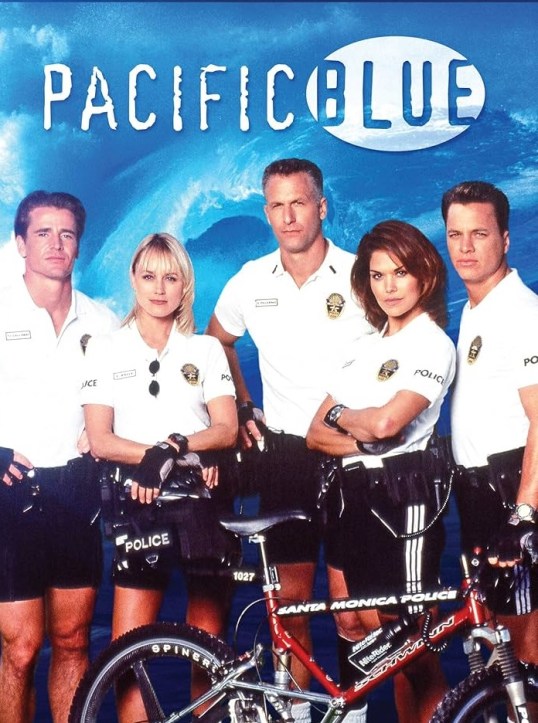
This week, the bike patrol continues to be largely ineffective.
Episode 3.2 “Ties That Bind”
(Dir by Sara Rose, originally aired on August 10th, 1997)
TC is excited because Jeff Pierce has moved to Santa Monica. I had no idea who Jeff Pierce was but the show explained that he was some sort of professional bike rider. Even if Jeff Pierce hadn’t been credited as “himself,” I would have guessed that he was a professional athlete just by how bad of an actor he was.
Pierce needs help retrieving his pink competition shirt. TC and Victor help him out. That was nice of them. Pierce challenges the thief to a race and the thief is so excited about getting to race Jeff Pierce that he doesn’t even mind when he gets arrested at the finish line. He even gets an autographed picture of Jeff Pierece!
Meanwhile, Gloria Allred also appears as herself. She appears as an advocate for a group of women who are protesting the release and the return of former serial killer Conway Henriksen (Marc Riffon). Conway has spent ten years in a mental hospital and he says that he’s now reformed. However, after he gets harassed by some of his former victims (apparently, he didn’t kill everyone) and his house house is set on fire, Conway snaps and kidnaps Cory’s best friend, Billie (Rainer Grant). Conway thinks that Billie is his abusive mother and he starts quoting from the Bible and the overacting gets a bit embarrassing. Finally, Conway shoots himself.
Now, this storyline had potential. Conway was sincere in his desire to start his life over again but the harassment campaign pushed him over the edge. Unfortunately, because this is Pacific Blue, the idea of the people trying to protect their neighborhood from a serial killer pushing the guy into becoming just that was left largely unexplored. Instead, everyone just breathes a sigh of relief after Conway shoots himself.
Finally, Chris’s real father (Kent McCord), shows up at headquarters and explains to Chris that, despite what her mother told her, he didn’t actually die in Vietnam. Instead, he’s been working as a commercial pilot and now he wants to get to know Chris. Chris, of course, acts like a total bitch about it, especially after she discovers that he’s married and that Chris has a teenage half-sister who is as much of a sullen brat as she is. Still, Chris eventually forgives her father for having a life and the episode ends with Chris and her real father going sky-diving. This episode missed an opportunity to have Gloria Allred and Jeff Pierce join them in jumping out of the plane. That would have been classic Blue.
It’s just another day in L.A.

Congratulations to the Los Angeles Dodgers, who earlier tonight won Game 2 of the NLCS, defeating the Brewers by a score of 5-1.
I am happy to say that the Dodgers are currently ahead 2-0 in the series while the Mariners are currently ahead of the Blue Jays, also by 2-0, in the ALCS. Hopefully, this will mean that the Blue Jays will not make it to the World Series (Thank you, Seattle!) and that the Dodgers will keep the both the Mariners and the Brewers from taking the Commissioners Trophy up north. (Thank you, Los Angeles!)
It’s not ideal but, after the season I just lived through, I’ll take it!
Go Mariners! Go Dodgers!

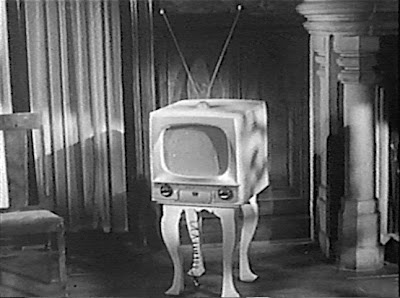
On tonight’s episode of Hammer House of Horror, a family picks up a hitchhiker. A subsequent tragedy leaves a wife wondering if her husband is actually her husband. This is a creepy and twisty episode that is guaranteed to inspire just a little paranoia.
This episode originally aired on November 29th, 1980.
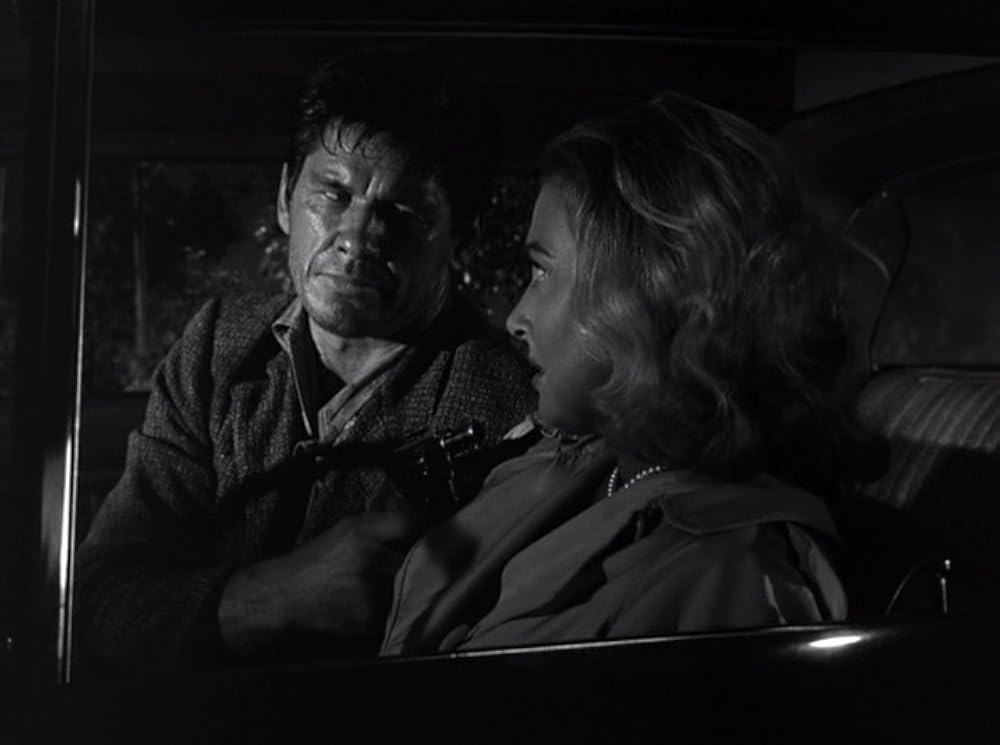
Charles Bronson appeared in three episodes of the ALFRED HITCHCOCK PRESENTS T.V. series. His first two appearances came in the first season in early 1956 when Bronson was still in the early stages of his career. When “The Woman Who Wanted to Live” aired on February 6th, 1962, Bronson’s standing in the film and television community had risen dramatically. Since those first two appearances, he had headlined several low budget films (MACHINE GUN KELLY and SHOWDOWN AT BOOT HILL), starred in his own television series (MAN WITH A CAMERA), and even co-starred as one of the seven gunmen in the western classic, THE MAGNIFICENT SEVEN! As opposed to those two early appearances, Bronson was a well known commodity to audiences in 1962, and he was on the precipice of breaking out in even bigger roles, as THE GREAT ESCAPE and THE DIRTY DOZEN were just over the horizon!
In “The Woman Who Wanted To Live,” we meet escaped convict Ray Bardon (Charles Bronson), a hardened criminal who was shot in the arm when busting out of prison. In serious pain and in need of some quick cash and a getaway vehicle, Bardon robs a remote gas station, even killing the attendant when he makes a move for his gun. Soon a beautiful young woman named Lisa (Lola Albright) drives up to the station. Bardon wants to steal her car and take off, but surprisingly Lisa, who sees his wounds, convinces him to let her drive him wherever he wants to go. As Bardon wonders why she’s willing to help him, Lisa assures him that she will do whatever he wants her to do as she just wants to stay alive. As they flee into the night, they have to deal with a flat tire and a gang of dangerous thugs, but Lisa continues to help Bardon and even passes up a couple of opportunities to take off to safety. Why is Lisa so invested in Bardon’s survival? If you’re guessing there’s more to the story, you would definitely be right!
After watching all three of Charles Bronson’s episodes of ALFRED HITCHCOCK PRESENTS, I believe that “The Woman Who Wanted To Live” just may be the best of the bunch. It’s not as creepy as “And So Died Riabouchinska,” and it certainly doesn’t play up the black comedy like “There Was An Old Woman,” but it does pack quite the emotional punch. First, the story is very effective, as we watch the bond that seems to be developing between the escaped criminal and his captive. You can’t help but wonder if we may be watching two twisted souls who may actually need each other. Hitchcock was always good at throwing people into desperate situations together, and script definitely goes that route here. In the short 25 minutes contained in this episode, each character is given the opportunity to truly help the other, as she helps mend his wounds and he protects her from roadside thugs with bad intentions. Even as the two help each other, as the story plays on, a tightening grip seems to take hold on the audience as to why Lisa hasn’t escaped when she’s had her chances. The strength of the episode just may be the fact that when the big reveal happens, it’s as plain as the nose on your face even though I never considered it a single time, something I have in common with our criminal, Frank Bardon. Second, this episode features two excellent performances from the stars. Interestingly, Charles Bronson and Lola Albright would appear together in the Elvis movie, KID GALAHAD, later this same year. As usual, Bronson brings a real world intensity to the role of the wounded and desperate criminal. With his lived in features, Bronson is incapable of presenting himself in a way that doesn’t seem true and authentic, whether he’s playing a cop or a killer, and his presence here is a clear indicator of his impending stardom. In a tribute to Albright’s performance, the two stars have quite a nice chemistry together, and she steals the final scenes as her character transforms right in front of our eyes and we understand why she’s refused to run away.
With its strong script and the excellent lead performances from Bronson and Albright, I easily recommend “The Woman Who Wanted To Live” as a superior episode of ALFRED HITCHCOCK PRESENTS. This episode truly surprised me and has lingered with me since I first watched it a few days ago.

Working on behalf of World Ecology Bureau (?), the Doctor (Tom Baker) and Sarah Jane Smith (Elisabeth Slader) are sent to a remote research station in Antarctica where an expedition has unearthed two mysterious plant pod. The Doctor recognizes the pod as a Krynoid, an alien that survives by laying its seeds in a host organism who is then slowly and painfully transformed into a plant. One of the members of the expedition, Winlett (John Gleeson), has already been infected. The infection is so bad that the Doctor is forced to say that there is nothing that can be done to save Winlett, other than amputating his arm to try to slow the infection.
While the Doctor and Sarah Jane try to deal with the Krynoid, a pant-obsessed millionaire named Harrison Chase (Tony Beckley) learns of the pod’s existence. He sends two of his henchmen, Scorby (John Callis) and Keeler (Mark Jones) to collect it for him. While the now fully mutated Winlett kills the other members of the expedition, Scorby and Keeler steal one of the pods. Scorby blows up the base, killing Winlett and nearly killing the Doctor and Sarah Jane as well.

That’s all in the first two episodes of this six-episode serial. The remaining four episodes find the Doctor and Sarah Jane (and eventually UNIT) invading Chase’s estate and trying to destroy the Krynoid before it grows big enough to destroy all animal life on Earth. Chase becomes possessed by the Krynoid, Keeler turns into fungus, and several people are strangled by plants. There’s even a death by mulcher.
The Seeds of Doom is one of those serials that has really stuck with me. I think it’s because of how desperate the Doctor gets once he realizes that he’s failed in his mission to keep the Krynoid from escape Antarctica. Tom Baker was usually known for being the funny Doctor but, in this episode, he’s almost an action hero, smashing through windows, beating up numerous henchpeople, and maybe snapping one man’s neck. (It’s hard to tell if the Doctor killed him or just rendered him unconscious.) It’s a different side of the Doctor but it’s appropriate because, for once, the Doctor isn’t one step ahead of everyone else. There’s no time for fun and games when the Krynoid has already taken over Chase’s entire estate.

Harrison Chase was one of the best of the Doctor Who one-off villains. Tony Beckley gave a great performance as Chase, playing him as someone who was an evil fanatic even before his mind was taken over by the Krynoid. By the end of the serial, as he rants while bullet fly around his estate, Chase has become a truly wonderfully loathsome character. Watching him, it’s easy to imagine Tony Beckley playing a minor villain in a James Bond movie. (Sadly, Tony Beckley died just four years after playing Harrison Chase.)

Still, the moment that has always stuck with me is Sarah Jane discovering Keeler, covered in spores and grasping onto his last strands of humanity before becoming a Krynoid. There was always considerable debate over whether or not Doctor Who was too scary for its target audience. That debate usually seems pretty dumb but I imagine The Seeds of Doom inspired more than a few nightmares.

The Seeds of Doom brought the 13th season of the classic series to an impressive end. The Doctor and Sarah Jane decided to take a vacation. They had earned it.
 Returning home from his latest adventure, Hercules (Reg Park) and his sidekick, Theseus (George Ardisson), are shocked to find their home city has fallen victim to a plague that puts its victims in a trance-like state. The woman that Hercules loves, Deianira (Leonara Ruffo), is one of the victims and, since she was also the city’s queen, the sinister Lico (Christopher Lee) is ruling in her place.
Hercules consults with the oracle, Medea (Gaia Germani). Medea says that the plague can only be lifted by the Stone of Forgetfulness, which can only be found in the land of the dead, Hades. Hercules and Theseus set out for Hades but before they can enter the realm of the dead, they have to perform a quest to defeat a rock monster and retrieve a magic apple from a giant tree. Nothing is simple in ancient Greece.
The best of all the Hercules films, Hercules in the Haunted World may not have had Steve Reeves in the lead role but it did have Mario Bava behind the camera. Bava shows what a clever director can achieve just through creative lighting, colorful mists, and detailed set design. The film has all of the mythological monsters and toga-clad action that you expect from a Hercules film but it also has atmosphere, bleeding plants made from the souls of the dead, zombies, and Christopher Lee. Lee may not be playing a vampire here but he still finds an excuse to drink blood in an attempt to achieve immortality.
Reg Park was a Brit who was inspired to become a bodybuilder after watching Steve Reeves in a competition. When Reeves left the role of Hercules, Park was cast in his place. Park only made a total of five peplum films and he was even worse at expressing emotion than Steve Reeves. Park did have the physique necessary to play Hercules and that was really all that was needed. Though Park tired of acting, he would still go on to mentor another bodybuilder who was inspired by Steve Reeves and would play Hercules in a film, Arnold Schwarzenegger.
 Through the Shattered Lens