Horror Film Review: The Ape Man (dir by William Beaudine)


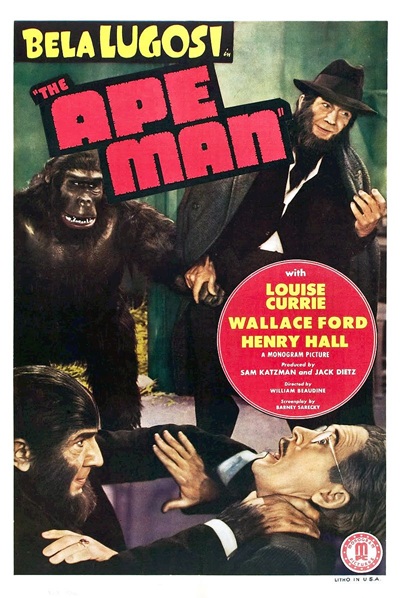
In this 1943 film, a mysterious man suggests to reporter Jeff Carter (Wallace Ford) that he should go out to the mansion of Dr. James Brewster (Bela Lugosi) and look into the recent disappearance of the doctor.  Dr. Brewster’s sister (Minerva Urecal) is a well-known ghost hunter and Carter’s editors likes the idea of Carter and photographer Billie Mason (Louise Currie) heading out to the mansion and getting a picture of a ghost.

Carter is upset because he’s having work with a — gasp! — woman.  Bliie is not impressed by the fact that Carter is still in America while all the other men his age are fighting overseas.  Carter explains that he’ll be enlisting in the Navy in a week.  Billie realizes that Carter is not an unpatriotic coward and we, the viewers, are reminded that this film was made during World War II.  I like the fact that America was so unified during World War II that even fictional characters were expected to explain what they were doing for war effort.

For the record, Dr. Brewster’s mansion is not haunted by ghosts.  Instead, the problem is that Dr. Brewster’s experiments have turned him into a man-ape hybrid.  He has a beard, he walks like a monkey, and he fears that he’s turning more into an ape everyday.  He spends almost all of his time locked up in a cage with a gorilla.  Dr. Brewster has (somehow) discovered that the only way to reverse the process is to get regular injections of spinal fluid.  However, it’s impossible to extract the spinal fluid without also killing the donor.  Dr. Brewster’s colleague, Dr. Randall (Henry Hall), refuses to be a party to murder but he still wants to help Brewster.  Unfortunately, Brewster is beyond saving and he’s also losing his mind as he finds himself slowly becoming more and more of an ape.

The Ape Man was directed by William Beaudine, a filmmaker who directed 179 movies over the course of his long career.  Beaudine worked in all genres, starting off as a major director during the silent era before then becoming a prolific B-movie maker during the sound era.  As a B-movie director, Beaudine was famous for rarely doing second take.  If someone flubbed a line or a piece of scenery nearly fell over, that was too bad.  Of course, it should be noted that Beaudine was working for various Poverty Row production companies and he probably didn’t have the budget to do multiple takes.  His job was to get the film shot quickly and for as little money as possible.

That certainly seems to be the philosophy between The Ape Man, which is only a little over an hour long and which features all of the usual plot holes and continuity eras that one might expect to find in a film that was tossed together in just a few days.  That said, The Ape Man is kind of a fun movie.  Bela Lugosi does his best, even when he’s wearing a totally ludicrous beard.  Wallace Ford and Louise Currie deliver their lines in the rat-a-tat fashion that seemed to be popular with journalists in the films of the 30s and 40s.  The plot’s cheeful lack of coherence actually becomes rather charming and the story ends with a nice moment of 4th wall breaking, as the film itself is saying, “Hey, we had fun, didn’t we?”
Horror Film Review: The Return of the Vampire (dir by Lew Landers)


1943’s The Return of the Vampire opens in 1918.

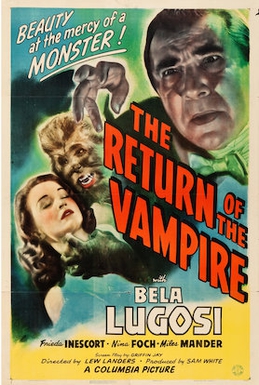
Lady Jane Ainsley (Frieda Inescort) and her colleague, Dr. Walter Saunders (Gilbert Emery), suspect that there might be a vampire active in London.  After reading a book on vampirism that was written by Dr. Armand Tesla, they manage to find the vampire’s coffin.  As the vampire’s servant — a werewolf named Andreas (Matt Willis) — watches, Lady Jane and Dr. Saunders drove a metal stake through the vampire’s heart.  It turns out that the vampire was none other than Armand Tesla himself!  Andreas turns back into a normal person and becomes Lady Jane’s assistant.

Jump forward to the 1940s.  During an attack by the Germans, a bomb explodes over Tesla’s grave and exposes not just his coffin but also the metal pole in the middle of his skeleton.  Two workmen assume that the pole is just bomb debris and they remove it.  Tesla (Bela Lugosi) promptly comes back to life and Andreas turn back into a werewolf.  Tesla sets out to get revenge on Lady Jane and the daughter of Dr. Saunders, Nicki (Nina Foch).

The Return of the Vampire is an interesting film.  Since the film was not made by Universal Pictures, it could not use the name “Dracula” for its vampire but it’s obvious from the start that Armand Tesla is meant to be Dracula.  Tesla wears his Dracula costume, speaks in his Dracula voice, and gives his Dracula performance.  To his credit, Lugosi actually gives a very strong performance in The Return of the Vampire.  His anger towards the people who staked him feels very real and there’s nothing of the intentional campiness that marred some of Lugosi’s later performances.  Lugosi leaves little doubt that Tesla is not only evil but he’s someone who truly enjoys being evil.  He can’t leave England until he gets his revenge on the people who previously defeated him.  For all the talk of stakes, sunlight, and crosses, the vampire’s true weakness is its own vanity and its inability to let go of a grudge.

As a history nerd, I found myself fascinated with how the film worked the then-current Blitz into its story.  The main villain may have been played by Bela Lugosi but the Germans definitely played their role as well, launching the bombing raids that distracted the authorities from the vampire in their midst.  Indeed, it’s probably not coincidence that it was a German pilot who brought Tesla back to life in the first place.  The German pilot is shot down but not before he drops a bomb on Tesla’s crypt.  The film says to be aware of the outside threat but to also be aware that threats can come from the inside as well.  While the Germany terrify the citizens of London, the vampire coolly moves through the night.

Clocking in at a fast-paced 69 minutes, The Return of the Vampire also features a stiff upper lip Scotland Yard inspector (Miles Mander) who, of course, is skeptical of the existence of vampires.  At the end of the film, he asks his subordinates if they believe in vampires.  They reply that they do.  He then looks at the camera and asks us, “And do you, people?”

Well, do you?

Join #MondayMania For The Wrong Boy Next Door!


Hi, everyone!  Tonight, on twitter, I will be hosting one of my favorite films for #MondayMania!  Join us for The Wrong Boy Next Door!

You can find the movie on Prime and then you can join us on twitter at 9 pm central time!  (That’s 10 pm for you folks on the East Coast.)  See you then!

Bonus Horror On The Lens: The Devil Bat (dir by Jean Yarborough)


Because today would have been Bela Lugosi’s birthday, it seems appropriate to showcase him in a bonus horror on the lens!

In the 1940 film, The Devil Bat, the owners of a company in the small town of Heathville are super-excited because they’re going to be given their head chemist, Dr. Paul Carruthers (Bela Lugosi), a bonus check of $5,000.  However, since Carruthers’s inventions have made millions for the company, he is offended by the small check and decides that the best way to handle this would be to sue in court and demand fair compensation …. just kidding!  Instead, Dr. Carruthers sends his army of giant bats to kill the families of his employers.

The Devil Bat was produced by Production Releasing Corporation, a poverty row studio that specialized in shooting quickly and cheaply.  Going from Universal to PRC was technically a step down for Lugosi but The Devil Bat is actually an excellent showcase for Lugosi and he gives one of his better non-Dracula performances as the embittered Dr. Carruthers.  Indeed, one can imagine that Lugosi, who played such a big role in putting Universal on the map, could relate to Carruthers and his bitterness over not being fairly rewarded for the work he did to make others wealthy.

Enjoy The Devil Bat, starring the great Bela Lugosi!

Horror Song of the Day: Fear of the Dark (by Iron Maiden)


If you’re new to Iron Maiden and want to experience a melodic metal song that doubles as a horror anthem, “Fear of the Dark” is a must-listen. Written and composed by Steve Harris, Iron Maiden’s bassist and primary songwriter, the song vividly captures that feeling of walking alone at night with the uneasy sensation that something might be lurking just out of sight. It’s a powerful exploration of a common fear—the discomfort and paranoia that darkness brings—which makes it feel like a spooky bedtime story set to powerful music.

What really makes this song stand out is how the music and Bruce Dickinson’s dramatic vocals work together to build tension and then release it. The guitars start slow and eerie, setting a creepy atmosphere, then shift into faster, catchy melodies that ramp up the excitement and nervous energy. Dickinson’s voice is full of drama and really sells that feeling of fear mixed with urgency. It’s not just heavy music; it’s storytelling with heart and melody.

Plus, the lyrics reference classic horror themes like watching scary movies and ancient folklore, which makes the song feel timeless and accessible. It’s a perfect gateway into how metal bands can blend melody with horror themes, making it approachable even if you’re not usually into heavy music. Overall, “Fear of the Dark” showcases Iron Maiden’s skill at creating music that is not only thrilling but also emotionally gripping and narratively rich.

Fear of the Dark

I am a man who walks alone
And when I’m walking a dark road
At night or strolling through the park
When the light begins to change
I sometimes feel a little strange
A little anxious when it’s dark

Fear of the dark, fear of the dark
I have a constant fear that something’s always near
Fear of the dark, fear of the dark
I have a phobia that someone’s always there

Have you run your fingers down the wall
And have you felt your neck skin crawl
When you’re searching for the light?
Sometimes when you’re scared to take a look
At the corner of the room
You’ve sensed that something’s watching you

Fear of the dark, fear of the dark
I have a constant fear that something’s always near
Fear of the dark, fear of the dark
I have a phobia that someone’s always there

Have you ever been alone at night
Thought you heard footsteps behind
And turned around, and no one’s there?
And as you quicken up your pace
You find it hard to look again
Because you’re sure there’s someone there

Fear of the dark, fear of the dark
I have a constant fear that something’s always near
Fear of the dark, fear of the dark
I have a phobia that someone’s always there

Watching horror films the night before
Debating witches and folklore
The unknown troubles on your mind
Maybe your mind is playing tricks
You sense, and suddenly eyes fix
On dancing shadows from behind

Fear of the dark, fear of the dark
I have a constant fear that something’s always near
Fear of the dark, fear of the dark
I have a phobia that someone’s always there

When I’m walking a dark road
I am a man who walks alone

Horror On The Lens: Monster From Green Hell (dir by Kenneth G. Crane)


I hate wasps!

A lot of that is because I’ve never been stung by a wasp so I have no idea whether or not I’m allergic.  Considering that I’m allergic to almost everything else, it just seems likely that I would be allergic to wasps as well.

Another reason why I dislike wasps is that, opposed to hard-working honey bees, wasps just look evil.  They fly straight at you.  They get tangled in your hair.  They try to build their nests right next to your air conditioning unit.  They’re the worst!

1957’s Monster From Green Hell is all about evil wasps.  A group of scientists, working with the space program, come up with the brilliant idea of sending wasps into space.  When the wasp rocket crashes back to Africa, it leads to giant wasps and paralyzed victims.  Can the scientists who created the problem fix things?  Or will nature have to take care of itself?

Watch and find out!  This film is one of many “giant monster’ films to come out of the 50s but it’s perhaps more interesting as an examination of the fears of what would happen when mankind finally went into space.  Today, we take space exploration for granted.  In 1957, it was very exotic and, I imagine to some, very frightening.

One final note: Barbara Turner, the female lead in this film, is also the mother of actress Jennifer Jason Leigh.


Monday Live Tweet Alert: Join Us for Killdozer!


As some of our regular readers undoubtedly know, I am involved in hosting a few weekly live tweets on twitter and occasion ally Mastodon.  I host #FridayNightFlix every Friday, I co-host #ScarySocial on Saturday, and I am one of the five hosts of Mastodon’s #MondayActionMovie!  Every week, we get together.  We watch a movie.  We snark our way through it.

Tonight, for #MondayActionMovie, the film will be 1974’s Killdozer!

It should make for a night of fun viewing and I invite all of you to join in.  If you want to join the live tweets, just hop onto Mastodon, pull up Killdozer on YouTube, start the movie at 8 pm et, and use the #MondayActionMovie hashtag!

Enjoy!


October Positivity: Redeemed (dir by David A.R. White)


In 2014’s Redeemed, Ted McGinley plays Paul Tyson.

Paul is married to Beth (Teri Copley) and is a respected businessman who is in charge of a cybersecurity firm.  His latest project is Jericho which, if successful, could revolutionize the way that information is protected online.  A Brazilian firm is interested in buying Paul’s company, which could make Paul a very wealthy man.

However, Paul has some secrets.  Work on Jericho has not gone as smoothly as one might hope and Paul suspects that it might be due to corporate espionage.  Paul is several thousand dollars in debt and the bank has been sending him threatening letters.  When Paul’s friend David (David A.R. White, who also directed) splits with his wife, Paul starts to wonder whether any marriage can survive the modern age.  How do you keep a marriage strong in an increasingly complicated world?  Paul and Beth are supposed to be renewing the vows in the near-future but Paul is preoccupied with both his job and what appears to be a massive mid-life crisis.

Temptation arrives in the form of Julia (Ana Ayora), a beautiful woman who has been sent from Brazil to check out the company.  Paul finds himself attracted to Julia and they bond over many a night of corporate intrigue.  Paul finds himself growing distant from Beth.  Is Paul going to cheat and destroy his marriage?

(Actually, David explains that Paul is already cheating just by spending time with a woman other than this wife.  David also explains that he’s not the one who cheated in his marriage.  Instead, his wife met some guy in an Internet chatroom and she’s been talking to him nonstop.  They haven’t even met but it’s enough for David to move out of his house and into a hotel.  So, remember — if you’re married and you have any close friends of the opposite sex, you’re just a cheatin’ whore.  Sorry, I didn’t make the rules.)

Will Paul remain faithful to Beth?  And will he ever discover who is trying to sabotage Jericho?

On the positive side, Redeemed features Ted McGinley in a dramatic lead role and McGinley does a pretty good job with it.  There are a few times when Paul is simply too naive to be believable but that’s due to the script and not due to McGinley’s performance.  McGinley does the best he can with the material that he’s been given to work with.  I will also point out that the stock footage of Brazil was lovely.  Finally, David A.R. White is a pleasant-enough actor and his direction here gives the entire film a comfortable Lifetime sort of fell.

On the negative side …. ugh, that plot.  The corporate espionage stuff was hokey and Paul’s indecision about whether or not to commit adultery made his character seem more than a little flakey.  Paul’s married to a very tolerant and understanding woman and he has a beautiful family.  The fact that Paul was so easily tempted to throw all that away makes it difficult to have much sympathy for his character and it also makes his eventual “redemption” a bit difficult to buy.  I think most genuinely good husbands would be able to decide not to cheat on their wives without having to fly off to Brazil to think about it.  In the end, the film is very forgiving of Paul but it doesn’t convince the audience to feel the same way.

Redeemed is a film that celebrates marriage and leaves one appreciating divorce.