TV Review: The Girl From Plainville Episodes 1-3 (dir by Lisa Cholodenko and Zetna Fuentes)


With The Dropout scheduled to air its final episode next week, Hulu is moving on to another 8-hour miniseries about another young blonde woman who was at the center of a media firestorm.  The Girl From Plainville stars Elle Fannie as Michelle Carter, a teenager who was convicted of more or less goading her “boyfriend,” Conrad Roy (played by Colton Ryan, who was one of the few good things about Dear Evan Hansen) into killing himself.

It was a case that got a lot of attention and Michelle was, for a few months, everyone’s favorite heartless villain.  She was eventually convicted of manslaughter and, after several appeals, was eventually sentenced to 15 months in prison.  She served 11 and is currently free.  She’s 25 years old and has already experienced not only prison but also being briefly the most hated person in the country.  And yet, for all the attention that she received, no one has ever been able to determine just why exactly she told Conrad Roy that he should kill himself or why she went as far as to order him to do so, even after he said he had changed his mind.  There was a lot of speculation that Conrad perhaps thought that he and Michelle had a suicide pact, one that Michelle didn’t follow through on.  It’s also undeniable that, after Conrad’s suicide, Michelle made herself the center of attention.  Before her final text messages to Conrad were discovered, Michelle organized a charity softball game in his memory.  Of course, she held the game in her hometown instead of Conrad’s and apparently, she went out of her way not to involve any of Conrad’s friends or family in her efforts.  Could Michelle have pressured Conrad to kill himself just so she could use his death to be the center of everyone’s attention?

The first three episodes of The Girl From Plainville dropped on Hulu earlier this week and they certainly suggest that Michelle could be capable of doing it all for the attention.  At the same time, they also suggest that Michelle herself probably didn’t truly understand what she did or why she did it.  As played by Elle Fanning and Colton Ryan, both Michelle Carter and Conrad Roy come across as two people who didn’t have much of a connection with reality.  Conrad, or Coco as his friends and family call him, wants to escape a home life that is dominated by the constant bickering between his divorced parents.  He’s at his happiest when he gets a summer job working on a fishing boat and he’s miserable when he has to return to the “real” world, where he’s anxious around people his own age and he’s constantly being used as a pawn in his mother and father’s never ending battles.  Meanwhile, Michelle is so detached that she has to watch an episode of Glee in order to come up with something to say after Conrad’s suicide.  Conrad’s family is earthy, loud, and working class while Michelle’s family is reserved and wealthy but both families have raised children who feel like permanent outsiders.  Indeed, it seems almost preordained that they would eventually find each other and both Colton Ryan and Elle Fanning do a good job of bringing Conrad and Michelle to life.

That said, as I watched the first three episodes of The Girl from Plainville, I did find myself wondering if there was anything more to say about this case.  After the endless news coverage, one Lifetime movie, one HBO special, and countless “ripped from the headlines” episodes of Law & Order: SVU, are there any new insights left to be gleaned from the story of Michelle and Conrad?  With a story this terrible, one’s natural tendency is to search for a deeper meaning but is there really one there?  What if, for all the speculation, Michelle really was just a heartless monster who manipulated Conrad into suicide because she knew she could?  In short, is there enough here to really justify spending 8 hours with someone like Michelle Carter?

I guess we’ll find out over the upcoming few weeks.
TV Review: The Walking Dead 11.14 “The Rotten Core” (dir by Marcus Stokes)


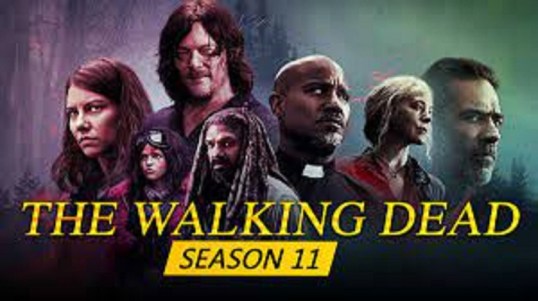
I’ve always wondered how little Herschel would react when he eventually met Negan and learned that Negan was responsible for killing Glenn.

I mean, we all knew that it would happen eventually because, let’s face it …. Maggie and Negan are totally in love!  It’s going to take them a while to admit it, of course.  Maggie’s busy ruling Hilltop like a dictator and Negan’s got a new wife.  Plus, there’s the whole thing where Negan savagely murdered Glenn and then spent a few seasons gloating about it.  I mean, it’s going to take a while to move on from all of that.  Taking all of that into consideration, Lauren Cohan and Jeffrey Dean Morgan still have more legitimate chemistry than anyone else on this show and Maggie and Negan are definitely in love.  Plus, they’re scheduled to get their own spin-off, where they both move to the most romantic city in America, New York!  Not only does that mean that Hilltop is probably screwed (because why else would Maggie leave) but it also means that Maggie and Negan are destined to fall in love while listening to Dean Martin sing That’s Amore.

And the question has always been, how would Herschel react?  Well, this week, we got our answer.  After discovering that bratty little Herschel had snuck into the Apartment Complex, Negan agreed to keep an eye on him while Maggie and the other Hilltoppers continued to fight off a combination of walkers and Commonwealth soldiers.  It didn’t take long for Herschel to figure out that Negan was the man who killed his father.  Herschel pointed a gun at Negan but was eventually talked out of shooting him, proving that Herschel is ready to forgive and it’s time to let the healing begin!

Just as Herschel was discovering that Negan killed Glenn, Darryl was discovering that the Commonwealth isn’t as much of a paradise as he perhaps originally thought.  He and Rosita was ordered by Sebastian to enter his old house and retrieve his cash.  The only problem was that the house was full of walkers!  In not very subtle terms, Sebastian threatened Darryl’s children.  Inside the house, Darryl and Rosita discovered that they were not the first people to be ordered into the House of Death.  There was also April, whose children were also threatened by Sebastian.  Apparently, threatening people’s children is Sebastian’s thing.  Fortunately, Carol and Mercer showed up to help.  Unfortunately, they still had to give the money to Sebastian because he’s Governor Milton’s son and, as a result, doesn’t have to face the consequences of his actions.

This was an okay episode, though it was hard not to feel that the whole thing with the Apartment Complex was a bit overextended.  The Complex invasion could have been wrapped up in one episode instead of stretching it out over two weeks.  That felt like a throwback to the days when almost every episode was Rick talking about something that he was going to do in a future episode as opposed to just going ahead and doing whatever needed to be done.  The Walking Dead has often had a bad habit of stretching things out a bit too far.  As far as the other subplot was concerned, we already know that Commonwealth is a bad place so devoting an entire episode to Darryl finally figuring it out felt a bit superfluous.

That said, the important thing is that this episode reminded us all that Negan and Maggie are totally in love, even if they won’t admit it.  Good for them.  The world may end but love never dies.

TV Review: The Dropout 1.7 “Heroes” (dir by Erica Watson)


This week’s episode of The Dropout was the most emotionally satisfying yet.

Seriously, after six episodes of Elizabeth and Sunny walking over their employees, lying to their investors, and basically getting away with all of it, it was deeply satisfying to watch everything start to unravel in episode 7.  Not only did Elizabeth and Sunny fail to kill the Wall Street Journal story about their fraud but, for once, their heavy-handed attempts at suppression made the situation worse for them.  Tyler Schultz refused to sign the new NDA.  Even if George Schultz is still too stubborn to admit that he was wrong about Elizabeth, he at least seems to suspect that he’s been played.  Even David Boies seems to be at the end of his limit as far as defending Theranos is concerned.  Perhaps that explains why he didn’t seem to be too upset when one of his associates made a very basic mistake that gave John Carreyou (well-played by Ebon Moss-Bachrach) the information he needed to keep his WSJ story alive.  Perhaps most satisfying of all was the scene where Phyllis Gardner finally got a chance to tell Elizabeth off to her face.  It was a stand up and cheer moment in a miniseries that, up until this point, has portrayed the world as being a very dark place.

This week’s episode also deserves a lot of credit for the perfect use of David Bowie’ “Heroes” over the opening montage.  Even when the proverbial walls closing on her and Sunny, Elizabeth still convinced a lot of people that she was a hero, a college dropout who has somehow managed to revolutionize the way that blood is tested.  To be honest, it was always too good to be true but, for many years, Elizabeth Holmes pulled it off.  Not only did she present herself as being a hero but she allowed her investors to feel that they were also heroes for supporting her.  As the song says, “We can be heroes …. if just for one day.”

This episode of features several clip of Elizabeth Holmes being fawned over by the members of the political and media establishment.  Cleverly, the show digitally inserted Amanda Seyfried into actual footage of Holmes being interviewed and praised by old men like Bill Clinton, Joe Biden, and Charlie Rose.  As the miniseries has made clear, Elizabeth Holmes’s biggest boosters were all older men.  Women easily saw through her but men like George Schultz, Ian Gibbons, and others took on an almost fatherly role with her.  When Tyler asked George if he secretly wished that Elizabeth was related to him instead of Tyler, George didn’t answer.  He didn’t have to.

On one final note, I do hope that this episode will be viewed by the people responsible for Inventing Anna because this episode’s portrayal of journalism and a working newsroom feels exciting authentic in a way that Inventing Anna doesn’t.  Unlike the neurotic and needy characters at the center of Inventing Anna, John Carreyou gets the story through his own hard work and he fights for the story because he knows that it’s true.  LisaGay Hamilton’s performance as Carreyou’s editor was one of the highlights of the episode and her scenes with both Moss-Bachrach and Kurtwood Smith were fun to watch.  They left the viewer wanting to know more about the character.  Indeed, one of the things that The Dropout does so well is that it creates the impression that everyone on the show is worthy of their own miniseries.  I would happily watch a show about Carreyou and his editor.

The Dropout finishes up next week as Elizabeth and Sunny finally face the consequences of their own bad actions.  I can’t wait!

A Few Random Thoughts On The Oscars


Let’s just be honest about this.

No matter what else you or I might have to say about the Academy Awards, the only thing that anyone is going to remember about this year’s ceremony is Will Smith walking up on stage and slapping Chris Rock.  That’s it.  That’s what these awards are going to be known for.  Whenever this ceremony is written about in the future, the accompanying picture won’t be of the cast and crew of CODA.  Instead, it’ll be Will Smith slapping Chris Rock.

The Slap, itself, was unpleasant to watch.  Will Smith sitting back down in his chair and continuing to shout at Chris Rock was unpleasant to watch.  It left me feeling awkward and uncomfortable and I was just watching it on TV.  I can only guess what it was like the celebrities sitting in the auditorium.  You know that they were probably terrified that something unexpected would happen with the vote for Best Actor.  At that moment, there was probably a lot of worry about what would happen if Andrew Garfield pulled off an upset.

Will Smith, however, did win Best Actor.  After making a few “fierce protector” excuses, he did, eventually, get around to apologizing to the Academy and “my fellow nominees.”  He also did a lot of God talk and I’m not sure if it’s a good idea to mention God twenty minutes after slapping someone on national TV.  He mentioned that Denzel Washington had apparently taken him aside and warned him that the Devil would come for him at the height of his success.  Which …. I mean, okay.  The thing is, Will Smith is 53 years old and he’s been a star longer than I’ve been alive.  By this point, the Devil should have moved on to someone else.

A few notes on the rest of the show:

It was good to see the show taking place in a theater, as opposed to a train station.  Just by using an actual theater, this year’s Oscar ceremony was a significant improvement over the previous year’s.

The hosts were pretty boring.  There was nothing gained by having three of them.  Amy Schumer needs to fire whoever picked out her first outfit.  If Schumer picked it out herself, she needs to hire someone to pick out her outfits.  Regina Hall looked lost.  Wanda Sykes was okay but that museum segment bogged down the whole show.

CODA is a likable film and it’s obvious that the audience appreciated its heartwarming approach more than the emotionally detached style of The Power of the Dog.  The fact that this tiny little indie film managed to defeat the expensive Netflix slate was gratifying in a David vs. Goliath sort of way.  CODA, if we’re going to be honest, really does feel more like a made-for-TV movie than a feature film but I think that, emotionally and mentally, people were just ready for a positive movie that wouldn’t leave them feeling disturbed or depressed.  After two years straight of pandemic panic, voters were perhaps not inclined to honor a film that ends with its main character dying on anthrax poisoning.

Dune swept the technical awards and ended the night with the most Oscars.  Dune II is probably going to win Best Picture.

Troy Kostur’s acceptance speech was definitely the most moving part of the night.  It’s a bit of a shame that it’s going to be forever overshadowed by The Slap.

Politically, it was pretty much a typical Oscar ceremony.  At this point, I think anyone who cares enough to be offended by Hollywood’s liberalism has probably already stopped watching the Oscars.

As the Academy promised, the cut categories (i.e., the Oscars there were awarded before the start of the live show) were edited into and shown during the show.  They were awkwardly inserted, so that we would see the people in the auditorium reacting to a speech that was given two hours earlier.  It just came across as weird and fake and, whenever the hosts did anything, I found myself thinking, “They cut categories for this.”  Even a brilliant hosting trio would have suffered as a result.  In this case, you had Amy Schumer dressed like Spider-Man on live TV while the winner for Best Film Editing had to make due with edited highlights of his speech.

What’s hilarious is that, even with all of ABC’s new measures, this year’s Oscar run longer than the previous two years.  The total show clocked in at nearly 220 minutes.  For comparison, that’s 20 minutes longer than The Godfather, Part II.  Will Smith’s acceptance speech alone ran for seven minutes.  Of course, would you want to be the person tasked to tell Will Smith to wrap it up?

It was hard to tell but I guess Army of the Dead won the Twitter Poll and Zack Snyder’s Justice League won the Oscar Cheer Moment thing.  Even from just watching on TV, it was obvious how annoyed everyone in the auditorium was with them.  Personally, I have to respect the ability of the Snyder fandom to game the system.

The interpretive dance that went along with the In Memoriam segment was distracting and annoying.  If I’m ever included in a memoriam segment, I’m hoping there will be no gospel music and no interpretive dancing.

The Godfather tribute was nice but I wish they had gotten Sofia Coppola to do the introduction instead of Sean “Whatever” Combs.

In the end, the Oscars weren’t as much of a train wreck as I thought they would be but it was still a fairly unfortunate ceremony.  The category cutting didn’t sit well and I doubt I’ll ever be comfortable with that.  (It’s something that I hope will be abandoned in the future.)  This ceremony will always be known for The Slap and probably not much else.  I would say that I would hope the Academy and ABC would learn from this but the only thing they care about is ratings.  If the ratings are good, ABC will take the credit.  If the rating are bad, the Academy will get the blame.  Who knows what next year will bring?

Speaking of next year, that’s what I am now concentrating on!  There’s a lot of good movies coming out over the next few months and a whole new Oscar race to prepare for!  Let’s get to it!

Here’s The Trailer For Moon Knight


Here’s the trailer Moon Knight!

Oscar Isaac and Ethan Hawke both should have an Oscar by now.  Well, they won’t win any for Moon Knight because it’s a miniseries.  They might get some Emmy love but eventually, everyone wins an Emmy so it’s not as big of a deal.  I mean, I’ve got an Emmy somewhere around here.  It arrived in the mail and I was like, “Cool, I guess I won something.”

My point is, Oscar Issac and Ethan Hawke should both be in a lot of stuff.  Anyway, here’s the trailer:

Here’s The Trailer For The Offer


To be honest, I can’t really say that we need a fictionalized miniseries about the making of The Godfather.  I say that as someone who is a Godfather fanatic and who eagerly reads anything that she can get her hands on that has to do with the production of the film.

I mean, the film’s production is an interesting story, don’t get me wrong.  But it’s a story that should be told by the people who were involved, people like Coppola and Pacino and Duvall and Caan and …. well, you get idea.  What it really doesn’t need is a fictionalized miniseries, one that will inevitably be more concerned with appealing to Twitter than with getting the facts right.

That said, my concerns aside, it looks we’re going to get at least one miniseries about the making of the film.  (Maybe two.)  Here’s the trailer for Paramount Plus’s The Offer.  For the record, this is the miniseries in which Miles Teller replaced Armie Hammer in the role of the film’s producer, Al Ruddy.  Hopefully, this will be good because a lot of people are going to assume it’s telling the genuine story of how The Godfather came to the screen, regardless of how many liberties it takes with the truth.

Lisa Marie’s Week in Television: 3/20/22 — 3/26/22


I didn’t watch much this week because I’ve been busy preparing for the Oscars.  Here’s a few thoughts on what little I did watch.

Allo Allo (Sunday, PBS)

Lt. Gruber thought that he spotted the ghost of Rene’s twin brother in the cemetery and was frightened for his life.  Of course, what we all know is that Rene never had a twin brother and instead, he’s been pretending to be his own twin brother after faking his death several seasons ago.  Somehow, no one on the show has figured this out yet or found it strange that Rene had to explain that both he and his twin have the same name.  Things only got more complicated from there, with Flick trying to disguise himself as a British spy and the Italian soldiers learning how to speak English.  Officer Crabtree still still thinks that he can speak French.  What I like is that, whenever he says “Good moaning,” all of the French characters respond with “Good moaning,” indicating that they are also mangling their French in sympathy for him.  That’s nice of them.  I’m also starting to get the feeling that those British airmen are never going to get out of France.

American Idol (Sunday and Monday Night, ABC)

ABC gave us two episodes of American Idol this week.  The auditions came to a close.  Because I was busy on both Sunday and Monday, it wasn’t until Tuesday that I watched both of the episodes on Hulu and I have to admit that it wasn’t long before I started to get bored and I ended up fast forwarding through some of the auditions.  From what I heard, some of the singers had good voices but there was still an overwhelming blandness to the whole thing.  Perhaps things will perk up in Hollywood.

Beyond the Edge (Wednesday Night, CBS)

The show is all about celebrities doing stuff in the jungle.  Aguirre, The Wrath of God, it is not.  So far, none of the celebs have had a breakdown and requested to leave the show so what even is the point?

The Brady Bunch (Sunday Afternoon, MeTV)

The Bradys went to a national park, laughed their way through a Native ceremony, and declared themselves to be The Brady Braves.  More like the Problematic Bunch, am I right?

The Dropout (Hulu)

I reviewed the latest episode of The Dropout here!

Full House (Sunday Afternoon, MeTV)

The Tanners and the Uncles are stranded at the airport on Christmas Eve and proceed to make life miserable for all of the other passengers.  Uncle Jesse gives a speech about the true meaning of Christmas.  Santa Claus is revealed to be a grumpy passenger who wears a toupee.  In a scene of maximum cringe, Danny falls asleep on the baggage claim carousel.  This was followed by three more episodes, all of which dealt with Jesse and Joey trying to work from home while Stephanie and Michelle demanded all of their attention.  DJ and Aunt Becky were the only characters on this show who ever seemed to worry about anyone else’s feelings.

The Love Boat (Saturday Afternoon, MeTV)

On Saturday’s episode, The Love Boat’s passengers included: Kim Darby, Howard Duff, Greer Garson, Lawrence Pressman, Louanne, and Jim Stafford.  To be honest, I didn’t know how the majority of those people were.  Greer Garson was a psychic.  Lawrence Pressman was a guy who used his best friend’s daughter to convince Kim Darby that he was a single parent.  In the episode’s serious plot, Isaac briefly went deaf.  It all worked out in the end.

The Office (All Week, Comedy Central)

On Sunday, I watched two episodes from season 1, both of which were classics of cringe comedy.  In Basketball, Michael challenged the warehouse to a game and Jim ended up getting punched in the face by Roy.  (Agck!  That was a lot of blood and, according to John Krasinski, it was real.)  Then, Amy Adams showed up at The Office to sell purses and Michael ran out to buy her a cappuccino machine.  Amy Adams deserved an Emmy for the look of horror she got in her face when Michael tried to flirt with her.  Will offices really let you sell purses out of their conference room?  I might actually check into that.

Open All Hours (Sunday Night, PBS)

This week, PBS aired the first ever episode of Open all Hours.  Granville looked younger and a smidgen less disgruntled than he did in later episodes.  He still seemed to be a bit of a ticking time bomb, though.

Survivor (Wednesday Night, CBS)

I wrote about this week’s episode here!  I enjoyed this week’s episode far more than I enjoyed the previous two episodes.

Talking Dead (Sunday Night, AMC)

Chris talked to Michael Biehn and Seth Gilliam, both of whom were absolutely charming.

The Walking Dead (Sunday Night, AMC)

I wrote about The Walking Dead here!

Now, on to the Oscars!

Great Moments in Television History #18: Frank Sinatra Wins An Oscar


On this date, 68 years ago, Frank Sinatra won his only Oscar when Mercedes McCambridge announced that he had won Best Supporting Actor for his role in From Here To Eternity. This is the role that some claimed the mob got for him, though the truth was that he was given the role after his-then wife, Ava Gardner, made an appeal to studio head, Harry Cohn. At that time, Gardner was actually a bigger star than Sinatra, whose career was considered to be in decline.

Sinatra in decline? The Academy disagreed! And so did the audiences who would make Sinatra a star for many decades to come.

Previous Moments In Television History:

  1. Planet of the Apes The TV Series
  2. Lonely Water
  3. Ghostwatch Traumatizes The UK
  4. Frasier Meets The Candidate
  5. The Autons Terrify The UK
  6. Freedom’s Last Stand
  7. Bing Crosby and David Bowie Share A Duet
  8. Apaches Traumatizes the UK
  9. Doctor Who Begins Its 100th Serial
  10. First Night 2013 With Jamie Kennedy
  11. Elvis Sings With Sinatra
  12. NBC Airs Their First Football Game
  13. The A-Team Premieres
  14. The Birth of Dr. Johnny Fever
  15. The Second NFL Pro Bowl Is Broadcast
  16. Maude Flanders Gets Hit By A T-Shirt Cannon
  17. Charles Rocket Nearly Ends SNL

TV Review: The Dropout 1.6 “Iron Sisters” (dir by Francesca Gregorini)


This week’s episode of The Dropout opens with Elizabeth Holmes staring at a camera. 

She’s got the black turtleneck on.  She’s speaking in the voice.  She’s doing the un-blinking stare.  She’s a bit awkward whenever she has to talk to anyone but that awkwardness now feels much more calculated than it did when we first met her.  Offscreen, we hear the voice of famed documentarian Errol Morris telling her which camera to look at.  Elizabeth tells Morris that she’s a huge fan of his work.  Though we don’t see Morris’s reaction, he certainly sounds thrilled by the compliment.  Of course, those of us who have been watching The Dropout from the start and who have also watched Alex Gibney’s documentary about Holmes, can guess what it probably the truth.  In all probability, Elizabeth Holmes had never seen any of Errol Morris’s documentaries.  For the most part, Elizabeth Holmes doesn’t appear to have had many interests beyond maintaining her carefully constructed public persona.  When Errol Morris makes mention of friends, a look of confusion crosses Elizabeth’s face.  Friendship is something that can only be shared between real people and, at this point, there’s nothing real about Elizabeth Holmes.

Friendship is a recurring theme throughout the sixth episode of The Dropout.  In fact, the episode returns so frequently to the theme that, for all of the show’s strengths, it actually runs the risk of getting a bit heavy-handed.  George and Charlotte Schultz are busy preparing Elizabeth’s 30th birthday party and they ask Elizabeth who they should invite.  They ask her who her friends are.  Elizabeth laughs and replies that the Schultzes are her friends.  The Schultzes laugh it off but to Elizabeth, her relationship with the Schultzes and the other members of the Board are really the only thing that she has.  For her, friendship is all about the validation of being praised by older, powerful people and, as this episode shows, men like George Schultz had a need to feel as if they were supporting her “good” work and ensuring that their final legacy will be a positive one.  Mix that with the stubborn refusal to admit to one’s mistake when one is old, wealthy, and well-connected and the end result is the type of environment that’s perfect for someone like Elizabeth Holmes.  

Indeed, the only vaguely real relationship that Elizabeth has is with Sunny and that relationship is one that she insists on keeping a secret.  (Though Charlotte instinctively understands what’s going on with Elizabeth and Sunny, George is clueless and complains, to Elizabeth, that Sunny just doesn’t have enough class.  In this case, George is right.)  In this episode, we see a bit more of Elizabeth and Sunny’s life together.  Sunny is resentful and manipulative.  Elizabeth needs him because she needs someone to actually be the bad boss while she’s busy shooting commercials and hanging out with the board of directors.  They enable each other, with Elizabeth almost using Sunny’s amorality as a shield from having to deal with the consequences of her own behavior.  If Elizabeth seems to be in deep denial about the extent of her fraud, Sunny seems to be convinced that he will always be able to outsmart anyone who tries to uncover the truth.  (Of course, as the show has repeatedly demonstrated, Sunny isn’t really that smart.)

Meanwhile, over the course of the episode, a much more unlikely friendship develops between Richard Fuisz, Phyllis Gardner, and Rochelle Gibbons.  All three of them are linked by a common desire to see Elizabeth revealed as a fraud.  Richard feels that Elizabeth treated him disrespectfully, Phyllis is offended by Elizabeth’s faux feminism, and Rochelle saw first-hand how Elizabeth and Sunny drove her husband to suicide.  Throughout the episode, the three of them try to get a Wall Street Journal reporter interested in the story but they struggle to find concrete evidence of Elizabeth’s fraud.  William H. Macy, Kate Burton, and especially Laurie Metcalf brought some much-needed moral clarity to last night’s episode.  In the past, I’ve complained that, as played by William H. Macy, Richard was almost too cartoonish to be believed but, as of last night’s episode, I stand corrected.  Richard is just as socially clueless as Elizabeth but, unlike Elizabeth, he has no idea how to use that to his advantage.  Instead of being cartoonish, Macy’s performance is instead a perfect counterpoint to Amanda Seyfried’s more tightly controlled performance as Elizabeth.

And finally, the episode’s most important friendship was the friendship between two new Theranos employees, Tyler Schultz (Dylan Minette) and Erika Cheung (Camryn Mi-Young Kim).  Erika began the episode in awe of Elizabeth, just to discover that Theranos was faking results and that the Edison was just a repurposed Siemen machine. Tyler and Erika took on the role of whistleblowers, just to discover that no one — especially not Tyler’s grandfather, George — had any interest in listening.  In the end, they both ended up losing the jobs.  That’s not a big deal for Tyler, who is a scion of the establishment.  For Erika, an idealist who shared much in common with the pre-Theranos Elizabeth Holmes, it’s very much a big deal.  As this episode makes clear, people will look the other way if it means being able to pay the rent and put food on the table.  It takes true bravery to do the right thing when you actually need the job, as Erika does.  Erika does the right thing and asks the right question and ends up by escorting out of Theranos by security guards.

There was a lot going on in this week’s episode but, ultimately, what I’ll always remember was Elizabeth’s birthday party, which featured the elderly members of the American establishment all wearing expressionless Elizabeth Holmes masks.  It was a sight of almost Cronenbergian horror.  Things only got more awkward as Elizabeth and George demanded that Tyler sing a song that he had written in honor of her birthday.  Of course, by this point, Tyler knew that Elizabeth was a fraud and Elizabeth knew that Tyler knew.  It was truly a moment of supreme cringiness but also one that apparently actually happened.  

The episode ends as it began, with Elizabeth Holmes staring straight at a camera and announcing that Theranos is the future.  #IronSisters!


TV Review: The Walking Dead 11.13 “Warlords” (dir by Loren Yaconelli)


This week, The Walking Dead introduced yet another community and also show us the darker side of the way that the Commonwealth does things.

Aaron and, for some reason, Father Gabriel were recruited to accompany the Commonwealth’s Toby Carlson (played by Jason Butler Harner) to a community that was based in an old apartment complex.  Toby told Aaron and Gabriel that their mission was one of recruitment.  They wanted to check out the Apartment People, learn about their customs and way of doing things, and then bring them into the Commonwealth.  Of course, it actually turned out that Toby just wanted to kill everyone in the apartment building because Lance Hornsby believed that the Apartment People were responsible for attacking a Commonwealth caravan.

Normally, I would be opposed to such wanton death and destruction but, in all honesty, the Apartment People were really annoying.  They were so annoying that I’m not even bothering to refer to them by the name of their community.  Oceanside deserves a name.  Hilltop deserves a name.  Alexandria and the Commonwealth deserve a name.  There’s been a lot of different groups that have wandered through The Walking Dead and they all earned the right to be known by the name that they selected for their community.  But the Apartment People were just jerks and, as such, I don’t care what they call their big, ugly home.  To me, they’re just the Apartment People.  From the minute that Aaron and Carlson showed up, the Apartment People were acting like jerks.  Are there any communities in the world of The Walking Dead that aren’t run by some overly loquacious Negan wannabe?

In this case, the Apartment People were ruled by Ian, the Warlord.  The Warlord was played by Michael Biehn, so at least he had that going for him.  The Warlord had a nice, dark office and a cool display case of skulls.  He claimed that all of the skulls came from the enemies of the Apartment People.  I’m not sure if I believed him but I guess it’s always good to have a display of some sort.  A good leader always used their decorating skills to make their office their own.  (Seriously, that’s on page 19 of Somehow I Manage by Michael Scott.)

I appreciated the fact that The Warlord was immediately suspicious of Father Gabriel because I’ve never really felt that Gabriel adds much to the show.  Gabriel started out this season as a newly confirmed atheist but now, suddenly, he’s back to being a fire-and-brimstone holy warrior.  Pick a persona and stick with it, Gabriel!  And, seriously — if you survived the zombie apocalypse, would you really feel like spending all of your Sundays sitting in church?  The fact that Gabriel even has a congregation is just weird to me.

As for the Apartment People, it turned out that Negan is living with them!  That’s probably good news for the Apartment People because the Warlord was dead by the end of the episode and someone is going to have to step in and be the new guy who gives long monologues while standing in front of a display case of skulls.

The episode ended with Maggie and her crew showing up, set to do battle with the Commonwealth.  I guess this is how the war gets started, over a shabby apartment complex that’s populated by some of the most unlikable people to ever appear on the show.  If Negan does’t want to take the Warlord’s place, I guess Maggie can take over the Apartment People and make them as miserable as she’s made everyone at Hilltop.

Anyway, this episode probably would have had more impact if we didn’t already know about the darkness at the heart of the Commonwealth.  Still, Michael Biehn was an effective Warlord and Jason Butler Harner was effectively fanatical as Toby Carlson.  At least now, we know just why exactly Hilltop and the Commonwealth are going to go to war.

Next week is the mid-season finale!