Horror On TV: The Unaired Pilot of Buffy the Vampire Slayer


When I first decided that I wanted to devote some of October to horror-themed television, I knew i wanted to feature a few episodes of Buffy the Vampire Slayer.  After all, Buffy is one of the most acclaimed and influential shows of all time.  On a personal note, the show started when I was 12 and it ended right before my senior year of high school.  As a result, Buffy was a show that I watched during some of the most emotionally turbulent years of my life and, as a character, Buffy Summers was the type of role model that I needed.

However, what i quickly discovered was that there really aren’t any full length episodes of Buffy on YouTube.  There’s plenty of fanvids.  There’s a lot of music videos featuring clips of Angel and Buffy staring soulfully at each other.  But, because of copyright issues, there aren’t any full-length episodes available on YouTube.

However, there is the unaired pilot.

This was a 30-minute “sample” episode of Buffy the Vampire Slayer that was written and directed by Joss Whedon in 1996.  The episode was never meant to be televised.  Instead, it was a tool that Whedon used to pitch the concept of Buffy to the networks.

So, since I couldn’t find Hush on YouTube, here’s the 1996 unaired pilot of Buffy the Vampire Slayer.

Horror On TV: Hammer House of Horror Ep. 3 “Rude Awakening”


Originally broadcast in the UK on September 27th, 1980, this episode of Hammer House Of Horror deals with a sleazy real estate agent (played by Denholm Elliot) who finds himself besieged by dreams about seducing his assistant Lolly (Lucy Gutteridge) and murdering his wife Emily (Pat Heywood).

Featuring an outstanding lead performance from Elliot and strong direction from Peter Sasdy, this is a good one.

Horror On TV: Hammer House of Horror Episode 7 “The Silent Scream”


Today’s episode of televised horror is The Silent Scream, the seventh episode of Hammer House of Horror.  It was originally broadcast in the UK on October 25th, 1980.

This episode features an odd pet shop, a youngish Brian Cox playing an ex-con, and — best of all — the iconic Hammer horror star Peter Cushing!

Seriously, how can you do a horror month without featuring at least one appearance from Peter Cushing?

Horror on TV: Hammer House of Horror Ep. 5 “The House That Bled To Death:


Today’s episode of televised horror comes from the UK.

First broadcast on October 11th, 1980, the fifth episode of Hammer’s House of Horror was entitled The House That Bled To Death.  It’s about a family who buys and moves into a house that has a sordid past.  The family plans to fix the house up and then sell it for a profit.  The house has other plans.

(Incidentally, The House That Bled To Death would have been a great title for one of Lucio Fuci’s later films.)

Horror on TV: Twilight Zone — “The Howling Man”


Tonight’s offering of Horror on TV is another episode of The Twilight Zone.

In The Howling Man, H.M. Wynant plays a rational man who, during a walk across Europe, finds himself in an isolated monastery.  Wynant discovers a bearded prisoner (played by Robin Hughes) who explains that he’s being held prisoner because he was caught kissing his girlfriend in public.  However, Brother Jerome (played by the legendary John Carradine) claims that Hughes is the devil himself!  It’s left up to Wynant whether to set the man free or to leave him imprisoned…

Written by Charles Beaumont and directed by Douglas Heyes, The Howling Man is a favorite of mine.  Not only does the show establish and maintain an atmosphere of palpable menace but it also features a brilliant ending.

Enjoy The Howling Man.


Horror On TV: Twlight Zone Ep. 54 “Twenty-Two”


Tonight’s televised horror story is Twenty-Two, the fifty-fourth episode of The Twilight Zone.

First broadcast on February 10th, 1961 and written by Rod Serling, Twenty-Two tells the story of a dancer (Barbara Nichols) who is in the hospital, suffering from fatigue.  As she tries to recover and get out of the hospital in time to catch a flight to Miami, Nichols finds herself having a reoccurring nightmare.  In her dreams, Nichols goes down to the morgue and is told, by a smiling nurse, “Room for one more, honey.”

This episode seriously freaks me out!  Perhaps it’s because I’m a dancer who, in the past, has suffered from fatigue or maybe it’s because I’m scared of flying but this episode scares me to death.  Though the episode’s final twist may have been spoiled by far too many inferior imitations, Twenty-Two, as directed by Jack Smight, manages to perfectly capture the feel of a nightmare.

It’s the perfect episode for an October night.

Horror On TV: The Twilight Zone 3.12 “The Jungle”


Along with starting each day of October with a horror film here at the Shattered Lens, we’re going to end each day with a horror-themed television show.

While  I had previously caught a few episodes of the Twilight Zone during one of the annual holiday marathons on SyFy, I didn’t truly appreciate the show until I first exchanged e-mails with my friend in Australia, Mark.  Among other things, Mark expressed a very eloquent appreciation for The Twilight Zone and that inspired me to watch quite a few episodes that have been uploaded to YouTube.  Along with being an essential piece of television history, the best episodes of the Twilight Zone remain watchable and entertaining 50 years after they were first broadcast.

Considering the esteemed place that the Twilight Zone continues to occupy in American culture, it seems appropriate to feature it during Horror Month here at the Shattered Lens.

The episode below is called The Jungle and it first aired on December 1st, 1961.  It was written by Charles Beaumont and directed by William Claxton.  John Dehner plays an engineer who, having recently returned from overseeing a project in Africa, foolishly believes that he’ll be safe from a tribal curse just because he’s in New York.  This is an effectively creepy 23 minutes of television and the ending is a classic.

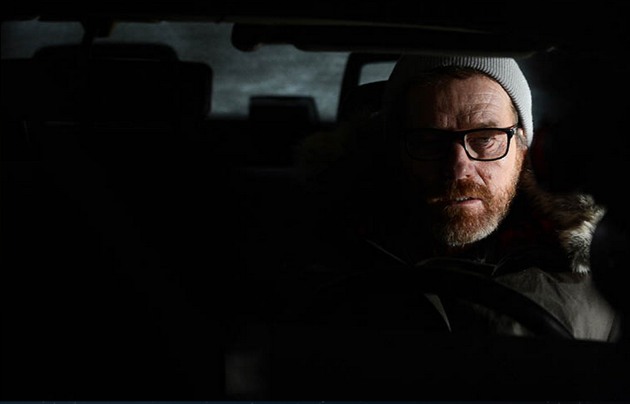
Trash TV Guru : “Breaking Bad” Series Finale


breaking-bad-season-5-episode-16-b

The promotional blurbs on A&E’s cover packaging for the various box set and stand-alone DVD releases of Patrick McGoohan’s classic series The Prisoner refer to it as “television’s first masterpiece,” but let’s be brutally honest here — for a good long time there it probably stood as television’s only “masterpiece.”

Which isn’t to say that there haven’t been some good shows over the years, but start-to-finish, wire-to-wire masterpieces have been pretty tough to come by. I won’t speculate here as to why that’s been with any kind of probing analysis, apart from making the obvious observation that American TV, in particular, has been geared to appeal to the so-called “lowest common denominator” for so long now that frankly most people don’t even expect for there to be anything good on the tube when they turn it on, even with 200-300 channels to choose from. We all just sorta watch it anyway.

I’ll be the first to admit that my two favorite shows of all time — Doctor Who and Twin Peaks — hardly fit the definition of “masterpiece” even though I love ’em dearly. Hell, one of the best things about Who — and I’m referring to old-school Who  here, not the current abomination running around cloaked in its title, which hasn’t held much of any appeal to me since the end of its first return season with Christopher Eccleston in the lead role — is that it’s so damn imaginative and clever and stupid in a fun way and addictively, insanely watchable and re-watchable in spite of its glaring production value weaknesses, often hammy acting, and atrocious dialogue that those so-called “deficiencies” actually become part of its charm. And I’m willing to be that “charm” is one of the things that has engendered such a strong following for various other “fan-driven” series, such as  Joss Whedon’s  Buffy The Vampire Slayer and Angel, both of which have rabid cult followings, to be sure, but neither of which, I think,  even the most zealous Whedon fan (and there’s plenty of competition for that title) would admit, at least in their more honest moments, was anything like a “masterpiece.”

Charm is not something that Breaking Bad ever had much of, though, is it? From the outset, we knew we were being asked to become involved in the life story of a guy who was dying, and furthermore was broke and dying. It’s been a pretty “heavy” show from day one, hasn’t it?

Which isn’t to say that it didn’t have lighter moments interspersed here and there throughout, because of course it did, and in early days it even looked like Dean Norris’ Hank character was never going to amount to much more than bog-standard, albeit well-written, comic relief. But as things progressed, even he became a more multi-dimensional character, and as Bryan Cranston’s Walter White sold out more and more of his soul to purportedly “provide for” his family, a show that started out heavy only became heavier.

And yet — lack of charm and a general “bummer” tone don’t preclude a show from being great, do they? And I would contend that Breaking Bad will be remembered as being more than just great, it will be remembered as — here’s that term again — a masterpiece (the third by my count anyway, in TV history — anyone care to guess what I think the second was? The only hint I’ll give is that it was a relatively recent show).

It was difficult, at times, to be sure. Watching the lives of all these people go to hell in a handbasket even became something of a chore during this final season, particularly the season’s second half following its over-12-month hiatus. Walt was a real bastard, wasn’t he? And that could be downright excruciating to witness. But here’s the thing:

You just never knew what the hell was going to happen next. Series creator Vince Gilligan and his coterie of writers always had another rabbit in their hat, another brightly- colored handkerchief tied to that long string of them coming out of their sleeve. The show never once lost its power to surprise.

Until tonight’s series finale, “Felina,” written and directed by Gilligan himself, which pretty much saw all loose ends tied up more or less exactly as you thought they would be.

I’m sure there might be some hand-wringing among fans that long-suffering characters like Anna Gunn’s Skyler and Aaron Paul’s Jesse weren’t given necessarily “that much to do” in this wrap-up episode — hell, RJ Mitte’s hapless Walter Jr./Flynn didn’t even have a single line of dialogue! Meanwhile, a couple characters we hadn’t seen much of since the second season, Gretchen and Elliot Schwartz, played a pivotal part in Gilligan’s last script.

And yet — everything ended on just the right note for all these people, whether they were given too much to do, too little, or just enough. Events played out more or less in exactly the fashion we expected them, maybe even needed them, to.

And that, finally, may prove to be Breaking Bad’s greatest trick of all : a series that thrived on the element of surprise gave us an entirely predictable conclusion that nonetheless felt exactly right.

Walter White is dead and gone now, and Heisenberg with him. His hat’s off. And so is mine. This series hit it out of the park from the word “go” to the word “stop.” As a slow-burn tale of human tragedy — hell ,of loss of humanity altogether — it stands unequaled. A “happy ending” or “loose, interpretive ending” would have been a huge cop-out. There’s only one way things could have gone here — only one way they were ever going to go.

That’s how they went. And that’s just perfect.

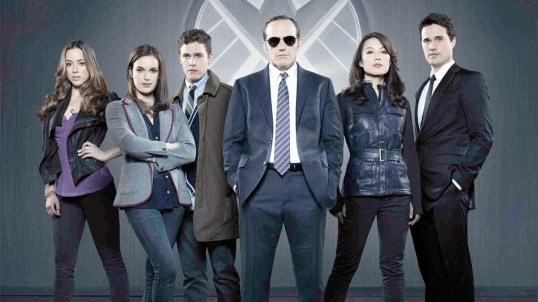
Review: Marvel’s Agents of S.H.I.E.L.D. 1.1 “Pilot” (dir by Joss Whedon)


SHIELD-cast

It would not be an exaggeration to say that Marvel’s Agents of SHIELD has been the most eagerly anticipated new series of the 2013 television season.

Ever since the show was first announced, fans of both Joss Whedon and the Marvel cinematic universe have been waiting to see whether the show would live up to its impressive pedigree.  Every casting announcement has been analyzed and every clip on Youtube has been viewed and debated.

Questions were asked: how would Phil Coulson (played by the wonderful Clark Gregg) manage to be the main character in this series when his death was a major plot point in The Avengers?  Who was the man who was seen jumping out of a burning building and landing without a scratch on his body?  Would Marvel’s Agents Of SHIELD be a prequel or a sequel to The Avengers?  Would the TV show even acknowledge the films from which it spawned?  Would Samuel L. Jackson show up to utter a few badass quips on network television?

But the most important question of all was this: Would Marvel’s Agents of SHIELD live up to all the hype or would it be another case of a show being smothered by the weight of high expectations?

Having just watched the first episode of Marvel’s Agents of SHIELD, I can now answer some of those questions.

How is Phil Coulson still alive?  Well, it turns out that he never died in the first place.  As he explains to newly recruited S.H.I.E.L.D. agent Grant Ward (Brett Dalton), he nearly died when he was attacked by Loki but ultimately, he survived.  Nick Fury told the Avengers that Coulson had died because he understood that Coulson’s “death” would cause the heroes to bond together.

After the end of The Avengers (or, as the show puts it, “the Battle of New York,”), Coulson spent a while recuperating on a beach and “reading Travis McGee novels.”  Now Coulson’s back and he’s in charge of the highly secretive Level 7.  (The Avengers, we’re told, are only Level 6.)  Level 7 investigates “special and strange” cases involving super powered individuals.

Who was the man that we saw jumping out of the burning building?  A lot of people online assumed that he was Luke Cage but instead, he turned out to be Mike Peterson (J. August Richards).  Mike is the show’s first “case,” a decent man who has recently lost his job and is struggling to deal with suddenly being super powered.  In a neat twist, the more powerful Mike becomes, the more easy it is for him to rationalize being destructive.

Coulson and Level 7 track Mike down with the help of Skye (Chloe Bennet), a forcefully recruited hacker and anti-government activist.  At the end of the episode, once Mike has been subdued through a combination of Coulson’s humanity and a tranquilizer dart fired by Grant, Skye is recruited into Level 7.

How direct a sequel is this show to the Marvel films?  It’s such a direct sequel that it would probably be unintelligible to anyone who hasn’t seen the films.  Not only is Mike’s origins story indirectly related to Capt. America’s (both of them owe their powers to a form of the super soldier formula) but the entire series takes place in a world that has been massively changed by the events of The Avengers.  Agents of SHIELD takes place in a world that now knows that there are super powered beings walking among us.

The show is also full of little comments and throw-away references to the characters and events of the films.  Those references are a nice gift to those who have seen all of the films that have seen all of the films that led up to Agents of SHIELD.  At the same time,  I have to admit that pretty much all of my knowledge of the Marvel universe comes from watching the films in the Avengers and X-Men franchises.  My boyfriend, however, grew up reading Marvel comics.  He assures me that, for every film reference that I picked up on, there were dozens of other references that would only be significant to those who have read the comic books.  If nothing else, this shows that Whedon and the show’s other writers respect their audience.  As a result, Agents of SHIELD invites its viewers to join the exclusive club of people who understand the importance of tweeting, “COULSON LIVES!”

No, Samuel L. Jackson does not show up but Cobie Smulders reprises her role from The Avengers, interviewing Grant and introducing him to Agent Coulson.  However, guest star power isn’t necessary because Clark Gregg is such a compelling and likable actor that he perfectly anchors the show.  Gregg brings a much-needed everyman quality to the role of Agent Coulson and, as such, he serves as the perfect guide through the world of super powered flamboyance.

Finally, did the pilot of Agents of SHIELD live up to all the anticipation?

In a word — yes.

Now, I should admit that I am a long-time fan of Joss Whedon’s and a good deal of my positive response to Agents of SHIELD has to do with the fact that it’s clearly a Whedon show.  Not only is the show populated by characters that’ll be familiar to any Whedonite but the self-aware and relentlessly quippy dialogue suggests that, on some level, they are all aware that they are characters on a television show along with being agents of S.H.I.E.L.D.  Along with Clark Gregg, the cast superstar so far is Chloe Bennet, who has a way with a one-liner and, on the basis of the pilot, an appealing chemistry with Brett Dalton.  Personally, I’m hoping that we’ll learn more about the appealingly eccentric Agents Fitz and Simmons (played by Ian De Caestecker and Elizabeth Henstridge).  I’m also hoping that J. August Richards will return in a future episode.  He generated a lot of empathy for the character of Mike and, as the result, prevented Agents of SHIELD from turning into an elaborate inside joke that would appeal only to us Whedonites.

Pilots are strange things.  Not only does a pilot have to introduce all the characters and justify the show’s existence, it also has to find the time to tell a fairly compelling story that will hopefully inspire people to tune in the following week.  Agents of SHIELD succeeded in doing all of that and I look forward to seeing in which direction the show ultimately heads.

What Lisa Watched Last Night #90: Hostages Episode 1 “Pilot”


Last night, after I got back from dance class, I watched the first episode of the new CBS series, Hostages.
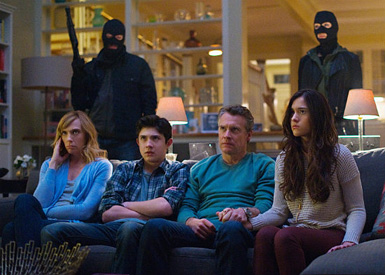
hostages-toni-collette-tate-donovan-cbs

Why Was I Watching It?

I spent the last three months watching and reviewing Big Brother for the Big Brother Blog.  During every episode of Big Brother, CBS would show at least one commercial for Hostages.  It was obvious that CBS was obsessed with the idea of making Hostages into the show that the entire nation would be watching and debating, a bit like a network TV version of Homeland or Breaking Bad.

The commercials, for the most part, all featured Dylan McDermott looking grim while Toni Collette frowned and, occasionally, some old white guy would tell Collette that she was the only doctor he trusted to operate on her and she would reply, “Thank you, Mr. President.”  In short, the commercials made the show look terrible.  The only question was whether or not Hostages would be intentionally bad or unintentionally awful.

Last night, I got my answer.

What Was It About?

President Paul Kinkaid (James Naughton) needs to have surgery and, of course, only one doctor can perform the operation.  That doctor is Ellen Saunders (Toni Collette).  Ellen is so concerned with the President’s health that she doesn’t realize that her husband (Tate Donovan) is having an affair, her son is selling weed, and her daughter is pregnant.

Meanwhile, Duncan Carlisle (Dylan McDermott) is a FBI hostage negotiator.  When we first see him, he’s gunning down a bank robber and smirking while he does it.  It turns out that Duncan needs money to take care of his sick wife.

Eventually, Duncan and a team of other black-clad operatives end up inside the Saunders home where they take the entire family hostage.  They tell Ellen that, if she wants to save her family, she must assassinate the President…

What Worked?

The show turned out to be just as bad as I was expecting it to be!  Whenever I saw the commercials for Hostages, I would think to myself: “That looks like it’s going to be a really boring, tedious series.”  Judging from the pilot, I was right.  It always feels good to be right.

That said, I do have to say that, alone among the cast, Dylan McDermott seems to understand that he’s playing a ludicrous character in a silly show and — much as he did in American Horror Story — he responds by giving an appropriately melodramatic performance.  While the rest of the cast appeared to be convinced that they were appearing in the next Homeland, McDermott seemed to be enjoying a joke that only he and the viewing audience could understand.

What Did Not Work?

If there’s even been a show that would obviously benefit from an over-the-top, melodramatic approach, it would be Hostages.  So, why did the pilot appear to be taking itself so damn seriously?  As I watched last night’s episode, I found myself wondering if anyone involved in the show (other than Dylan McDermott) understood just how silly this all was.  Instead, the show moved at an almost somber pace and all of the actors (again, with the notable exception of McDermott) delivered their lines with the type of gravity that one would usually associate with Jeff Daniels delivering one of Aaron Sorkin’s pompous polemical speeches on The Newsroom.  Considering all of the melodramatic potential of this show’s plot, Hostages really has no excuse to be as boring and predictable as it was last night.

Toni Collette is one of my favorite actresses so it was kind of sad to see her give such a boring performance in the lead role of Ellen Saunders.  Then again, as written, Ellen Saunders is a pretty boring character.  It’s as if the show’s producers and writers were so proud of creating a professional woman that they didn’t notice that they neglected to give her a personality.

Finally, the President is just some boring old white guy.  What’s up with that?

“Oh my God!  Just like me!” Moments

I was tempted to say that, like the family in Hostages, I would totally freak out if a bunch of people appeared in the house, pointed their guns at me, and announced that they were holding me hostage.  However, it then occurred to me that nobody in Hostages really freaked out about being held hostage.  They were certainly annoyed and occasionally, they even attempted to be defiant.  But they never really freaked out.

Nor could I really see much of myself in the character of Ellen Saunders or her daughter.  Since neither one of them came across as being anything more than a two-dimensional plot device, neither one of them was capable of inspiring any “just like me” moments.

I tried to relate to Sandrine Holt, who plays Maria, the only female hostage taker.  However, Maria spent most of the episode carrying around a gun and, while I’m totally into the 2nd amendment, I’m not really into guns.

Then I remembered that, early on in the episode, Ellen’s daughter talks to her best friend.  The friend takes one look at her and says, “Your eyes are puffy,” which is the exact same thing that I would say if one of my friends had puffy eyes.

So, that was my “Oh my God!  Just like me!” moment.

Lessons Learned

Sometimes, commercials don’t lie.