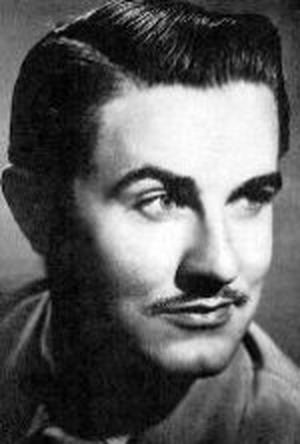
Since the 10th of October was the 100th anniversary of the birth of director Edward D. Wood, Jr., it seems appropriate to dedicate this week’s edition of Lisa Marie’s Favorite Grindhouse Trailers to him!
Below …. can you handle six trailers for six Ed Wood films!?
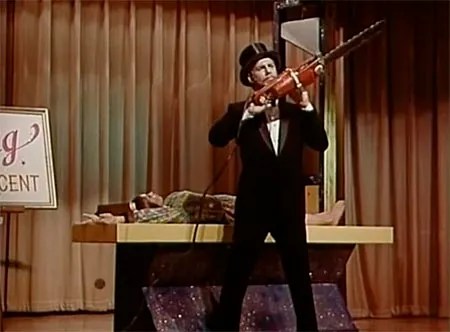
First released in 1970, Herschell Gordon’s Lewis’s The Wizard of Gore tells the story of Montag The Magnificent (Ray Sager), a magician who has a rather macabre stage show.
After lecturing his audience about how everyone secretly wants to see blood and violence, he selects a female volunteer from the audience. Both the woman and the rest of the audience are hypnotized. Montag’s tricks all involve mutilating his volunteers. One volunteer is chainsawed. Another gets a metal spike driven into her brain. Another is drilled by a giant punch press. (Like seriously, how does one store a giant punch press?) The hypnotized audience only sees Montag using his various instruments of torture but they don’t see the wounds or the blood or the intestines. (The movie audience is a bit less lucky.) The victim is hypnotized into not realizing that she has essentially been murdered but, when the hypnosis wears off after the show, they promptly drop dead, mysteriously mutilated in the same way that everyone saw Montag miming on stage.
Naturally, the police arrest Montag and the movie ends.
No, actually, it doesn’t. Even though it’s obvious that Montag is the murderer and that he’s hypnotizing people, the police don’t arrest him because his hypnotized audience swears that Montag didn’t really hurt anyone during his stage act. However, television host Sherry (Judy Cler) and her lunkhead boyfriend, Jack (Wayne Ratay), both come to believe that Montag is the killer and they try set up a plot to expose him on national television, Montag can’t hypnotize people through the television …. can he!? And if he can do that, who is to say that he hasn’t hypnotized the people in the theater who would have been watching The Wizard of Gore when it was first released?
The Wizard of Gore appears to have been Herschell Gordon Lewis’s attempt to comment on his own status as a director who was notorious for making gory films. (His 1963 film, Blood Feast, is often referred to as being the first gore film.) Montag is a monster who appeals to his audience’s desire to see something extreme and forbidden. For all of Montag’s evil, he can only exist and get more victims because people are willing to watch him torture strangers. Lewis was not exactly known for being a particularly artful director but the shots of Montag’s victims screaming in terror while Montag’s audience silently and unemotionally watches are about as close to a genuinely powerful moment as you’re likely to find in a Herschell Gordon Lewis film. The Wizard of Gore, with its commentary on the gore genre that Lewis himself largely invented, is one of Lewis’s more self-referential films. And with it’s trick ending and shots of people suddenly collapsing with their intestines literally spilling out of them, it’s also one of Lewis’s stranger films and that’s saying something when you consider just how many odd films Lewis made over the course of the 60s and 70s. (There’s a reason why one of his better films was called Something Weird.) The Wizard of Gore is definitely a Lewis film, with his trademark stiff actors and non sequitur dialogue giving the whole thing a dream-like feel.
There’s a scene in Junowhere Jason Bateman tells the film’s title character that Herschell Gordon Lewis is a superior filmmaker to Dario Argento and that The Wizard of Gore is scarier than Suspiria. As soon as I heard that, I knew his character was going to turn out to be a sleaze and I was right. The Wizard of Gore is a historically interesting film, especially for those who love the old grindhouse films. But it’s no Suspiria.
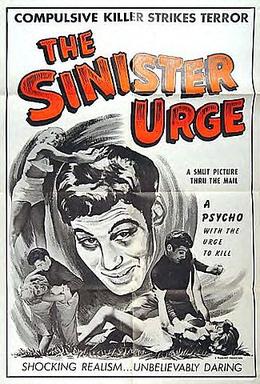
1960’s The Sinister Urge opens with a shot of a blonde woman running down a highway while clad only her underwear.
As I watched this scene unfold, I was reminded of a chapter in Hollywood Rat Race, a non-fiction book about the sordidness of the film industry that was written by Edward D. Wood, Jr. The chapter takes the form of a letter to aspiring young actresses who come to Hollywood, convinced that they’ll become stars. In the chapter, Wood asks what the innocent young ingenue will do if a director tries to force her to film a scene in just her underwear. Will you give in, Wood asks, or will you stick true to your values? Wood seems to suggest that the actress should say no, no matter how much pressure the director puts on her. Of course, Wood himself was a director, as well as a writer. In fact, he directed The Sinister Urge.
The Sinister Urge is about the dark side of the film industry. Police Lt. Matt Carson (Kenne Duncan) and Sgt. Randy Stone (Duke Moore) are investigating a series of murders. The victims have all been women and they’ve all been killed in the same park. Carson and Stone suspect that the murders might be connected. Gee, guys, ya think so?
The murders are being committed by Dirk Williams (Dino Fantini), a knife-wielding teenager who works for the local pornographic filmmakers, Johnny (Carl Anthony) and Gloria (Jean Fontaine). Dirk has become addicted to viewing pornography and it’s driven him crazy. Johnny, who laments that he was once a serious filmmaker before he found himself reduced to directing and distributing “smut” to make money, is full of guilt and self-loathing. Gloria doesn’t care about anything other than making money through selling smutty pictures and movies. She doesn’t care that she’s helping to produce a product that is inspiring the sinister urge that drives Dirk to kill.
Can Dirk be stopped before he attacks innocent Mary Smith (Jeanne Willardson), who has fallen into the clutches of Gloria’s smut syndicate? (That’s a great band name, by the way.) And how will Dirk react when he learns that both Johnny and Gloria are thinking about sacrificing him for the greater good of their evil organization?
The Sinister Urge is an over-the-top melodrama that is clearly an Ed Wood production. (Posters for Plan 9 From Outer Space and Bride of the Monster appear in Johnny’s office.) Some of the actors deliver their lines stiffly. Some of them delvier their lines with just a little bit too much emotion. The hard-boiled dialogue is full of cliches. The action sometimes comes to a complete stop so that the cops can discuss the threat of adult films. The film may be sordid but it’s all presented with such an earnest DIY style that it becomes rather fascinating to watch. At one point, Wood spliced in footage from a totally different film because why not? Wood had the footage. The Sinister Urge was running short. Why not pad out the length with something totally unrelated? That never surrender spirit is why Ed Wood remains a beloved figure 100 years after he was born in Poughkeepsie.
Sadly enough, this was Wood’s final “mainstream” film. After this film, he could only find work writing adult novels and writing and directing the same type of movies that are criticized in The Sinister Urge. (One has to wonder if The Sinister Urge was Wood’s attempt to satirize the moral panic of the time.) Sadly, Wood sank into alcoholism and died 17 years after this film was released. He was 54 years old. His films, however, live on.
In 1986’s Dreamaniac, Adam (Thomas Bern) is a total dork who lives with his much more popular sister, Pat (Ashlyn Gere). Adam aspires to be a heavy metal superstar and he is very much interested in the occult. He’s been having dreams about being visited by a sultry and mysterious woman named Lily (Sylvia Summers). When he performs a Satanic ritual to summon her for real, Lily offers him anything that he wants. Instead of asking her to turn him into the world’s greatest guitarist or something smart like that, Adam asks to be irresistible to women.
Seriously, Adam, if you were the world’s greatest guitarist, you would be getting laid all the time whether you were irresistible or not. The ugliest guy in the world is still be sexy if he can play guitar. Take a look at the Rolling Stones and its long history of ugly guitar players who all looked good as long as they were playing. Take a look at …. oh, I don’t know. I’m tired and I’m just trying to pad out this review because there’s not much to be said about this movie. Let’s move on.
Anyway, Adam gets his wish but he also has to kill the women so that Lily can take their soul and …. eh, that’s stupid. Like Adam, why would you agree to such a counter-productive agreement? Adam was so desperate to get a girlfriend that he apparently didn’t consider that none of them would really live long enough for him to have a real relationship with them. What an idiot.
After Adam sells his soul or whatever it is that he’s supposed to be doing with Lily, Pat throws a party at the house and a bunch of shallow sorority girls and fraternity boys come over and everyone dies one-by-one, usually right after having sex. No one really notices that everyone at the party is dying but then again, no one in this movie really seems to like anyone else so maybe they just don’t care.
Dreamaniac kind of ticked me off, largely because the title should have been Dream Maniac instead of Dreamaniac. I guess I would have let them even get away with something like Dreammaniac. But Dreamaniac, with only one m, just doesn’t make sense and looking at the word makes my multi-colored eyes tear up. This may sound like a petty complaint but there’s honestly not much to be said about Dreamaniac. It’s one of those low-budget, shot on video horror films where the lighting is often so dark and the soundtrack so muddy that you’re never really sure what’s happening on-screen. I dare anyone to watch this film and seriously try to tell one character a part from another. I had no idea who half the characters were and quite frankly, I didn’t care. This was one of David DeCoteau’s earlier films and it has none of the subversiveness that distinguished DeCoteau’s better efforts. (Considering the harsh tone of this review, I feel like I should point out that DeCoteau has directed some truly entertaining movies. Dreamaniac is certainly not the film that should be used to judge his overall career.)
Of course, today, DeCoteau is best known for directing the “Wrong” films for Lifetime. And really, I think the only thing that could have saved Dreamaniac would have been Vivica A. Fox showing up and saying, “Adam, you picked The Wrong Succubus.”
Within the first five minutes, the film features not only a training montage but also a scene where a family cheering good news immediately gets a phone call delivering bad news. (“SHUT UP!” our hero yells at his friends and family.) By the time the film hits the five minute mark, it has managed to denounce communism, terrorism, laziness, and drunk driving! And that’s even before James Spader shows up as a cocaine-sniffing teenage crime lord!
First released in 1986 and directed by the same guy who did the first Friday the 13th, The New Kids tells the story of Loren (Shannon Presby) and his sister, Abby (Lori Loughlin). Their father (Tom Atkins) was a badass army colonel who fought communists, received commendations from the President (and that President was Ronald Reagan so you know those commendations were for doing something cool and not just for posting memes on twitter), and who taught his children self-defense. Every morning, he exercised with them and drilled into their heads the importance of being disciplined and willing to stand up for themselves. Sadly, their father and mother were both killed in a car accident after meeting with President Reagan at the White House.
Though they’ve been taught how to survive in the world by an expert, Loren and Abby are both teenagers and the law says that they need adult supervision. They move down to Florida and stay with their Uncle Charlie (Eddie Jones), Charlie owns a run-down amusement park that he’s decided to call Santa Land. He figures that tourists who are driving to “Walt Disney World and Epcot” will want to stop off at Santa Land. Personally, I think the tourists will probably want to keep driving to where they actually want to go but who knows? Uncle Charlie does have a petting zoo and there is something oddly charming about the idea of Santa hanging out in the bayous of Florida. I mean, there’s a reason why Santa Claus And The Ice Cream Bunny is beloved by viewers all over the world.
At the high school, everyone notices Loren and Abby. Abby gets a dorky boyfriend named Mark (Eric Stoltz …. no, really!) and Loren starts dating the sheriff’s daughter, Karen (Paige Lynn Price). Unfortunately, the new kids have been noticed by Eddie Dutra (James Spader) and his gang of inbred rednecks. Dutra and his gang deal drugs and have a pit bull who they’re hoping to enter into dog fights. (“Went straight for the jugular,” one gang member says at one point.) Dutra decides that he likes Abby, which leads to Loren getting protective, which leads to Dutra and the boys waging their own war on Abby and Loren and everything eventually comes to a deeply satisfying Straw Dogs-style conclusion at Santa Land.
The New Kids is one of those films that succeeds by being thoroughly absurd and over-the-top. Dutra and his gang aren’t just evil. Instead, they’re downright Satanic in their determination to destroy the new kids. The gang is fearsome enough, especially Gordo (Theron Montgomery), who is the fat future forklift operator from Hell. But what really makes this gang memorable is the fact that their leader is James Spader, with bright blonde hair, a smooth Southern accent, and moves that are so assured that he sometimes seem to be dancing across the screen. Dutra’s evil and the cocaine that he snorts leads to him making some bad decisions but he’s got style. As for the New Kids, Shannon Presby is a bit bland as Loren but that blandness actually provides a nice contrast to Spader’s more flamboyant performance. Lori Loughlin is likable and kicks Gordo in the balls, which is pretty cool. (Gordo more than deserved it.)
Cheerfully sleazy and unapologetically ridiculous, The New Kids is 80s exploitation cinema at its best.
Simon (Andrew Prine) is a bearded man who lives in a storm drain and who says that he is on a quest to become a god. He also says that he’s a warlock and he wants to make sure that everyone understands that there’s a huge difference between being a wizard and being a warlock. Don’t call Simon a wizard!
Simon’s quest for godhood hasn’t led to much success so he makes his living selling trinkets and charms to gullible people. One night, the police arrest him for vagrancy. While sitting in jail, Simon meets Turk (George Paulsin), a gay male prostitute who quickly becomes Simon’s first disciple. With the help of Turk, Simon is introduced to upper class society. It turns out that Turk’s clients include several very wealthy people. Simon is a hit on the party circuit. Slumming hippies view him as a potential guru. Wealthy people view him as a humorous oddity. Simon meets other occultists and starts to engage in bizarre rituals. He finds time to date Linda (Brenda Scott), the daughter of the totally square district attorney. Some people insist that Simon is a fake and some people say he is the real thing. For his part, Simon is soon getting revenge on all of his enemies and taking part in all sorts of freaky ceremonies as he continues his quest for supreme power.
Don’t let the supergroovy name fool you. Like a lot of films about the 60s and 70s counterculture, Simon, King of the Witches is remarkably dull. The action moves slowly. The plot never really makes that much sense. Andrew Prine gives a wonderfully over-the-top performance as Simon but the rest of the cast never really seems to wake up. The film’s most interesting moments are the ones where Simon effortlessly switches from upper class society to “street” society. Undoubtedly, this film’s portrait of jaded people looking for the new thing and getting taken advantage of by a sociopathic grifter felt very familiar in the 70s. And, actually, I guess it still does. There’s still a lot of wannabe gurus out there and a lot of people who have neither the willpower nor the intelligence to see through them. But the film itself just too boring to really be effective. Probably the most interesting thing about the film is that Simon seems to be a mix of Charles Manson and Rasputin. Like Manson, Simon knows how to take advantage of those who are lost and seeking a place where they can belong. And, like Rasputin, Simon turns his sordid lifestyle into an asset when he’s trying to thrill the stuffy old folks.
As I mentioned earlier, the film’s saving grace is Andrew Prine’s intense performance as Simon. Prine himself was an up-and-coming actor with a bright future ahead of him until his girlfriend, Kathryn Kupcinet, was murdered in 1963. As the boyfriend, Prine was immediately a suspect. Though the police quickly cleared him, the scandal still derailed his career and he ended up spending the rest of his career in films like The Town That Dreaded Sundown, Amityville II, and Simon, King of the Witches.
2019’s Do Not Reply is about Chelsea (Amanda Arcui, who previously played Lola during the final seasons of Degrassi), a high school student who is super-excited to have found an online boyfriend. Brad (Jackson Rathbone) seems like he’s funny, handsome, and charming and he’s even got a semi-tragic life story! Now, it should be mentioned that there are some immediate red flags about Brad. Brad seems to be just a bit too perfect and the story of his life — being adopted and having parents who won’t even spend the money necessary to get him a new phone — seems to be a little bit too on-the-nose as far as getting Chelsea to feel sorry for him is concerned.
Brad and Chelsea agree to go to the Halloween dance together. Brad says that he’ll show up as a zombie football player and he requests that Chelsea show up dressed a cheerleader. (RED FLAG! RED FLAG!) To the surprise of no one, Chelsea meets up with Brad at the dance and is promptly kidnapped.
Brad, it turns out, is not a teenager with parents who refuse to buy him a new phone. Instead, he’s a man in his 20s who lives in a surprisingly nice house. He’s been meeting and kidnapping teenager girls for a while. He holds them prisoner in his house, requiring that they wear cheerleader uniforms while cleaning the place. Brad wants the house to be spotless. He wants his prisoners to adore him. He wants them to be very polite and well-mannered whenever they eat the dinners that he prepares for them. One girl who tried to escape was several beaten by Brad and locked in her room, where she suffers as a warning to the others. Meagan (Kerri Medders) and Heather (Elisa Luthman) both seem to be suffering from Stockholm Syndrome and they not only go out of their way to keep Brad happy but also to keep Chelsea from trying to escape.
If he’s in a good mood, Brad rewards his prisoners with “outdoor time,” which means that he allows them to wear a VR headset and visit an imaginary park. Brad spends most of his day wearing his headset, not only searching for new realities but also reliving all of the terrible things he did in the past. Brad is one sick man, his madness apparently inspired by his incestuous feelings towards his deceased sister who was — wait for it — a cheerleader!
The premise is a disturbing one, precisely because it is based on reality. There are internet stalkers out there and there have been internet murderers as well. Most of them aren’t as wealthy or handsome as Brad but they’re still out there, preying on those who are too naive to question their intentions. While there’s definitely more than a small element of exploitation to the film (with the camera tending to linger over the cheerleader uniforms almost as intensely as Brad does), the film is ultimately on the side of Brad’s prisoners. As opposed to the hyperarticulate madmen who tend to populate films like this, Brad is a loser from the start and the moment when his victims finally start to get the upper hand on him is a cheer-worthy moment. Though the film gets off to a rather slow start, Amanda Arcuri, Kerri Medders, and Elisa Luthman all give good performances. It’s a flawed film but it gets the job done.
The 1974 film, Satan’s Children, tells the story of unfortunate Bobby Douglas (Stephen White).
Bobby is a teenager who lives in a hideous suburban house with his stepfather (Eldon Mecham) and his stepsister (Joyce Molloy), who looks old enough to be Bobby’s mother. Bobby’s a rebellious kid who doesn’t understand why he should always have to cut the grass while his stepsister hangs out by the pool. Bobby is sick of the whole scene, man. When his stepfather yells at Bobby for having a small stash of marijuana in his room, Bobby decides to run away from home. Seriously, that scene was totally melvin so I don’t blame Bobby.
Bobby goes to a bar, where an old man tries to talk to him until Jake (Bob Barcour) tells the old man to get lost. Jake tells Bobby that he has to be careful because there are perverts all over the place. Bobby nods and laughs because Bobby’s not a square. He knows what’s up. Jake invites Bobby to come hang out at his place and Bobby is like, “Cool, way too friendly stranger, I’ll get you in your rape van.” Bobby goes home with Jake and is promptly raped. With Bobby naked and bound, Jake calls all of his friends over and Bobby is then gang raped. The scene where Jake and his friends drive the bound Bobby around is pure nightmare fuel and I can only imagine how audiences in 1974 reacted to it.
The next morning, a group of hippies found Bobby lying in a field and they take him back to their commune. Of course, these folks aren’t just hippies. They’re also Satanists! Sherry (Kathleen Marie Archer) wants to let Bobby stay with them while she nurses him back to health. Joshua (John Edwards), an older member of the group, says that Bobby isn’t welcome because Bobby is probably “queer.” Simon (Robert C. Ray II), the turtleneck-wearing leader of the group, is also hesitant to allow Bobby to stay and again, it’s because Simon assumes Bobby must be gay. Simon also makes it clear that he doesn’t want any lesbians in his Satanic cult either. He just wants people who are prepared to carry out a blood sacrifice….
(I swear, that Satan. Not only is he the ruler of Hell and the tormenter of souls and the fallen angel responsible for getting Adam and Eve kicked out of the Garden and bringing sin into the world, he’s also apparently a massive homophobe!)
While the Satanists torture Sherry for displeasing Simon, Bobby tries to figure out a way to escape. Fair warning: the majority of the film’s finale involves Bobby running around in tighty-whities, which get progressively more and more mud-stained as the movie goes on. Seriously, ew! On the other hand, not one but two people manage to die as a result of accidentally wandering into quicksand. If nothing else, it’s a reminder that Bobby isn’t the only incredibly stupid person in the movie.
This is a weird movie. I imagine it was made to capitalize on the notoriety of the Manson Family but, with its extended opening scenes in the suburbs, it instead becomes an ennui-drenched look at how far people will go to escape conventional society. Despite all the of the truly terrible things that happen to him, Bobby is not a sympathetic or likable character. In fact, he comes across as being just the type of idiot who probably would get sucked into a cult. That said, the film is truly a unique (if rather slow) experience and the brutal ending took me totally by surprise. Like many grindhouse film, Satan’s Children is an oddity that you truly can’t look away from.
Filmed in 1982 but not released until 1984, Boogeyman II is — as the name implies — the sequel to 1980’s The Boogeyman.
What’s that, you say? You don’t remember anything about The Boogeyman and you don’t want to take the time to read my review of it? Well, don’t worry. It’s not necessary to have seen the original Boogeyman to follow the sequel, largely because the sequel is full of flashbacks to the first film. Boogeyman II is only 79 minutes long and 30 minutes of that running time is taken up with footage from the first Boogeyman. Indeed, if you want to see the good parts of Boogeyman without having to deal with any of the filler, I would recommend just watching the first 30 minutes of Boogeyman II.
There is a plot to Boogeyman II, kind of. Having survived the massacre of her family at the farm, the now-divorced Lacey (played by Suzanna Love, the then-wife of director Ulli Lommel) goes out to California to visit her friends, actress Bonnie (Shannah Hall) and her husband, director Mickey (Lommel). How is it that Lacey, who was portrayed as being a simple and not particularly worldly farm wife in the first film, happens to be friends with a wealthy actress and director? It’s never really explained.
Bonnie and Mickey ask Lacey whether or not the people who killed her family were ever caught. Lacey replies that they can’t be caught because they’re spirits. Over dinner, Lacey tells Bonnie and Mickey the story of the shattered mirror and the killer whose spirit was trapped in the broken glass. Bonnie and Mickey listen sympathetically, though they both think that Lacey’s crazy. (Perhaps they noticed that Lacey’s flashbacks include scenes in which she wasn’t even present. Or maybe they’re wondering why Lacey would take the time to apparently describe a lengthy, bondage-themed nightmare that she had during the first film. Or maybe they’re just amazed by the presence of John Carradine in the flashbacks.) Bonnie and Mickey also think that Lacey’s story would make a great movie!
For some reason, Lacey is still carrying around a piece of the haunted mirror. This is the mirror that contains the spirit that possessed her during the first film and which killed the majority of her family. I would throw that piece of the mirror away but I guess Lacey’s more sentimental than I am. A creepy butler named Joseph (Sholto von Douglas, a rather stiff actor who still had a fascinatingly menacing screen presence) steals the piece of the mirror and soon, Hollywood phonies are dying.
Boogeyman II was directed by the late Ulli Lommel, a German director who got his start as an associate of Rainer Werner Fassbinder’s and who eventually came to America, where he hung out with Andy Warhol, directed some documentaries about the American punk scene, and married heiress Suzanna Love. Love bankrolled Lommel’s early films, including The Boogeyman. With Lommel, it was always a challenge to figure out how seriously he took any of his films. In interviews, he would joke about being an exploitation filmmaker while, at the same time, claiming that his films were designed to expose the hypocrisy of American society. Boogeyman II is full of phony Hollywood types and there’s a scene where Mickey comments that, in America, “exploitation is a genre.” It’s probably not a coincidence that it’s the servant, Joseph, who uses the mirror to take out the film’s wealthy victims. The opening credits of Boogeyman II appear to literally be written in magic marker. Is Lommel mocking expensive Hollywood productions or could Lommel only afford a box of magic markers? I suppose both could be true.
The best parts of Boogeyman II are the flashback to the first film, which was a genuinely atmospheric horror film with some serious pacing issues. The rest of Boogeyman II is dull, though you do have to appreciate the sense of ennui that Lommel brings to the proceedings. Was the ennui intentional? That’s the mystery of Ulli Lommel.
As for Lommel, he and Love eventually divorced and Lommel ended his career making trashy true crime films that went direct-to-video. As usual, Lommel claimed that his crime films were meant to be a serious critique of everything that was wrong with America. Lommel’s true crime films have none of the atmosphere or occasional flashes of wit that distinguished Lommel’s earlier films. Was Lommel an incompetent director or was he a subversive artist? Again, both could be true. Lommel died in 2017, bringing to close an enigmatic career.
The 1986 film Spookies is not exactly the easiest film to describe.
A 13 year-old boy named Billy (Alec Nemser) runs away from home after his parents forget his birthday. After a conversation with a random drifter, Billy ends up entering a spooky and apparently abandoned mansion. The inside of the house is decorated for a birthday party. “They didn’t forget!” Billy says, assuming the party is for him even though neither he nor his parents live at the house. Needless to say, the party is not for Billy, who soon ends up getting buried alive by a werecat (Dan Scott).
The werecat is the pet of Kreon (Felix Ward), an elderly warlock who lives in the abandoned house and spends his time playing chess and trying to convince his wife, Isabelle (Maria Pechukas), to fall in love with him. He’s been trying to convince Isabelle for 70 years. Kreon is very old but Isabelle is still very young because Kreon has been sacrificing people to keep her young. Isabelle is not particularly happy about that.
Meanwhile, a group of four couples and one friend come across the house on the same night of Billy. Having gotten kicked out of a previous party, they decide to have a new party in the house. The main thing that most viewers will notice about the nine friends is that none of them seem to have much in common. Duke (Pat Wesley Bryan) and Linda (Joan Ellen Delaney) are apparently supposed to be rebellious teenagers, despite appearing to be in their 30s. Adrienne (Charlotte Alexandra) appears to be wealthy and spoiled and is married to wimpy Dave (Anthony Valbrio). Peter (Peter Dain) and Meegan (Kim Merril) both appear to be in their 40s and seem to be way too straight-laced and intelligent to be hanging out with Duke. Rich (Peter Iasillo, Jr.) is the practical joker of the group and carries a puppet around with him. Finally, Carol (Lisa Friede) and Lewis (Al Magliochetti) don’t get much character development as it only takes a few minutes for Carol to get possessed by a demon and for Lewis to die while trying to flee the mansion.
It turns out that the entire mansion is crawling with demons. There’s zombies in both the wine cellar and the nearby cemetery. There’s a spiderwoman who has spun quite an impressive web. There are little green lizard things that chew off people’s faces. There’s a hooded figure who can shoot out electrified tendrils. While the monsters track down and kill the party-goers one-by-one, the Werecat watches from a distance and purrs. Occasionally, he goes and visits with Kreon, who says that everything is going as he planned it. Personally, I think Kreon is just saying that because it’s obvious that next to no planning went into any of this.
To say that Spookies is a bit disjointed would be an understatement. The fact that there are three credited directors provides a clue as to how that came to be. The footage with the partygoers and all the house monsters was filmed first and directed by Brendan Faulkner and Thomas Doran. Creative differences between the film’s producers and financial backers led to the film being temporarily abandoned during the editing process. A year later, Eugene Joseph was hired to shoot the scenes of Billy, Kreon, the Werecat, and Isabelle and those scenes were rather clumsily inserted into the original footage. The end result was Spookies.
But, oddly enough, as confusing and disjointed and nonsensical as it all is, it kind of works. The old mansion is creepy. (Interestingly enough, the mansion is actually the Jay Estate, the home of founding father John Jay.) Some of the monster makeup is effectively grotesque. The story’s incoherence and even the all-around bad acting on the part of the actors playing the victims all come together to create a nightmarish atmosphere. (And, in defense of the scenes that were shot by Eugenie Joseph, the performances of Felix Ward, Dan Scott, and Maria Pechukas are all actually quite good.) The film’s frenzied ending actually works surprisingly well.
At its worst, Spookies is an Evil Dead rip-off that lacks the enthusiasm that Sam Raimi and Bruce Campbell brought to that film. At its best, Spookies feels like a filmed nightmare.